
From Concept to Launch: Partnering with the Right B2B Podcast Production Agency

Podcast production includes strategy, guest planning, recording, editing, and the systems that keep your show running reliably.
A focused agency plan also turns your podcast into content you can use across campaigns, sales, and customer programs.
But you need the right partner to benefit from all that.
This guide shows how to choose a B2B podcast production agency that aligns with revenue, builds a durable workflow, and meets enterprise standards for quality and ROI. Budgets face closer review today, and leaders want impact they can recognize in real activity.
This article discusses:
An evaluation framework you can use on vendor calls
Planning steps that link episodes to ABM and sales enablement
Production, review, and delivery standards that scale
A distribution and repurposing plan for video and audio
A measurement model that ties episodes to pipeline signals
And you’ll also learn how Content Allies runs concept, launch, and the first 90 days
Let’s dive in.
Why Choosing the Right B2B Podcast Agency Matters
Choosing a B2B podcast partner sets the tone for concept, strategy, launch, and growth. The right agency aligns the show with your buyers, builds a simple plan your team can follow, and runs production with clear roles and timelines.
Podcasting’s role in modern B2B marketing and sales
A well run podcast feeds campaigns, prospecting, and lead generation. Episodes capture expert insights, client stories, and product narratives your team can quote, clip, and publish.
Sales teams use short cuts for outreach. Marketing turns long conversations into blog posts, newsletters, and LinkedIn posts.
One production cycle yields a steady stream of assets that support awareness, evaluation, and expansion.
Strategic vs. tactical podcast production agencies: what’s the difference?
A strategic partner begins with purpose. You get:
A show concept that fits your market
A simple set of editorial pillars
A guest plan that lines up with accounts
Production follows a clear path with roles, reviews, and turnarounds that keep episodes moving. The result is a calendar your team trusts and content that naturally feeds campaigns, sales enablement, and employer branding.
Here’s a table below highlighting the difference between these types of agencies.
| Dimension | Strategic agency | Tactical vendor |
|---|---|---|
| Starting point | Business goals, audience, accounts | Recording needs and episode tasks |
| Core deliverables | Show concept, narrative pillars, guest map, 12-week plan | Edited audio/video files, basic assets |
| Planning horizon | Quarterly roadmap with milestones | Week-to-week scheduling |
| Governance | RACI, SLAs, approval gates, single source of truth | Informal roles, ad hoc approvals |
| Production roles | Producer, editor, writer, PM, designer | Editor or engineer |
| Quality standards | Defined audio/video specs, brand QA checklist | General editing guidelines |
| Review cadence | Scheduled reviews with timeboxed edits | Reviews on request |
| Distribution plan | Channel map for YouTube, Apple, Spotify, LinkedIn, site hub | Publish to core feeds |
| Repurposing | Clip kits, copy blocks, thumbnails, show notes, blog draft | Episode description and standard clip |
| Measurement | Episode KPIs tied to campaigns and sales activity | Basic downloads and plays |
| Optimization | Quarterly review with actions and owners | Improvements when flagged |
| Compliance & security | SSO, DPA, access controls, captioning workflow | Standard tool access |
| Onboarding | Stakeholder intake, asset audit, templates, runbook | Kickoff call and file handoff |
| Tools & automation | PM suite, asset management, naming conventions, backups | Editing software and file transfer |
| Pricing model | Scope for strategy, production, distribution, reporting | Per-episode or edit-only scope |
| Definition of success | Meetings, influenced opportunities, content reuse lift | Episodes delivered on time |
Why not choose a generalist podcast production agency?
Enterprise teams run into recurring friction when a program lacks a clear plan and single owner. These are the patterns to watch:
Kickoff without a defined show goal and audience
Meetings that drift with no decision owner or notes
Assets delivered without guidance for reuse across campaigns
Approvals scattered across tools, which leads to duplicate edits and delays
Inconsistent audio or video standards from episode to episode
Thin metadata and weak thumbnails that limit discovery
Irregular publishing cadence and unclear review gates
Clips not planned or packaged for leaders and guests
Reporting delayed or incomplete, which makes wins hard to share
No single tracker for roles, status, and deadlines
How to Choose a B2B Podcast Production Agency in 6 Steps
If you want to avoid those risks above, you need to pick the right agency. Here’s what we advise you to consider.
Step 1. Assess Strategic Alignment With Your B2B Podcast Goals
The best signs that an agency is a good strategic fit come from the kickoff call where:
There is a clear alignment on your audience
They have a podcast strategy
They are able to show you clearly how they can help you achieve your core objectives
Usually, this revolves around thought leadership, ABM, demand generation or a mix of all three. Here’s how to evaluate these points:
A Good B2B podcast production agency has business alignment and strategic planning expertise
Audience research and ICP fit
Real audience insight comes through in the details. That’s why our strategy briefs clearly define the main listener, what the show helps them accomplish, and why they’ll keep tuning in. We also include discovery notes with actual buyer language, sample questions, and common triggers that give your team something concrete to work with.
Remember: Ask for a one-page ICP summary to keep everyone aligned and give future creative decisions a clear direction.
Editorial calendars mapped to campaigns and buyer journeys
Editorial planning takes loose ideas and turns them into a schedule your team can actually follow.
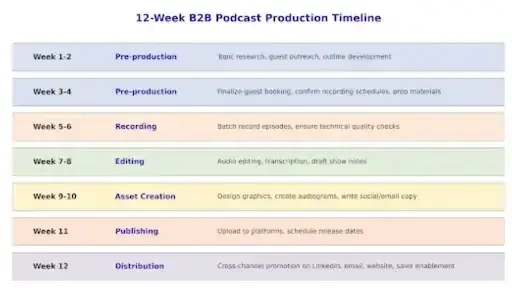
We encourage a 12-week calendar that typically maps episodes to launches, events, and nurture campaigns. Each entry includes a working title, target listener, intent, outline, publish date, and key review points.
From our experience, the most effective plans also have a reuse column that outlines clips, leadership posts, and newsletter inserts. The point is making sure every episode finds its way into the channels your audience already engages with.
Defining success: metrics beyond downloads
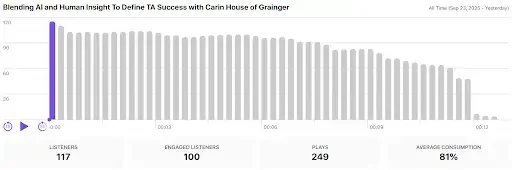
It’s easier to spot real success when you look beyond just download numbers. Dashboards that track YouTube watch time, audio consumptions, meetings triggered by episode engagement, and how clips show up in live campaigns give us a much clearer picture of what’s working.
For example, the image below shows the consumption rate of a podcast episode on Apple Podcasts.
Competitive positioning and market differentiation
Content gap analysis and show positioning
At Content Allies, we help clients stand out by analyzing what’s already in the market and where there’s room to lead. We review top podcasts in your space, looking at audience size, episode count, SEO performance, and engagement to identify gaps and opportunities.
That research feeds into a one-page positioning brief that defines your niche, your host’s role, and the core promise to listeners. It guides everything from episode titles to interview structure.
For a recent client in the AI and data science space, we conducted a full competitor scan to pinpoint where their show could stand out, like so:
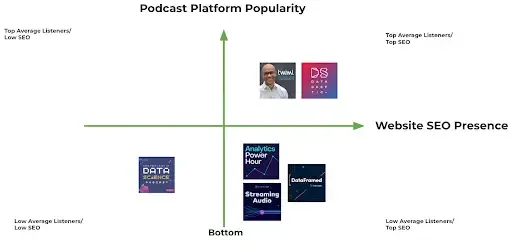
The perceptual map above highlights how current leaders like TWIML AI and Data Skeptic dominate both listener counts and SEO visibility, while others cluster in the bottom right with strong SEO but weaker audience traction.
This gap showed us a clear opportunity: launch a podcast that brings fresh, practical insights to the same high-intent audience but fills the SEO blind spots many of these shows leave open. Our strategy focused on search-optimized show pages, article-based content extensions, and a tightly defined audience niche with a clear value prop.
Strategic guest curation for pipeline and authority
Guest selection shapes both your credibility and your connections from day one. Strong early lineups include a mix of:
Strategic accounts
Customers with success stories
Respected industry voices your buyers already know
Good podcast production agencies choose each guest with intent, whether it’s to build a relationship, showcase proof, or extend reach.
For example, we give clients a short host brief before each recording.
This brief outlines the guest’s perspective, key takeaways, and the one outcome to focus on after the episode airs. This keeps the conversation sharp and makes it easy to turn each episode into usable content across sales and marketing.
What to read next: The Ultimate Guide to Guest Scheduling for Your B2B Podcast in 2025
Step 2. Evaluate Podcast Production Capabilities and Content Execution
A strong podcast production agency shows its value not just in the final files, but in the process behind them. You’ll see it in the reference assets they share, the clarity of their tech specs, and the consistency of the content pack delivered with each episode. The goal is simple: high-quality output that moves smoothly through your existing channels, without adding friction.
Audio and Video Quality Standards
Quality is easy to spot when it's done right. Crisp multi-track audio, a steady tone, and stable video all signal a polished production.
In fact, podcasts with professional-grade sound see up to 62% higher completion rates, showing just how much quality affects listener engagement.
A strong podcast agency builds this into every episode, using reliable tech specs and a repeatable quality check process that ensures consistency from start to finish.
Multi-track capture, editing, and mastering
Each voice is recorded on its own track, using high-quality settings (48 kHz sample rate and 24-bit depth). This makes the dialogue cleaner and easier to edit.
During mixing, we focus on making speech sound clear and natural. That includes adjusting EQ, applying light compression to even out volume, and using de-essing to soften harsh "S" sounds. We also set loudness levels around −16 LUFS so everything plays smoothly across headphones, laptops, and phones.
As the episode moves through edits, versioned project files help track what changed and when. Everything is backed up and clearly labeled so files stay organized and nothing slips through the cracks.
YouTube optimization and video clip repurposing
A solid video strategy includes full episodes in 16:9 for long-form viewing, along with vertical and square clips tailored to social platforms. This matters because vertical videos can drive up to 2.5 times more engagement on mobile compared to horizontal formats.
A good podcast production agency for B2B also knows that:
Branded lower thirds and captions in SRT or WebVTT formats boost accessibility and viewer retention.
Features like chapters, end screens, and cards make navigation easier.
A thumbnail system with clear naming rules and title variations helps teams test performance and optimize as they go.
Content Ecosystem Creation
Scalable B2B podcast production gives you a consistent set of assets with every episode. This typically includes show notes, a polished transcript, ready-to-use social copy, and a blog draft or outline tailored to your site’s style and structure.
Show notes, transcripts, social posts, SEO blogs
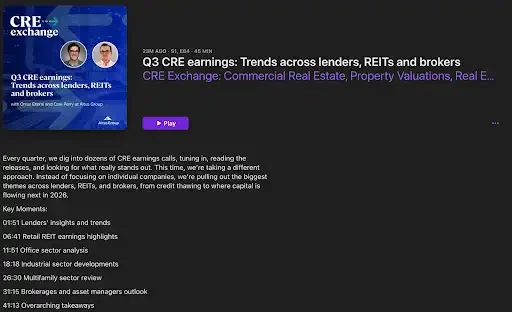
Well-crafted show notes act like a focused landing page, with a short summary, key moments marked by timestamps like the example below, and internal links for deeper exploration. A good podcast production agency also cleans up transcripts for readability and includes speaker tags.
Of course, they should give you social copy in plug-and-play formats, complete with links and UTM tags.
And if they create blog drafts, they should follow the episode’s structure, using clear headings, standout quotes, and an intro that matches your brand voice.
Repurposing workflows that scale
Scalable content reuse starts with a few simple systems that your podcast production agency should use, like the following:
An asset menu outlines what gets delivered with each episode.
Clear naming conventions and a structured folder setup make files easy to find.
A central repository with permission controls keeps both master and derivative assets secure.
Lightweight task lists, with clear owners and deadlines, help maintain momentum.
Basically, a good B2B podcast agency should have a repeatable workflow that turns every recording into clips, posts, and pages your team can publish on schedule.
Step 3. Review the Podcast Production Agency’s Project Management and Workflow Scalability
A dependable program runs on clear owners, simple checklists, and tools your team already uses. The strongest signals of fit show up in your podcast agency’s onboarding plan, their approval path, and how work moves without constant oversight.
Onboarding, timelines, and enterprise approvals
Look for a one-page onboarding plan that names stakeholders, required assets, and dates for discovery, pilot recording, and first publish.
A 12-week schedule with milestones, review gates, and service levels keeps everyone in sync. Expect a RACI so each decision has an owner, plus a simple intake for every episode with title, guest, outline, links, and legal notes.
At Content Allies, we make sure that every account is paired with:
an Episode Producer who runs day-to-day,
a Production Manager who owns timelines and deliveries,
a Strategist who keeps the concept and editorial pillars aligned to your market.
a Recording Engineer supports tech checks and early sessions when needed.
Also, make sure your podcast production agency has clear turnaround targets. These set expectations, such as an early audio cut within a few days and final asset delivery on a planned cadence.
Stakeholder communication and legal signoffs
Here’s how a good podcast production agency for B2B streamlines stakeholder communication. They make sure:
Strong programs keep decision-making centralized and easy to follow.
Weekly status notes give a clear view of what's been published, what's in edit, and what still needs approval.
Comments stay within the file or task system, so feedback doesn’t get lost.
Legal review moves through a straightforward sequence: first a transcript or rough cut, then a change log, and finally the approved version.
Brand checks follow a focused checklist that covers tone, names, and any key claims.
Guests are given a set window to provide feedback, along with a clear deadline for signoff.
Once everything is approved, one message outlines the publish date, the included assets, and who will share them at launch.
Tech stack and workflow automation
The right stack is visible and light. Expect your podcast production agency to follow these rules:
A shared board in Airtable tracks intake, record, edit, review, and publish, with automations that open clip tasks and post status updates to Slack.
Folder maps and file names follow a pattern so masters and derivatives are easy to find in your drive.
Editing runs in Descript with labeled versions, while recording uses Zoom with multi-track enabled.
Templates create consistency across show notes, social copy, thumbnails, lower thirds, and captions, and tools like Headliner speed clip creation for vertical and square formats.
Automations handle handoffs, file moves, and reminders, such as generating caption files at export in Descript and notifying owners in Slack when a cut is ready.
ChatGPT supports first-pass titles, descriptions, and summaries, and Perplexity helps source topical references, with human review for tone and accuracy.
Step 4. Examine How the Podcast Production Agency Handles Distribution, Promotion, and Audience Growth
Distribution is a system that needs structure and consistency. The right agency will show you a clear channel plan, a standard set of assets for each episode, and a predictable publishing cadence. The strongest programs back them up with simple, inspectable tools that show exactly how content moves from production to audience, every time.
Organic Promotion Across Owned and Earned Channels
SEO, LinkedIn, newsletters, content syndication
Well-run programs build each release around a dedicated episode page, designed like a landing page with clear headings, timestamps, internal links, and a summary written for search.
LinkedIn activity follows a plan, with tailored posts for the company, the host, and team members who can reach the right audience.
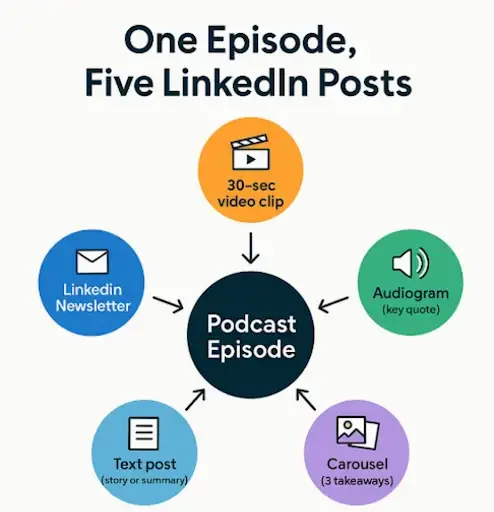
Newsletters carry the same message in a tighter format, focused on a single call to action. Content syndication helps extend reach by placing episodes in outlets and communities your audience already trusts.
The podcast production agency should outline who is posting, when it goes live, and how links are tagged so results can be tracked back to your campaigns.
Guest promotion and cross-podcast partnerships
Guest distribution should be part of the plan from the start. Good podcast production agencies typically provide a compact media kit for each guest, complete with clips, visuals, and prewritten copy. This makes sharing easy and increases the chances guests will promote the episode.
Besides, podcast agencies know that partnerships with adjacent shows help expand reach without starting from scratch.
And they help you start these partnerships.
First, they give you a clear partner list that outlines the value exchange and what each side needs to contribute. The process is designed to be repeatable, with timelines and owners in place so collaborations can happen regularly and efficiently.
At Content Allies, our guest asset folder typically includes:
Transcription for accurate quotes and captions
Audiograms or videograms cut to platform lengths
Cover art sized for feeds and social posts
Quote blocks ready to paste into posts and newsletters
Social posts with links to the full video and timestamps that point to key moments
Paid Amplification and Funnel Integration
Paid support works when targeting mirrors the buyer map. A solid podcast production agency has plans to describe audiences by role and topic, placement by channel, and how downloads are verified.
The agency you pick should show where paid fits in the release rhythm, what creative goes where, and how results split cleanly between paid and organic.
At Content Allies, we layer paid distribution to give each episode predictable reach inside the audience you define, often powered by Listen Network. We set the audience, align creative to the episode, and verify results in your hosting platform so reporting matches what you already use for organic performance.
We deploy across four mediums, matched to goals and budget:
Display Ads: out-stream placements across websites that align contextually with each episode topic.
YouTube Ads: YouTube out-stream podcast ads to drive 30-second views and grow YouTube subscribers..
LinkedIn Ads: Sponsored Content to reach professional roles and company lists, with clean tagging that attributes traffic and downloads back to campaigns.
Meta Ads: Facebook and Instagram placements for incremental reach where your audience spends time, with host-level verification for downloads.
The workflow is simple to follow.
We choose targets, launch placements, and monitor delivery against agreed floors. Reports separate paid from organic, show timing and geography, and include job-function insights when available. This layer complements organic distribution, speeds discovery among the right listeners, and produces analytics leaders can use.
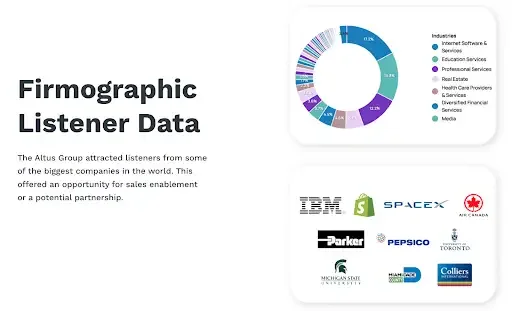
This is how we launched a multi-channel Podcast Ad Campaign to reach CRE Executives in North America for the CRE Exchange Podcast driving more than 20k downloads, ~7k views and a 72% completion rate.
For further reading, check out our Enterprise Podcast Distribution: Multi-Platform Strategy Guide.
Step 5. Verify the Podcast Production Agency’s Compliance, Security, and Enterprise Standards
Strategic agencies treat security and governance as part of production language docs, traceable approvals, and access controls that match your policies.
Data Security, SSO, and Access Control
Over 98% of organizations indicate they have at least one third‑party vendor that experienced a data breach. This shows you just how central structured compliance has become.
So, you should receive a clear security overview that explains what data is collected, where it's stored, and who has access. You need:
Single sign-on and role-based permissions help keep everything aligned with your organization’s identity systems.
Detailed access levels control who can view, edit, approve, or publish content.
Logs, version history, and audit trails make it easy to track changes.
Backups are run on a set schedule and regularly tested for reliability.
During onboarding, the agency should share:
A list of tools used
Data retention timelines
Encryption standards for storage and transfers
A clear point of contact for any issues
A simple matrix also outlines subprocessors and the specific data they handle.
Legal Review, Brand Governance, and Content Approvals
Compliance is reflected in how content moves through each stage of production, too. A dependable workflow includes:
Guest release forms
Speaker consent
Music license documentation
Your podcast production agency should follow a clear sequence for legal reviews too. This begins with a transcript or rough cut, moves through a change log, and ends with a final cut for signoff.
We also advise you to look for agencies that keep brand governance simple. All you need is a checklist that covers approved names, claims, disclaimers, and sensitive topics. All approvals are stored in one place, with clear ownership and time stamps.
After signoff, a single publish note outlines where the episode will appear, which assets are included, and who will handle promotion.
Regulatory Compliance (HIPAA, GDPR, FINRA, etc.)
Enterprise podcast programs often deal with regulated topics, so it’s important to work with partners who know how to manage that risk. Experienced agencies explain how they avoid capturing regulated data during recordings and how they handle it if it does come up.
For industries like healthcare and finance, extra steps should be built into the process.
These might include screening questions before recording, redacting sensitive information during editing, and adding legal disclaimers in the episode description.
Privacy standards shape how data is collected, stored, and processed. The agency should outline:
Who’s responsible for personal data
How breaches are handled
For how long data is retained
Accessibility is part of the same conversation.
Captions should meet WCAG guidelines.
Transcripts must include speaker labels.
Multilingual support must follow the same quality and storage standards.
If procurement teams need more detail, a capable agency can provide recent security questionnaires, an up-to-date list of subprocessors, and links to certifications or audits from their core vendors.
This level of transparency gives your security team confidence and helps leadership sign off with ease.
Step 6. Compare B2B Podcast Production Pricing Models, Service Packages, and ROI
Strategic podcast production agencies price around scope and cadence. The clearest signals are transparent rate cards, named roles with SLAs, defined asset bundles
What B2B podcast production typically costs
Each B2B podcast agency has specific price packages, but from our experience, here are the most common fees you can expect:
Interview-based B2B shows (predictable cadence, repeatable assets)
What buyers usually see: a one-time launch or migration fee, then a monthly production tier tied to episode volume and asset count. Representative examples:
Monthly production: about $5,000 for weekly, $3,500 for two per month, or $2,500 for one per month
One-time launch: ~$4,000; migration: ~$2,000
Inclusions commonly listed: remote video and audio production, YouTube-ready edits, 200-word descriptions, original thumbnails, hosting and publishing to Apple, Spotify, and YouTube, social posts, and two talking-head clips per episode
Add-ons often itemized: guest sourcing (~$1,000/month), recording engineer support (~$100/episode), senior strategist support (~$1,000/month), finance-compliance writing (~$1,000/month), premium social videos (~$200 each), sponsorship program management (base + rev share).
These tiers typically come with named team roles, a 12-week production calendar, and a two-stage delivery flow that moves from headline/audio approval to final assets, which makes cross-vendor comparisons straightforward.
Narrative or documentary-style branded shows (story editing, writing, original scoring, fact-check)
Budgets trend higher due to added pre-production and editorial craft. Public benchmarks show:
Per-episode budgets for branded shows commonly span $1,000–$15,000+, depending on format and depth.
Agency retainers for full-service narrative production frequently publish in the $6,000–$25,000+ per month range.
Some producers price by finished-minute; a typical figure is ~$400 per finished minute, which puts a 6-episode, 20-minute season near $48,000 including strategy, research, creative, and distribution.
Mid-tier vs premium vs custom enterprise packages
Mid-tier interview programs usually bundle producer + editor, remote video capture, captions, 2–4 clips, episode art, and a simple monthly report.
Premium interview programs add a production manager, strategist presence in key meetings, larger clip kits, thumbnail testing, faster SLAs, and a quarterly review.
Custom enterprise packages expand to booking services, accessibility workflows, security requirements (SSO/SCIM, DPAs), and procurement support, plus options like influencer hosts or studio capture. Rate cards that spell out owners, turnaround targets, and asset counts reduce ambiguity.
Key ROI metrics: guest conversion, pipeline influence, content reuse
Results should show up in a small set of signals most leaders recognize. A good podcast production agency should follow these B2B podcast KPIs:
Guest conversion: programs often track meetings that follow appearances, referrals initiated by guests, and lift in engagement on named accounts. A simple view is meetings per episode and win rate for opportunities that include a guest interaction.
Pipeline influence: teams commonly review episode touches against opportunity creation and stage movement using tagged links and consistent episode pages. Many agencies align download counting to IAB v2.2, then pair it with platform engagement such as YouTube watch time and Apple or Spotify completion to show quality.
Content reuse: healthy programs tend to report the percentage of live campaigns using episode assets, the presence of clips in sales emails and SDR sequences, leader posts published with episode links, and newsletter click-throughs to episode pages.
What to expect based on objectives
If the goal is a steady, interview-led B2B show that fuels campaigns and sales enablement, expect tiered monthly pricing like the figures above with clear inclusions and optional add-ons.
If the goal is a story-driven narrative series aimed at brand lift or category creation, expect season budgets or higher monthly retainers that cover story development, writing, mixing, and original creative, consistent with the public ranges cited.
This distinction helps you match cost to intent, and read proposals through the lens of staffing, cadence, asset depth, and the business signals leaders track.
Remember: Cost makes more sense when it is read next to these signals, the staffing model, and the cadence. Proposals that present scope, timeline, and reporting on one page help stakeholders see how a given package supports the outcomes that matter inside an enterprise.
What to read next: B2B Podcasts by the Numbers: What the Latest Data Tells Us (and How to Act on It)
Best 3 B2B Podcast Production Agencies Compared
Now that you know what to look for in a good podcast production agency for B2B, let’s review three leading providers to help you decide faster.
1. Content Allies: Revenue-first strategy, ABM integration, global enterprise clients
Content Allies specializes in interview-led B2B shows for enterprises and SMBs built to support campaigns, sales enablement, and account programs.
And we’ve got the happy clients:
and the results to prove our system works. For Chris Cano and Upshifts, for example, we converted over 50% of interviews into revenue streams.
Our core services span strategy, production, guest scheduling, publishing to Apple, Spotify, and YouTube, plus organic promotion and clip kits, with options for booking support and paid amplification.
And as you’ve seen so far, our programs emphasize predictable cadence, clear roles, and a content pack per episode leaders can share.
This model fits enterprise teams that want a steady engine tied to pipeline activity and reuse across marketing channels.
2. Lower Street: Narrative podcasting, creative production, YouTube strategy
Lower Street is known for story-forward production with research, scripting, and narrative editing, plus a strong video posture for YouTube distribution and search.
Their materials highlight end-to-end strategy and production, with case references to global brands and a focus on video SEO, chapters, and titles that position episodes for discovery.
Teams that want crafted stories, cinematic pacing, and a cohesive YouTube plan tend to gravitate here.
3. Quill Podcasting: Enterprise programs, creative branded series, measurable distribution
Quill runs full-service branded podcast programs for enterprise brands, pairing concept development and production with growth and analytics.
Public materials cite work with global companies and position the agency around launch, growth, and measurement, with an emphasis on branded content and business results. Quill also operates CoHost, a hosting and analytics platform designed for brand use cases.
This footprint suits teams that want creative polish with reporting that clarifies reach and audience fit.
How to read this comparison
If your objective is an interview-driven B2B engine that feeds campaigns and sales, prioritize operational depth, guest workflows, and repeatable asset packs like those highlighted by Content Allies.
If your objective is a narrative brand series with shaped storytelling and a YouTube growth plan, look for research and scripting capabilities plus video SEO practices common in Lower Street’s work.
If your objective is a branded series with enterprise reporting and platform-level analytics, note Quill’s positioning around growth and measurement, alongside CoHost for brand-ready hosting.
P.S:. We put together a list of the Top 20 B2B Podcast Production Agencies & Companies in 2025 for a deeper dive.
B2B Podcast Production Agency Evaluation Checklist
Here’s what a B2B podcast production agency should offer you:
| Category | What to Look For | Checklist |
|---|---|---|
| 1. Strategic Fit | Do they understand your funnel, ICPs, and ABM goals? |
|
| 2. Operational Fit | Can they support enterprise timelines, workflows, and compliance? |
|
| 3. Proof of Impact | Do they demonstrate measurable results for clients like you? |
|
Strategic Fit: Can They Support Your Funnel, ABM Goals, and Target Audience?
A strong partner starts with your ICP, funnel, and marketing strategy.
We’ve seen teams struggle because their former agency never asked about their target audience or buyer triggers.
A strategic podcast production agency brings a one-page ICP, a clear content strategy, and a 12-week content calendar tied to launches and campaigns. Guest booking aligns with named accounts and customer stories, not whoever is available.
And success metrics extend beyond downloads to the signals leaders watch: brand awareness, content creation impact, and activity across sales and social media channels.
Operational Fit: Can This Podcast Production Agency Support Your Workflow and Compliance?
Operational red flags show up fast. Some teams come to us after working with agencies that had unclear roles, missed deadlines, or no structure.
A real podcast production agency gives you named producers and audio engineers, predictable turnarounds, and a clean RACI for reviews and approvals.
Their tools match your daily stack (Airtable, Slack, Drive, Descript, Zoom) and their recording equipment guidance prevents quality issues. Accessibility workflows, captions, and transcripts arrive on schedule.
And if you’re enterprise, look for SSO, data processing, and role-based access baked into the way they deliver B2B podcast services.
Proof of Impact: Can They Show Results You Can Measure?
Impact should be obvious.
Many clients come to us after agencies sent only downloads or vague “growth” claims.
A real partner separates paid and organic reach, shows how podcast content supports content marketing and social media, and ties engagement to meetings or pipeline activity.
You should see reuse in advertising campaigns, newsletters, and executive posts, and understand how episodes contributed to brand awareness or outreach momentum.
Clear monthly rollups and quarterly reviews make it easy for stakeholders to compare results to plan and see whether the show is truly working.
Why Content Allies Is Built for Enterprise Podcast Success
Content Allies runs interview-led B2B shows that align with your accounts, campaigns, and sales motion.
You’ll get a focused show concept, a 12-week production plan, clearly defined roles, and consistent delivery across both audio and video. Each episode comes with everything your team needs, captions, chapters, thumbnails, and clips that are ready to share.
Reporting connects platform engagement to real business activity, so progress is easy to track. Security, accessibility, and procurement standards are fully integrated into the process.
When you're ready for reliable reach, paid distribution is available to amplify your audience.
Whether you're launching something new or scaling an existing show, we're here to help. Let’s talk.
FAQs
What should I look for in a B2B podcast production agency?
Look for an agency that goes beyond editing and audio. Strategic partners offer business alignment, content mapped to buyer journeys, ABM-focused guest selection, compliance-ready workflows, and attribution models that tie podcasting to pipeline and revenue.
How do B2B podcasts support sales and account-based marketing?
B2B podcasts support sales and ABM by featuring strategic guests, enabling multi-threading across buying committees, and generating reusable content for outreach. High-performing agencies integrate podcast data with CRMs to track influenced pipeline and deal progression.
What’s the typical cost of enterprise B2B podcast production?
Enterprise podcast production ranges from $2,500 to $12,000+ per month depending on service scope. Costs vary based on episode volume, strategic support, video requirements, compliance needs, and content repurposing workflows.
How do I measure the ROI of a B2B podcast?
Top agencies do performance tracking using metrics like guest-to-customer conversion, influenced pipeline value, sales enablement reuse, organic lead generation, and ROI. Podcast analytics tools like HubSpot or Salesforce help attribute podcast interactions to deal outcomes.