
Best Technology Podcasts in 2026 for Smarter Industry Insights
Technology moves quickly, and there is always another product launch, platform update, research breakthrough, or industry debate competing for your attention.
Keeping up with the technology industry can be exhausting, especially when it is part of your job.
Half of current tech workers say they cannot learn fast enough to keep pace with the industry’s rapid rate of change.
Fortunately, you can follow the biggest developments without spending hours moving between news sites, reports, and social feeds.
Specialized technology podcasts are the most convenient way to stay informed in a format you can enjoy anywhere.
This guide covers some of the best technology podcasts to follow in 2026.
You will learn what each show focuses on, who it is best suited for, and why it may deserve a place in your regular listening schedule.
Keep reading to find your next favorite.
Interested in the security side of technology as well? Take a look at our Best Cybersecurity Podcasts for Security & IT Leaders guide for the top shows covering digital threats and defense strategies.
A Quick Comparison of the Leading Tech Podcasts
The table below gives you a quick overview of our top picks.
| Podcast | Host(s) | Best For | Main Focus |
|---|---|---|---|
| Lex Fridman Podcast | Lex Fridman | Long-form conversations with the biggest minds in tech | AI, science, engineering, philosophy |
| Acquired | Ben Gilbert & David Rosenthal | Deep dives into legendary technology companies | Business history, Big Tech, strategy |
| Hard Fork | Kevin Roose & Casey Newton | Weekly analysis of the biggest tech stories | AI, Big Tech, internet culture |
| Waveform: The MKBHD Podcast | Marques Brownlee, Andrew Manganelli & David Imel | Consumer technology and gadget enthusiasts | Smartphones, hardware, consumer tech |
| All-In Podcast | Chamath Palihapitiya, Jason Calacanis, David Sacks & David Friedberg | Startup founders, investors, and tech leaders | AI, venture capital, markets |
| The Vergecast | Nilay Patel & David Pierce | Keeping up with consumer technology | Gadgets, software, industry news |
| Big Technology Podcast | Alex Kantrowitz | Executive interviews and AI discussions | Big Tech, AI, product strategy |
| Dwarkesh Podcast | Dwarkesh Patel | Technical deep dives with world experts | AI research, computing, science |
| Pivot | Kara Swisher & Scott Galloway | Technology through the lens of business and politics | Big Tech, media, economics |
| This Week in Tech (TWiT) | Leo Laporte | Weekly roundtable discussions | Technology news, AI, cybersecurity |
What Makes Technology Podcasts Valuable
Technology podcasts give you direct access to expert analysis, industry debates, and ideas that rarely fit into a short news article.
Let’s explore why they are a valuable source of insights:
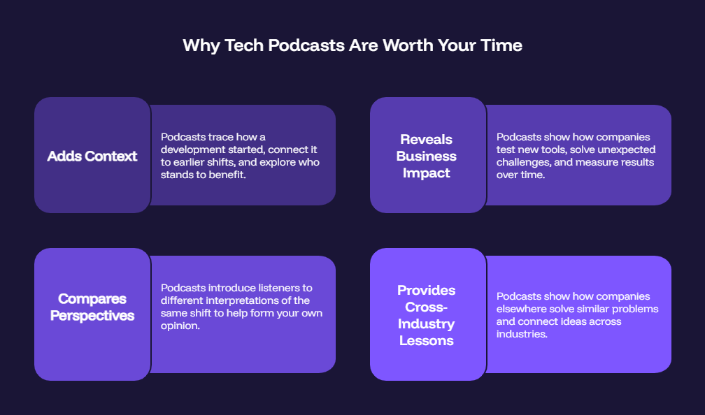
Adds Context That Headlines Leave Behind
Technology news usually reaches us as a stream of announcements and dramatic predictions.
A headline can tell you what happened, yet it rarely explains the decisions or pressures behind it.
Podcasts create room for that missing context. Hosts can trace how a development started, connect it to earlier shifts, and explore who stands to benefit.
This helps explain why around 57% of podcast listeners consume shows that explore topics in the news in depth.
Reveals How Technology Shapes Real Businesses
New technology eventually influences how companies operate, serve customers, and make decisions.
Through detailed conversations, podcasts show how companies test new tools, solve unexpected challenges, and measure results over time.
You hear what succeeded, what changed along the way, and which lessons proved worth sharing.
This practical detail rarely appears in product announcements or short news reports.
It also matters because successful experimentation does not always lead to wider adoption.
For example, only 25% of AI initiatives deliver their expected return on investment, and just 16% reach enterprise-wide scale.
Helps You Compare Competing Perspectives
Of course, one expert can only offer one view.
But the best technology podcasts introduce listeners to different interpretations of the same shift.
One guest may see a new platform as a major opportunity, while another focuses on its limitations.
Hearing both sides makes it easier to form your own opinion. After all, 94% of global directors say diverse perspectives lead to better decision-making.
Over time, regular listening also helps you recognize recurring arguments and weak predictions.
Provides Lessons From Other Industries
PwC found that 40% of CEOs say their companies have expanded into new sectors over the past five years.
This creates new competitive pressures and forces leaders to look beyond familiar playbooks.
Podcasts make this process easier by showing how companies elsewhere solve similar problems.
At Content Allies, we regularly see how the strongest conversations connect ideas across industries and turn one company’s experience into a useful lesson for many others.
For instance, a financial services company might borrow a retailer’s personalization strategy to make customer communications more relevant.
Now we can finally turn our attention to the main list.
Find the Technology Podcasts That Deserve Your Time: In-Depth Reviews
Below, we break down what each podcast covers, who it is best suited for, and what makes it worth adding to your listening rotation.
1. Lex Fridman Podcast
Host: Lex Fridman
Opening our ranking with a show that treats technology as a doorway into much bigger questions.
The Lex Fridman Podcast began in 2018 with physicist Max Tegmark discussing intelligence, consciousness, and humanity’s future.
Since then, it has developed into a huge long-form interview platform where technology sits alongside science, philosophy, business, and history.
His YouTube channel has attracted more than 5 million subscribers, while the podcast itself has passed 490 episodes as of July 2026.
We placed the Lex Fridman Podcast at number one because it combines extraordinary access with genuine intellectual curiosity.
A conversation about NVIDIA can begin with chips and data centers, then gradually reach leadership, Artificial General Intelligence (AGI), consciousness, and mortality.
Notable guests: Elon Musk, Sam Altman, Jensen Huang, Jeff Bezos, Demis Hassabis, Andrej Karpathy.
Episode worth starting with: #494: Jensen Huang, NVIDIA, the $4 Trillion Company & the AI Revolution explores the engineering bets, leadership philosophy, and computing infrastructure behind NVIDIA’s central role in the AI era.
Discussion topics:
Artificial intelligence and machine learning
Robotics and autonomous systems
Extreme programming and computer science
Technology leadership and entrepreneurship
Physics, mathematics, and neuroscience
Philosophy and the human condition
Geopolitics and the future of society
2. Acquired

Hosts: Ben Gilbert and David Rosenthal
Acquired approaches technology through the companies that built its most important platforms, products, and infrastructure.
Hosts Ben Gilbert and David Rosenthal reconstruct those stories from the beginning. They explain how early technical choices developed into durable advantages.
An episode may explore the creation of Windows, the economics of semiconductors, or the decisions that turned a startup into a category-defining company.
Their research-heavy episodes usually run for several hours. This gives them enough time to explain how different parts of the technology industry evolved together.
Notable guests: Mark Zuckerberg, Daniel Ek, Howard Schultz, Charlie Munger, Steve Ballmer, and Michael Lewis.
Episode worth starting with: Microsoft Volume I traces Microsoft’s rise from Bill Gates and Paul Allen’s early programming work to DOS, Windows, Office, and the company’s dominance of the PC era.
Discussion topics:
Company secrets, histories, and founder stories
Technology strategy and competitive advantage
Mergers and acquisitions
Business models and market power
Venture capital and investing
Semiconductors and artificial intelligence
3. Hard Fork
Hosts: Kevin Roose and Casey Newton
Our third pick is Hard Fork, a technology podcast for anyone who wants to understand this week’s biggest stories.
New York Times journalists Kevin Roose and Casey Newton combine reporting with sharp commentary. They discuss AI launches, platform battles, and Silicon Valley drama in a way that feels informed and genuinely entertaining.
The show describes itself as covering “the future that’s already here”, which captures its focus perfectly.
The chemistry between the hosts gives Hard Fork its distinctive rhythm.
Roose mostly approaches emerging technology with curiosity and cautious optimism, while Newton draws on years of reporting about social platforms and the companies behind them.
Notable guests: Sam Altman, Brad Lightcap, Arvind Narayanan, Dylan Field, Daniel Kokotajlo, Sayash Kapoor, and San Francisco Mayor Daniel Lurie.
Episode worth starting with: Mayhem at OpenAI + Our Interview With Sam Altman combines a remarkably well-timed interview with Altman and the hosts’ analysis of the leadership crisis that erupted at OpenAI shortly afterward.
Discussion topics:
Artificial intelligence and its social impact
Big Tech companies and platform strategy
Social media and online culture
Technology policy and regulation
Startups and Silicon Valley leadership
Consumer devices and digital products
Unusual stories from the internet
Read more: Best Real Estate Podcasts for Investors and Agents
4. Waveform: The MKBHD Podcast
Hosts: Marques Brownlee, Andrew Manganelli, and David Imel
Notable guests: Carl Pei, Josh Miller, Becca Farsace, and Joanna Stern
We included Waveform for listeners who care about how technology fits into everyday life and want informed opinions before spending money on the next heavily promoted gadget.
Hosted by Marques Brownlee, better known as MKBHD, alongside Andrew Manganelli and David Imel, the show feels like sitting in on a conversation.
They spend every day testing the latest hardware before anyone else gets their hands on it.
Rather than repeating specifications, the hosts discuss how devices actually feel, which compromises matter, and whether an upgrade deserves your money.
Regular trivia, experiments, and playful disagreements also give Waveform an easygoing personality that separates it from more formal technology reporting.
Episode worth starting with: Carl Pei Discusses the New OnePlus Nord & How Smartphones Are Made offers a rare look at how a smartphone moves from an early concept to pricing, certification, manufacturing, and launch.
Discussion topics:
Smartphones and mobile hardware
Cameras and creator equipment
Electric cars & vehicles
AI-powered consumer products
Product design and purchasing decisions
Technology launches and industry news
5. All-In with Chamath, Jason, Sacks & Friedberg

Hosts: Chamath Palihapitiya, Jason Calacanis, David Sacks, and David Friedber
All-In gives listeners a seat at the table with four Silicon Valley investors who regularly disagree about where technology is heading.
Chamath Palihapitiya, Jason Calacanis, David Sacks, and David Friedberg examine the week’s biggest developments through the lens of seasoned operators.
The podcast works well when the hosts move beyond the announcement itself.
A new AI model can lead into a debate about infrastructure costs, startup valuations, regulation, or the future of work.
Their backgrounds also pull the conversation in different directions.
Jason focuses on founders and early-stage companies, Chamath examines capital and market structure, Friedberg brings science into the discussion, and Sacks connects technology with public policy
Notable guests: Elon Musk, Sam Altman, Sheryl Sandberg, Bill Gurley, Brian Armstrong, Ray Dalio, and Travis Kalanick.
Episode worth starting with: Episode 280 brings the hosts together for a wide-ranging discussion of OpenAI and SpaceX IPO prospects, enterprise AI adoption, sovereign models, and the growing rivalry between OpenAI and Anthropic.
Discussion topics:
Generative AI and computing infrastructure
Startups and venture capital
Technology markets and company valuations
Science, agriculture, and climate technology
Cryptocurrency and financial technology
Regulation and public policy
IT security & Security strategy
6. The Vergecast
Hosts: Nilay Patel and David Pierce
The Vergecast sits somewhere between a technology newsroom and a lively group chat among people who spend far too much time thinking about gadgets.
Nilay Patel and David Pierce show how corporate strategy eventually reaches your phone, laptop, car, or streaming subscription.
The show publishes several times each week, which gives it room for both rapid news analysis and more focused conversations with Verge reporters.
Friday episodes usually take a wider view of Big Tech, while other installments explore a particular device, software trend, or strange corner of digital life.
The hosts also bring plenty of personality when debating whether a product solves a real problem or simply gives its manufacturer something new to sell.
Notable guests: Tim Berners-Lee, Walt Mossberg, Casey Newton, Cory Doctorow, Jamie Siminoff, and Shishir Mehrotra.
Episode worth starting with: OpenAI and Jony Ive’s AI super-gadget connects the mysterious OpenAI hardware project with Google I/O, Gemini, smart glasses, and the wider race to define the next major computing device.
Discussion topics:
Consumer gadgets and product launches
Artificial intelligence
Cloud computing
Big Tech strategy
Software and digital platforms
Privacy and technology policy
Smart homes and personal devices
Internet culture
7. Big Technology Podcast
Host: Alex Kantrowitz
At number seven, we have the Big Technology Podcast, where independent journalist Alex Kantrowitz gets unusually direct answers from the people shaping the technology industry.
Kantrowitz brings the instincts of a reporter rather than a founder or investor.
He presses guests on failed strategies, internal pressure, and the gap between an exciting demonstration and a product people will actually use.
Some episodes feature major executives, while others invite researchers, critics, and journalists to challenge the industry’s dominant narrative.
This mix gives the show enough range to cover a Meta product decision one week and the social risks of advanced AI the next.
Notable guests: Sam Altman, Demis Hassabis, Dario Amodei, Greg Brockman, Yann LeCun, Brian Chesky, Mark Zuckerberg, and Larry Ellison.
Episode worth starting with: Why Google Never Shipped Its ChatGPT Predecessor features LaMDA’s founding product manager explaining how Google developed advanced conversational AI years before ChatGPT and why the product remained inside the company.
Discussion topics:
Artificial intelligence and major AI labs
Platform engineering solutions
Technology leadership and internal decision-making
Social platforms and online culture
Product development and company strategy
Regulation and technology policy
The relationship between Big Tech and society
8. Dwarkesh Podcast

Host: Dwarkesh Patel
Dwarkesh Podcast is one of the fastest-rising interview shows in the AI and technology world.
We included it for listeners who already understand the basic technology headlines and want to go several levels deeper.
Dwarkesh Patel regularly spends weeks studying a guest’s work before recording. This allows him to skip introductions and move directly into the questions that experts usually discuss among themselves.
Artificial intelligence forms the center of his show, yet the strongest episodes place it inside a much larger picture.
Patel explores computing infrastructure, economic change, geopolitics, mathematics, military history, and the future of scientific discovery.
Notable guests: Elon Musk, Jensen Huang, Dario Amodei, Terence Tao, Grant Sanderson (3Blue1Brown), Michael Nielsen, Eric Jang, and David Reich.
Episode worth starting with: Jensen Huang – TPU Competition, Why We Should Sell Chips to China & Nvidia's Supply Chain Moat. One of the best interviews with NVIDIA's CEO, covering AI infrastructure, CUDA, chip competition, and the future of computing in remarkable depth.
Discussion topics:
Artificial intelligence and AGI (Artificial General Intelligence)
Machine learning research
Computer chips and AI infrastructure
Mathematics and computer science
Robotics
Scientific discovery
Economics of emerging technology
The future of humanity and intelligence
9. Pivot

Hosts: Kara Swisher and Scott Galloway
Notable guests: Anthony Scaramucci, Stephanie Ruhle, California Attorney General Rob Bonta, and media journalist Matt Belloni.
Pivot examines technology from the place where it increasingly matters most: its influence over business, politics, media, and public life.
Veteran technology journalist Kara Swisher and NYU professor Scott Galloway meet twice a week to debate the companies and executives accumulating power across these worlds.
One may focus on the harm a platform creates, while the other asks whether its business model remains attractive.
The show has been active since 2016 and has built a catalog of roughly 790 episodes.
Episode worth starting with: Cheaper Teslas, OpenAI’s Cash Burn, and Apple’s CEO Succession Plans shows the full Pivot formula by connecting consumer technology, AI infrastructure spending, leadership succession, and financial markets in one fast-moving discussion.
Discussion topics:
Big Tech leadership and corporate power
Artificial intelligence and platform strategy
Technology regulation and antitrust
Digital media and the creator economy
Markets, IPOs, and company valuations
Social platforms and online influence
The relationship between technology and politics
10. This Week in Tech
Host: Leo Laporte
Last in our ranking, yet certainly far from least important, This Week in Tech is one of the shows that helped define what a technology podcast could be.
Leo Laporte launched it in 2005, when podcasting itself was still new and many of today’s dominant platforms barely existed.
More than two decades later, the weekly roundtable continues to examine the stories shaping the industry every Sunday.
Rather than moving through a fixed news script, the panel follows the connections between stories.
A conversation about AI coding may lead into cybersecurity, labor, copyright, or the future of the open web.
Recent episodes have explored everything from Apple launches and AI investment to surveillance technology and digital rights.
Notable guests: Cory Doctorow, Alex Stamos, Christina Warren, Jason Hiner, Victoria Song, Shoshana Weissmann, Devindra Hardawar, and Stacey Higginbotham.
Episode worth starting with: The Big Sleep explores how AI is transforming cybersecurity, from autonomous coding tools and zero-day discovery to the new threats facing companies and consumers.
Discussion topics:
Weekly technology news
Artificial intelligence and automation
Cybersecurity and digital privacy
Digital espionage, social media disinformation
Internet policy and digital rights
Consumer devices and software
Software architecture
What Earned Each Podcast a Place
Our team lives and breathes podcasting, which means we regularly track the shows gaining attention across the technology industry.
We looked for podcasts that remain relevant while still offering enough depth to reward regular listening.
The ten selections above represent some of the most respected and advanced conversations available in 2026.
Start with any one of them, and you will quickly understand why it earned a place in our ranking.
Should You Start Your Own Tech Podcast?
After exploring these shows, you may be considering whether a technology podcast could support your company’s goals.
Below, we have shared some of the main reasons it may be worth creating one.
Creates a Platform for Your Company’s Ideas
A podcast gives your company room to discuss the technology topics where it has genuine experience and insight.
Instead of reacting to conversations started elsewhere, you can shape the discussion around your experience and point of view.
In fact, 75% of decision-makers say thought leadership has led them to explore a product or service they had previously overlooked.
Your show can create that same moment of discovery while establishing your company as a credible source of ideas.
Builds Relationships With Valuable Guests
The format also gives you a natural reason to connect with customers, partners, and respected industry voices.
Inviting someone onto a podcast feels far more personal than sending a standard networking message.
After hosting and producing hundreds of podcast episodes, we've found that roughly 1 in 10 guests eventually becomes a client, partner, or referral source.
Each recording can begin a relationship that continues well beyond the episode.
Generates Content Beyond the Full Episode
It is no surprise that 47% of enterprise marketers still struggle with content repurposing.
A podcast helps you solve that challenge. One recording can support far more than a single release.
At Content Allies, we regularly turn conversations into video clips, articles, social posts, and sales content for our clients.
This approach helps companies get more value from every guest and every topic they cover.
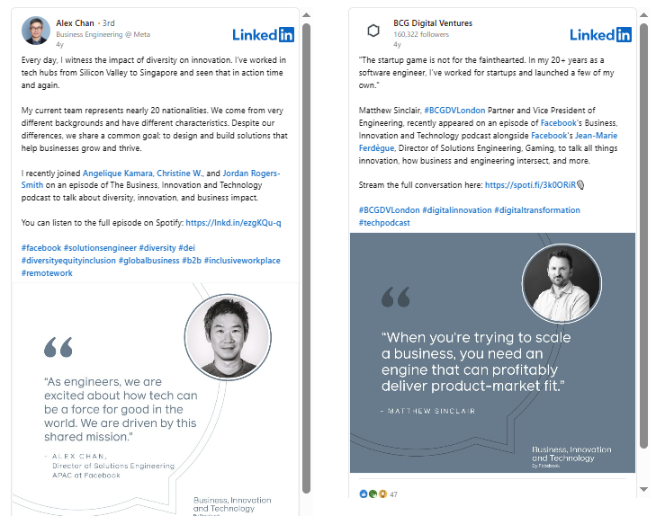
For example, for Meta’s Business Engineering team, we transformed podcast interviews into branded LinkedIn posts that highlighted guest insights and extended each conversation beyond the episode.
Extends the Value of Events and Product Launches
A podcast can add more value to conferences, launches, and industry gatherings.
With 78% of organizers naming in-person conferences their most impactful marketing channel, a podcast gives your team a practical way to preserve that value.
Your team can record guest interviews before an event or capture conversations on location.
This turns a single moment in the calendar into a wider stream of useful stories and insights.
Read more: B2B Podcast Content Calendar Planning
Turn Your Technology Expertise Into a Podcast With Content Allies
By now, you have a collection of technology podcasts that can keep you informed long after this guide.
But if listening to great conversations has inspired you to start one of your own, we'd love to help.
Content Allies helps B2B companies launch podcasts that build relationships, showcase expertise, and create content that keeps delivering long after each episode is published.
Get in touch with us to start planning your podcast.
FAQs
What is the best technology podcast for AI?
If AI is your main interest, start with the Lex Fridman Podcast, Dwarkesh Podcast, or Big Technology Podcast. Each offers thoughtful discussions with researchers, founders, and industry leaders shaping the future of artificial intelligence.
Which technology podcast is best for keeping up with weekly news?
Hard Fork, The Vergecast, and This Week in Tech are excellent choices for staying current. They cover major product launches, AI developments, and the biggest stories from across the technology industry.
Are technology podcasts useful for business leaders?
Absolutely. Many of the best technology podcasts focus on leadership, product strategy, innovation, and market trends, making them valuable resources for decision-makers.
Does Content Allies work with remote technology podcast guests?
Yes. We regularly produce remote interviews and guide guests through the recording process. Our team helps maintain consistent audio and video quality even when participants join from different locations.
Why work with Content Allies instead of producing a podcast in-house?
Working with Content Allies gives you an experienced team that manages the entire process. We help you avoid common mistakes, save time, and produce a podcast that supports your marketing and business goals.