
How to Write a Podcast Script
Starting a podcast seems straightforward until you sit in front of a blank page. Should you write every sentence, prepare a few prompts, or rely on improvisation?
Writing too much can make you sound stiff, while writing too little can leave you circling the same idea, losing your place, or ending an episode without a clear takeaway.
Regardless of the format and style, you need a podcast script to do it right.
The opportunity is substantial. Around 584 million people are tuning into podcasts every month, according to the 2026 Current State of Podcasting by RSS.
With that many people consuming spoken media, new creators are not simply competing on ideas. They must also communicate those ideas clearly enough to earn continued attention.
A podcast script gives you that clarity without forcing you to sound as though you are reading a screenplay. Think of it as a practical map: it identifies what must be said, where evidence or examples belong, and how each idea leads to the next.
This guide will go through everything you need to ace this crucial part of pre-production. Plus, you can access our free podcast script templates to get a quick start.
Why You Need a Podcast Script in the First Place
Podcast listeners have more choices today than ever before. If your podcast is to stand out and provide value, it needs to offer something solid, backed by facts, knowledge, bold ideas, and sparking conversations.
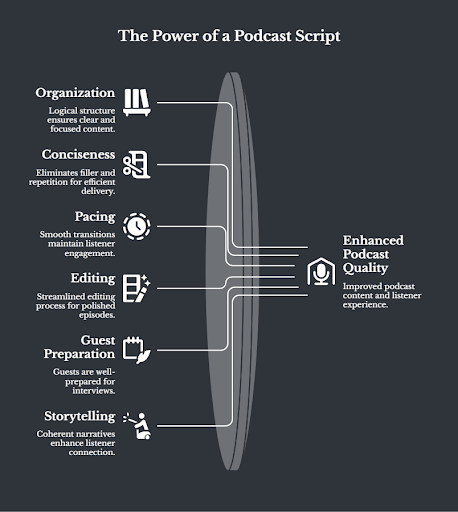
While a script can’t magically make your podcast episode a hit, it can definitely help. Here’s how:
Keeps the episode organized: A script divides your material into logical sections. That ensures each supporting point contributes to the main topic. Even a lightweight set of talking points can improve organization by giving the host a clear path from the opening idea to the final recap.
Helps avoid rambling: Planned bullet points help you identify what the listener needs to hear and what can be removed before you start speaking. This reduces repeated explanations, unrelated tangents, and filler phrases (you should leave enough flexibility for spontaneous insights).
Improves pacing and flow: A planned sequence of segments and transitions creates smoother content flow and prevents one idea from taking over the entire runtime.
Makes editing easier: A well-planned draft gives your editor a reference for identifying tangents, retakes, and material that does not support the intended message. Tools such as Descript let you edit audio via transcription, shorten word gaps, and perform bulk filler-word removal, but cleaner preparation means there is less unnecessary material to fix.
Helps guests know what to expect: For guest interviews, sharing the theme, format, and a selection of interview questions allows them to prepare. You should also explain why the discussion is taking place, establish ground rules, and ask concrete questions.
Supports better storytelling: A script helps you arrange context, conflict, evidence, and resolution into a coherent narrative rather than presenting disconnected facts.
Keeps calls to action clear: Having a script with clearly marked calls to action helps you state exactly what listeners should do, whether that means subscribing, leaving ratings, visiting the show notes, or following your social media account. We usually give the primary action its own line in the draft and limit each placement to one main request.
A Step-by-Step Guide to Writing a Podcast Script
Writing a podcast script is easy because, in most cases, it’s a simple outline of segments, subtopics, ideas, questions, and helpful information. The point is to have structure, direction, and cadence, which is particularly important for B2B podcasts.
You can follow these steps to write any kind of podcast script.
1. Choose the Right Podcast Script Format
The best script format depends on your podcast format, delivery experience, and how much spontaneity the episode requires.
Before filling in a podcast script template, decide whether you need precise wording, flexible prompts, recurring sections, or prepared guest questions.
Podcast scripts can be categorized into four distinct types:
Word-for-Word Script
A word-for-word episode script is best for narrations, educational material, audio drama, sponsor ads, intros, and outros where exact language matters.
Since typical speech falls around 120-180 words per minute, a fully scripted 10-minute monologue may require roughly 1,200-1,800 words.
This format provides control over timing, supporting data, and sponsor messaging, but it can sound stiff when written like an article.
Bullet-Point Script
A bullet-point script is most commonly used because it works well for conversational shows, unscripted discussions, and a co-host setup.
Instead of writing complete paragraphs, list the claim you need to make, two or three supporting points, any required statistic, and brief performance notes such as “pause,” “give example,” or “ask co-host.”
Pro Tip: Mark essential facts separately from optional anecdotes so the host knows what cannot be skipped. This approach protects natural conversation flow, although inexperienced speakers may still wander unless each prompt is tied to the episode’s central purpose.
Chapter- or Segment-Based Outline
A segment-based format is useful for recurring shows that follow a consistent sequence, such as opening, topic introduction, main discussion, music jingle, sponsor message, listener Q&A, recap, and closing.
Add estimated timestamps to the outline so that no single chapter consumes the entire planned episode length.
Interview Question Script
An interview question script is best for guest episodes. It should contain the welcome, guest introduction, core questions, likely follow-ups, transition phrases, sponsor placement, and closing remarks, while leaving enough room to pursue any unexpected answer.
Need some help preparing the questions for your podcast guest? Check out the best interview questions.
2. Consider the Purpose of the Episode
Before writing, define what the listener should know, feel, or do by the end of the episode.
A clear purpose helps you choose the right episode topic and subtopics, decide which content belongs in the script, and remove material that may be interesting but does not support the listener’s goal.
Spotify recommends identifying your target audience before publishing because it influences your show’s topic, style, tone, format, and messaging.
Write a one-sentence purpose statement using this formula:
By the end of this episode, our audience will understand [subject] and be able to [specific action or outcome].
For example, “By the end of this episode, first-time freelancers will understand three common pricing methods and be able to choose one for their next proposal” is more useful than “This episode is about freelance pricing.”
The stronger version gives you a filter to select examples, arrange the key takeaways, and write the show notes.
A clearly stated goal also shows you what success looks like. For instance, for a SaaS B2B leadership podcast, the goal may be to generate leads. Or perhaps, you simply want more engagement from listeners.
Apple counts someone as an ‘Engaged Listener’ after they play at least 20 minutes or 40% of an episode, and its analytics also reports plays, average consumption, and time listened.
You want to tie specific metrics to the episode, whether those are related to the podcast consumption or the greater business outcome.
3. Research the Topic Before Writing and Create an Outline
Good research prevents your episode from relying on vague claims, outdated statistics, or examples your audience can’t verify.
Before even beginning the scriptwriting, research the topic at hand to understand it better and to collect enough evidence to support your arguments. For a guest interview episode, you should learn about the guest, their work, or opinions.
Use this five-step process:
Write the central question the episode will answer.
Collect primary sources, such as official reports, original studies, company documentation, or direct interviews.
Confirm important claims through at least one additional reputable source.
Record the source, publication date, statistic, sample size, limitation, and link in a research table, especially for academic and research content.
Arrange the strongest evidence into an outline with an opening hook, context, three or four main ideas, examples, and a final takeaway.
Next, convert the evidence into clear subheadings. Under each one, add:
The main claim you want to communicate
One statistic, expert insight, or concrete example
Any necessary explanation or counterpoint
The sentence that should lead into the next idea
Pro Tip: Don’t force every fact you discover into the final draft. Too much evidence can bury the listener’s main takeaway and make your voice sound impersonal. We recommend one strong proof point for each major claim and secondary material for the show notes.
4. Create a Strong Podcast Opening
Your opening should quickly answer three listener questions:
What is this episode about?
Why should I care?
Who is guiding me through it?
That means the opening needs the host name and brief intro, the episode topic, what shall be covered, and why it’s important.
And you want the hook to be compelling because the intro is your best shot at retaining the audience, especially those who have tuned in for the first time.
A pressing question, an anecdote, or even an intriguing clip (for video podcasts) can do the trick.
Use this simple intro structure:
Open with a specific problem, surprising fact, vivid moment, or short guest clip.
State the episode’s promise in one sentence.
Identify yourself and the show.
Preview the main lesson or discussion.
Move directly into the first segment.
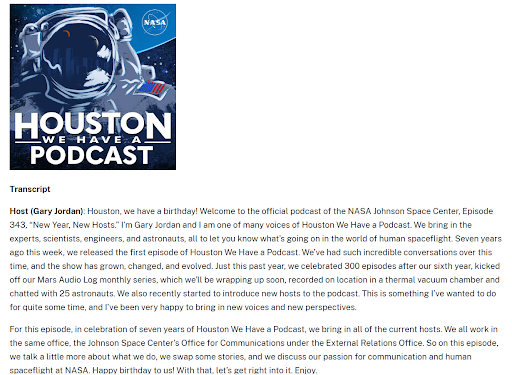
NASA’s Houston, We Have a Podcast provides a useful real-world example. In Episode 343, the opening identifies the program, episode number, subject, and host before explaining that the discussion will cover the show’s seven-year history and new presenters.
Source: NASA
5. Build the Main Body of the Script
The main body must deliver the promise made in your opening. That means the body is where you explain things, justify any claims, bring in counterpoints, and tie the different discussions together. That’s usually done best in segments, where you can focus on a particular point.
For example, in a 20-minute educational episode, you might allocate:
Three minutes to introduce the problem
Eight minutes to the main ideas
Six minutes to examples, mistakes, or expert insights
Three minutes to the summary and next step
Also, plan the body according to your target runtime. Your script should have enough material to cover the time you intend to have for the final edited version.
Here’s a blueprint for a segment-based approach to the body of the script:
Segment 1: Introduce the Problem
Define the challenge in language your listener recognizes. Explain what is happening, who it affects, and what may happen if it remains unresolved.
Keep this segment focused. Too much background can delay the answer, especially when your public audiences do not need a complete history of the subject.
Segment 2: Explore the Main Points
Divide your answer into two to four major ideas and place them in a logical order. For every point, include the claim, evidence, explanation, example, and any meaningful counterargument.
For structured content, use this pattern:
Main point → supporting evidence → practical example → limitation → listener action
This structure improves content flow because each detail has a defined purpose.
Segment 3: Add Depth
Once the listener understands the core ideas, add something they are unlikely to learn from a basic search. This can be a common mistake, a myth, a case study, a personal experience, an expert clip, or an opposing viewpoint.
Here’s a good example about using your tone to get more leads with B2B cold calls:
A business show could compare two companies that approached the same problem differently. A documentary might introduce an archival clip that challenges the accepted account.
An interview could use follow-up questions such as:
What happened next?
Can you give a specific example?
What did that cost in time or money?
What would you do differently now?
Is there a situation where that advice would not work?
Pro tip: Here are more best practices you can implement to run a great podcast interview.
Segment 4: Summarize the Lesson
End the body by returning to the original problem and condensing the discussion into no more than three memorable lessons. Don’t repeat whole passages. Synthesize the discussion into a clear conclusion the listener can remember or apply.
6. Write Natural Transitions
Natural transitions help listeners understand why you are leaving one idea and entering the next. Without them, even well-researched material can sound like disconnected notes. But don’t go overboard. That will make your delivery too mechanical.
Use this three-part formula for most segues:
Briefly close the current point.
Explain how it connects to what follows.
Introduce the next question, example, or segment.
This works because it does more than announce a new section. It shows the relationship between the two ideas.
Useful transition phrases include:
“That matters because…”
“Here is where it becomes difficult…”
“To see what this looks like, consider…”
“There is another side to this…”
“Before we move on, remember…”
“That leads to the next question…”
“We have covered the problem; now let’s look at the solution.”
Adapt these lines to your normal vocabulary. Repeating “next,” “moving on,” or “as we mentioned earlier” throughout the script can make the episode sound formulaic.
For an interview or co-host discussion, transitions should also protect the conversation flow. Briefly acknowledge what the other speaker said before changing direction. For example:
“You mentioned that preparation reduced the number of retakes. What changed when you started preparing guests as well?”
This type of bridge shows that you are listening rather than simply reading the next interview question. It also gives your guest an opportunity to clarify or expand on an important point.
7. Add Stories, Examples, and Personality
Facts explain an idea, but stories help listeners experience it. Research on emotional memory has found that emotionally nuanced narratives can produce significantly better verbatim recognition than neutral narratives. However, emotion should support the lesson rather than manipulate listeners or replace credible evidence.
For effective storytelling, build each example around four elements:
A person with a clear goal
A specific obstacle or moment of uncertainty
A decision or change
A lesson connected to the episode topic
Instead of writing, “Preparation reduces mistakes,” you could say:
“The first time I recorded an expert interview, I prepared 20 questions but no follow-ups. Ten minutes in, the guest shared the most useful insight of the session, and I moved straight to the next question. That mistake taught me to prepare prompts while leaving room to listen.”
The second version presents the listener with a situation, a consequence, and a lesson. Keep the details that reveal the stakes, but remove background information that does not change what happened.
Your own stories do not need to be dramatic. A missed deadline, an awkward first interview, an unexpected listener response, or a failed product decision can make an abstract lesson practical.
We usually ask three questions before adding an anecdote:
Does it help the listener understand the point?
Does it include a concrete moment rather than a general summary?
Can it be told in less than two minutes without losing its meaning?
By the way, even the audio edits can make your podcast more engaging.
8. Write the Podcast Outro
Your outro should give the episode a clear ending. A useful closing typically includes a brief recap, one next step for the listener, acknowledgments where appropriate, and a consistent sign-off.
Use this structure:
Restate the main lesson in one or two sentences.
Summarize no more than three key takeaways.
Give the listener one primary call-to-action.
Thank the guest, co-host, production team, or audience.
Tease the next release when you have confirmed the topic.
End with your sign-off and outro music.
Keep the main request specific.
Asking listeners to subscribe, leave ratings, write a review, follow three social accounts, join a newsletter, visit a sponsor, and share the release at the same time creates unnecessary competition between actions. Choose the request that best supports the episode’s purpose.
Pro Tip: Plan sponsor messages separately from your editorial CTA. When a sponsor ad appears near the end, use a clear verbal transition so listeners can distinguish paid sponsor messaging from your personal recommendation or closing request. Then return briefly to your own sign-off rather than allowing the advertisement to become the final voice of the episode.
Podcast Script Best Practices
When writing your podcast episode script, keep these tips in mind:
Keep things simple. Give each section one main idea, one strong example or piece of evidence, and one practical takeaway. Don’t pack several claims into the same paragraph.
Write how you would speak. Use contractions, familiar vocabulary, and a tone casual enough to sound like your natural voice, but avoid forced slang or expressions you would never use in conversation.
Keep delivery notes easy to recognize. Place performance notes like [PAUSE], [SLOW DOWN], [EMPHASIZE], or [MUSIC FADES] on separate lines so you can easily see them.
Include CTAs naturally. Connect each call to action to the value the listener has just received. Again, use one CTA at a time so you do not overwhelm the audience with competing requests.
Plan for listener retention. Place useful information early, and introduce new examples or questions throughout the discussion. Check analytics to see whether listeners skip the intro or later sections of your podcast episodes.
Read the script out loud. Perform a timed rehearsal before entering the podcast studio, marking awkward phrases, long sentences, repeated words, and places where you run out of breath. A paragraph that looks clear on a screen may still sound unnatural, so revise for your mouth and your listener’s ears.
At Content Allies, we know firsthand the importance of a script for an effective podcast episode, with fewer retakes and less post-production editing. We’ve helped B2B organizations like Zendesk and Cisco plan and produce professional podcasts with co-hosts and guests alike.
Our experts can help you prepare scripts to empower the hosts and get your message across with proper facts and research.
Schedule a meeting to discuss your very first (or next) podcast episode idea.
FAQ
How many words in a 20-minute podcast?
A 20-minute podcast contains about 2,400 to 3,000 words. Most podcast hosts speak between 120 and 150 words per minute, depending on pacing, pauses, and conversation style.
How long should my podcast episode be?
Choose a podcast episode length that matches your audience and topic. Most popular podcast episodes run 20 to 45 minutes, while interview shows typically last 30 to 60 minutes. There’s no rule as such. The episode length should be sufficient to deliver complete, valuable content rather than cutting or extending it to meet a specific duration.
Do podcasters use AI to write scripts?
Yes, many podcasters use AI to write podcast scripts, generate outlines, refine introductions, and improve episode flow. AI speeds up content creation, but successful podcasters review, edit, and personalize every script to match their voice, audience, and expertise before recording.
What’s a good podcast intro?
A good podcast intro introduces the host, explains the show's purpose, and tells listeners what they will learn in the first 60 seconds. Include a brief welcome, the podcast name, the episode topic, and a clear reason to keep listening before transitioning into the main content.
Does Content Allies help with podcast scripting?
Yes, Content Allies takes care of everything required for podcast production and distribution, including creating outlines and scripts. We ensure scripts support both hosts and guests, while covering relevant information that’s valuable to the listeners.