
Our Podcast Script Templates (Easy, Free & Totally Effective)
Podcasting has gone mainstream. 55% of Americans aged 12 and older consumed a podcast each month, according to Edison Research’s Infinite Dial 2025.
At the same time, more and more podcasts are vying for attention. And while there are many variables at play for your podcast’s success, the podcast script is most impactful early on.
A well-planned podcast script helps the host organize key talking points, maintain a consistent tone, introduce a guest clearly, ask solid questions, and guide the audience seamlessly from the intro to the outro and final call to action.
More importantly, scripting does not have to mean reading every word from a teleprompter or removing a show's natural personality. The right podcast script template can provide just enough structure to improve content flow while leaving room for spontaneous conversation, storytelling, and guest interviews.
This guide includes 13 easy, free, and editable podcast script templates for different formats, such as solo monologues, interview podcasts, narrative podcasts, cohosted shows, teaser episodes, sponsor messages, and more.
What to Include in a Podcast Script?
Most podcast scripts include three core sections: an intro, the main body, and an outro.
The intro should welcome the audience, introduce the host or guest, introduce the podcast, explain the episode topic, and give listeners a reason to keep listening.
The body contains the main talking points, questions, stories, research, examples, or discussion segments. This, of course, depends on the kind of podcast. A clear outline with delivery notes, segues, sponsor messages, and prompts can help the conversation move seamlessly without making the episode sound overly rehearsed.
The outro should summarize the key takeaway and end with a clear call to action, like subscribing to the show, visiting a website, joining a newsletter, or following the podcast on social media.
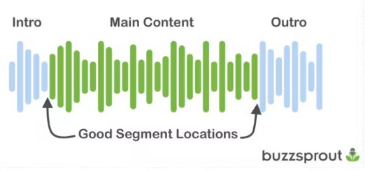
Again, the exact structure and content flow will depend on the format. But the intro-body-outro script works virtually for all kinds of podcast series.
Pro tip: For a closer look at how these three sections come together across an entire recording, see our step-by-step guide for an enterprise podcast episode.
Podcast Intro Script Template
A podcast intro sets expectations for the episode and gives listeners a reason to continue. It should quickly introduce the show, host, episode topic, and value of listening without delaying the main content with a long biography, extended intro music, or unnecessary announcements.
This matters when attracting new listeners. For instance, a 2024 podcast discoverability survey found that 17% of listeners give a new podcast only five minutes to hook them.
So, you want to keep the opening focused, use a clear tone, and move seamlessly into the first content section or guest conversation. Here’s an intro template you can use:
[Intro music or short music jingle begins]
HOST:
“Welcome to [podcast name], the show where [one-sentence description of the podcast and who it helps]. I’m your host, [host name].
In today’s episode, we’re talking about [episode topic]. You’ll learn [key takeaway one], [key takeaway two], and [key takeaway three].”
[For a guest episode:]
I’m joined by [guest name], [guest title, company, or relevant credential], who will share [what the guest will help the audience understand].
Stay with us until the end to discover [valuable insight, answer, tip, or resource teased for later in the episode].
Let’s get started.”
[Intro music fades out]
[Segue into the first talking point, story, or interview question]
Also, here are some tips to make your intro hook interesting:
Podcast Body Script Template
The body is the main content section of a podcast episode, where the host explores the episode topic in detail through talking points, stories, research, examples, guest interviews, or co-host discussion.
Its structure should follow a logical content flow, with clear sections and smooth segues that help the audience understand how each idea connects to the next.
Most podcast body scripts can be outline-based rather than word-for-word, teleprompter-style scripts. That’s usually the best approach with podcasts for a natural flow of conversation. But having an outline or questions in the body of the script helps you cover the different topics and ensure the podcast stays within the duration you planned.
Again, what goes in the body script depends entirely on the podcast show and the particular series or episode. A solo show may use a detailed episode script, while an interview podcast may rely on guest interview questions, prompts, and delivery notes.
Jump to the complete templates to find the appropriate body script template for your podcast.
Pro Tip: Whatever the format, the body should stay focused on the listener’s needs, avoid unnecessary repetition, and maintain a consistent tone that supports audience engagement and listener retention.
Podcast Outro Script Template
A podcast outro gives the episode a clear ending while guiding listeners toward the next step.
It should briefly recap the main takeaway, thank the guest and audience, and include one focused call to action, typically following the show on the platform they’re listening or watching, subscribing to a newsletter, visiting a website, or even sharing the episode with friends.
See it as an opportunity to reinforce the podcast’s identity and keep listeners even more connected after an episode ends.
Keep this section concise so the ending does not feel repetitive or delay the outro music. Here’s a general template you could follow.
HOST:
“That brings us to the end of today’s episode of [podcast name].
We covered [main topic or takeaway], including [key point one], [key point two], and [key point three].”
[For a guest episode:]
A big thank-you to [guest name] for joining us and sharing their insights on [subject discussed]. You can learn more about their work at [website or social media account].
If you found this episode helpful, [primary call to action: follow the podcast, leave a review, subscribe to the newsletter, share the episode, or visit the website].
You can find the resources and links mentioned today in the show notes.
Thanks for listening. I’m [host name], and I’ll see you in the next episode.”
[Outro music or music jingle begins]
[Optional series outro:]
“You’ve been listening to [podcast name], a [media network or company name] production.”
[Outro music fades out]
Types of Podcast Scripts
Podcast scripts can range from a loose outline to a complete, word-for-word episode script. The right format depends on the show’s tone, episode topic, host experience, and production style.
The level of detail in your script also depends on the host's ability to remember talking points or cover certain topics in an interview. Some podcasters need only a few prompts to stay on track, while others benefit from a detailed structure that includes transitions, delivery notes, music cues, and sound effects. The template is there to help you.
Use one of the following based on the specific episode content:
Segments
A segment-based script divides the episode into clear content sections, such as the intro, news roundup, main discussion, guest interview, audience questions, sponsor messages, and outro.
Each segment can include a short description, estimated length, talking points, and segues.
This format works well for structured shows, cohosted podcasts, radio-style programs, and episodes that follow a consistent recurring format.
Interview Questions
An interview podcast script is usually built around a list of guest interview questions rather than complete dialogue. It may also include a guest introduction, background research, follow-up prompts, sponsor ads, and a closing call to action.
The questions should follow a logical sequence while leaving enough flexibility for the host to explore unexpected insights and maintain a natural conversation.
Bullet Points
A bullet point outline lists the main ideas, examples, statistics, and/or stories you want to cover without scripting every sentence. This approach helps preserve a conversational tone and creative personality. But it also prevents the episode from becoming unfocused or veering into other directions.
This is less of a proper script and more of a collection of ideas or questions, so it's best for experienced hosts, solo commentary, thought leadership podcasts, and informal discussions between co-hosts.
Fully Scripted
A fully scripted podcast includes nearly every word the host or narrator will say, along with delivery notes, pauses, music, sound effects, and transitions.
This format is common in narrative podcasting, audio storytelling, training content, branded series, and solo monologues. It requires more content prep and editing, but it can create a polished and consistent podcast experience.
However, a fully scripted podcast with a guest isn’t recommended. You want the conversation to flow naturally.
Podcast Script Templates & Examples
We’ve compiled 13 podcast script templates that cover pretty much every type and style of podcast, including B2B podcasts.
You can also download the entire template collection to easily reuse on your device.
1. Solo Host Podcast Script Template
This is best for episodes where one host explains, teaches, reviews, or reflects on a topic. The actual topic can vary, but the structure can remain the same. Since there’s no co-host or guest, this script should have a clear bullet point outline, smooth segues, and any sponsor messages.
[Intro music begins]
HOST:
“Welcome to [podcast name], the show where we explore [main subject or promise of the podcast]. I’m your host, [host name].
Today, we’re talking about [episode topic]. [Briefly explain the problem, opportunity, or relevance].
By the end of this episode, you’ll understand:
• [Talking points]
Let’s get started.”
[Intro music fades out]
Section 1: Introduce the Topic
“Let’s begin with [first main idea].
In simple terms, [explain the idea, provide context, or define an important term].
One example of this is [story, example, research finding, or personal experience].
The key point to remember is [main takeaway from this section].”
[Segue]
“Now that we’ve covered [previous point], let’s look at [next point].”
Section 2: Explore the Main Argument
“The next thing to understand is [second main idea].
There are a few reasons this matters:
1. [Reason one]
2. [Reason two]
3. [Reason three]
You may be wondering, [common listener question]. The answer is [clear response].”
Section 3: Share Practical Advice
“So, how can you apply this?
Start by [first action]. Then, [second action]. Finally, [third action].
A common mistake is [mistake]. Instead, try [better approach].”
Recap and Outro
“To recap, we discussed [topic], why [main argument], and how you can [desired result].
The most important takeaway is [one-sentence conclusion].
If you found this episode helpful, [call to action: follow the show, share the episode, visit the website, or join the newsletter].
You can find additional resources in the show notes.
Thanks for listening to [podcast name]. I’m [host name], and I’ll speak to you again in the next episode.”
[Outro music begins]
2. Co-host Podcast Script Template
A co-host podcast script gives two or more hosts enough structure to maintain a focused conversation without making the discussion feel rehearsed. It should clarify who introduces each section, which talking points each person will cover, and where natural discussion or debate can take place.
[Series intro or music jingle begins]
HOST 1:
“Welcome to [podcast name], where we talk about [show description]. I’m [host one’s name].”
HOST 2:
“And I’m [host two’s name]. Today, we’re discussing [episode topic].”
HOST 1:
“We’ll cover [talking point one], [talking point two], and [talking point three].”
HOST 2:
“And later, we’ll also share [tip, recommendation, prediction, or personal experience]. Let’s get into it.”
[Intro music fades out]
Opening Discussion
HOST 1:
“Let’s start with the basics. How would you describe [topic or question]?”
HOST 2:
[prepared response or talking point]
HOST 1:
[agreement, contrast, or follow-up point].
Discussion prompts:
• What is changing about this topic?
• Why should the audience care?
• Have the hosts had different experiences?
• Is there a common misconception to address?
Main Segment
HOST 2:
“Let’s move on to [second section].”
HOST 1:
“One of the most important things here is [talking point].”
HOST 2:
[Any additional point or alternative view]
HOST 1:
“Can you give an example?”
HOST 2:
“Sure. [Example, story, case study, or experience].”
Outro
HOST 2:
“That brings us to the end of today’s discussion.”
HOST 1:
“We covered [main points], but the key takeaway is [main conclusion].”
HOST 2:
“Let us know what you think by [social media or audience engagement prompt].”
HOST 1:
“And remember to [call to action].”
HOST 2:
“Thanks for listening.”
BOTH:
“We’ll see you in the next episode.”
[Outro music begins]
3. Interview Podcast Script Template
An interview podcast script should guide the conversation without restricting it. In addition to prepared guest interview questions, the host can include background research, follow-up prompts, a guest introduction, sponsor messages, and delivery notes.
[Intro music begins]
[Introduction]
HOST:
“Welcome to [podcast name], the show where [show description]. I’m your host, [host name].
Today’s episode is about [episode topic], and I’m joined by [guest name].
[Guest name] is [brief description of their role, expertise, achievements, or experience]. They have worked on [relevant project, company, book, campaign, or field].
In this conversation, we’ll explore [topic one], [topic two], and [topic three].
[Guest name], welcome to the show.”
[GUEST RESPONSE]
Opening Questions
HOST:
“To begin, could you briefly introduce yourself and explain how you became involved in [field or topic]?”
Possible follow-ups:
- What first attracted you to this work?
- Was there a defining moment in your career?
- How has your perspective changed over time?
Main Interview Questions
HOST:
[List of questions particular to the guest or the topic at hand]
- Question 1:
- Question 2:
- Question 3:
- Question N:
[Possible follow-up prompts to guest answers]
- Can you give us an example?
- What happened next?
- Why do you think that approach worked?
- What would you do differently today?
- What do most people misunderstand about this?
- How can listeners apply this insight?
Optional Sponsor Message
HOST:
“This episode is brought to you by [sponsor name].
[Sponsor message explaining the product, offer, or benefit].
[CTA like ‘Visit website’, ‘use code,’ or ‘sign up.’]”
Closing Questions
HOST:
“Before we finish, I have a few final questions.”
[A couple of questions regarding the topic or the guest that summarizes the discussion or gets a message from the guest.]
Example questions:
- What is one lesson you wish you had learned earlier?
- What trend should our listeners pay attention to?
- What is one action they can take today?
- Where can people learn more about your work?
Outro
HOST:
“[Guest name], thank you for joining us and sharing your perspective on [topic].”
HOST:
“You can find links to [guest name’s] work in the show notes.
If you enjoyed this guest interview, follow [podcast name] on [Spotify, YouTube, or another platform] and share the episode with someone who may find it useful.
Thanks for listening. I’ll see you in the next episode.”
[Outro music begins]
4. Narrative Storytelling Podcast Script Template
A narrative storytelling podcast script combines narration, scenes, interviews, music, and sound effects to create an immersive podcast experience. This detailed structure is suited to documentary series, true crime, history, brand storytelling, and personal audio storytelling.
This is typically a word-for-word script that the host reads as is. So, the exact contents of the script vary based on the episode context. Here’s a template for a podcast script that narrates a person’s story.
[Cold open: ambient sound or sound effect]
NARRATOR:
“On [date or time period], in [location], [describe the event, person, or moment that begins the story].
At first, [what people believed or expected].
But then, [unexpected event or revelation].”
[Pause]
“Everything was about to change.”
[Theme music begins]
NARRATOR:
“This is [podcast or series name]. I’m [narrator name].
In this episode: [story title or central question].”
[Theme music fades]
Scene 1: Establish the Setting
[Sound effect: location ambiance]
NARRATOR:
“To understand what happened, we need to go back to [time and place].
At the time, [historical context, background information, or character situation].”
INTERVIEW CLIP:
“[Relevant quote or paraphrased interview contribution].”
NARRATOR:
“That’s [speaker name and role]. They remember [important detail].”
Scene 2: Introduce the Conflict
NARRATOR:
“The first sign that something was wrong came when [event].
According to [research source, document, witness, or expert], [important evidence].”
[Music builds softly]
NARRATOR:
“But one question remained: [central unanswered question]?”
Scene 3: Develop the Story
[Transition sound]
NARRATOR:
“Over the next [time period], [describe what happened].”
CHARACTER OR INTERVIEWEE:
“[Emotional memory, testimony, or explanation].”
NARRATOR:
“This changed [person, community, company, or investigation] because [explanation].”
Scene 4: Reveal or Turning Point
[Music stops or changes]
NARRATOR:
“Then came the discovery that changed the story: [revelation].”
[Pause]
“[Explain why the revelation matters].”
Resolution
NARRATOR:
“In the end, [explain the outcome].
For [main character or affected group], the experience meant [personal or wider significance].
But the story also raises a larger question: [thought-provoking concluding question].”
Outro
NARRATOR:
“You’ve been listening to [podcast name].
This episode was written and produced by [names], with editing by [name] and music by [name or source].
Additional research, source materials, and interview details are available in the show notes.
To hear the next part of this series, follow the podcast on [platform].”
[Outro music begins]
5. Educational/How-To Podcast Script Template
An educational or how-to podcast script breaks a concept or process into clear, manageable steps. It is useful for training, professional development, thought leadership, tutorials, and episodes designed to help listeners solve a specific problem.
[Intro music begins]
HOST:
“Welcome to [podcast name], where we help [target audience] learn how to [show’s core promise].
I’m [host name], and today I’ll show you how to [specific outcome].
By the end of this episode, you’ll be able to:
- [Learning objective one]
- [Learning objective two]
- [Learning objective three]
You may want to pause the episode and take notes as we go. You can also find a written guide and additional resources in the show notes.”
[Intro music fades]
Step 1: Understand the Basics
“Before we begin, let’s define [important concept].
[Provide a simple definition and explain why it matters].
You will need:
[Information or preparation required]”
Step 2: Complete the First Action
“The first step is to [action].
Here is how to do it:
- [Instruction]
- [Instruction]
- [Instruction]
At this stage, you should see [expected result].”
Step 3: Build on the Process
“Next, [second major action].
The most important thing to remember is [tip or warning].
A common mistake is [mistake]. You can avoid it by [solution].”
Step 4: Review the Results
“Once you have completed those steps, check [result, measurement, or quality indicator].
Ask yourself:
- Did [desired outcome] happen?
- Is [important element] working correctly?
- What could be improved?
Practical Example
“Let’s walk through a quick example.
Imagine that [scenario]. You would begin by [step], then [step], and finally [step].
The result would be [outcome].”
Recap and Outro
“Let’s quickly recap the process:
- [Step one]
- [Step two]
- [Step three]
- [Step four]
Your next action is to [simple assignment or practical next step].
For the full checklist, visit [website] or download the resource linked in the show notes.
Follow [podcast name] for more step-by-step episodes about [subject].
Thanks for listening, and I’ll see you in the next lesson.”
[Outro music begins]
6. News or Commentary Podcast Script Template
A news or commentary podcast script helps the host cover current events, industry updates, trends, or expert opinions in a clear and organized way. The script should separate verified facts from personal analysis, identify research sources, and guide listeners through why each development matters. Because news episodes can become outdated quickly, confirm all names, dates, statistics, and quotes before recording.
[Intro music or short news-style music jingle begins]
HOST:
“Welcome to [podcast name], where we break down [industry, subject, or type of news] and explain what it means for [target audience].
I’m [host name], and today is [recording or publication date].
In this episode, we’re covering [main event or trend].
Here’s what you need to know:”
- [Key development one]
- [Key development two]
- [Key development three]
“We’ll also look at why this matters and what may happen next.”
[Intro music fades out]
The Main Update
HOST:
“On [date], [company, organization, government, or individual] announced [development].
According to [source], [verified fact, statistic, or statement].
This follows [relevant background or earlier development].”
Context and Background
“To understand why this is important, we need to look at [historical, market, political, or industry context].
Previously, [brief background information].
The situation changed when [turning point or new information].”
Commentary and Analysis
“Here’s what I think. This development may affect [audience, market, customers, creators, or industry] in three main ways.
First, [analysis point one].
Second, [analysis point two].
Third, [analysis point three].
It is important to separate what we know from what is still uncertain. We know [confirmed information], but it is not yet clear whether [unresolved question].”
Different Perspectives
“Supporters of this development argue [viewpoint one].
Critics or skeptics point to [viewpoint two].
Another perspective is [expert, customer, competitor, or industry viewpoint].”
What to Watch Next
“Over the next [time period], watch for:”
- [Upcoming decision or announcement]
- [Possible market reaction]
- [Regulatory, customer, or competitor response]
- [Metric or signal that may reveal the impact]
Outro
“To recap, [briefly summarize the event].
For more updates on [subject], follow [podcast name] on Spotify, YouTube, or your preferred podcasting platform.
Thanks for listening. I’m [host name], and I’ll speak to you again in the next episode.”
[Outro music begins]
7. Panel Discussion Podcast Script Template
A panel discussion podcast brings together multiple guests to discuss one episode topic from different perspectives. A clear script helps the host manage guest introductions, distribute speaking time, introduce new content sections, and prevent the conversation from becoming unfocused. The questions should encourage discussion between panelists rather than create a series of separate mini-interviews.
Pro tip: For more on drawing out better answers once the mic is on, see our guide on how to conduct great podcast interviews.
[Series intro music begins]
HOST:
“Welcome to [podcast name], the show where [show description].
I’m your host, [host name], and today we’re discussing [episode topic] with a panel of experts who approach the subject from different angles.
Joining me are:”
- [Guest one], [Introduction like title, company, or relevant expertise]
- [Guest two], [Introduction like title, company, or relevant expertise]
- [Guest three], [Introduction like title, company, or relevant expertise]
“Thank you all for being here.”
PANELISTS RESPOND
HOST:
“Today, we’ll explore [discussion area one], [discussion area two], and [discussion area three].
Let’s begin.”
[Intro music fades out]
Opening Perspectives
HOST:
“I’d like to start by asking each of you the same question.
THE MAIN TOPIC/QUESTION”
GUEST 1:
“[Opening viewpoint].”
GUEST 2:
“[Opening viewpoint].”
GUEST 3:
“[Opening viewpoint].”
Main Discussion
HOST:
“Let’s move to [first major discussion area].
Possible follow-up prompts:”
- Does anyone disagree with that?
- Who is most affected by this issue?
- Can one of you provide a real example?
- What is often missing from this conversation?
- How does this look from your area of expertise?
- Has the situation changed in recent years?
Comparing Viewpoints
HOST:
“[Guest one] has argued [viewpoint], while [guest two] has emphasized [contrasting viewpoint].
Where do the two perspectives overlap?”
GUEST 1:
“[Response].”
GUEST 2:
“[Response].”
HOST:
“[Guest three], where do you stand on this?”
Practical Recommendations
HOST:
“Let’s make this practical for the audience.
What should [target listener] do first?”
GUEST 1:
“[Recommendation].”
GUEST 2:
“[Recommendation].”
GUEST 3:
“[Recommendation].”
Quick-Fire Round
HOST:
“I’d like to finish with a quick-fire round. Please keep each answer to one or two sentences.
Example questions:”
- One trend to watch: [Responses]
- One common misconception: [Responses]
- One useful resource: [Responses]
- One prediction for the future: [Responses]
Closing Discussion
HOST:
“Before we wrap up, what is one final thought you want listeners to remember?”
[Each panelist gives a closing response.]
Outro
HOST:
“Thank you to [guest names] for joining this panel discussion and sharing your insights on [topic].
You can find information about our guests, along with the resources mentioned today, in the show notes.
Share this episode on social media and let us know which perspective you found most useful.
Thanks for listening to [podcast name]. I’m [host name], and we’ll be back with another discussion soon.”
[Outro music begins]
8. Q&A Podcast Script Template
A Q&A podcast script is built around listener questions, customer concerns, community prompts, or frequently searched topics. It allows the host to speak directly to the audience while turning real questions into useful content. The questions can come from social media, email, a newsletter, website forms, guest outreach, or keyword research.
[Intro music begins]
HOST:
“Welcome to [podcast name], where we answer your questions about [subject].
I’m [host name], and today’s episode is a Q&A focused on [episode theme].
The questions in this episode came from [social media followers, newsletter subscribers, customers, community members, or listeners].
We’ll cover:
- [Question topic one]
- [Question topic two]
- [Question topic three]
“Let’s start with the first question.”
[Intro music fades out]
Question 1
HOST:
“Our first question comes from [listener name or ‘an anonymous listener’], who asks:
‘[Question]’
The simple answer is [brief answer].
Here’s the fuller explanation: [Detailed response, context, or example].
The most important thing to remember is [main takeaway].”
Question 2
“Next, [listener name] asks:
‘[Question]’
This is a common question because [why people are confused or concerned].
There are [number] factors to consider:
- [Factor one]
- [Factor two]
- [Factor three]
“In most situations, I recommend [practical guidance].”
Question 3
“Our third question is:
‘[Question]’
A good example is [case, scenario, experience, or comparison].
In that situation, [explain what happened or what should be done].”
Rapid-Fire Questions
“Before we wrap up, here are a few rapid-fire questions.”
Question: [Short question]
Answer: [Short answer]
Question: [Short question]
Answer: [Short answer]
Question: [Short question]
Answer: [Short answer]
Recap
“Today, we answered questions about [topic one], [topic two], and [topic three].
The main takeaway is [summary insight].”
Outro
“To submit a question for a future episode, [send an email, complete the website form, leave a comment, or message the show on social media].
You can find additional links and resources in the show notes.
Follow [podcast name] so you don’t miss the next Q&A episode.
Thanks for listening. I’m [host name], and I’ll speak to you soon.”
[Outro music begins]
9. Case Study Podcast Script Template
A case study podcast script walks listeners through a real example, business scenario, customer success story, failed project, campaign, or important lesson. This is particularly good for B2B podcasts, where the host can cover a success story, the challenges behind it, and the results achieved for the client. And it gets even better if you can get a client representative on the show for questions.
The best case study episodes explain the original problem, the strategy used, the results achieved, and what the audience can learn from the experience.
[Intro music begins]
HOST:
“Welcome to [podcast name], where we cover [subject or industry].
I’m [host name], and today we’re breaking down how [person, organization, or brand] went from [starting situation] to [result].
In this episode, you’ll learn:
- The challenge they faced
- The strategy they used
- What worked and what did not
- The lessons you can apply to your own work
[Intro music fades out]
Background
“Let’s begin with some context.
[Company, person, or project] is [brief description].
Before this project began, they were dealing with [market condition, business problem, customer issue, or operational challenge].
At the time, [provide relevant background, scale, or circumstances].”
The Challenge
“The main challenge was [problem].
This was affecting [revenue, growth, customer experience, productivity, audience engagement, or another outcome].
The available data showed:
- [Metric or fact one]
- [Metric or fact two]
- [Metric or fact three]
Previous attempts to solve the problem included [earlier strategies], but they failed or underperformed because [reason].”
The Strategy
“The team decided to [main strategy or solution].
Their approach included:
- [Action one]
- [Action two]
- [Action three]
- [Action four]
One important decision was [specific choice].
This mattered because [explanation].”
Implementation
“The project was carried out over [time period].
During the implementation, the team encountered [obstacle or unexpected issue].
They responded by [adjustment or solution].
A major turning point came when [event or discovery].”
Results
“The results were [positive, mixed, or negative].
After [time period], the case study reported:
- [Result or metric one]
- [Result or metric two]
- [Result or metric three]
- [Qualitative outcome]
However, it is important to note [limitation, missing information, or context].”
Lessons Learned
“What can listeners learn from this case?
First, [lesson one].
Second, [lesson two].
Third, [lesson three].
The biggest mistake to avoid is [mistake].
The strategy may work best for [type of organization or situation], but it may be less suitable when [limitation].”
Outro
“To recap, [case study subject] faced [challenge], responded with [strategy], and achieved [result].
The main lesson is [one-sentence takeaway].
You can find the original case study, supporting research, and other resources in the show notes.
For more real-world breakdowns, follow [podcast name] and share this episode with someone working on a similar challenge.
Thanks for listening. I’m [host name].”
[Outro music begins]
10. Review Podcast Script Template
A review podcast script helps the host evaluate a product, book, tool, movie, software platform, service, or industry development. It should cover the evaluation criteria, discuss both strengths and limitations, and make clear who the subject is best suited for. The host should also disclose sponsorships, affiliate relationships, free products, or other potential conflicts of interest.
[Intro music begins]
HOST:
“Welcome to [podcast name], where we review [type of products, media, tools, or developments] to help you decide what deserves your time, attention, or budget.
I’m [host name], and today I’m reviewing [name of item].
In this episode, I’ll cover:
- What it is
- Its main features or qualities
- What it does well
- Where it falls short
- Who should consider it
[Disclosure, if applicable:]
For transparency, [explain whether the item was purchased, provided for free, sponsored, or connected to an affiliate relationship].”
[Intro music fades out]
Overview
“[Item name] is [brief description].
It was created by [company, author, director, developer, or organization] and is designed for [target audience or use case].
It costs [price or pricing structure] and is available through [website, retailer, platform, or service].”
Evaluation Criteria
“For this review, I evaluated it based on:
- [Criterion one]
- [Criterion two]
- [Criterion three]
- [Criterion four]
These criteria matter because [explain what the target audience needs].”
First Impressions
“My first impression was [initial reaction].
The [setup/opening chapter/user interface/first scene/initial experience] was [description].
One feature that immediately stood out was [feature or quality].”
What Works Well
“Let’s begin with the strengths.
First, [strength one and explanation].
Second, [strength two and explanation].
Third, [strength three and explanation].
A particularly strong example is [specific example, scene, feature, or experience].”
Limitations
“However, there are also some drawbacks.
The first is [limitation one].
Another issue is [limitation two].
Depending on your needs, [feature, price, complexity, pacing, or restriction] may also be a concern.”
Comparison
“How does it compare with [alternative or competitor]?
[Item being reviewed] is better for [use case], while [alternative] may be more suitable for [different use case].
The biggest difference is [price, features, tone, performance, audience, or experience].”
Who Is It For?
“I would recommend [item] to:
- [Audience type one]
- [Audience type two]
- [Audience type three]
It may not be the best choice for:
[Audience type]
[Use case or requirement]”
Final Verdict
“My final verdict is [recommend, recommend with conditions, or do not recommend].
Its strongest quality is [strength], while its biggest weakness is [limitation].
Overall, I would rate it [score, rating, or summary judgment].”
Outro
“That concludes my review of [item name].
You can find links, specifications, references, or related resources in the show notes.
Have you tried, read, watched, or used it? Share your experience through [social media, email, YouTube comments, or website form].
Follow [podcast name] for more reviews and comparisons.
Thanks for listening. I’m [host name], and I’ll see you in the next episode.”
[Outro music begins]
11. Roundtable Podcast Script Template
A roundtable podcast features several hosts, guests, or subject-matter experts having a relatively informal conversation around one central theme. Unlike a formal panel discussion, the exchange can be more spontaneous. But the host should still use prepared prompts, clear content sections, and time limits to keep the episode focused and give everyone an opportunity to contribute.
If lead generation is the real goal behind these episodes, our piece on how to convert podcast interviews into revenue walks through how those relationships actually turn into pipeline.
[Intro music begins]
HOST:
“Welcome to [podcast name], where we bring together different voices to discuss [show topic or industry].
I’m [host name], and today we’re having a roundtable conversation about [episode topic].
Joining me are:”
- [Participant one], [role or relevant background]
- [Participant two], [role or relevant background]
- [Participant three], [role or relevant background]
- [Participant four, if applicable], [role or relevant background]
“Today, we’ll explore [discussion area one], [discussion area two], and [discussion area three].
Let’s start with a quick opening question for everyone.”
[Intro music fades out]
Opening Round
HOST:
“In one or two sentences, what is your current view on [topic or trend]?”
PARTICIPANT 1:
“[Opening thought].”
PARTICIPANT 2:
“[Opening thought].”
PARTICIPANT 3:
“[Opening thought].”
HOST:
“We already have a few different perspectives, so let’s unpack them.”
Discussion Section 1
HOST:
[Introduce the sub-topic]
Possible discussion ideas:
- What has changed recently?
- What are people getting wrong?
- Who is most affected?
- Does anyone have a different experience?
- Can someone share a practical example?
Discussion Section 2
HOST:
[Introduce the sub-topic]
Possible discussion ideas:
- What worked well?
- What failed?
- What surprised you?
- What would you do differently?
- Was the result typical or unusual?
Discussion Section 3: Areas of Disagreement
HOST:
“One point people often disagree on is [controversial issue or decision].
Where does everyone stand?”
Final Round
HOST:
“To close, I’d like your final thoughts.”
Outro
HOST:
“That brings our episode on [topic] to a close.
Thank you to [participant names] for sharing your experiences and perspectives.
You can find links to our guests and the resources mentioned in this episode in the show notes.
Let us know where you stand on this topic by commenting on YouTube, contacting us through our website, or joining the conversation on social media.
Follow [podcast name] for more group discussions about [subject].
Thanks for listening.”
[Outro music begins]
12. Long-Form Deep-dive Podcast Script Template
A long-form deep-dive podcast explores a single subject in detail through research, expert commentary, examples, statistics, stories, and multiple sections. Because these episodes may run for an hour or longer, the script should clearly establish the central question, divide the topic into manageable chapters, and regularly remind listeners how each section connects to the main argument.
[Cold open, interview clip, quotation, or sound effect]
CLIP OR NARRATOR:
“[Compelling statement, surprising statistic, or short story that introduces the central problem].”
[Pause]
HOST:
“This raises an important question: [central question]?”
[Intro music begins]
“Welcome to [podcast name], the show where we take a detailed look at [subject area].
I’m [host name], and today we’re exploring [episode topic].
Over the course of this episode, we’ll examine:
- [Section one]
- [Section two]
- [Section three]
- [Section four]
- [Section five, if applicable]
By the end, you should have a clearer understanding of [main audience takeaway].”
[Intro music fades out]
Section 1: Define the Topic
HOST:
“Let’s begin by defining [key term or concept].
[Cover definition, explanation, and the scope or meaning]”
Section 2: Historical or Industry Context
“To understand the current situation, we need to go back to [date, period, event, or earlier development].
[Discussion historical context, preceding events, sources of information, and any relevant facts or statistics]
[Segue]
“That explains how we arrived here. Now let’s examine what the situation looks like today.”
Section 3: Current Evidence
“The available evidence suggests [main finding].
Consider these figures:
- [Statistic or finding one, with source note]
- [Statistic or finding two, with source note]
- [Statistic or finding three, with source note]
However, there are limitations.
[Discuss limitations]
Section 4: Expert Perspective (Optional But Recommended)
HOST:
“To understand this from a practical perspective, I spoke with [expert name and role].”
EXPERT CLIP:
“[Interview quote or summarized contribution].”
HOST:
“The expert’s main point is [interpretation].
This supports or challenges the earlier evidence because [explanation].”
Section 5: Case Study or Example
“Let’s look at a real example.
[Person, company, country, project, or event] faced [challenge].
This case is useful because it shows [lesson], although it may not apply to every situation because [limitation].”
Optional Sponsor Message
“This episode is supported by [sponsor name].
[Brief sponsor message focused on audience relevance and benefits].
Learn more at [website] and use [offer or code, if applicable].”
Section 6: Competing Perspectives
“Not everyone agrees on how to interpret this issue.
One argument is [perspective one].
Supporters point to [evidence or reasoning].
The opposing view is [perspective two].
Its supporters argue [evidence or reasoning].
A third position is [middle ground or alternative perspective].”
Section 7: Practical Implications
“So, what does all of this mean for [target audience]?
There are several practical implications.
[Cover the implications]
For organizations or individuals making decisions about this topic, the most important questions are:
- [Decision question one]
- [Decision question two]
- [Decision question three]
Section 8: What Happens Next?
“Looking ahead, several developments could shape the future of [topic].
Watch for:
- [Upcoming trend or event]
- [Regulatory or market change]
- [Technology or audience shift]
- [Metric that may indicate progress]
My expectation is [prediction or informed opinion], although this depends on [uncertainty or condition].”
Recap
“Let’s bring the different sections together.
We began by looking at [starting point].
We then examined [evidence or case studies].
We also considered [competing perspectives].
The central conclusion is [answer to the episode’s main question].”
Outro
“You’ve been listening to [podcast name].
You can find the research, source links, interview details, and additional reading for this deep dive in the show notes.
For more research-heavy podcast episodes about [subject], follow the show on Spotify, YouTube, or your preferred podcasting platform.
You can also join our newsletter at [website] to receive future episodes and supporting resources.
Thanks for listening. I’m [host name].”
[Outro music begins]
13. Debate Podcast Script Template
A debate podcast presents opposing positions on a defined question or motion. The script should establish clear rules, give each speaker equal time, distinguish evidence from opinion, and allow participants to respond directly to one another. The host is essentially the moderator, and their job is to run the debate smoothly.
[Intro music begins]
MODERATOR:
“Welcome to [podcast name].
I’m [moderator name], and today’s debate asks:
‘[Debate question or motion]’
Arguing in favor is [speaker one], [brief introduction and relevant expertise].
Arguing against is [speaker two], [brief introduction and relevant expertise].
The debate will include opening statements, moderated questions, rebuttals, and closing arguments.
Each participant will have [time limit] for their opening statement and [time limit] for each rebuttal.
The goal is to help listeners understand the strongest arguments on both sides and make their own conclusions.”
[Intro music fades out]
Opening Statement: In Favor
MODERATOR:
“[Speaker one], you have [time] to make the case in favor of the motion.”
SPEAKER 1:
[Main claim/argument]
Opening Statement: Against
MODERATOR:
“Thank you. [Speaker two], you now have [time] to argue against the motion.”
SPEAKER 2:
[Main counter claim/argument]
Moderator Questions
MODERATOR:
“I’ll now ask both speakers a series of questions.
Our first question is: [Question]?”
SPEAKER 1:
“[Response].”
SPEAKER 2:
“[Response].”
Example debate questions:
- What is the strongest evidence supporting your position?
- What would change your mind?
- What is the greatest weakness in your own argument?
- Who benefits from your proposed approach?
- Who may be disadvantaged?
- What are the practical costs?
- How would your position work in a real-world scenario?
Direct Response Round
MODERATOR:
“Each speaker may now respond directly to one point made by the other side.
[Speaker one], which claim would you like to challenge?”
SPEAKER 1:
“[Identify and challenge a specific argument].”
MODERATOR:
“[Speaker two], your response?”
SPEAKER 2:
“[Response].”
MODERATOR:
“Now, [speaker two], which part of the opposing argument would you like to challenge?”
Evidence Check
MODERATOR:
“I’d like each of you to clarify the evidence behind one of your main claims.
[Speaker one], you stated [claim]. What is the source or reasoning behind it?”
SPEAKER 1:
“[Evidence and explanation].”
MODERATOR:
“[Speaker two], you stated [claim]. What supports that conclusion?”
SPEAKER 2:
“[Evidence and explanation].”
Common Ground
MODERATOR:
“Before the closing arguments, is there any point on which both of you agree?”
SPEAKER 1:
“[Area of agreement].”
SPEAKER 2:
“[Area of agreement or qualification].”
Closing Argument: Against
MODERATOR:
“[Speaker two], you have [time] for your closing argument.”
Closing Argument: In Favor
MODERATOR:
“[Speaker one], you have the final closing argument.”
Moderator Summary
MODERATOR:
“Today, the argument in favor emphasized [main points].
The argument against focused on [main points].
Both speakers agreed that [common ground], but disagreed over [central point of disagreement].”
Outro
“Now we want to hear from you.
Do you support or oppose the motion: ‘[repeat debate motion]’?
Share your view through [website, social media, YouTube comments, or newsletter], and explain which argument you found most convincing.
Thank you to [speaker one] and [speaker two] for taking part.
Follow [podcast name] for more structured discussions and debates about [subject].
Thanks for listening.”
[Outro music begins]
Plan, Produce & Promote Scripted B2B Podcasts with Content Allies
Use the templates above according to your specific podcast types, style, and the agenda for the particular episode. These templates are a starting point to help you easily write your script and prepare for the actual podcast recording.
Scripts can be particularly useful for B2B podcasts, like expert interviews, case studies, and panel discussions, where time is limited and you need structure to ensure everything important is covered.
But the script is just one part of the puzzle. An authoritative, engaging B2B podcast also requires strategy, high-quality production, polished editing, and promotion.
This is where Content Allies comes in as a full-service podcast support service for B2B podcasts. We strategize the episodes, schedule relevant guests, produce for audio and video formats, and promote the podcast online. It’s a plug-in system for busy enterprise teams to tap a highly effective medium for lead generation and reputation building.
Get in touch to plan and produce your B2B podcast with the experts.
FAQ
What are podcast scripts?
Podcast scripts are written outlines or full documents that guide a podcast episode. A podcast script organizes the introduction, main discussion, transitions, sponsor messages, and closing.
Should podcasts be scripted?
A script for a podcast improves clarity, reduces mistakes, and maintains a consistent episode structure. It doesn’t have to be entirely scripted, but at the very least, it should have a clear outline, containing an intro and outro.
How long should a podcast script be?
A podcast script should match the planned speaking time and presentation style. A fully scripted 30-minute episode typically contains up to 4,500 words. But your outline can contain only 500 to 1,000 words. The ideal length depends on the amount of improvisation.
How many segments to include in a single podcast episode?
A single podcast episode typically includes three to six segments (the exact number depends on your topic and target duration). Too many segments can lengthen the episode. The segments can feature the main discussion, interview or feature, sponsor message, listener questions, and conclusion.
How to quickly create a podcast script?
Quickly create a podcast script by defining the episode topic, outlining 3 to 5 key points, writing the introduction and conclusion, adding transitions, and preparing a call to action.
How long is a 30-minute podcast script?
A 30-minute podcast script is typically 3,900 to 4,500 words when fully scripted. Speaking speed averages 130 to 150 words per minute for conversational podcasts. Scripts with frequent pauses, interviews, or audio clips would contain fewer words.
Can ChatGPT make a transcript of a podcast?
AI tools like ChatGPT can format, edit, summarize, and improve a podcast transcript after receiving the transcript text. ChatGPT may not accurately transcribe audio by itself. Use an automatic speech recognition tool to generate the transcript, then use ChatGPT to refine, organize, and summarize the content.