
Solo Podcast: How to Build a One-Host B2B Show That Works
Guest-led B2B podcasts sound great until the production calendar starts falling apart.
You need to find the right guests, manage outreach, chase availability, prep questions, handle reschedules, and still turn every episode into something your audience actually wants to hear.
That’s why the solo podcast format deserves more attention.
According to the Pew Research Center, 58% of top-ranked U.S. podcasts feature a single host, which makes solo podcasts the most common format among successful shows.
For B2B companies, solo podcasting is a powerful way to build authority, share expertise, and create content without the challenges of guest booking.
In this guide, we'll explore why solo podcasts work, where they present challenges, and how to build a show that lasts.
What Is a Solo Podcast?
A solo podcast is a show led by one main host without a regular co-host or interview guest. Instead of relying on conversations with others, the host delivers the content through teaching, commentary, storytelling, analysis, or personal insights.
In B2B, solo podcasts are usually hosted by founders, executives, consultants, and subject-matter experts who want to share expertise and build authority around a specific topic or industry.
Common Solo Podcast Styles
Some common formats include:
Educational solo episodes
Industry commentary
Tactical playbook episodes
Market breakdowns
Narrative or story-led episodes
Buyer-question episodes
According to the same Pew Research Center analysis we shared above, only 23% of top-ranked podcasts use an interview format. The remaining shows are built around formats like deep reporting, commentary, recaps, news summaries, and other non-interview styles.
This helps explain why solo podcasting continues to grow in popularity. As podcast strategist Jason Cercone puts it:
"Solo podcasting is one of the most effective ways to build authority, trust, and engagement with your audience."
For B2B brands, a solo podcast creates a direct line between your expertise and your audience without depending on a steady stream of guests to keep the show moving.
Solo Podcast vs. Interview Podcast vs. Co-Hosted Podcast
| Format | Best For | Strength | Weakness |
|---|---|---|---|
| Solo podcast | Authority, POV, education | Full control and easier scheduling | Depends heavily on host quality |
| Interview podcast | Guest credibility and networking | Variety and borrowed expertise | Guest scheduling and inconsistent quality |
| Co-hosted podcast | Conversational energy | Natural back-and-forth | Requires chemistry and coordination |
Why You Should Start a Solo B2B Podcast?
For many brands, a solo podcast is the most efficient format for turning internal knowledge into a long-term thought leadership asset.
The following are some of the main reasons to start one:
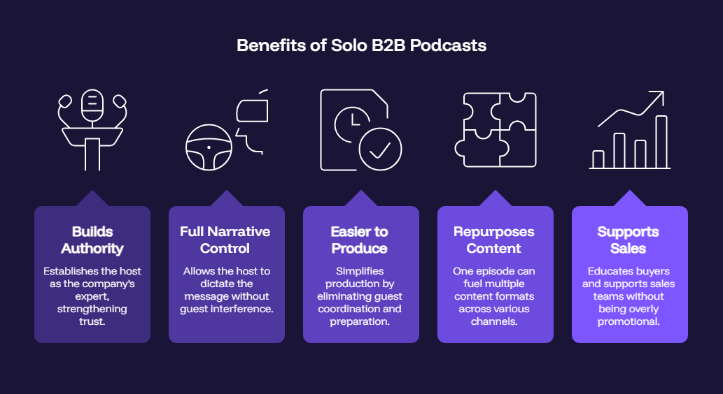
1. Builds Authority Around One Clear Voice
With a solo podcast, the host becomes the face of the company's expertise. This works well for founders, consultants, executives, operators, and niche subject-matter experts who have a unique perspective to share.
Over time, listeners begin to associate the host with specific ideas, frameworks, and solutions, strengthening trust and credibility.
2. Gives the Brand Full Narrative Control
Interview podcasts are mostly shaped by the quality and direction of the guest conversation. A solo show gives the host complete control over the message.
There are no guest detours, no conflicting viewpoints to navigate, and no dependence on outside contributors. Every episode can reinforce the company's market position and point of view.
3. Easier to Produce Consistently
One of the biggest advantages of solo podcasting is simplicity.
There's no guest outreach, calendar coordination, or interview preparation. Hosts can batch-record podcast episodes, plan topics in advance, and publish on a schedule they control.
4. Turns Internal Expertise Into External Content
A single episode can fuel an entire content strategy. One recording can become:
LinkedIn posts
Short video clips
Newsletter content
Blog articles
Sales enablement assets
Executive thought leadership posts
Social media content
Instead of creating every asset from scratch, you can repurpose one idea across multiple channels.
5. Supports Sales Without Sounding Like a Sales Pitch
The best B2B podcasts educate rather than sell.
Solo episodes can answer common buyer questions and explain complex topics in ways that help prospects make better decisions. Sales teams can also share relevant episodes before or after meetings to support client communication and keep conversations moving forward.
The trend toward solo podcasting is only accelerating. According to The Podcast Host's Independent Podcaster Report 2025, 53% of pre-launch podcasters plan to launch a solo show, which makes it the most popular format among new creators. The same report found that promoting a brand or business is now one of the primary reasons people start podcasts.
For B2B organizations, a solo podcast is one of the most effective ways to consistently publish expertise-driven content without the scheduling and production challenges that often come with guest-based shows.
When a Solo Podcast Is the Right Fit for B2B
A solo podcast can be highly effective, but only when it aligns with your company's goals, audience, and available resources. Before choosing the format, it's worth evaluating whether a solo-host approach matches what you're trying to accomplish.
A Solo Podcast Is a Good Fit When:
You have a strong internal expert who can consistently create content. The host doesn't need to be a professional broadcaster, but they should have valuable insights and a clear perspective to share.
Your audience wants education and analysis. Solo shows work best when listeners are looking for industry expertise or practical insights.
You need a more efficient production model. Without guest outreach, scheduling, and interview preparation, solo podcasting offers a simpler path to consistent publishing.
The podcast supports a broader business objective. Whether the goal is content marketing, demand generation, sales enablement, executive visibility, or Business Development, a solo format can help reinforce those efforts.
You have a clearly defined audience and topic. The most successful solo podcasts serve a specific listener and focus on a well-defined subject area.
A Solo Podcast May Not Be the Right Fit When:
The host doesn't have time to prepare. Even conversational episodes require research, planning, and thoughtful execution.
The topic depends on outside perspectives. If the audience expects diverse viewpoints, interviews may be a better fit.
Building relationships with guests is a primary goal. Interview podcasts are often better suited for partnership building and industry outreach.
Leadership expects immediate audience growth. Like most content channels, podcasting requires consistency and patience before results compound.
Success will be measured only by downloads. Many B2B podcasts generate value through trust, client communication, sales conversations, and brand awareness rather than large audience numbers alone.
Ultimately, a solo podcast works best when you have a knowledgeable host, a clear audience, and a long-term commitment to sharing useful insights. When these pieces are in place, the format can become a highly scalable thought leadership asset.
The Unique Challenges of Running a Solo Podcast
A solo podcast offers more control and flexibility than many other formats, but it also puts more responsibility on the host. Without guests or co-hosts contributing ideas and energy, the host becomes the primary driver of the show's quality and consistency.
Some unique challenges you’ll run into as a solo podcaster are:
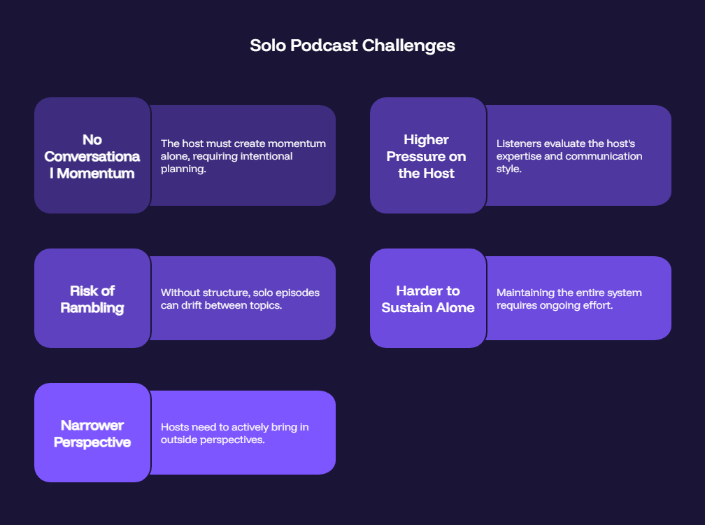
No Conversational Momentum
Interviews and co-hosted podcasts benefit from natural back-and-forth discussion. Questions lead to stories, stories lead to insights, and the conversation creates its own rhythm.
In a solo podcast, the host has to create that momentum alone. And maintaining constant energy and engagement requires more intentional planning and delivery.
Higher Pressure on the Host
Listeners are evaluating the host's expertise, perspective, communication style, and credibility throughout every episode. Without another voice to balance the conversation, the host carries the full responsibility for delivering value, which can amount to a lot of pressure on one person.
Risk of Rambling
One of the fastest ways to lose listeners is to cover too many ideas at once.
Without a clear structure, solo episodes can drift between topics and become difficult to follow. The most effective solo podcasts are built around one central idea and a handful of supporting points that reinforce the main takeaway.
Harder to Sustain Alone
One of the biggest challenges of solo podcasting is maintaining the entire system around the show over time.
Topic planning, outlining, recording, editing, publishing, promotion, and performance tracking all require ongoing effort.
In fact, according to the Independent Podcaster Report 2025, 52% of active independent podcasters handle every aspect of production themselves. Among creators who have considered quitting, the most common reasons include struggling to grow an audience (30%), lack of time (25%), and burnout (22%).
For solo hosts, these pressures can accumulate quickly when one person is responsible for the entire operation.
Narrower Perspective
Guests naturally introduce new experiences, opinions, and examples. Solo hosts don't have that advantage.
To keep episodes fresh, hosts need to actively bring in outside perspectives through research, customer conversations, industry trends, market observations, and real-world examples. Otherwise, even a knowledgeable expert can start to sound repetitive over time.
The good news is that these challenges are predictable. With the right preparation and workflow, most of them can be addressed before they become problems.
How to Build a Solo B2B Podcast That Works
The strongest solo podcasts are built around a clear business objective and a defined audience. Plus, they use a repeatable process that makes publishing sustainable over the long term.
Below, we have shared a step-by-step process for building a solo B2B podcast that feels focused, sustainable, and worth coming back to.
1. Define the Business Job of the Show
Before you choose topics or hit record, decide what role your podcast will play for the business.
Your goals might include:
Supporting sales conversations
Educating the market
Increasing executive visibility
Supporting category creation
Nurturing prospects throughout the buying journey
A podcast that tries to do everything usually does very little well. In our daily practice at Content Allies, we have noticed that the clearer the objective, the easier it becomes to make smart decisions about the show’s topics, format, promotion, and success metrics.
2. Define the Listener Precisely
Many B2B podcasts fail because they're built for everyone. Instead of targeting "business leaders" or "B2B buyers," define a specific audience.
Use the questions below to build a clear listener profile:
| Audience factor | Example |
|---|---|
| Role | VP of Marketing |
| Industry | B2B SaaS |
| Company size | 100 to 500 employees |
| Current challenge | Proving marketing ROI while scaling pipeline |
| Knowledge level | Experienced marketer looking for practical strategies |
| Topics they want to learn about | Attribution, AI workflows, demand generation, pipeline reporting |
| Questions they want answered | How do I measure campaign impact? Which channels deserve more investment? |
Remember: the more specific your audience, the easier it becomes to choose topics, examples, and calls to action that feel relevant. Your ideal listener should be able to read an episode title and immediately know the content is meant for them.
3. Choose a Sharp Show Premise
Your premise is the promise behind the podcast. It tells listeners what they will get from the show and why it is worth adding to their rotation.
A strong premise should answer:
What specific problem does the show help listeners solve?
What kind of insight will each episode deliver?
What point of view makes the show different?
Why should someone subscribe instead of reading or watching similar content elsewhere?
For example, “marketing advice for B2B companies” is too broad. A sharper premise would be, “weekly teardown episodes that help B2B SaaS marketers improve pipeline quality without increasing ad spend.”
A focused premise makes it easier to plan episodes, write stronger titles, and promote the show with a clear reason to listen.
4. Build Around a Clear Point of View
Information alone rarely creates a compelling solo podcast. Listeners can find facts, news, and best practices almost anywhere. What they can't easily find is your interpretation of those ideas.
The most effective and memorable hosts share frameworks, lessons learned, observations, and informed opinions that help listeners think differently about a challenge. Rather than repeating conventional wisdom, they offer a perspective that makes the content uniquely valuable.
5. Create Repeatable Episode Formats
We have learned that recurring formats reduce planning time and make the show easier for listeners to follow. Instead of starting from scratch every week, you can build episodes around a few reliable structures.
| Episode format | Best used for |
|---|---|
| One big idea | Explaining one clear insight, trend, or strategic shift |
| Buyer question breakdown | Answering sales questions your prospects ask repeatedly |
| Market commentary | Sharing your perspective on industry news, platform changes, or market developments |
| Tactical playbook | Walking listeners through a practical process they can apply |
| Myth vs. reality | Challenging common beliefs or misconceptions in your industry |
| Case-based lesson | Turning a client story, internal lesson, or public example into practical takeaways |
| Framework episode | Teaching a repeatable model or decision-making framework |
| Mistake diagnosis | Explaining common mistakes and how to avoid them |
| Strategy teardown | Analyzing a campaign, business strategy, or real-world example to uncover key lessons |
Pro tip: You do not need every format. Most strong solo podcasts rely on two or three repeatable structures that match the audience, the host’s expertise, and the business goal behind the show.
6. Use a Simple Episode Structure
Most strong solo episodes follow a clear flow. This keeps the episode focused and makes it easier for listeners to stay with you.
Start with a hook that introduces the problem, tension, or question. Then add context, so listeners understand why the topic matters now.
From there, move into the core idea and support it with three to five key insights. Use a real-world example to make the point easier to understand, then close with a practical takeaway listeners can apply.
At the end, include a soft CTA that points listeners to a relevant resource, related episode, newsletter, consultation, or next step.
A simple structure helps you avoid rambling. It also makes each episode easier to plan, record, edit, and repurpose into other content.
7. Use an Outline Rather Than A Full Script
We have noticed that most hosts sound better when they work from an outline rather than a word-for-word script.
You can use bullet points to organize key ideas, examples, and transitions. Some hosts also script their introduction and conclusion.
The goal is to create enough structure to stay focused without turning the episode into a speech.
8. Keep the Setup Lean
You don't need a professional studio to launch a successful solo podcast. Start with the essentials:
A quality microphone
Headphones
A quiet recording environment
Reliable recording software
A simple video setup if content clips are part of the strategy
Focus on clear audio and a distraction-free environment before investing in more advanced equipment.
If you're looking for a practical walkthrough of equipment and workflow recommendations, this video provides a useful overview for new solo hosts:
9. Build a Sustainable Workflow
The best solo podcasts operate from a documented process rather than improvisation. A typical workflow includes:
Topic planning
Episode outlining
Recording
Editing
Show notes
Publishing
Promotion
Performance review
When every episode follows the same process, it becomes easier to maintain momentum and improve over time.
10. Get Help Where It Makes Sense
You do not have to handle every part of the podcast yourself. Your primary job is to share expertise and deliver valuable content. Tasks such as editing, publishing, writing show notes, creating social clips, repurposing episodes into blog content, distributing the show, and reporting on performance can be handled by a production partner or your internal team.
This gives you more time to focus on preparing strong episodes while keeping the podcast consistent behind the scenes.
Principles of a Successful Solo B2B Podcast
Once the foundation of the show is in place, long-term success comes down to how the host approaches the podcast. The strongest solo shows are built around a repeatable set of principles that keep episodes valuable and relevant over time.
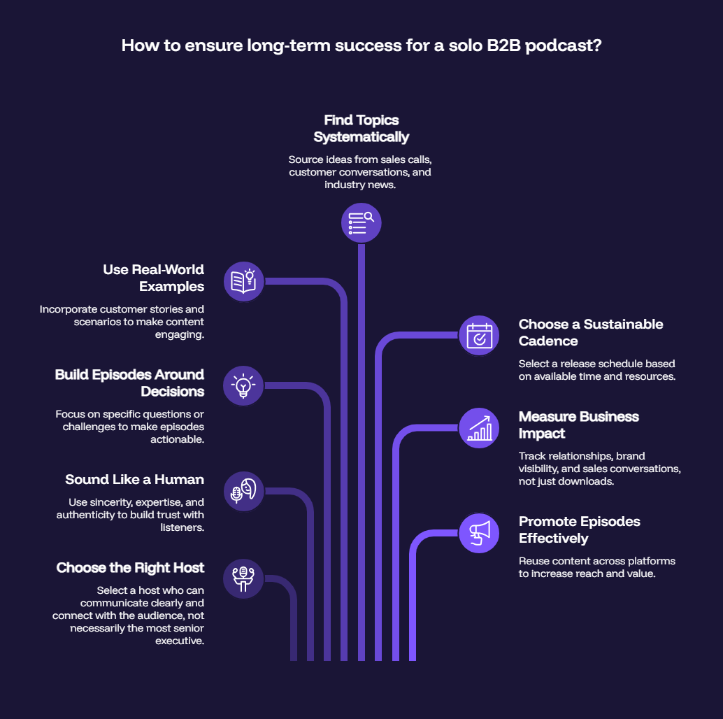
Put the Right Person Behind the Microphone
Many companies automatically give the podcast to the most senior executive, but that’s mostly a mistake.
The best host is the person who can consistently communicate ideas, explain complex topics clearly, and connect with the audience. In some organizations, that's the founder. In others, it may be a consultant, operator, subject-matter expert, or practice management advisor with deep industry knowledge.
Sound Like a Human
Listeners want expertise. The most effective solo hosts sound like they're talking to a smart client, colleague, or peer. Research on podcast host-listener relationships suggests that sincerity, expertise, transparency, and authenticity help build trust over time. The host's personality is often one of the show's greatest assets.
Build Episodes Around Decisions
Instead of creating an episode about "content marketing" or "cyber security," focus on a specific question, choice, or challenge your audience is facing. Episodes built around decisions tend to be more actionable and easier for listeners to apply.
Use Real-World Examples
Whether you're discussing legal tech, public relations, Business Development, or client communication, examples help listeners understand how ideas work in practice. Customer stories, market observations, implementation lessons, and real-world scenarios make episodes more engaging and memorable.
Build a System for Finding Topics
Great podcast ideas are usually hiding in plain sight. Create a running topic bank sourced from:
Sales calls
Customer conversations
LinkedIn discussions
Webinar questions
Internal subject-matter experts
Industry news
Competitor messaging
If the same question keeps coming up, it probably deserves an episode.
Choose a Cadence Based on Capacity
A sustainable bi-weekly podcast is often more valuable than a weekly show that becomes difficult to maintain. Choose a cadence based on the time and resources available to the host and their team.
Measure Business Impact As Well As Downloads
Downloads are only one measure of success. Many solo B2B podcasts generate value through stronger relationships, improved brand visibility, sales conversations, pipeline influence, and audience trust. Looking only at download numbers can cause teams to overlook the broader business impact of the show.
Getting Your Solo Podcast Heard
Producing a great solo podcast is only half the challenge. Distribution is what turns episodes into business results.
A single episode can become LinkedIn posts, short video clips, audiograms, newsletter content, blog articles from the transcript, and sales enablement assets. The more ways you reuse an episode, the more value you get from the time spent creating it.
That's why promotion matters as much as production in B2B podcasting. A great episode that nobody sees won't generate awareness, trust, or pipeline.
At Content Allies, podcast promotion is a core part of our process. We help clients repurpose and distribute episodes so every recording reaches a wider audience.
Build a High-Impact Solo Podcast with Content Allies
A solo podcast is one of the most effective thought leadership assets a B2B company can own. It gives you a platform to share expertise, educate buyers, and build trust around a consistent point of view.
But the format succeeds or fails based on one thing: the host's ability to show up consistently with valuable content.
That's where a production partner can help.
Content Allies helps B2B companies produce, repurpose, and promote podcasts without adding more work to their internal teams.
Request a solo podcast strategy review to identify the right format, topics, production workflow, and promotion plan for your show.
FAQs
How do I measure whether my solo B2B podcast is actually generating business results?
Don't judge success by downloads alone. Track sales conversations influenced, inbound leads, newsletter signups, and campaign performance across LinkedIn, email, and other channels to understand how your podcast contributes to business growth.
Should a solo B2B podcast be audio-only, or do I need video for it to perform?
Audio is enough to build a successful show, but recording video gives a content creator more assets for social media. Whatever format you choose, minimizing background noise is more important than having an expensive studio.
How long does it typically take for a solo show to build a meaningful audience?
Most solo B2B podcasts need 6 to 12 months of consistent publishing before audience growth accelerates. Business owners should focus on serving a specific audience rather than chasing rapid download growth.
What's a realistic time commitment per episode if I'm hosting solo?
Planning, recording, and reviewing a 20-30 minute episode typically takes 2-4 hours. If you're also editing, publishing, promoting, and managing intellectual property for the content, the total can easily reach 6-10 hours per episode.
Does Content Allies help produce solo-host shows, or only interview-format podcasts?
Yes. Our experts at Content Allies help you produce solo-host podcasts, interview shows, and Dual Voices formats. We also help you choose the format that best fits your business goals, audience, and content strategy.
How does Content Allies promote a solo podcast once the episodes are produced?
We turn each episode into multiple content assets, including blog posts, video clips, audiograms, newsletter features, and social media content. This helps every recording reach a larger audience instead of living only in podcast apps.
Appendix
- Pew Research Center — A Profile of the Top-Ranked Podcasts in the U.S. (2023)
- Jason Cercone — 5 MORE Tips For Effective Solo Podcasting (May 25, 2025)
- The Podcast Host / Alitu — Independent Podcaster Report 2025 (Solo Podcasting)
- Alitu — The Independent Podcaster Report 2025
- ResearchGate — Aural Parasocial Relations: Host–Listener Relationships in Podcasts
- Riverside — The Best Podcast Setup and Workflow For Solo Podcasts (YouTube)