
Podcast Description Examples: 10 B2B Templates That Convert
A podcast description is one of the few pieces of copy that determines whether a casual browser becomes a listener. For B2B brands competing for the attention of busy decision-makers, it can make the difference between a download and a scroll past.
Still, many podcasters spend hours on content creation and podcast production, then write their description as an afterthought. That's a mistake. Your description tells your listeners who the show is for, what they'll learn, and whether it's worth their time.
The data support this. In The Podcast Host's 2024 Podcast Discovery Survey of 166 listeners, podcast descriptions scored 3.7 out of 5 as a factor in deciding whether to listen, ranking ahead of episode titles (3.0), release frequency (2.8), and ratings and reviews (2.4).
In this guide, you'll learn what to include in a podcast description, get a template you can adapt today, and see 10 podcast description examples from successful B2B shows.
What Is a Podcast Description and Why Does It Matter?
A podcast description is the short piece of copy that explains what your show is about, who it is for, and why someone should listen.
Before someone listens to an episode, follows your show, or visits your website, they'll usually read a few lines of text that explain what your podcast is about. Those few lines help listeners decide whether your show is relevant to them or whether they should keep scrolling.
This matters in B2B marketing, where you are trying to reach busy executives and decision-makers. According to a LinkedIn study, 44% of C-suite executives, VPs, and department heads who are familiar with podcasts listen to them. When those listeners discover your show on Apple Podcasts, Spotify, Pocket Casts, or YouTube Podcasts, your description helps them quickly determine whether your content is worth their time.
At its core, a podcast description answers four questions:
Who is this show for?
What topics does it cover?
Why should I listen?
What will I gain from it?
A strong description helps the right people self-identify as your audience and gives them a reason to hit play.
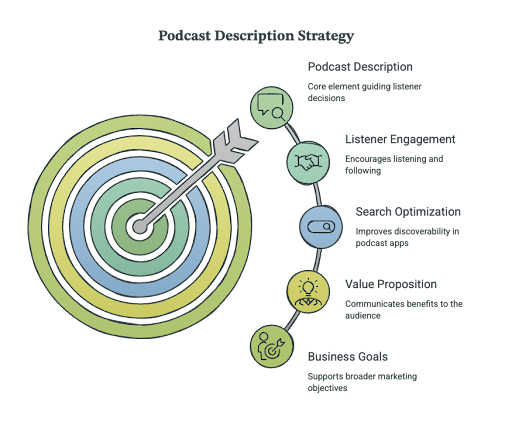
It also plays an important role in podcast search optimization. Keywords in your description can help podcast apps and search engines better understand your show, which improves discoverability for topics related to your niche, customer profile, and industry expertise.
For B2B brands, the best podcast descriptions communicate a clear value proposition, establish credibility, and support broader goals like thought leadership, brand authority, demand generation, and lead generation.
A good podcast description is a conversion asset. Every new listener will see it before they decide whether your show deserves their attention.
Is a Podcast Description the Same as Show Notes?
No. A podcast description and show notes serve different purposes, even though they're commonly confused.
A podcast description is about the entire show. It lives in your podcast host, whether that's Buzzsprout, Transistor, Captivate, or Libsyn, and is distributed everywhere your RSS feed appears. Most listeners encounter it when they first discover your podcast, so its job is to explain who the show is for and why someone should subscribe.
Show notes (sometimes called episode descriptions) are about one specific episode. They change every time you publish a new episode and typically include the guest's name, key topics, resources, timestamps, links, and calls to action.
Consider it this way: your podcast description sells the show, and your show notes support the episode.
| Factors | Podcast Description | Show Notes / Episode Description |
|---|---|---|
| Scope | The whole show | One specific episode |
| Audience | New listeners deciding to follow | Mostly existing listeners |
| Updated | Rarely (when positioning shifts) | Every episode |
| Length Norms | 120-170 words is common | Anywhere from 100 to 1,000+ words |
| Primary Job | Filter and convert browsers | Drive deeper engagement and SEO |
Both are important, but they work at different stages of the buyer journey. Your podcast description helps attract and convert new podcast listeners, while your show notes help existing listeners engage more deeply with individual episodes, guests, and topics.
You can see our guide to writing great show notes here.
Where Should You Share Your Podcast Description?
You should share your podcast description wherever your show is introduced to someone for the first time.
By default, your description is distributed through your RSS feed and appears across major podcast directories, including:
Apple Podcasts
Spotify
YouTube Podcasts and YouTube Music
Amazon Music
Pocket Casts
Overcast
Castbox
Castro
Player FM
Pandora
Most other podcast apps and directories
This matters because discovery increasingly starts inside podcast apps. According to The Podcast Discovery Survey we shared above, 50% of listeners begin their search for a new podcast by opening their preferred podcast app, and 70% of those users search by topic.
Your show descriptions help platforms understand what your show is about and when it should appear in those searches.
Beyond podcast directories, you should also reuse your description in places you control:
Your podcast website or landing page
Your company's website
Your LinkedIn company page
The host's LinkedIn Featured section
Guest one-sheets and outreach materials
Email signatures and newsletter footers
Sales enablement materials
Your YouTube channel's About section
Conference speaker bios
Two placements are mostly underused.
First, sponsor and guest pitch decks. A strong description quickly explains your audience, positioning, and value proposition without requiring additional context.
Second, your episode pages. Adding a short "About the Show" section pulled from your description helps visitors understand the broader podcast if they land on an individual episode through search, social media, or a shared link.
The simplest rule is that if someone can discover your podcast there, your description should be there too.
The more consistently your positioning appears across channels, the easier it becomes for the right audience to recognize your show and understand why it deserves their attention.
How Long Should a Podcast Description Be?
The reality is nuanced and depends heavily on the platform you use. Technically, Apple Podcasts allows descriptions up to 4,000 characters, and RSS feeds don't impose a meaningful limit. In theory, you could write several pages of text.
In practice, most listeners will never see more than the first sentence or two.
Most podcast apps display only the beginning of a description before requiring users to tap "see more." That means the opening lines carry disproportionate weight. If your audience, value proposition, or differentiator doesn't appear early, many listeners may never see it.
For most B2B podcasts, we recommend a three-layer approach:
Layer 1: The Hook (First 120-150 characters)
This is the most important part of your description. Clearly identify the audience and the promise.
Example:
A podcast for B2B marketing leaders looking to generate more pipeline and build category authority.
Layer 2: The Expanded Pitch (Next 300-500 characters)
Add context around the host, format, topics, notable guests, or release cadence. This is where listeners learn what makes your show different from dozens of similar options.
Layer 3: Search and Context (Final 200–400 characters)
Use relevant industry terms, topics, and keywords naturally. Include a subtle call to action if appropriate.
For example, a B2B podcast might mention topics like demand generation, content marketing, customer success, sales enablement, or thought leadership. This helps both listeners and podcast platforms better understand the show's focus.
For most B2B shows, our expert at Content Allies recommends a total length of 700-1,200 characters, or roughly 120-200 words.
That's long enough to communicate your positioning, establish credibility, and support discoverability, while remaining concise enough to keep attention.
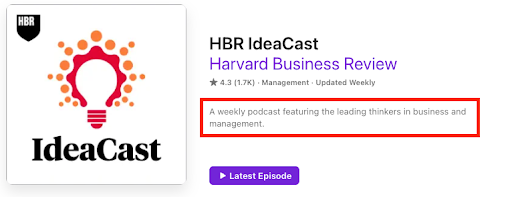
However, there are exceptions. Established brands with significant recognition can sometimes get away with extremely short descriptions. HBR IdeaCast, for example, uses just a single sentence because the Harvard Business Review brand already carries substantial authority.
For most companies, though, your podcast description needs to do more of the selling. It's worth using the space you have.
What to Include in Your Podcast Description
A good podcast description is a concise pitch that helps the right people decide whether your show is worth their time.
As Matthew McLean puts it:
"Writing a good podcast description or summary is like writing a blurb for a book. You want to sell the show to your potential listeners and encourage them to give you a shot."
Here's what that blurb should include:
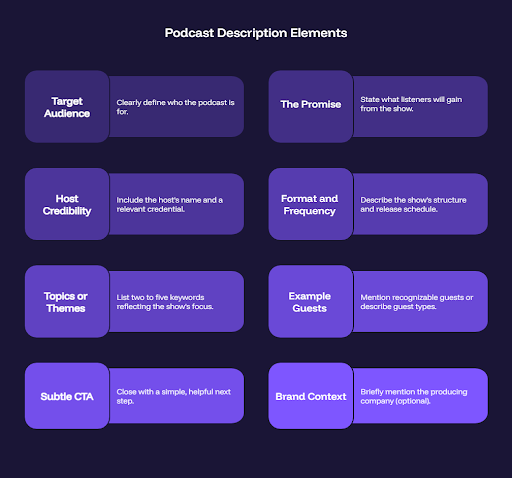
1. Who the Show Is For
Start with the audience, not yourself. The best podcast descriptions make the right listener feel immediately recognized.
Instead of:
A podcast about B2B marketing.
Try:
For B2B marketing leaders who want to generate more pipeline and improve campaign performance.
The more specific you are, the easier it is for your ideal audience to self-identify.
2. The Promise
Once you've identified the audience, tell them what they'll gain. Focus on outcomes rather than vague benefits. Concrete promises outperform clever ones.
Instead of:
Insights to level up your sales game.
Try:
Tactical strategies for landing enterprise accounts and shortening the sales cycle.
Listeners should quickly understand what they'll learn, achieve, or become by following the show.
3. Host Name and Credibility Marker
Include the host's name and one credential that matters. You don’t need a full biography or a career history, just enough context to answer, "Why should I listen to this person?"
For example:
Hosted by Ryan Dull of SageMark HR.
Or:
Hosted by former HubSpot executive Jane Smith.
One strong credibility marker is usually enough.
4. Format and Frequency
Tell people what they're signing up for. Is the show interview-based? Solo? Narrative? A panel discussion? Is it weekly, biweekly, or daily?
A simple sentence removes uncertainty and helps set expectations.
5. Topics or Themes
This is where your keywords naturally belong. Include two to five topics that accurately reflect the show's focus. Consider the terms your audience might search for on Apple Podcasts, YouTube, or Google.
Examples might include:
ABM strategy
Demand generation
Customer success
Product marketing
Revenue operations
Don't force keywords into every sentence. Instead, weave them into a natural description of the show's content.
6. Example Guests or Guest Types
For B2B podcasts, this is your chance to establish credibility. If you've interviewed recognizable founders, executives, authors, or industry leaders, mention a few of them.
Even one or two names can help a potential listener understand the caliber of conversations they can expect. If you're early in your journey, describe the type of guests instead.
7. A Subtle CTA
Close with a simple next step. Examples include:
Subscribe wherever you get your podcasts.
Join the community at [website].
Get additional resources in our newsletter.
Keep it helpful rather than promotional.
8. Brand Context (Optional)
If your podcast is produced by a company, include a brief mention at the end. One sentence is usually enough.
This provides context without shifting the focus away from the listener. The show should always come before the brand.
What to Leave Out
A few things consistently weaken podcast descriptions:
"Welcome to the show!" introductions
Repeating the word "podcast" multiple times
The host's full biography
Long company descriptions
Generic phrases like "insightful conversations," "industry experts," or "diving deep"
If a phrase could describe thousands of other shows, it's probably not helping yours stand out.
The following YouTube video is a helpful breakdown of what to include in your podcast description:
Podcast Description Best Practices
Once you've covered the fundamentals, a few small optimizations can make your description work much harder.
Below, we have shared some best practices to help your podcast description attract more of the right listeners:
Treat your description as a living asset. The positioning that made sense at episode 5 may not reflect the show at episode 50. Revisit your description every 6 months, especially after major guest milestones, audience shifts, or changes in content strategy.
Include the host's name in the description itself. Don't rely solely on podcast metadata fields. Some podcast apps and directories have historically placed greater emphasis on description text when matching search queries.
Don't repeat your show title. The title is already displayed prominently above the description. Use that valuable space to communicate who the show is for and what listeners will gain.
Preview it on your phone before publishing. A description that looks great in your podcast host's dashboard can feel very different inside Apple Podcasts, Spotify, or Pocket Casts. Check the real user experience before you finalize it.
Do keyword research. Think about the terms your audience is actually searching for. Tools like Listen Notes, Rephonic, and Google Keyword Planner can help you identify relevant topics and phrases to incorporate naturally into your description.
Remember: none of these tactics will rescue a weak positioning statement. But once the foundation is solid, they can improve discoverability, clarity, and conversion.
10 B2B Podcast Description Examples + Template
The best podcast descriptions don't all follow the same formula. Some win with brevity, some rely on credibility and social proof, and others succeed because they speak directly to a specific audience and pain point.
To show the different approaches that work, we've grouped these examples into a few categories. As you read through them, pay attention to the underlying structure. The goal here is to identify the techniques you can adapt for your own show.
Short and Confident
Not every great podcast description needs to be long. Some of the most effective examples communicate a clear idea in a sentence, or even a few words.
The key is that every word has to earn its place.
1. Marketing Over Coffee: John Wall & Christopher Penn
Why It Works
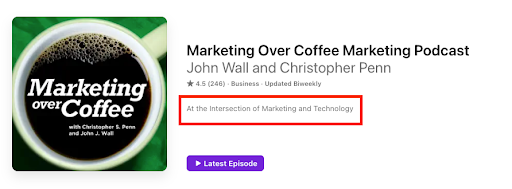
This description demonstrates the power of category ownership. In just five words, listeners understand exactly what topics the show covers.
Combined with the show's title, it creates a complete picture without requiring additional explanation. The wording is memorable, specific, and easy to repeat.
What B2B Podcasters Can Learn
If your show consistently sits at the intersection of two disciplines, industries, or functions, consider making that positioning central to your description. It helps listeners immediately understand your perspective and differentiates your show from broader competitors.
How to Make It Your Own
Template:
At the intersection of [topic] and [topic].
Short descriptions work best when they communicate a unique position rather than a generic topic.
2. HBR IdeaCast: Harvard Business Review
Why It Works
By most standards, this description is too short. Yet it works because Harvard Business Review has spent decades building trust and authority with its audience. The description doesn't need to explain the value proposition because the brand itself already does that work. Instead, it simply reinforces the type of expertise listeners can expect.
What B2B Podcasters Can Learn
Even if your company doesn't have HBR-level brand recognition, you can borrow the principle. Use your description to highlight the caliber of perspectives, guests, or expertise featured on the show.
How to Make It Your Own
Template:
A [cadence] podcast featuring [expert type] sharing insights on [industry, discipline, or topic].
Most brands need more context than HBR provides, but the focus on expertise is worth copying.
Authority and Credibility Flex
These descriptions use host credentials, guest names, and brand reputation to establish credibility quickly and reassure listeners that the insights will be worth their time.

3. Masters of Scale with Reid Hoffman and Others
Why It Works
This description combines a clear value proposition with an exceptionally strong credibility signal.
By naming Reid Hoffman and including his LinkedIn and Greylock credentials, the show instantly borrows authority from one of the most respected figures in technology and venture capital. The description also expands the audience by framing the journey from early-stage ideas to global scale, making the content relevant to founders at different stages of growth.
What B2B Podcasters Can Learn
If your host has a credential that carries weight with your audience, include it directly in the description. One strong credibility marker can be more effective than a long biography. The goal is to quickly answer the question, "Why should I trust this person?"
How to Make It Your Own
Template:
Conversations with [guest type] sharing [lessons, strategies, or insights] to help [target audience] achieve [outcome]. Hosted by [host name], [most relevant credential], the show explores [key topics] across every stage of [industry or journey].
A single credibility marker can dramatically increase trust when it's relevant to the audience you're trying to reach.
4. The Twenty Minute VC (20VC) with Harry Stebbings
Why It Works
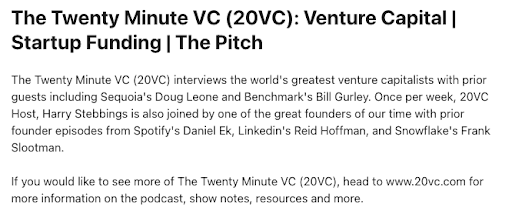
This description relies heavily on social proof. Within a few seconds, listeners see some of the most recognizable names in venture capital, technology, and startups. Rather than claiming the show is influential, the description lets the guest list make that argument on its behalf.
What B2B Podcasters Can Learn
If you've hosted genuinely notable guests, don't hide them. Naming a few recognizable people is far more persuasive than broad phrases like "industry leaders" or "top executives." Specific names help potential listeners quickly understand the caliber of conversations they can expect.
How to Make It Your Own
Template:
Conversations with [guest type], featuring guests such as [recognizable guest], [recognizable guest], and [recognizable guest], sharing insights on [topic or industry].
When you've earned credibility through guests, make it visible.
5. The Dave Gerhardt Show with Dave Gerhardt
Why It Works
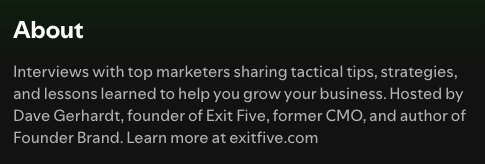
This description follows a simple but effective structure. First comes the audience benefit, then the host's credibility, and finally a call to action. Every sentence has a clear job, and none of the space is wasted.
What B2B Podcasters Can Learn
Notice how Dave's credentials are stacked in a highly digestible way: founder, former CMO, author. Readers can process that information almost instantly. If your host has multiple credibility signals, list them in order of relevance rather than turning them into a long paragraph.
How to Make It Your Own
Template:
Conversations with [guest type] sharing [insights, tactics, or lessons] to help you [achieve a specific outcome]. Hosted by [name], [most relevant credential], [second credential], and [third credential].
Strong descriptions separate credibility into simple, scannable chunks.
Audience-Led Specificity
The strongest podcast descriptions start with the listener rather than the host. These examples clearly define who the show is for and what outcomes the audience can expect, which makes it easy for the right people to self-identify.
6. Lenny's Podcast with Lenny Rachitsky
Why It Works
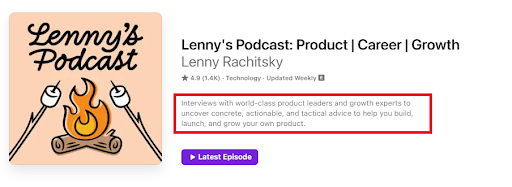
The Lenny’s Podcast description does three things in a single sentence. It establishes credibility through the guests, sets expectations with words like "concrete, actionable, and tactical," and focuses on outcomes with the verbs "build, launch, and grow."
The result is a description that feels practical and clear.
What B2B Podcasters Can Learn
Stack three concrete verbs that describe what your listener will do after listening. Aspirational, specific, and tactical is a powerful combination.
The verbs should reflect your audience's actual goals over generic business outcomes. A sales leader wants to close, expand, and retain. A marketer wants to attract, convert, and nurture. The more closely your verbs match a listener's day-to-day priorities, the more compelling your description becomes.
How to Make It Your Own
Template:
For [audience], featuring conversations with [guest type] sharing [adjective], [adjective], and [adjective] insights to help you [verb], [verb], and [verb].
The best descriptions focus on concrete outcomes. Instead of describing your show, describe what listeners will be able to achieve after they listen.
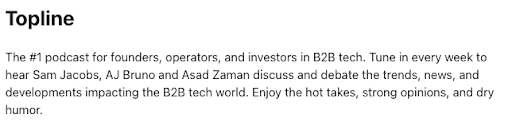
7. Topline with Sam Jacobs, AJ Bruno & Asad Zaman
Why It Works
Topline immediately identifies its audience of founders, operators, and investors in B2B tech. There's no ambiguity about who should listen. The description then strengthens that positioning by highlighting the hosts, the content format, and even the tone of the conversations.
What B2B Podcasters Can Learn
Most podcast descriptions focus on topics but ignore personality. Topline uses phrases like "hot takes, strong opinions, and dry humor" to filter for the right listeners and repel the wrong ones. The more competitive your category, the more important it becomes to communicate your perspective.
How to Make It Your Own
Template:
The podcast for [audience] who want [outcome]. Join [host(s)] as they discuss [topics] with [tone or perspective].
Your content attracts listeners, but it’s your personality that keeps them coming back.
Content Allies Client Examples
These examples come from shows we've helped launch and grow. While each serves a different audience, they all prioritize audience clarity, business outcomes, and strong positioning over generic marketing language.
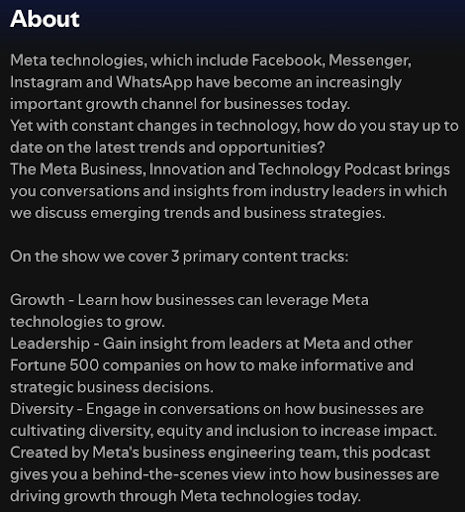
8. Meta Business, Innovation and Technology Podcast by Meta
Why It Works
This description opens with a problem the target audience immediately recognizes: keeping up with technological change. It then organizes the show's value around three clearly defined themes: Growth, Leadership, and Diversity, which gives listeners an easy mental model for understanding the content.
What B2B Podcasters Can Learn
If your show covers multiple topics, group them into a few core pillars. This creates clarity for listeners and helps your team maintain a consistent editorial direction. Categories feel more intentional than scattered lists.
How to Make It Your Own
Template:
Facing [challenge]? Join [host/company] as they explore [pillar 1], [pillar 2], and [pillar 3] through conversations with [guest types].
Clear content pillars help listeners understand your show before they hear a single episode.
Disclosure: Content Allies served as the consulting and production partner for this show. We handled strategy, production, guest scheduling, and multichannel promotion.
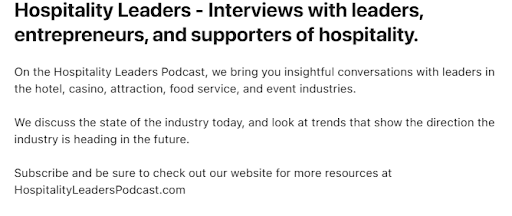
9. Hospitality Leaders: Hospitality Leaders Podcast
Why It Works
This description succeeds because it focuses on a clearly defined professional audience. Rather than trying to appeal to everyone in hospitality, it speaks directly to leaders responsible for growth, operations, and guest experience. That specificity makes the show more compelling to the people it wants to reach.
What B2B Podcasters Can Learn
The narrower your audience definition, the easier it becomes to communicate value. Most B2B podcasts suffer from being too broad. A strong description should make some people think, "This isn't for me."
How to Make It Your Own
Template:
On [show name], we bring you conversations with [audience type] in [sector 1], [sector 2], [sector 3], and [sector 4]. We discuss [current topic] and look at [future trend or direction].
The goal is to specifically attract the right people.
Disclosure: We served as a production and growth partner for this show. See the full case study here.
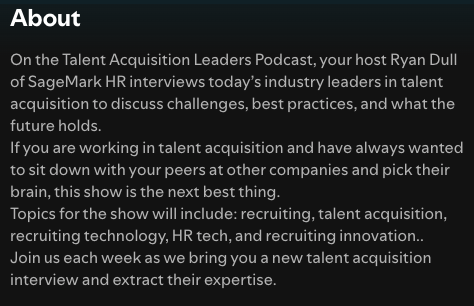
10. Talent Acquisition Leaders with Ryan Dull
Why It Works
This description is highly audience-driven. It identifies a specific professional function and builds the entire show around the challenges, priorities, and goals of that audience. Listeners don't have to guess whether the content is relevant to them.
What B2B Podcasters Can Learn
Many companies define their audience by industry, but a more effective approach is to define it by role. Job titles frequently create stronger identification than company categories because they map directly to day-to-day responsibilities.
How to Make It Your Own
Template:
On [show name], [host name] interviews [guest type] in [industry or function] to discuss [challenge], [best practices], and [future topic]. Join us [cadence] for conversations on [topic 1], [topic 2], and [topic 3].
A listener should be able to recognize themselves in the first sentence.
Disclosure: Content Allies partnered on strategy, production, and growth for this show. Here’s the full case study and what we helped Ryan achieve.
How Content Allies Helps B2B Podcasts Grow
Your podcast description is one of the highest-impact pieces of copy associated with your show. In just a few sentences, it helps potential listeners decide whether your content is relevant, credible, and worth their time.
As we've seen across these 10 examples, the most effective descriptions follow a few consistent patterns. They lead with the audience, communicate a clear outcome, establish credibility through the host, guests, or brand, and close with a simple next step.
Most importantly, they make that value clear immediately. The first 120-150 characters mostly do the majority of the work because that's all many listeners will see before deciding whether to tap "see more."
If you're launching a B2B podcast or looking to improve the performance of an existing one, Content Allies helps companies develop podcast strategies that attract the right audience, build thought leadership, and generate measurable business results.
Get in touch to learn how we can help you grow your show.
FAQs
Can I change my podcast description after publishing?
Yes. You can update your podcast description at any time through your podcast hosting platform. Once updated, the new version will typically sync automatically to Apple Podcasts, Spotify, YouTube Music, and other podcast directories, although update times vary by platform.
Should my website and podcast descriptions match?
Mostly, yes. Your podcast directory description should remain the source of truth, but your website can expand on it with additional details, links, and SEO-focused content. The core positioning and messaging should stay consistent across both.
Can I write a description before launching my podcast?
Absolutely. In fact, you should. A strong description helps shape your positioning before launch and gives potential listeners a reason to subscribe from day one. Focus on the audience, topics, and outcomes the show will deliver.
Do podcast descriptions help with search rankings?
Yes. Podcast descriptions help platforms understand what your show covers and can influence discoverability in podcast app searches. They're not the only ranking factor, but relevant keywords and clear topic signals can improve visibility.
Does Content Allies write podcast descriptions?
Yes. Podcast description development is typically included as part of our podcast strategy and launch process. We help clients define their audience, positioning, messaging, and discoverability strategy before a show goes live.
Can Content Allies improve an existing podcast description?
Yes. We frequently audit and rewrite podcast descriptions for existing shows. In many cases, small changes to positioning, audience clarity, and messaging can make a significant difference in listener conversion.
What matters more: descriptions or show notes?
Both matter, but they serve different purposes. Podcast descriptions help convert new listeners at the show level, while episode-level show notes support discoverability, engagement, and SEO for individual episodes. The strongest podcast strategies invest in both.