
How to Make Your B2B Podcasts Crush It on YouTube
B2B podcasts can be gold for demand generation, but too often they languish on audio‑only platforms, unseen by the broader audiences who search for solutions on video.
We believe there’s a better way.
At Content Allies, we’ve helped several teams turn their audio shows into powerful B2B podcasts on YouTube. Our clients’ podcasts have reached decision‑makers, boosted engagement, and accelerated buyer interest.
With roughly 2.7 billion monthly active users globally, YouTube is now the second‑largest media platform worldwide, and its scale alone makes it a must for any video podcast production strategy.
In this article, we’ll walk you through our proven framework for optimizing B2B podcast content on YouTube, from titles, chapters, and thumbnails to retention triggers, packaging, and analytics, so your next episode gets seen, heard, and acted on.
Let’s dive in.
Why YouTube Is a Growth Engine for B2B Podcasts
First, let’s take a closer look at why YouTube is such an effective channel for your B2B podcast. There are several big reasons for this.
YouTube Is a High-Intent Discovery Channel
Your buyers are on YouTube, searching for answers to real business problems. Unlike Apple Podcasts or Spotify, YouTube functions as a true search engine. That means your podcast content, when packaged right, can rank for niche, intent-driven queries, and get discovered through intentional search behavior.
We’ve seen this firsthand. In the case of Tonkean, for example, we built their podcast content strategy around clear buyer pain points and decision‑driver language, which helped position them as a legitimate enterprise company.
Here’s one poignant example (look at their title):

The results were impressive: unique listeners increased by 174.36% in just three months and the podcast became category leader in just six months.
YouTube Videos Build More Trust in B2B
Seeing the guest and host onscreen adds another layer of credibility that audio-only content just can’t match. For complex topics like B2B sales strategies, demand generation, or even generative AI, video helps make abstract ideas feel more tangible and human.
As such, podcasts are great for brand activation and increasing your marketing ROI.
You Can Access Analytics That Improve Your B2B Podcast Content Strategy on YouTube
YouTube provides performance insights you just don’t get from traditional podcast platforms. Watch time, retention rate, and click-through rate (CTR) all help you understand what’s resonating, where viewers drop off, and how to improve future episodes.
Backing the YouTube Podcast Trend with Market Data
Beyond our own experience, the broader B2B landscape validates the move to video. A 2025 survey shows that 89% of B2B marketers integrate video into their content marketing strategy.
That means if you’re not using video, especially via a discoverable, searchable platform like YouTube, you could be missing out on a large portion of your audience’s research and decision journey.
This clip dives into how brands can create a winning B2B podcast strategy on YouTube:
How to Adapt Your B2B Podcast for YouTube
Bringing your B2B podcast to YouTube means smartly adapting your content so it performs in a visual, search-driven environment. And the shift is well worth it.
What Video Formats Work Best for B2B Podcasts
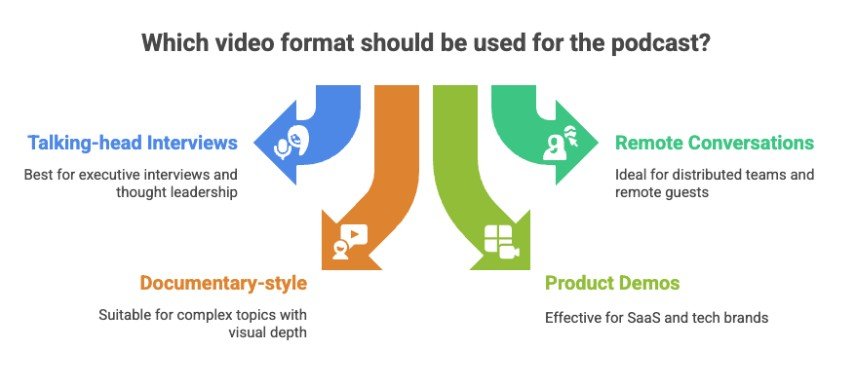
Depending on your podcast listeners, brand, and resources, different formats will make sense, and we’ve seen all of the following succeed with our clients:
Talking‑head studio interviews. This classic setup involved a host (and sometimes a guest) on camera in a simple, clean studio. They’re great for executive interviews, thought leadership, or deep-dive discussions.
Remote split‑screen conversations. Especially useful for distributed teams or when you have remote guests. Tools like Zoom, Riverside, or similar help you record, then you polish with custom branding in post. This gives you a good balance of convenience and professionalism.
Narrative/documentary‑style cutdowns. Best for bigger topics like market shifts, industry trends, case‑study storytelling, or topics like “digital sales transformation.” This works well if you want to mix interview clips with B‑roll, slides, graphics, or overlays, which gives you more visual depth that suits complex B2B themes.
Product demos or explainers embedded into episodes. This is particularly effective if you're a SaaS or tech brand. You can combine a conversational podcast with visual demos, screen shares, slides, or walk‑throughs to help buyers understand a product’s value concretely.
In our work, we match format to clients’ brand voices. More formal clients gravitate toward studio interviews, while tech-savvy startups often lean on remote calls with branded overlays.
Filming and Production Basics: Don’t Overthink It, But Nail the Essentials
You don’t need a Hollywood‑level setup to make YouTube work. You do, however, want to meet a baseline of quality so the video doesn’t distract from the content. Here’s what we always recommend:
Clean, consistent lighting. Lighting can make or break viewer perception. Good lighting keeps faces clear, avoids harsh shadows, and gives a polished, credible look.
1080p minimum resolution. Full HD (1920×1080) is the baseline. Lower resolutions tend to look amateur and might frustrate viewers (especially those watching on larger screens or mobile devices in high‑quality mode).
Crisp audio. Visuals matter, but bad audio is a guaranteed way to lose viewers. Clear, high‑quality audio (good mic, proper mixing) often matters more than perfect video, especially for conversational content.
We sometimes provide clients with a simple “starter kit checklist”: camera (can be as basic as a good webcam or entry-level DSLR), lighting (soft LED panel or ring light), and a decent mic plus a quiet space. That’s enough to look professional without blowing the budget.
Building a Consistent Visual Brand on YouTube
If you want to treat your show like a proper B2B marketing asset, visual consistency matters. Here’s what we advise:
Branded intros/outros. A short branded intro (this could be as simple as a logo, music, and subtitle) helps set the tone and signals professionalism. Outros give you space for CTAs, next‑episode teasers, or “subscribe” prompts.
Lower‑thirds/on‑screen graphics. Display names, titles, companies, or key takeaways. This all helps make interviews clearer, especially for viewers who skip around or come in mid‑way.
Consistent color palette, typography, and overlays. Using the same font, colors, and graphic style episode after episode builds brand recall and helps your content feel unified and trustworthy.
Thumbnail template/style. Once you nail a thumbnail look that works (clean, readable, and brand-consistent), reuse that template for each episode. This helps with recognizability and professionalism.
We used this approach with our client Meta to make each episode look intentional, cohesive, and on‑brand.
As a side note, their results proved that our approach worked: Meta achieved ~170,000 downloads in the first 6 months of working together.
We built a full visual identity system for the show: color palette, typography, graphic shapes, and on-screen elements that matched Meta’s established brand guidelines. Every episode used the same palette of deep blues and neutrals, the same clean sans-serif typography, and the same geometric accents, so viewers immediately recognized the show no matter where they saw it: YouTube, LinkedIn, internal decks, or repurposed clips.

We also built an audio identity to match. Each episode opens with the same short sound cue, a soft bell-like sequence that acts as a branded audio signature. It’s subtle but it matters: when an audience hears the same intro sound over and over, your podcast begins to feel like a polished, cohesive production rather than a string of disconnected videos.
YouTube SEO Strategies for B2B Podcast Growth
To make your B2B podcast succeed on YouTube, you need to think like a search engine. That means using smart SEO practices so buyers searching for industry solutions, thought‑leadership, or insights can actually find your show.
Below, we share our go‑to methods for titles, descriptions, metadata, and visuals that help push B2B podcast episodes into front‑of‑search results and in front of decision‑makers.
How to Write Search-Driven B2B Podcast Titles That Attract Buyers
Your title is the #1 ranking factor on YouTube, and it sets the tone for the viewer’s click decision.
Lead with the problem or benefit. Titles like “How to Scale Enterprise Sales Without Burning Cash” beat “Episode 7 – Interview with Jane Doe.”
Front-load your keywords. YouTube gives more weight to words at the beginning of your title.
Keep it clear and under 55 characters. This helps make sure it doesn’t get cut off in search and displays well on mobile.
Avoid filler like episode numbers or generic phrases, unless your brand is already highly recognizable
At Content Allies, we build podcast titles around the question: “What would the buyer search for when they have this pain point?”
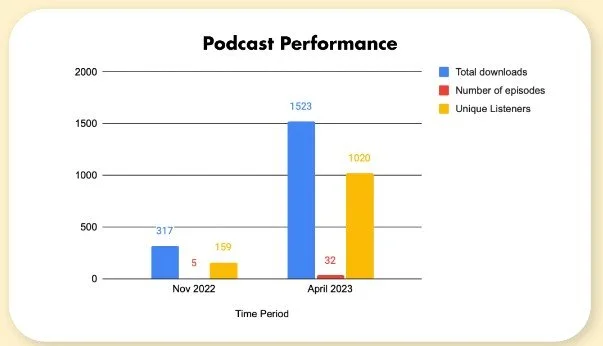
Our client MSH offers a good example of picking the correct titles according to search intent and audience interests:

Tactics like these helped them increase downloads and unique listeners considerably:
Use Descriptions and Chapters to Rank Your B2B Podcast for Niche Queries
YouTube descriptions are indexable by both YouTube and Google, which means they’re critical for long-tail SEO. A recent SEO study by Adilo found that top-ranking videos had, on average, 222 words in their descriptions.
Write like you’re optimizing a blog post. Include keywords naturally, especially industry-specific phrases and decision-maker pain points. Also, try to cover all parts of the sales funnel.
Use clear headers and bullet points for readability.
Add a short guest or company bio if relevant to high-intent searches (especially for notable executives or SaaS brands).
Include chapters with timestamps and keyword-driven titles, e.g., 12:15 – How to Align Sales & Customer Success. This boosts scanability and ranking.
This approach helps B2B podcast episodes show up not just for brand searches, but for searches like “how to improve SaaS onboarding” or “AI in enterprise workflow automation.”
Take this example from our client Upshift. As a side note, they managed to turn almost 50% of their podcast interviews into meaningful business conversations.
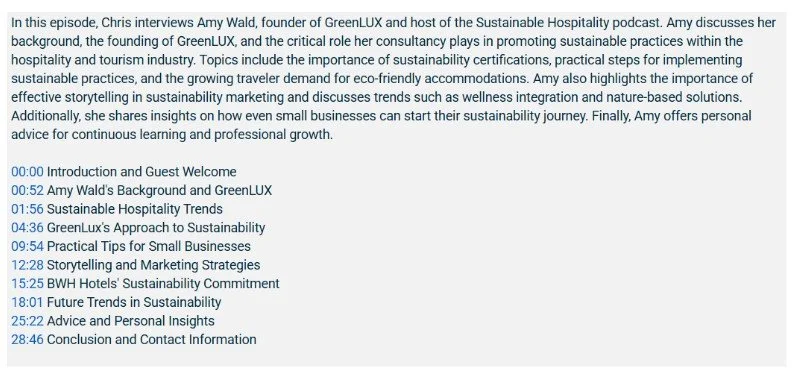
Anyway, this description works for YouTube because it tells viewers exactly what they’ll get. Besides, the clear summary gives YouTube plenty of context to understand the topic, which helps the video show up in the right searches.
Also, the timestamps boost watch-time because people can skim and dive straight into sections that interest them. All of this signals to YouTube that the video is valuable and worth recommending.
Optimize Tags, Playlists, and Internal Linking to Boost Discoverability
YouTube’s metadata system extends beyond titles and descriptions, and the most successful channels use all the tools available.
Tags help YouTube understand the context of your video. Use 7–15 per episode, mixing broad and specific terms (e.g., B2B sales, enterprise SaaS, lead conversion frameworks).
Playlists act like topic hubs. Group episodes around themes like “B2B Marketing Strategy,” “Revenue Growth Frameworks,” or “Customer Success Stories.”
Use cards and end screens to promote related episodes, as this keeps users on your channel and improves session time
Link to your best content in descriptions, particularly other high-performing or evergreen episodes
This strategy is especially effective for B2B teams with multiple personas or product lines. Playlists and links help guide viewers down tailored content paths.
YouTube Thumbnail Techniques That Improve Click-Through Rates
Your thumbnail is your first impression. High-ranking videos overwhelmingly used custom thumbnails with strong contrast, legible text, and consistent branding. Following these best practices can increase your click-through rates by up to 40%, according to some sources.
Here’s what we advise:
Use a clean facial expression (either host or guest). Faces create human connection and increase CTR.
Add 3-5 bold, high-contrast words summarizing the value prop, e.g., “Fix Your Funnel,” or “Stop Churn Fast.”
Use a consistent layout across episodes with the same color palette, logo placement, and typography
Avoid overloading with text or visual clutter. The best thumbnails are scannable even on mobile.
The Knowledge Project Podcast offers a great example, featuring its guests prominently. The red on white contrast is also striking, while the thumbnail titles can raise your curiosity with definitive statements like “Hard work isn’t enough” or “Why everyone is wrong about AI (including you).”
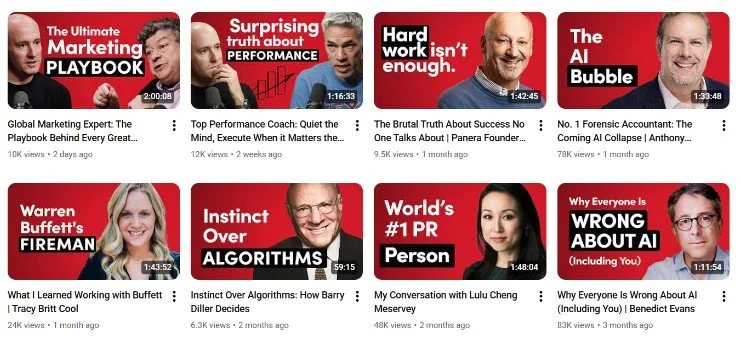
At Content Allies, we build thumbnail templates for every client, so visual identity compounds over time, and each new episode reinforces brand recognition.
How to Turn YouTube Viewers Into B2B Leads
Once you’ve got people watching your B2B podcasts on YouTube, the next step is to convert some of that audience into real leads. Here’s how we recommend doing that by combining good content practices with a lead‑gen strategy that works.
Insert High‑Converting CTAs Naturally
To capture leads, you need clear, relevant calls‑to‑action (CTAs) that don’t feel salesy but that invite next steps:
Place soft, value‑forward CTAs during the video or at the end. For example, “Download our free B2B marketing checklist,” “Book a demo,” or “Get the full framework via link below.”
Use built-in tools like cards and end‑screens to guide interested viewers to your website, landing page, or gated download.
In the description, repeat the CTA with a trackable link (UTM parameters, landing pages, or lead magnets) so you can attribute leads back to the video. This is especially important for B2B pipelines.
Content should solve a problem and offer a clear next step for interested viewers.
Use Descriptions Like Mini Landing Pages
Your video description is like a mini landing page to amplify credibility and guide action:
Include a short, tight summary of the video’s value, key insights, or takeaways (great for decision‑makers who skim)
Add context: guest bios, company names, and relevant credentials to build credibility if you’re targeting enterprise clients or sophisticated buyers
Offer social proof or downloadable assets: e.g. ,“See how we helped Company X increase conversion rate by 40%”. Or, link to case studies, whitepapers, or relevant resources
Embed a clear CTA link near the top of the description like “Download our B2B Lead Gen Guide → [link]” or “Book a 15‑min consult”. Make it easy for viewers to act without searching.
When you think of descriptions this way, you’re turning passive video content into an active lead‑capture asset.
Retarget Podcast Viewers Across Channels
Don’t count on a single view converting. Many B2B buyers take their time, revisit content, and consider before acting. That’s why retargeting can be powerful:
Use remarketing tools (via YouTube / Google Ads) to re‑engage viewers who watched (or completed) the podcast and direct them to landing pages, gated content, or a scheduler. This helps keep your brand top-of-mind.
Combine with social or display retargeting. For example, show ads on LinkedIn or Meta to people who watched your YouTube content but didn’t convert. This layered approach increases the chances that those viewers become leads.
Retargeting turns passive watchers into warm prospects over time, which often works better in B2B settings where decisions take longer and require multiple touches.
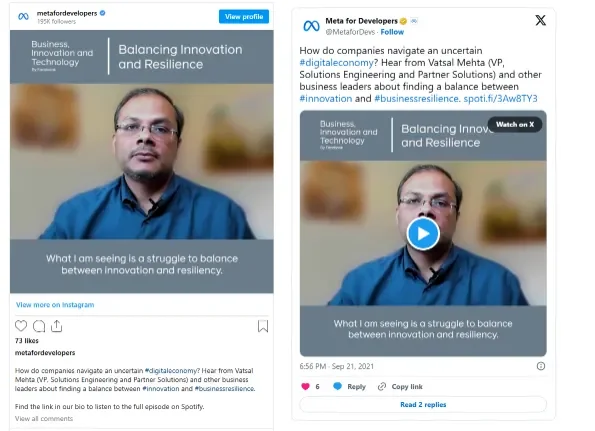
For Meta, for example, we created social posts like these:
Use YouTube Shorts for B2B Podcast Lead Generation
Short-form content can complement full-length podcasts, and in some cases, outperform them for lead generation and distribution.
Short-form videos (like YouTube Shorts) are rising fast: according to a 2024 study comparing Shorts vs regular videos, Shorts generally attract more views and get more likes per view, which can boost reach.
Shorts are perfect for sharing bold insights, quick tips, or teaser‑level value that prompts viewers to watch the full episode or click through to a resource. That makes them ideal for B2B marketing teams targeting busy professionals who may prefer quick, digestible content over long videos.
What Short‑form Clips Work Well for B2B Podcasts
When you repurpose full episodes into Shorts or produce standalone clips, these are the formats that tend to work:
Bold insight snippets: quick, strong statements about strategy, ROI, or market shifts that grab attention
Framework breakdowns summarize complex ideas (like “3 steps to scale enterprise sales”) in concise bullet form, which appeals to busy execs
Myth‑busting or counterintuitive takes: challenge assumptions in your industry; this often generates curiosity and shares
Visual walkthroughs or quick demos: especially for SaaS or tech, showing a feature or process in motion can drive interest faster than words alone
Short-form clips give you multiple touchpoints with your audience. Some will watch full episodes while others will engage through quick shorts. Mixing it up increases your overall reach, lead potential, and brand exposure.

How to Build a Scalable YouTube Distribution Workflow
Success with podcasting on YouTube involves building a repeatable, scalable workflow. That means thinking ahead about cadence, repurposing, and distribution across platforms so each episode works harder for you.
Recommended Upload Cadence for Consistent Growth
Maintaining a regular upload schedule helps build trust, both with your audience and with YouTube’s algorithm. Data shows that channels publishing 12 or more times a month tend to receive 53% more views and 66% more subscribers compared to less frequent posting.
What we recommend for B2B podcasts:
Start with one high‑quality long‑form podcast video per week. This gives your team time to film, edit, add chapters/metadata, and ensure quality.
Once that cadence is stable, consider layering in additional formats (clips, shorts, etc.) to expand reach without overburdening your production schedule
The goal isn’t volume, it’s consistency and quality. A predictable schedule helps set audience expectations and signals reliability to the algorithm.
How to Repurpose Each Episode Into Multiple Formats
Publishing a single long-form video doesn’t have to be the end of its lifecycle. A smart repurposing strategy can multiply reach and ROI. Here’s a workflow many of our clients follow:
Full episode: Publish the full-length version (e.g., 30–60 min) on YouTube as the “hub.”
3–7 clips: Extract key segments or highlights .(e.g., insights, soundbites, takeaways) to use as shorter videos or promo material
Shorts: Convert selected clips into vertical, short-form content to drive discovery and appeal to audiences who prefer quick bites.
Community posts / social content: Use quotes, summaries, or hooks from the episode to create LinkedIn /X / social media posts, embed video in blog posts, or share in newsletters.
Repurposing helps you squeeze more mileage out of each episode, reach different audience types, and maximize the value of the original production.
Combine YouTube and LinkedIn for Maximum Reach
For B2B content, combining long-form video on YouTube with narrative-driven, bite-sized content on a professional network (like LinkedIn) can be powerful:
Use YouTube for in-depth discussions, thought‑leadership, technical explanations, and interviews. Full episodes give space for nuance, depth, and detailed insight.
Use LinkedIn to share short clips, key takeaways, quotes, or mini‑case studies. This is perfect for decision‑makers who browse LinkedIn casually or want quick, digestible ideas before committing to a full video.
This combo helps you meet potential buyers where they already are: YouTube for research/ learning, LinkedIn for professional context, network effects, and visibility among peers and stakeholders.
Over time, this kind of cross‑platform workflow builds a sustainable content engine.
Common Mistakes B2B Podcasts Make on YouTube
Even solid podcasts can struggle on YouTube. YouTube has its own rules, user behaviors, and algorithmic quirks, and B2B podcast teams that overlook these end up missing growth opportunities. Here are the most common mistakes we see (and help clients avoid).
Treating YouTube Like a File Dump
Just uploading your podcast to YouTube as a backup or extra channel doesn’t work. YouTube favors intentional content that’s been structured for the platform, with searchable titles, good visuals, engagement triggers, and consistency. Treat it like its own product.
Uploading Audio‑Only Episodes
This is a big one: YouTube is a visual platform. Uploading an audio‑only episode with a static image dramatically reduces retention and engagement. If you’re investing in YouTube at all, go with real video, as even a basic webcam setup can outperform static content.
Weak or Inconsistent Thumbnails
Your thumbnail is your first impression. If it’s low‑effort, off‑brand, or inconsistent with your past episodes, viewers are less likely to click. You want clear, consistent thumbnails with readable text, human faces, and brand identity. Think of it like the cover art for your content library: it should build recognition and trust over time.
Titles Focused on the Guest Instead of the Topic
“Episode 11 – Jane Doe, VP at SaaSCo” means nothing to a cold viewer. Your titles should highlight what the episode teaches or solves, instead of just who’s talking. We recommend leading with problems, solutions, or insights: e.g., “How to Fix B2B Lead Flow Without Burning Budget.”
No Clips Strategy
One of the best ways to get YouTube traction, especially for B2B, is with 3-5 minute clips that hit on specific pain points. But too many teams upload a single long-form episode and stop there. With a clips strategy, you create more entry points into your content and improve search reach, session time, and watch‑through rates.
No Visual Identity
If every episode looks totally different in terms of fonts, colors, layout, lower‑thirds, or lighting, it’s harder to build brand memory. Your visual identity on YouTube should feel unified and professional. That means intros, thumbnails, layouts, and motion graphics that repeat across episodes. That consistency builds trust and helps your show stand out in a crowded feed.
Build a Winning YouTube Strategy with Content Allies
YouTube is one of the most powerful discovery engines for long-form business content today, and it’s going nowhere. But success doesn’t come from uploading and hoping for the best. It takes intentional titles, SEO-smart formatting, retention-focused editing, and consistent repurposing to truly grow reach and generate real business outcomes.
We’ve helped companies like Meta, Gusto, and Tonkean use this exact approach to turn their B2B podcasts into high-performing YouTube engines by expanding their reach, improving engagement, and driving real revenue opportunities from their content.
If you want to make your B2B podcast really work on YouTube, get in touch with us today and we’ll create the right strategy for your needs.
FAQ
What makes B2B podcasts different from B2C when publishing on YouTube?
B2B podcasts usually target niche, professional audiences, so they rely more on educational depth, credibility, and long-tail discoverability than viral entertainment.
How long should a B2B podcast video be on YouTube?
Anywhere from 20 to 60 minutes for full episodes, depending on your content. What's more important is clarity, structure, and giving viewers a reason to stick around.
Are chapters really necessary for B2B podcast episodes?
Yes, they help viewers skip to what they care about and boost your video’s visibility in both YouTube and Google search.
What’s the ideal thumbnail style for a B2B audience, corporate or casual?
Keep it clean, consistent, and clear. Faces, bold text, and brand colors generally work better than stiff corporate templates or clever visuals.
How often should we repurpose clips from a full podcast episode?
Every episode should give you 3-7 clips minimum, short-form and mid-form, to fuel social, Shorts, newsletters, and beyond.
Which analytics metric matters most for podcast growth on YouTube?
Retention and average view duration tell you how well your content is performing and directly impact how often YouTube recommends your videos.
How can Content Allies help my team optimize B2B podcast videos for YouTube?
We build end-to-end YouTube strategies, from SEO-driven titles and thumbnail design to full editing, chaptering, and platform-native optimization.
Can Content Allies assist with clip repurposing and multi‑platform distribution?
Absolutely. We turn every episode into a mix of long-form, clips, Shorts, and LinkedIn-native assets. Our clients regularly get 5-10x reach from the same source content.
Does Content Allies offer ongoing analytics review and performance optimization?
Yes. We track performance metrics like retention, CTR, and engagement, then use those insights to continuously refine your content strategy over time.