
The Ultimate Podcast Launch Checklist for 2026 [+ FREE In-House Templates]
![The Ultimate Podcast Launch Checklist for 2026 [+ FREE In-House Templates]](https://images.squarespace-cdn.com/content/v1/5be23aae8f5130842228b758/d0cc7c1e-20a8-4231-8c22-0e31bbfdebd3/CONALL-Article+thumbnails+%281%29.png)
Launching a podcast for B2B brands is not a side project anymore.
It sits alongside webinars, events, and flagship content as a channel that can move pipeline, deepen relationships, and shape how your market sees you.
Here’s the thing.
The difference between a show that quietly fizzles out and one that earns trust, listens, and leads usually comes down to how well the launch is planned.
We see this every day.
When our teams help launch shows like CRE Exchange, Talent Acquisition Leaders Podcast, or Meta Business Podcast, the public feed is only the visible tip of a much larger system.
Behind the scenes, we have a clear purpose, aligned stakeholders, technical readiness, and a promotion plan that treats the first episodes like a campaign, not a random drop.
This guide gives you that system in checklist form.
We built this Podcast Checklist for marketing and communications leaders who need their show to serve real business goals. You can use it to brief executives, coordinate with legal and compliance, align your content team, and pressure-test whether to build in-house or partner with an agency like Content Allies.
Work through each phase, tick off the items, and you will have the foundations of a professional-grade podcast launch you can defend in any leadership meeting.
Next, we will walk step by step through each phase of the launch: strategy, technical setup, content, marketing, and post-launch optimization.
Download the full checklist below.
Phase 1: Pre-Launch Strategy & Planning
Before we touch a mic, we want to be crystal clear on why the show exists, who it serves, and how we will measure success. This is where we avoid “random act of content” syndrome and give leadership confidence that the podcast fits into our broader marketing and comms plan.
1. Define Your Podcast Goals
Most successful B2B shows have a primary job: account-based marketing, category education, internal storytelling, or executive thought leadership. For example, the CRE Exchange Podcast by the Altus Group leans into executive thought leadership, while the Talent Acquisition Leaders Podcast supports account-based marketing for Sagemark HR and secured 9 new clients in its first year.
Checklist: Podcast Goals
Choose 1–2 primary goals
Brand authority in our niche
Demand generation / pipeline influence
Account-based marketing for target accounts
Internal communications and culture
Map the podcast to existing campaigns or initiatives
Write a simple goal statement:
“We will use this podcast to [goal] for [audience] so that [business outcome].”
2. Identify Your Target Audience And Listener Persona
You are not speaking to “everyone who might care about our industry.” You are speaking to a specific person with a specific job, pressure, and commute pattern.
Think of something as concrete as: “Amira, VP of Operations at a 500-person manufacturing company, who listens on her 30-minute commute and wants practical stories from peers.”
Checklist: Listener Persona
Define role and seniority (e.g. VP Marketing, Director of Ops, Founder)
Define company profile (industry, size, region)
List 3–5 core pains they are trying to solve
Capture when and where they listen (commute, gym, lunch walk)
Write a 3–4 sentence persona story we can share with stakeholders
3. Decide On Podcast Format
Format should serve your goals and resources. Interview shows like The Data Cloud Podcast (Snowflake) and The McKinsey Podcast work well for expert positioning. Narrative or panel formats can work for complex internal comms or multi-voiced stories, but they are heavier to produce.
Common B2B formats we recommend:
Interview: Host plus one guest per podcast episode
Co-hosted conversation: Two internal hosts each episode
Roundtable: Host plus 2–3 guests, often topic-driven
Narrative / documentary: Scripted with clips and voiceover
Checklist: Format Decisions
Choose primary format (interview, roundtable, narrative, hybrid)
Decide episode length target (e.g. 20–30 minutes)
Decide publishing cadence (weekly, biweekly, monthly)
Decide on remote vs in-person recording
4. Develop Your Content Theme Or Editorial Angle
We want a clear promise that distinguishes us from generic “industry chat.” Manufacturing Happy Hour, for example, clearly frames each episode as “the podcast where we talk leadership and careers in manufacturing while keeping it real.”
Your show needs a similar editorial spine.
Checklist: Editorial Angle
Choose a central theme (e.g. “AI in HR operations,” “SaaS renewals strategy,” “Modern supply chain leadership”)
List 5–10 recurring topics that fit that theme
Define 1–2 recurring segments we can reuse (e.g. “Playbook Breakdown,” “Revenue Moment,” “Failure Story”)
Write a one-sentence show promise:
“This is the podcast where [audience] learns how to [outcome] through [angle].”
5. Get Internal Buy-In From Executives, Legal, And Marketing
In B2B, you are rarely launching this alone. You may need approvals from brand, legal, compliance, and the executive team. You want to align expectations early so nobody is surprised by topics, guest choices, or publishing cadence later.
Stakeholder Alignment Checklist
Identify key stakeholders (CMO, Head of Comms, Legal, Sales, Product)
Share a 1-page brief with:
Goals and audience
Format and episode cadence
Example episode titles
High-level risk boundaries (topics to avoid, approval steps)
Decide who owns:
Final sign-off on podcast episodes
Guest approvals
Budget and vendor relationships
Confirm how we will report back success (cadence, metrics, formats)
6. Set Realistic KPIs For Launch
You don’t need Joe Rogan numbers to call a B2B podcast launch a success. It’s less about raw downloads and more about reaching the right people, especially those in target accounts.
Still, it helps to know what “good” looks like. According to Buzzsprout:
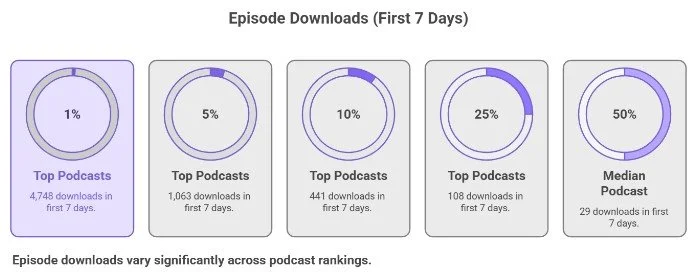
If you get 29+ downloads in the first week, you’re already in the top 50% of all podcasts.
Break 108 and you’re in the top 25%.
Hit 441 and that’s top 10%.
Over 1,063 means you’ve cracked the top 5%.
And if you somehow cross 4,748 in week one, welcome to the top 1%.
Examples Of Launch KPIs
Reach and engagement
Total downloads in first 90 days
Average listens per episode
Completion rate per episode
Audience quality
Percentage of listeners from target countries or industries
Number of target accounts that listen or engage
Business impact
Number of sourced or influenced opportunities tied to podcast touchpoints
Number of guests turning into partners, customers, or advocates
Checklist: KPI Setup
Choose 3–5 primary KPIs for the first 90 days
Document realistic targets for each KPI
Decide where we will track them (hosting analytics, CRM, attribution tools)
Create a simple reporting template we can reuse after launch
Phase 2: Technical Setup & Workflow Foundation
Once your strategy is clear, you need a technical setup that feels boringly reliable. The goal here is simple: remove tech stress so you can focus on great conversations.
When we launch shows for clients at Content Allies, we keep the stack as simple as possible and standardize the workflow from day one.
1. Choose Your Recording And Production Stack
You do not need a studio to sound professional. You do need a consistent setup your team and guests can use without friction.
Example Recording Stack
When we work with B2B brands, we often recommend:
A browser-based studio like Riverside for remote interviews
Good USB mics for hosts
A clear decision on whether you need video for LinkedIn and YouTube clips
Checklist: Recording Stack
Choose your primary recording platform
Decide if you record audio only or audio plus video
Select microphones for hosts and key spokespeople
Decide if you will ship mics to executives or remote leaders
Choose who owns editing and mixing
Internal podcast editors
Freelancer
Agency partner such as Content Allies
2. Set Up Your Podcast Host And RSS Infrastructure
Your podcast host is the hub that stores episodes, generates your RSS feed, and connects your show to listening apps. When we launch client shows, we choose hosts with clean analytics and straightforward distribution.
Side note: Speaking of analytics, check out the Top B2B Podcast Analytics Platforms for Measuring Enterprise ROI to get the best data.
Checklist: Hosting And Distribution
Choose a podcast hosting platform that fits your size and reporting needs
Create your show in the host with:
Show title and subtitle
Show description that reflects your promise and ideal listener
Author name and brand
Contact email for platforms and listeners
Upload logo and cover art that meet platform specs
Configure categories and tags so you appear in relevant sections
Generate your RSS feed URL and save it in a central document
Submit your show to:
Apple Podcasts
Spotify
YouTube Music or your YouTube channel
Any niche apps your audience uses
Confirm the show appears correctly in at least two apps before launch
3. Create A Clear Folder Structure And Naming Convention
Future you will appreciate a tidy structure. Clean organization makes collaboration and handoff much easier for marketers, editors, and agencies.
Example Folder Structure
/Podcast/
/01 Admin/ (briefs, strategy docs, templates)
/02 Brand Assets/ (logo, cover art, intros, music, lower thirds)
/03 Episodes/
/EP001_GuestName_Topic/
EP001_Raw_Host.wav
EP001_Raw_Guest.wav
EP001_Video_Host.mp4
EP001_Video_Guest.mp4
EP001_Edit_v1.wav
EP001_Final_Master.wav
EP001_ShowNotes.docx
Curious how we did this? We followed this:
Checklist: File Management
Create a root podcast folder with clear subfolders
Standardize episode folder naming (for example: EP###_Guest_Topic)
Standardize file names for raw audio, video, and final masters
Decide where you store everything (Drive, SharePoint, Notion, project tool)
Document your structure in a short “How we organize the podcast” guide
4. Standardize Host And Guest Recording Environments
Listeners forgive occasional imperfections caused by video podcast equipment. However, they disengage from consistently noisy, echoey audio. You can protect their experience with a simple environment checklist.
Host Recording Checklist
Record in a quiet, low echo room
Avoid big glass walls and open office spaces
Use an external microphone with a pop filter if possible
Wear headphones to prevent echo and feedback
Close unnecessary apps and browser tabs
Use a wired connection where you can or record near your router
Guest Tech Checklist
You can send this as a one-page prep guide before every interview.
Ask guests to join from a quiet room, not a car or open workspace
Share simple mic recommendations if they have options
Encourage headphones or earbuds
Ask them to pause Wi-Fi heavy tasks during recording
Provide clear joining instructions and a test link for your platform
Pro tip: When we host senior executives or customers for clients, we always send this type of checklist. It protects their personal brand and yours.
5. Build Your Editing And Post-Production Workflow
You do not need cinematic sound design. You do need a consistent standard so every episode feels intentional and on brand.
Checklist: Editing Standards
Decide your editing style
Light cleanup for a natural, conversational feel
Tighter edit for a concise, “no fluff” tone
Create or commission:
Intro music and a short spoken intro
Outro script with a clear call to action
Any sponsor or internal promo spots you will use
Standardize your episode structure:
Optional cold open or strong hook
Intro
Main conversation
Summary and call to action
Set baseline audio targets
Consistent loudness level across episodes
Removal of major background noise and distractions
Use an editing checklist for every episode:
Sync and trim recordings
Remove long tangents and obvious stumbles
Insert intro, outro, and promos
Export final master in the correct format and upload to your host
If you partner with Content Allies, this editing checklist becomes your shared quality standard so episodes feel consistent even as your team changes.
6. Plan For Backups And Contingencies
Tech will fail at some point. The shows that keep momentum treat backup plans as part of the system, not a last-minute scramble.
Checklist: Backups And Failsafes
Enable local recording in your chosen platform when possible
Set up a backup option such as Zoom if your primary studio has issues
Keep a spare microphone at your office for last-minute recordings
Add a 10 minute buffer to every recording block for tech checks
Write a short “If something breaks” guide for your team
Pro tip: When we plan recordings for clients with hard-to-book executives, we always schedule that buffer and test backup paths ahead of time.
7. Document Everything In A Simple Podcast Playbook
You want this podcast to run like a repeatable system, not a heroic effort from one person. A short internal playbook keeps everyone aligned.
Checklist: Podcast Playbook
Document all tools and key links (host, recording platform, shared folders, templates)
Map each step from “episode idea” to “published and promoted”
Assign an owner for every step (marketing, executive assistant, editor, agency partner)
Store the playbook where your team naturally works
Plan to update this playbook after your first three to five episodes
Phase 3: Content Creation & Guest Planning
At this point, you know what the show is for and you have the tech foundation. Now you need launch-ready content: a clear guest strategy, an initial episode slate, and simple scripts that keep conversations sharp without feeling stiff.
When we build enterprise shows, we front-load this phase so launch week feels calm.
1. Build Your Initial Episode Slate
You want more than a single “pilot.” A strong launch gives new listeners a small library they can binge, plus a clear roadmap of what is coming next.
Checklist: Launch Episode Plan
Decide how many episodes you will launch with (ideally 3–5)
Map each launch episode to a core theme or pain point for your ideal listener
Plan 8–12 additional topics for your first quarter of publishing
Mix show formats where it makes sense
A few expert interviews
1–2 customer or partner stories
Possibly one narrative or case-study style deep dive
Store these in a simple content calendar so guests, hosts, and stakeholders can see what is coming
When we script launch slates for clients, we usually start with: “one episode that explains the problem space,” “one customer or partner story,” and “one very tactical ‘how we did X’ episode” to cover awareness, credibility, and practical value from day one.
2. Design Your Guest Strategy For Launch And Beyond
Your guest list is a relationship and pipeline decision. Guests can be future customers, partners, or connectors.
Pro tip: We wrote a separate piece on how to build long-term relationships with them.
Checklist: Guest Targeting
Define 3 priority guest types:
Target buyers and strategic accounts
Partners, investors, or ecosystem players
Industry influencers and practitioners your audience trusts
Build a “Dream 50” guest list mapped to key accounts
Log basic guest data in your CRM or a simple database:
Name and role
Company and ideal-fit notes
LinkedIn URL
Account tier or priority level
Treat the invite as a relationship opener, not a pitch
Decide who is responsible for outreach (host, AE, founder, marketing)
You can go further by planning follow-up formats from day one: future roundtables that bring multiple guests back, co-authored blog posts, or research reports that weave guest insights together.
3. Create Episode Briefs For Each Launch Episode
Before you ever hit “record,” you should have a simple episode brief that clarifies the goal, audience, and structure. This is where you keep things strategic and avoid meandering conversations.
Checklist: Episode Brief Essentials
For each launch episode, capture:
Episode goal
Build authority on a specific topic
Nurture a specific account or segment
Support a product, initiative, or campaign
Ideal listener for this episode (a slice of your main persona)
Guest background and why they are the right person
3–5 key segments or topic blocks with lead questions
Backup questions you can use if conversation stalls
Any sensitive topics to avoid or handle carefully
The primary call to action you want listeners to take
When we build briefs for clients, we treat them as conversation maps, not word-for-word scripts. They keep the host grounded while leaving room for genuine moments.
4. Match Script Depth To Episode Type
Not every episode needs the same level of scripting. A simple expert interview might only need a bullet outline, while a narrative docu-style episode needs a full script with transitions and cues.
Script Depth By Episode Type
contentallies.com
Checklist: Script Format Decisions
Choose a default script format for your core episode style
Use bullet outlines for most interviews to keep things natural
Reserve full scripts for narrative or highly produced episodes
For panels, create a simple rundown with segments, speaker order, and timing notes
Document which script format you use for each launch episode
5. Write Hooks, Intros, And CTAs That Keep Listeners
Your script does not have to be a wall of text. It should focus on the moments that matter most for listener retention and conversion: hooks, intros, transitions, and calls to action.
Checklist: Hook And Intro
Open with a clear hook in the first 30–45 seconds
A bold claim
A surprising stat
A vivid one-liner from the guest
Quickly answer: “Why should your listener care right now?”
Introduce the guest with context, not just a bio
Tease 2–3 outcomes or insights the listener will get if they stay
For example, when we script intros for enterprise shows, we often use a hook + context + promise pattern: a strong quote or stat, one sentence on why this matters this quarter, and a clear preview of what the episode will unpack.
Checklist: Calls To Action
Script your primary CTA into the outro (for example: “Subscribe,” “Download the guide,” “Share with your team”)
Tie the CTA to the value of the episode, instead of asking something generic
If you include sponsor or internal promos, mark exactly where they sit in the episode
Pre-record sponsor reads or internal promos for consistency across episodes
6. Plan How You Will Leverage Each Guest Relationship
Your launch episodes give you a set of high-value guest relationships that you can turn into pipeline later. You can plan simple follow-up steps now so you are not improvising later.
Checklist: Post-Recording Guest Touchpoints
Send a personalized thank-you message when the episode goes live
Share ready-to-use assets: quote graphics, clips, or audiograms
Offer to support the guest (for example: “Is there anything I can help amplify?”)
Invite select guests to:
Future roundtables
Co-authored blog posts or case studies
Webinars or virtual events
Ask for a backlink from the guest’s company blog or newsroom when you publish written content from their episode
Log all of these actions in your CRM or tracking sheet so sales and marketing can see the relationship history
When we manage relationship marketing around podcast guests, we treat every episode as the start of a collaboration, not the end of an interaction.
Phase 4: Launch Marketing & Distribution
You have episodes recorded and ready to go. Phase 4 is where you turn your show from a file in a folder into a visible launch that your ideal listeners actually see. When we launch podcasts for B2B brands, we treat this as a campaign with clear assets, dates, and channels, not just “hit publish and hope.”
1. Create A Branded Podcast Landing Page
Your podcast needs a home on your site where people can understand what the show is about, listen to episodes, and take the next step with your brand.
Checklist: Podcast Landing Page
Write a clear headline that speaks to your ideal listener
Add a short show description that reinforces your promise and positioning
Embed your latest episodes or a show player
Add links to Apple Podcasts, Spotify, YouTube, and other major platforms
Include a simple email capture or newsletter signup tied to your CRM
Add a “Work with us” or “Services” CTA that points to your core offer
For example, you can link to the Content Allies services page as the next step for visitors who want help launching or scaling a podcast.
You can also treat this page as an SEO asset by using keyword-focused titles, metadata, and episode summaries so episodes are discoverable in search.
P.S. For help on setting up a new podcast landing page, or incorporating into your company’s website, check out this guide we put together.
P.P.S. You can also check out the Talent Acquisition Leaders Podcast website for more inspiration.
2. Distribute Your Show Across Key Platforms
Your audience does not live in one app. Enterprise listeners split time across YouTube, Spotify, Apple, internal channels, and newsletters.
Checklist: Audio Distribution
Use your podcast host to syndicate audio to:
Apple Podcasts
Spotify
Other audio directories your audience uses
Confirm that episode titles, descriptions, and artwork are consistent across platforms
Test-play your first episodes in each app to catch any issues before launch
Checklist: YouTube And Video
Decide if you will publish full video episodes, clips only, or both
Upload video episodes directly to YouTube since it does not pull from RSS
Optimize for search and discovery with:
Strong thumbnails
Clear titles and descriptions with keywords
Chapters for easier navigation
Playlists grouped by theme or series
When we build multi-platform distribution for clients, we usually host audio on CoHost or Transistor and treat YouTube as a separate but coordinated channel with its own analytics and optimization.
3. Turn Launch Episodes Into Repurposed Assets
A strong launch gives you more than three links. Each episode can become a week or more of content across LinkedIn and other channels.
Check out: The Podcast-First Content Strategy: How to Repurpose Episodes for Maximum ROI
Checklist: Social Launch Assets
For each launch episode, create:
1–2 short video clips with a strong quote or insight
1 audiogram for audio-only platforms
1 carousel post that breaks down key takeaways
1 text post that frames a problem or big idea from the episode
1 quote graphic with your guest’s headshot and title
Publish from both your company page and the host’s personal profile so you benefit from brand consistency and personal reach.
4. Schedule Launch Announcements And Internal Hype
You want launch week to feel coordinated. That means email, internal channels, and any PR activity all pointing to your show at the same time.
Checklist: External Launch Communications
Add a launch announcement to your main email newsletter
Send a focused “New podcast” email to your core email list with:
Why you created the show
Who it is for
Links to the first 3–5 episodes
Add a short announcement or banner to your website and blog
Consider a simple press release or blog article that frames the show as part of your broader thought leadership strategy
Checklist: Internal Launch Communications
Announce the podcast internally before public launch
Share key links, listener personas, and how different teams can use episodes
Provide a few suggested LinkedIn posts employees can copy and personalize
Encourage sales and success teams to send relevant episodes to prospects and customers as part of their follow-up
In enterprise environments, we typically see internal email and Slack announcements drive the first wave of listens and help employees understand how the show supports their work.
5. Run A Focused Launch Week Campaign
Think of launch week as your first test of repeatable promotion. You want a simple, realistic plan you can sustain over time, which is why we recommend you to build a podcast content calendar.
Checklist: Organic Launch Week Plan
Publish at least 3 episodes on day one so new listeners can binge a bit
Plan 1–2 LinkedIn posts per day across:
Company page
Host’s profile
Any executive sponsors or key guests
Tag guests and companies in launch posts and share a small media kit with clips, graphics, and sample copy so it is easy for them to repost
Publish at least one LinkedIn poll during launch week to spark engagement around a topic from an episode, then follow up with a recap post tying results back to the conversation
Checklist: Optional Paid Boost
When you have budget and a clear ICP, you can add paid distribution on LinkedIn to get your launch episodes in front of your exact audience.
Define your ICP targeting by job title, industry, seniority, and company size
Choose 1–2 flagship episodes to promote with Sponsored Content
Set a test budget per episode, for example 1,000 to 2,000 USD, and track:
Clicks and view-through plays
Average consumption rate
Follows, form fills, or page visits tied to your CTAs
In one campaign we discuss here, running LinkedIn ads for a branded podcast helped achieve a 64 percent consumption rate and nearly 7,000 downloads, which is a strong benchmark for a targeted B2B audience.
Pro tip: You can consider subscriber-only shows, but for that, you’ll need to think of how to create a premium experience worth the subscription price:
Early access to episodes
Ad-free listening
Additional episodes for members
6. Align Launch Tracking With Pipeline
Launch week is also when you start collecting data that connects podcast activity to pipeline.
Checklist: Measurement And Attribution For Launch
Add UTM parameters to links from show notes, landing pages, and paid ads
Track visits and conversions from your podcast landing page in your analytics tool
Decide how you will log podcast-sourced or influenced opportunities in your CRM
Share an initial performance snapshot with stakeholders after the first 30 days
Downloads and listens
LinkedIn reach and engagement
Email clicks from launch announcements
Any early opportunities or meetings that reference the podcast
When we help clients launch, we frame this as the shift from “podcast as content” to “podcast as a demand and relationship engine.” Every launch campaign is a chance to refine that engine for the next quarter.
What to read next:
Phase 5: Post-Launch Optimization & Analytics
Once your show is live, the work shifts from “get episodes out the door” to “make this channel smarter every month.” This phase is where you stop guessing and start using data and feedback to sharpen the format, prove ROI, and turn episodes into a compounding content engine.
1. Set Up Your Analytics Dashboards
Your hosting platform and analytics tools already show you a lot. The key is deciding what matters and putting it in one place.
Checklist: Core Analytics Setup
Choose where you will track performance (host dashboard, CoHost, Looker, etc.)
Create a simple podcast analytics dashboard with:
Total downloads / listens per episode
Unique listeners and subscribers
Average consumption / completion rate
Follower / subscriber growth over time
Top platforms (Apple, Spotify, YouTube, etc.)
Add firmographic or demographic views if your platform supports it (industry, company size, job role)
Make sure marketing, sales, and leadership can view the dashboard without asking you for screenshots
According to B2B podcast statistics, shows that average around 1,000 downloads per episode often sit in the top 20% of shows in their category, and typical completion rates hover around 50–55%, which is already strong compared to most content formats.
2. Collect Quantitative And Qualitative Feedback
Numbers tell you what is happening. Humans tell you why.
Checklist: Quantitative Signals
Watch which episodes beat your average on:
Downloads / listens in the first 30 days
Completion or average consumption
New listeners or subscribers gained
Track where people drop off in episodes (for example, at minute 5, 20, or right after the intro)
Note which titles and thumbnails correlate with higher click-throughs
Checklist: Qualitative Signals
Add a single question to your newsletter or landing page:
“What topics or guests would you love to hear next?”Watch for listener DMs, replies, and comments on LinkedIn and YouTube
Ask guests for feedback after recording and after launch:
How did the process feel?
Would they share the episode internally?
When you review these side by side, you see patterns: certain topics get replayed or shared more, some segments always lose listeners at the same moment, and specific guests spark more inbound interest.
3. Track ROI Against Your KPIs
You already defined KPIs in Phase 1. Now you connect those to real activity in your CRM and analytics.
The core categories most B2B teams track are: reach, engagement, pipeline, and customer value.
Checklist: Map Podcast To Business Metrics
Connect your podcast links and CTAs to analytics with UTMs
Create basic CRM fields for podcast touchpoints (for example: “Listened to podcast,” “Was a guest,” “Engaged with podcast clip”)
Track:
Marketing-qualified leads (MQLs) influenced by the podcast
Opportunities that mention the podcast or originate from guest relationships
Traffic and time-on-page lift on your podcast landing page and related resources
Deal velocity or win rate differences when prospects consume podcast content
Example ROI Questions To Answer Quarterly
Are episodes that feature target-account guests showing up in more opportunities or higher deal sizes?
Do prospects who listen to at least one episode convert faster or with higher contract values?
Are we seeing new contacts come in through podcast-specific CTAs or landing pages?
Use your answers to adjust how you pick guests, topics, and CTAs for the next quarter.
4. Optimize Format, Guests, And Production Flow
Post-launch, you can start making small, evidence-based changes instead of giant pivots.
Checklist: What To Tune Using Data
Episode length
Compare completion rates for 20–25 minute episodes vs 40+ minute episodes
Shorten or tighten episodes where drop-off consistently happens at the same time mark
Guest quality and topics
Tag episodes by topic and guest type (customer, partner, influencer, internal leader)
See which combinations outperform your baseline in downloads and completion
Double down on topics and guest profiles that outperform; retire the ones that consistently underperform
Production flow
Test stronger hooks and shorter intros if you see early drop-offs
Remove recurring segments that listeners consistently skip
Experiment with adding brief recaps or “next up” teases mid-episode
Across B2B shows, it is common to see completion rates improve once teams tighten intros and keep episode length closer to the 20–30 minute window their audience prefers.
5. Repurpose High-Performing Episodes Into Other Assets
Your analytics should tell you which episodes deserve a second life as articles, LinkedIn content, and lead magnets.
Checklist: Repurposing Based On Performance
Identify your top 3–5 episodes by:
Total listens
Completion rate
Pipeline influence
Turn those into:
Long-form blog posts or articles optimized for search
LinkedIn carousels, text posts, and video clips
Email sequences or nurture content for specific personas
Gated lead magnets (for example, “Playbook” PDFs distilled from multi-episode themes)
Use quotes and stats from your B2B Podcast Statistics article as supporting data in those assets to strengthen thought leadership.
This is where the podcast becomes the source for your broader content strategy rather than a separate silo.
6. Create A Regular Optimization Cadence
You do not need to live inside your dashboards. You do need a simple rhythm for checking performance and making decisions.
Checklist: Review Rhythm
30-day check-in after launch
Look at early numbers and make basic tweaks to intros, descriptions, and CTAs
Monthly or quarterly reviews
Identify your top and bottom episodes
Decide which topics, guests, and formats to repeat or retire
Share a one-page update to leadership focusing on business metrics, not just downloads
Annual or semi-annual strategy review
Revisit your original goals and KPIs
Decide whether to add new formats, spin-off series, or double down on what is working
If the show is clearly driving pipeline and relationships, consider increasing promotion budget or adding more production capacity
When we run this process with clients, we frame it as: Launch. Learn. Tune. Repeat. You keep the core strategy steady, but you continuously adjust the dials on content, guests, and promotion so the show gets more effective with every quarter rather than just older.
How Content Allies Supports Podcast Launch Success
If you like this checklist but do not have the time or team to run it, this is where we come in. At Content Allies, we specialize in B2B podcasts that align with revenue, engage decision-makers, and meet enterprise standards for quality and governance.
When you partner with us, you hand off the complexity while keeping control of the strategy.
Turnkey Strategy For B2B & Enterprise Brands
We work with you from concept to launch and through the first 90 days so your show is built on a strategic foundation.
You get:
Senior podcast strategists who have launched shows for brands like Meta, Siemens, Gusto, Cisco, and more, and who understand ABM, demand gen, and executive audiences.
A launch strategy that ties episodes and guests directly to your ICP, target accounts, and campaigns, not just “interesting topics.”
A 12-week editorial roadmap mapped to launches, events, and nurture programs so your team always knows what is coming next.
For enterprise teams, we also respect the realities of security, approvals, and compliance, with clear roles, SLAs, and review gates. contentallies.com
End-To-End Production, Guest Scheduling, And Promotion
If you want a turnkey launch, we can run everything outlined in this checklist for you:
Production: Editing, show notes, artwork, video clips, audiograms, social graphics, QA, and publishing to Apple, Spotify, YouTube, your site, and more. You do the conversations; we handle the rest.
Guest scheduling: Research, outreach, scheduling, and prep calls with high-value guests so your show becomes a relationship engine with customers, partners, and industry leaders.
Host support: Producer prep calls before every interview, interview frameworks, scripts, and host coaching so your spokespeople sound confident and consistent from episode one.
Analytics, ROI, And Audience Growth
Your CFO and CMO care about more than downloads. We design your launch so you can see who is listening and how it supports pipeline.
You get:
A podcast BI dashboard that brings together podcast stats, YouTube plays, LinkedIn performance, paid campaigns, and site traffic in one place.
B2B analytics and revenue attribution that identify which companies listen and push that data into your CRM so sales can act on it.
Ongoing QBRs and show audits where we review performance, optimize topics and formats, and align the show with your KPIs.
On the growth side, we design distribution plans for LinkedIn, YouTube, and owned channels so your podcast reaches the executives who matter.
Remember: 74% of business executives are listening to work-related podcasts weekly and 83% of leaders at 500+ employee companies are tuning in regularly. So, you are putting your brand where decision-makers already spend time.
If you want a partner to take this entire launch checklist off your plate and run it as a proven system, you can learn more about our B2B podcast strategy and production services here.
Launch Your Podcast With Content Allies
Launching a B2B podcast that actually moves the needle requires strategic clarity about why the show exists, who it serves, and how it supports pipeline, paired with operational discipline across planning, tech setup, content, launch, and optimization.
When you treat your podcast as a system, you give it a real chance to become a long term growth channel.
If you want help putting this into action, you can download a printable version of this podcast checklist for your team or schedule a launch consult to walk through your specific goals and constraints.
Ready to launch a B2B podcast? Let’s talk.
FAQS
What do I need to launch a podcast?
You need a clear strategy, a basic recording software and podcast equipment, and a simple workflow. At minimum: a defined audience and goal, a show concept, a decent mic, a recording platform, a podcast host, 3–5 launch episodes, and a basic promotion plan.
How much do podcasts with 10,000 listeners make?
It depends on your model. Ad-only consumer shows might make a few hundred to a few thousand dollars per episode at that size. For B2B brands, the real value usually comes from pipeline: relationships with guests, influenced deals, and content repurposing, not just ad revenue.
How many podcasts make it to 100 episodes?
Most shows do not. Many podcasters stop before 10 episodes, and only a small percentage make it past 50. Reaching 100 episodes is a strong signal that the podcast is supported by a real strategy, process, and business case, not just early enthusiasm.
Can ChatGPT create a podcast?
ChatGPT can help with planning and production, but it cannot replace you or your guests. You can use it to brainstorm concepts, write episode outlines, draft scripts, suggest interview questions, and create show notes. You still need humans for hosting, recording, and real conversations.