
How to Write Podcast Show Notes That Drive Traffic and Leads
Most podcasters treat podcast show notes like an afterthought, or a quick episode summary written just before publishing. That’s where things go wrong.
Well-written show notes do a lot more than describe your episode in Apple Podcasts or other directories. They help your content show up in search, guide listeners to take action, and keep bringing in traffic long after the episode goes live.
And this matters more than you might expect. Around 30% of listeners discover podcasts through search engines. If your content isn’t backed by strong, keyword-rich show notes, you’re missing out on that audience.
At Content Allies, we approach show notes very differently. Instead of treating them as a summary, we see them as a strategic asset that supports SEO, promotion, and lead generation.
In this guide, you’ll learn how to write podcast show notes that rank in search, engage listeners, and turn traffic into subscribers and leads.
Why Good Podcast Show Notes Matter
Good podcast show notes need to work for three audiences: your listeners, search engines, and potential subscribers.
They act as your digital storefront, which means the copy that convinces someone to hit play. Around 50% of listeners discover new podcasts through app directories, where episode titles and descriptions make the difference between a click and a bounce.
Show notes also make your content easier to access and share. You can link to your guest’s work, include social handles, and give listeners a clear next step after the episode.
On top of that, they create long-term SEO value. Well-structured notes help your episodes appear in search results and continue bringing in traffic well after publishing.
In the video below, you’ll find a quick guide to show notes along with some templates.
What to Include in Podcast Show Notes
There’s no single perfect format you have to follow. You don’t need to include everything every time, and in many cases, shorter show notes work better. What matters is including the elements that actually help your listener and support search visibility.
1. SEO-optimized episode title
Your episode title should be clear, keyword-driven, and outcome-focused.
Let’s look at an example of a podcast our Content Allies team produced for Tonkean.

This works because it does a few things right away. It highlights the guest “Dr. Elouise Epstein”, includes a strong keyword like “AI in procurement,” and gives enough context around the broader topic.
You immediately understand what the episode is about and who it’s for. That clarity makes it much easier for someone to decide whether to click and listen.
2. Hook/summary paragraph
Start with what the listener will get rather than just recapping the episode.
Here’s how we approached this for Tonkean:

This works because it focuses on outcomes and insights right away. Instead of just saying what the episode covers, it highlights what the listener will learn, from AI in enterprise functions to practical perspectives on productivity and governance.
It also builds credibility by mentioning the guest’s role and keeps the flow easy to follow. You get enough context to understand the value of the episode without having to read a long block of text.
3. Timestamped chapter markers
These help listeners navigate the show and improve retention.
This is how it looks in Tonkean’s episode:
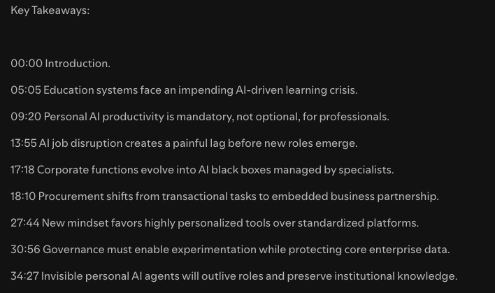
This works because it breaks the episode into clear, scannable sections with specific time markers. A listener can quickly find the parts that matter most without listening from start to finish.
It’s more useful for busy audiences. When time is limited, this level of clarity often decides whether someone keeps listening or drops off.
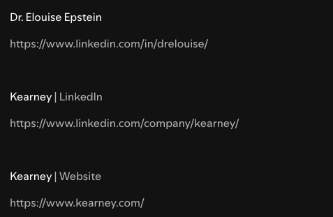
4. Guest bio and links
The guest bio is your opportunity to include guest information, even if minimal, with links to social pages and other places to find them. This builds credibility and makes cross-promotion easy across social media and professional networks. It’s also respectful to your guest and helps raise their profile.
5. Key takeaways and bullet points
This makes your insights scannable so your listener can get a quick rundown on what the episode will be about.
For example:
“AI job disruption creates a painful lag before new roles emerge.”
“Procurement shifts from transactional tasks to embedded business partnership.”
A lot of people skim show notes, so breaking information into short, clear points helps them get value even if they don’t read everything.
6. Resources and links mentioned
Turn your show notes into a resource hub with clickable links.
This could include things like:
LinkedIn profiles for guests and hosts
Company website
Links to any resources mentioned
Links to any products mentioned
Any further listening to learn more
This adds more depth to your episode and gives listeners a clear next step. It also supports SEO and encourages people to explore more of your content.
7. Tweetable or quotable moment
Pull out a strong, shareable line. This could be something like:
“Personal AI productivity is mandatory, not optional, for professionals.”
The best lines here capture a single, complete thought in one sentence that will resonate with your audience. This fuels social media posts and content repurposing.
8. Call to action (CTA)
CTAs are your chance to give one clear next step. Check out our CTA for Tonkean:
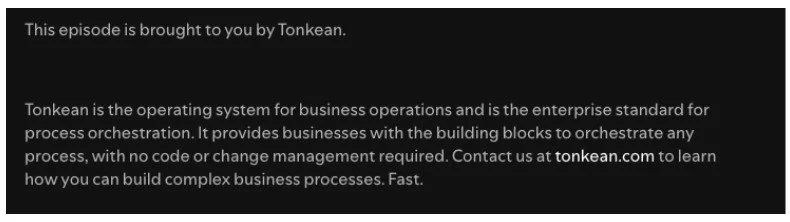
This works because it clearly explains who is behind the podcast, what they do, and how to get in touch. Without a clear next step, your show notes are less likely to drive leads or conversions.
9. Transcript (optional)
While it’s not necessary in all show notes, a transcript of the podcast content can sometimes be a good call.
Adding a transcript via a transcription service like Descript can improve accessibility and give search engines more content to index.
It also helps to understand where transcripts and show notes fit across different platforms.
Podcast app descriptions are short and appear in platforms like Spotify and Apple Podcasts.
Episode webpages are longer and give you space to include detailed show notes, SEO keywords, and blog-style content.
Podcast Show Notes SEO: How to Rank and Drive Organic Traffic
SEO is a really important part of growing a podcast, but most guides barely cover it. If you want consistent search traffic, each episode needs to be treated as a search-focused asset.
This opportunity is bigger than you realize. SEO drives over 1,000% more traffic than organic social media, with 53.3% of website traffic coming from search vs. just 5% from social.
Even with that gap, many podcasters still focus heavily on social media and overlook search. Discoverability remains a common challenge, yet episode titles, website pages, and show notes usually don’t get the attention they need.
Search engines can’t listen to your podcast. Without text, your content doesn’t show up in search results. Show notes solve this by turning your audio into something searchable and helping your episodes appear in both search engines and podcast directories.
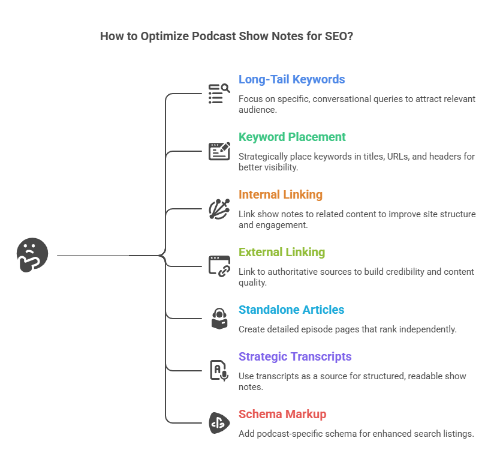
1. Focus on a long-tail keyword strategy
Don’t chase broad keywords. Focus on specific, conversational queries your audience is actually searching.
For example, instead of: “B2B marketing”, use: “B2B podcast marketing strategies for lead generation.”
Long-tail keywords are easier to rank for and better aligned with search intent, particularly for B2B audiences.
2. Place keywords where they matter most
You don’t need to stuff keywords everywhere, just place them strategically:
Episode title
URL slug
First 100 words
Headers (H2/H3)
Image alt text
These are the areas search engines prioritize when determining relevance and search engine rankings.
3. Build authority through internal linking
Link your show notes to related episodes, relevant blog posts, and any services and landing pages. Internal linking improves site structure, helps search engines crawl your content, and increases time on page, all of which support SEO.
4. Strengthen credibility with external links
Link to high-quality external resources where relevant. Outbound links to authoritative sources signal trust and improve the overall content quality. This is particularly useful for B2B and educational topics, where readers often look for supporting information.
5. Turn each episode page into a standalone article
Your podcast app description isn’t enough. Podcast platforms like Apple Podcasts and Spotify rely on short, limited descriptions. Your website gives you the space to go deeper with long-form show notes.
Each episode page should read like a complete article, with enough detail to rank on its own and bring in search traffic over time.
6. Apply transcripts strategically for SEO
Remember: transcripts can support SEO, but they don’t work well in their raw form.
A full transcript adds searchable text to your page and helps capture long-tail keywords. It also improves accessibility for people who prefer reading.
The problem is that most transcripts are unedited. They can feel messy, repetitive, and hard to follow, which affects readability and engagement.
A better approach is to treat transcripts as a source. Pull key insights, structure them into clear sections, and turn them into long-form show notes that are easy to read and optimized for search.
7. Use structured data (schema markup)
Add podcast-specific schema to your episode pages. This helps search engines understand your content better and can improve how your episodes appear in search results.
In some cases, it can also lead to enhanced listings, which makes your content more visible and easier to click.
How Long Should Podcast Show Notes Be?
Most podcast show notes fall between 150 and 600 words, depending on the episode. The ideal length depends on your format and how much context you need to include.
Short solo episodes can be covered in 150-300 words, while interview episodes typically need 300-600 words to include guest information, takeaways, and links.
More in-depth or educational episodes can go up to 600–1,500 words, particularly when SEO is a priority. Narrative formats stay shorter to maintain curiosity and pacing.
| Format | Recommended length | Why |
|---|---|---|
| Short-form or solo | 150–300 words | Covers the main idea quickly while including key points and a clear CTA |
| Interview or guest | 300–600 words | Allows space for guest context, key insights, and relevant links |
| Deep-dive or educational | 600–1,500 words | Adds depth and context, which helps with search visibility and long-term traffic |
| Narrative or storytelling | 200–400 words | Keeps the focus on curiosity and flow without revealing too much upfront |
It’s also important to separate podcast app descriptions from your episode webpage. Apps like Apple Podcasts truncate around 250 characters, so your hook needs to come first. Your website, on the other hand, is where long-form show notes act like a blog post and drive search engine rankings.
In practice, there are two tiers: a short “minimum viable” version, and a longer, structured version built as a full SEO asset. If your goal is traffic and leads, the latter consistently performs better.
How to Write Good Podcast Show Notes?
This is where most podcast show notes fall apart. The difference here lies in the execution. Strong show notes are written to convert rather than just summarise. Remember that your goal is to attract search traffic and convert listeners into leads.
Let’s see how to write show notes that bring you closer to that.
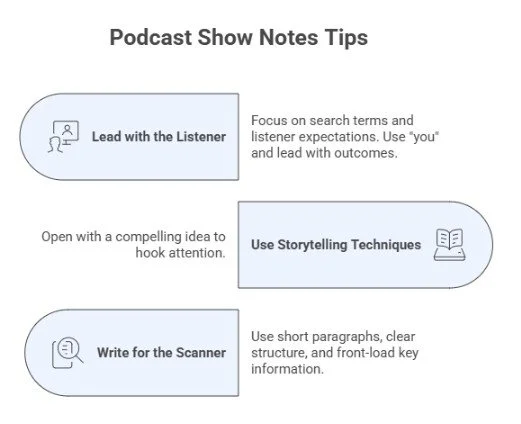
Lead with the listener
If your opening reads like a recap, it won’t rank or convert. Focus on what someone is searching for and what they expect to get. Write directly to the reader using “you” and lead with outcomes instead of descriptions.
This makes your content easier to find in search and clearer for anyone deciding whether to keep reading.
Use storytelling techniques
Search gets you the click, but story is what keeps them reading. Open with a compelling idea, tension, or shift in perspective from the episode. This should be something that hooks attention immediately.
Strong hooks reduce bounce rate and increase time on page. Both of these are signals that help search engines rank your content higher and keep readers engaged long enough to act on your call to action.
Write for the scanner
Most visitors from search engines will scan your show notes since they don’t have time to read them thoroughly.
Therefore, we suggest using short paragraphs, a clear structure, and front-loading key information so readers can quickly find what they need. This makes it easier for someone to decide whether to stay, click, or move forward.
Podcast Show Notes Styles & Examples
It’s easy to think of show notes as having one universal template. In reality, there are distinct formats, each optimised for a different goal. That could be search traffic, conversion, or listener experience.
Here are five styles, with real episode pages you can study.
Style 1: The Minimalist (App-First)
This is the format you’ll see most often inside podcasting apps. It’s short, tight, and built for quick scanning.
A good example is how many daily shows structure their descriptions in apps like Spotify and Apple Podcasts.
Here’s an example from Planet Money:
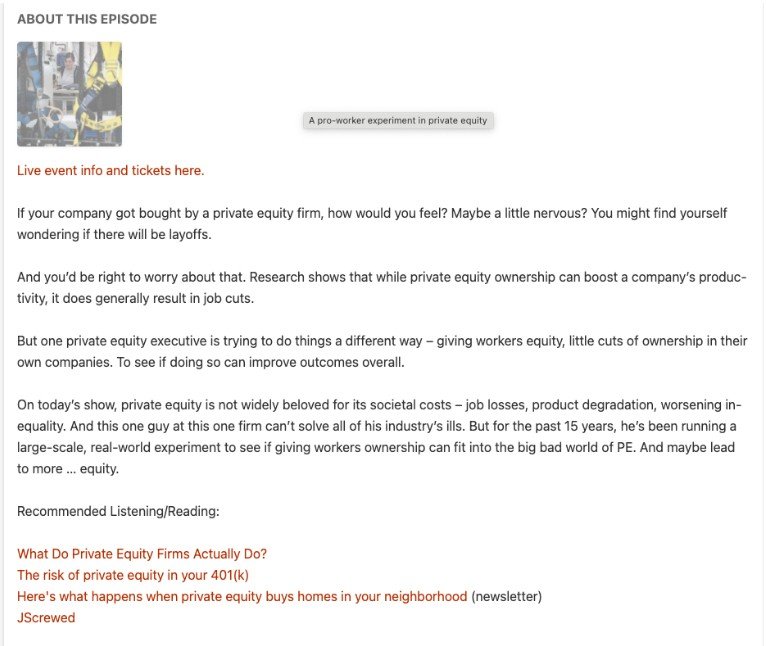
These typically include:
A short episode summary
Minimal formatting
Few or no outbound links
This format works because it’s optimized for podcast directories, where users are browsing quickly. It sacrifices SEO depth for speed and consistency.
Style 2: The SEO Blog Post
This is the most powerful format for driving search traffic. It works by turning podcast show notes into a full article.
Here’s an example from the NPR Planet Money episode page, where the podcast episode has been repurposed into a full article.
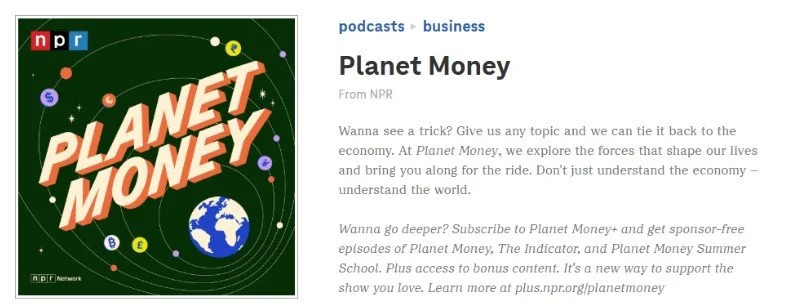
On NPR’s own site, episodes are published as full webpages, with:
Structured summaries
Embedded audio
Internal linking across related episodes
Why it works: Each episode becomes a standalone SEO asset that can rank in search engines and drive long-term traffic.
Style 3: The Story Hook
This format opens with a narrative moment before explaining the episode.
Here’s an example from This American Life:
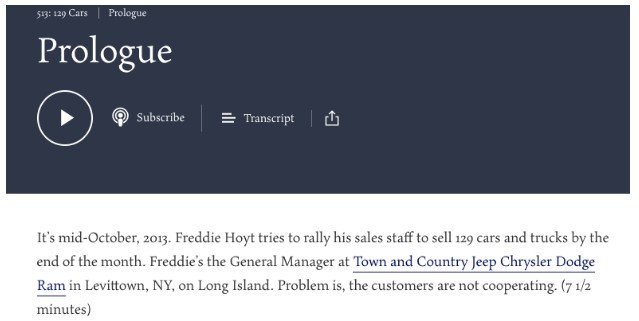
This description introduces a real-world scenario and characters first, then expands into the broader theme of the episode.
It works well because This American Life uses a story-first structure, where:
The narrative creates curiosity before explanation
The audience is pulled into a situation, not a topic
The “what this episode is about” comes second
For podcast show notes, this approach increases time on page (stronger SEO signals), improves engagement and shareability, and converts more readers into listeners.
Instead of summarising the episode upfront, it hooks attention through story, then delivers context.
Style 4: The Executive Brief
This is a structured, skimmable format designed for B2B audiences. Check out this example from Meta:
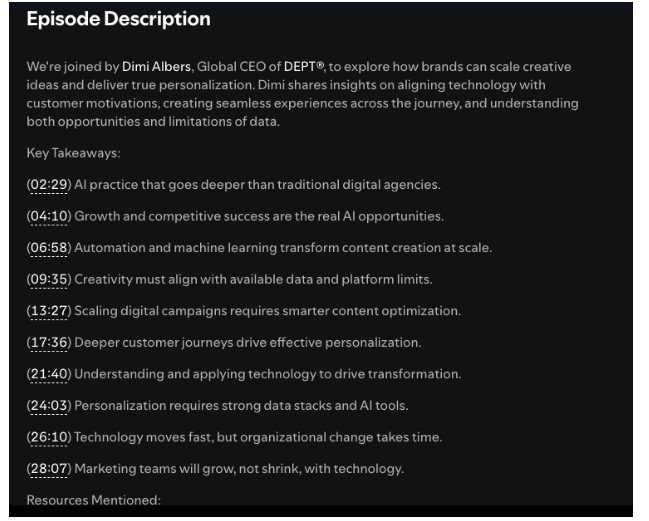
These pages typically include:
A concise summary
Structured insights
Clear sections and hierarchy
This works because it respects the reader’s time. Everything is scannable and outcome-focused, which increases engagement and makes CTAs more effective.
Style 5: The Guest-Led
This format centers the guest’s expertise and credibility. The podcast we looked at earlier from Content Allies and Tonkean is a good example of this.

These pages highlight who the guest is, why they matter, and what perspective they bring.
This turns episodes into distribution assets. When the guest is prominent, they’re more likely to share, which drives backlinks, reach, and potential leads.
Remember that there’s no single “best” format, only the right one for your goal.
Want speed? Go for a minimalist approach
Want SEO traffic, you might be better with a blog-style show notes
For engagement, use a story hook
If you need clarity, opt for an executive brief
For distribution and authority, go with a guest-led show notes
Most high-performing podcasts combine elements of 2-3 of these into a repeatable content structure.
Tools and Software for Podcast Show Notes
There are tons of tools out there for podcasters, for just about every function you can imagine. Show notes are no exception to this. Here are some of the best tools out there to help you create slick, relevant, and SEO-friendly show notes.
AI-assisted tools
Tools like Riverside.fm and Podbean’s AI Content Assistant can generate episode summaries, titles, and timestamps automatically.
If you’re producing multiple podcast episodes per week, they’re useful for speed and first drafts. But the output is mostly generic, repetitive, and lacking specificity.
Your best bet is to treat AI as a starting point. Use it to structure your show notes, then edit for clarity, voice, and accuracy.
SEO and keyword research tools
Ahrefs, Semrush, and Google Search Console help you understand what your audience is actually searching for and whether your show notes are ranking.
These tools play a massive role if your goal is to drive search traffic. They help you decide on your episode title, keyword targeting, and overall SEO strategy.
For best results, you can use these tools to identify long-tail keywords for each episode and track which pages are generating organic traffic over time.
Writing and editing tools
Grammarly helps with grammar and tone, while Notion or Google Docs are useful for building templates and collaborating with a team.
These tools won’t improve your strategy, but they can help you improve consistency and quality. It’s best to create a repeatable content structure so every set of show notes follows the same high standard.
Publishing platforms
Buzzsprout, Captivate, and Transistor all include built-in editors for episode descriptions and show notes.
These are fantastic tools for distribution, but limited from an SEO perspective since most traffic won’t come from podcast directories alone.
Our advice is to use these platforms for publishing, but host full show notes on your website to capture search traffic.
AI tools are great. There’s a reason why the global AI transcription market is predicted to grow to about USD 19.2 billion by 2034.
But it’s worth remembering that, while AI tools are fast, they tend to produce flat, undifferentiated copy. SEO tools provide direction, but not execution. Writing tools improve quality, but not strategy.
The best results come from combining them. You can use AI for speed, SEO tools for insight, and human editing for voice, specificity, and conversion.
How to Track the Performance of Your Podcast Show Notes
Most podcasters don’t track how their show notes perform, which makes it hard to know what’s actually driving traffic or leads. Since show notes live on your website, they should be measured like any other content asset.
We suggest focusing on a few core metrics:
| Metric | What does it tell you |
|---|---|
| Organic traffic | Whether your show notes are being discovered through search |
| Click-through rate (CTR) | Whether readers are taking action from your page |
| Time on page | How long people are engaging with your content |
| Keyword rankings | How each episode performs in search over time |
| Conversions | Whether your show notes are generating leads or sign-ups |
Note: You don’t need complex tools to track this. A simple spreadsheet works. Track each episode with its target keyword, page URL, traffic, rankings, and conversions, then review it monthly to spot patterns.
Once you have that data, you can start improving what’s already published. Revisit older show notes, update keywords, add internal links, refresh resources, and strengthen your call to action.
To measure if those changes are working, we recommend keeping an eye on a couple of simple benchmarks. Aim for at least 2 minutes of time on page and a 3% or higher CTR. These give you a quick sense of whether your content is engaging and aligned with what people are looking for.
When to Outsource Podcast Content Production?
At some point, podcasting runs into a time constraint. Recording, editing, and publishing already take hours. Supporting content like show notes and repurposed assets often gets pushed aside.
If you’re publishing occasionally, handling this in-house works. But once your podcast becomes a consistent marketing channel, maintaining quality across content becomes harder.
Outsourcing helps you stay consistent and turn each episode into more than just audio. That includes structured show notes, blog content, and distribution across different channels.
This usually makes sense when your podcast is tied to lead generation, you’re publishing regularly, or you want to get more value from each episode.
If you’re interested in working with a partner, check out our guide to the top podcast production companies, agencies, and services.
Turn Your Podcast Into a Lead Engine with Content Allies
Most podcasts don’t fail because the content is bad. Instead, they fail because that content never gets discovered or converted.
Content Allies specializes in helping B2B podcasters turn their show into a real marketing channel. This means podcast show notes that are built to rank in search engines, written to convert readers into leads, and delivered consistently every single week.
That’s exactly how we helped Tonkean grow its Modern Business Operations podcast into a category leader. Their show reached the top of its category on Spotify and increased unique listeners by 174.36% in a single quarter. That’s the difference between publishing episodes and building a scalable growth engine.
Instead of treating show notes as an afterthought, we turn them into SEO assets, conversion pages, and content hubs, so your podcast drives traffic and pipeline.
If you want your podcast to actually perform, get in touch with us today.
FAQs
What are podcast show notes?
Podcast show notes are written summaries and resources that accompany each episode, helping listeners understand, navigate, and take action after listening.
Do podcast show notes help with SEO?
Yes, show notes give search engines text to index. This helps your podcast episodes rank and drive organic search traffic.
How long should podcast show notes be?
Most show notes are 150-600 words, but longer, structured versions (500-1,500+ words) perform better for SEO and lead generation.
What should I include in podcast show notes?
At minimum, include a clear summary, key takeaways, relevant links, and a call to action. More advanced versions add timestamps, guest info, and SEO structure.
Should I include a full transcript in my show notes?
Yes, because transcripts can improve SEO and accessibility. But they should be edited or structured. Raw transcripts alone don’t perform well.
What’s the difference between a podcast description and show notes?
Podcast descriptions are short summaries shown in apps, while show notes are longer, structured pages (usually on your website) designed for SEO and conversion.
How does Content Allies help with podcast show notes?
At Content Allies, our team creates SEO-optimized, conversion-focused show notes that turn podcast episodes into traffic and lead-generation assets.
Can Content Allies handle the full podcast workflow?
Yes, we support end-to-end podcast production, including strategy, guest booking, production, and content repurposing.