
Video Podcast Production: A B2B Brand's Complete Guide
Video podcast production is becoming a core growth channel for B2B companies.
Traditional audio podcasts usually struggle to drive sustained engagement or repurpose effectively across channels. But when you add a video layer, each episode becomes a multi-format content asset that can reach audiences across YouTube, LinkedIn, and short-form platforms.
The shift in audience behavior makes this even more important. YouTube now reaches over 1 billion monthly podcast viewers, with 31% of weekly podcast listeners in the U.S. choosing YouTube over Spotify (27%) and Apple Podcasts (15%).
At the same time, 71% of Gen Z actively watch video podcasts and say they value the added context of visual storytelling.
For B2B teams, this creates a clear opportunity to turn podcast episodes into a scalable content engine that fuels social media, supports marketing campaigns, and accelerates audience growth.
If you’re exploring how to make that shift, this guide will walk you through what it takes to produce and scale a high-performing video podcast.
We’ll also share the strategies we use at Content Allies to help B2B brands turn their podcasts into consistent drivers of reach, engagement, and pipeline.
So, let’s get started!
Why Video Podcasts Are Worth It for B2B Brands
For B2B companies, video podcast production is a fantastic way to drive pipeline, build trust, and maximize your content ROI. Here’s why it works so well.
The B2B podcast listener is your ideal buyer
B2B podcasts attract decision-makers with budget and intent. In fact, data shows that 83% of senior executives listen to at least one podcast weekly, which makes it one of the most direct ways to reach buyers.
On top of that, you’re also speaking to a high-value audience. About 56% of monthly podcast listeners earn over $75,000 annually, which signals strong purchasing power and real commercial relevance.
Video expands your reach to YouTube, LinkedIn, and beyond
When you add video, your podcast becomes searchable and easier to discover across platforms like YouTube, LinkedIn, and short-form channels.
YouTube alone is driving massive growth. Users streamed over 700 million hours of video podcasts on TVs in October 2025, nearly doubling the previous year. This kind of distribution simply isn’t possible with audio podcasts alone.
P.S. You can explore this further in our guide on growing your podcast on YouTube.
Thought leadership and trust at scale
Video builds trust faster than audio. Viewers can see tone, expressions, and reactions, all of which are key credibility builders in B2B sales.
For founders, marketers, and executives, this creates a consistent way to show up in front of your audience, build familiarity, and stay relevant throughout longer sales cycles.
The content multiplication effect: one recording, many assets
A single recording session can power your entire content stack. It can support a steady stream of content across multiple channels.
From one full-length video episode, you can create:
Short-form clips for social media
Blog posts and show notes for SEO optimization
Snippets for marketing campaigns and email
Audio versions for Apple Podcasts and RSS feed distribution
This shift in content consumption is already happening. As Charlie Warzel from The Atlantic points out:
“People are moving away from the medium of text and toward basically anything that’s similar to short-form video content. Anything that can be clipped, edited, picked apart, put on social media to go viral.”
This makes video podcast production one of the most efficient content engines available to B2B teams today.
Check out this YouTube video, which covers the basics of video podcast production:
Video Podcast vs. Audio Podcast: Key Differences
A video podcast includes both visual content and audio, while audio podcasts rely solely on sound. For B2B brands, adding a video component unlocks greater reach, engagement, and repurposing potential.
What changes when you add video
Adding video introduces more complexity, but also more upside.
You now need:
Cameras, lighting setup, and thoughtful camera angles
Stronger video editing and post-production workflows
Distribution across social media platforms like YouTube and LinkedIn
The payoff is significant. 51% of Americans have watched a podcast, with YouTube capturing one-third of weekly podcast listeners. This alone makes it a dominant discovery channel.
What stays the same
Despite the shift to video, the fundamentals don’t change:
Content strategy still drives success
Audio quality remains critical (clear sound design, proper audio mastering, pop filters, and a solid audio interface)
Consistency in publishing podcast episodes matters more than perfect production
In short, great content still wins, and video just amplifies it.
When audio-only still makes sense
Audio podcasts are still valuable when:
You need a low-cost entry point
Studio recording or video podcast equipment isn’t available
The focus is internal content or niche audiences
They’re simpler to produce but come with limited discoverability and weaker audience engagement.
Video vs. Audio Podcast: A Quick Comparison Table
| Aspect | Video Podcast | Audio Podcast |
|---|---|---|
| Format | Video and audio | Audio only |
| Production complexity | High (cameras, lighting, editing) | Low |
| Cost | Higher | Lower |
| Distribution channels | YouTube, LinkedIn, social video, and podcast apps | Podcast apps only |
| Discoverability | Strong (YouTube search and recommendations) | Limited |
| Engagement | Higher (visual connection and retention) | Moderate |
| Repurposing potential | Very high (clips, ads, and social content) | Limited |
| Best use case | B2B growth, thought leadership, and pipeline | Simple content and internal use |
| Recommended strategy | Record once and distribute everywhere | Good starting point or supplement |
Video Podcast Formats and Styles
Remember: not all video podcasts are created equal. And the format you choose directly shapes who you attract, how you build trust, and what kind of business outcomes you drive.
This matters more than it might seem. Around 61% of branded podcast listeners say a podcast makes them more favorable toward a brand, and 43% of adults are open to listening to a podcast from a brand they already like.
So the way your podcast is structured plays a big role in how that perception is built and how your audience engages with it.
Let’s explore some common formats and when it makes sense to use each one.
1. Interview / Guest format
Best for: ABM, partnerships, network building
Outcome: Pipeline and relationship capital
The interview format is the backbone of most successful B2B podcasts because it naturally ties into relationship-building. Instead of creating content in isolation, you’re consistently bringing your ideal buyers and partners into the conversation.
Example
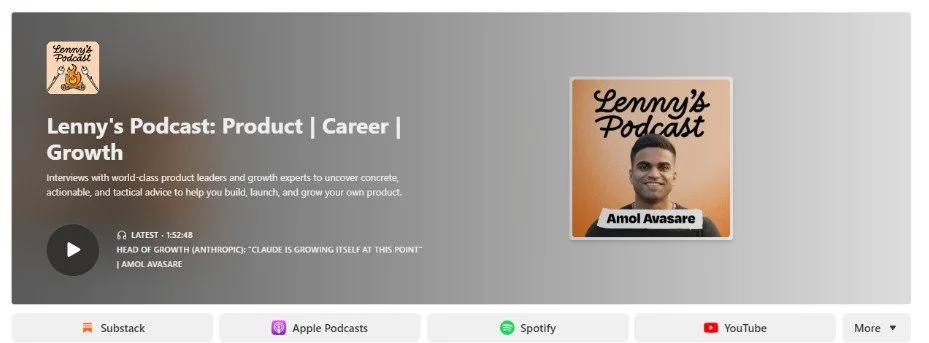
A strong example is Lenny’s Podcast, hosted by Lenny Rachitsky. The show features product and growth leaders from companies like Airbnb, Stripe, and Figma, with episodes distributed on YouTube and across podcast platforms.
What makes it powerful isn’t just the content, it’s the network effect. By consistently interviewing high-caliber operators, the show has built an audience that mirrors Lenny’s ideal peer group.
2. Solo / Monologue
Best for: Founder-led brands, POV-driven content
Outcome: Authority and brand voice
If the interview format builds relationships, the solo format builds authority. This is where founders and executives can develop a clear point of view and reinforce it over time.
Example
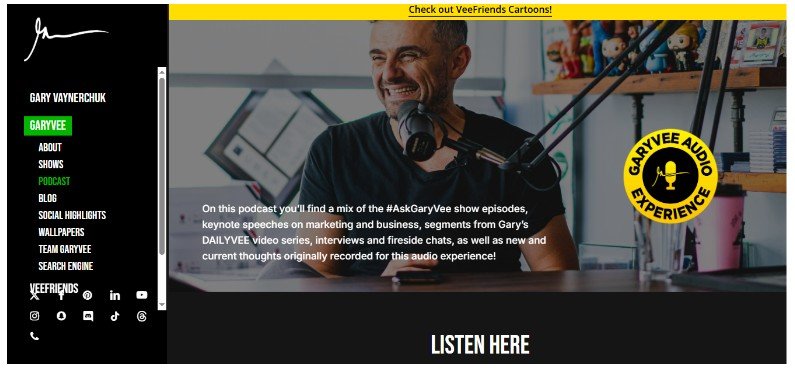
The GaryVee Audio Experience is one of the clearest examples of this approach. Gary Vaynerchuk combines solo commentary, keynote clips, and direct responses to audience questions to share unfiltered perspectives on marketing and entrepreneurship.
Over time, this consistent output has become a core driver of both his personal brand and VaynerMedia’s positioning, which proves how powerful POV-driven content can be when sustained.
3. Panel/Roundtable
Best for: Events, industry conversations
Outcome: Multi-perspective credibility
Panel-style podcasts shift the dynamic from one-on-one conversations to multi-voice discussions, which can add depth and credibility, especially for complex topics.
Example
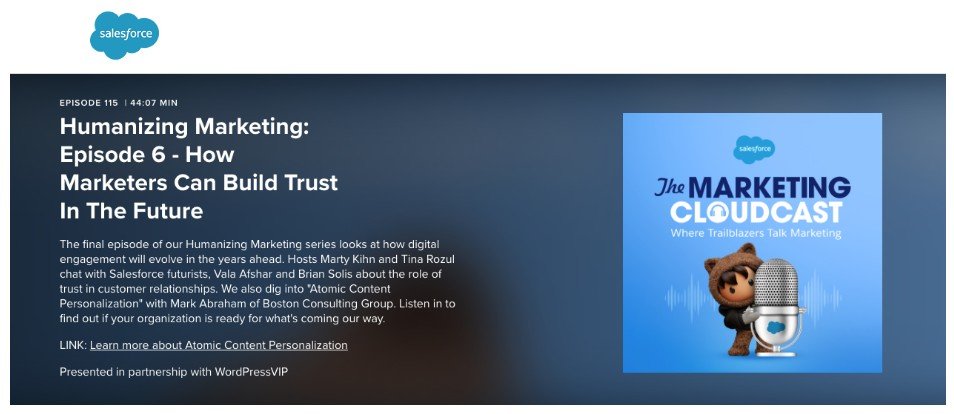
Salesforce’s Marketing Cloudcast is a strong example of this format in action. With recurring hosts joined by internal experts and external guests, the show explores marketing trends and customer data strategy from multiple angles. This structure allows Salesforce to showcase expertise across its ecosystem, while maintaining its position as a leader in the space.
4. Hybrid / Documentary Style
Best for: Premium brand positioning
Outcome: Differentiation and storytelling
For brands looking to stand out, the hybrid format combines interviews with structured storytelling, editing, and narrative arcs. The result feels closer to a produced show than a traditional podcast.
Example
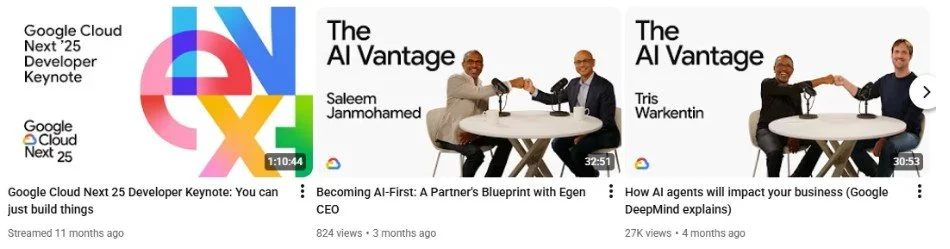
Google Cloud’s video content on YouTube is a strong example of this direction. Their tech series combines expert interviews with explainers and tightly edited segments, especially around topics like AI and infrastructure. Instead of simply recording conversations, they shape episodes into clear, story-driven pieces of content.
5. Internal Video Podcast
Best for: Sales enablement, customer education, culture/internal comms
Outcome: Underserved but high ROI
One of the most overlooked formats is the internal or dual-purpose podcast. While sometimes published externally, these shows are designed to educate teams, align messaging, and support sales conversations.
Example
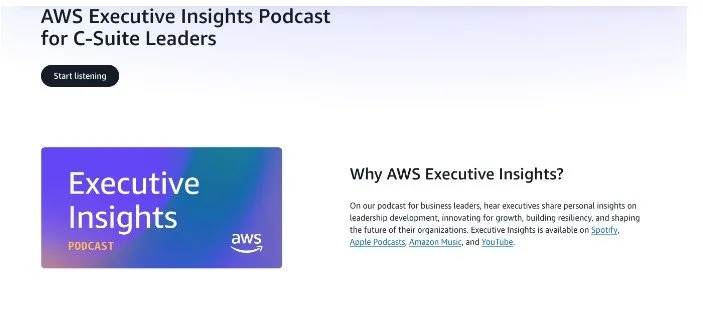
AWS’s Executive Insights is a strong example. The show features discussions with executives across industries, but its value goes beyond thought leadership and shares content that sales teams can share and internal teams can use to stay aligned on messaging and market trends.
6. Static/Audiogram Format
Best for: Low barrier to entry
Outcome: Transitional format (not long-term competitive)
At the simplest end of the spectrum is the audiogram-style format. This is audio paired with minimal visuals. It’s fast, cost-effective, and widely used, especially by large enterprises.
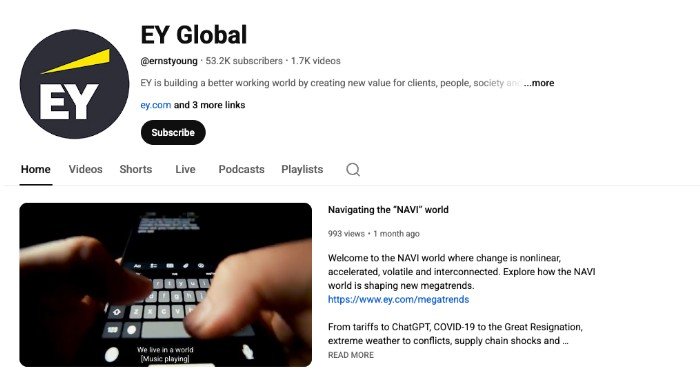
EY’s podcast content on YouTube often follows this model, using static visuals or lightly branded templates to distribute audio-first episodes. While this approach makes publishing easy, it typically lacks the engagement and discoverability of full video podcasts. As a result, most B2B brands eventually move beyond this format as they invest more seriously in video podcast production.
How Much Does a Video Podcast Production Cost?
Video podcast production typically costs between $500 and $7,000 per episode, depending on the level of production and complexity.
Basic recording and editing usually range from $500 to $1,500 per episode. Full production with multiple assets and editing falls between $1,500 and $3,500. Premium or branded shows with advanced production, graphics, and distribution support can cost $3,500 to $7,000 per episode.
What You Need to Produce a Video Podcast
Successful video podcast production requires a mix of equipment, workflow, and the right team. The best setups balance quality with consistency.
1. Equipment (Tiered by budget)
Your setup should match your ambition, but more importantly, your publishing consistency.
A starter setup is enough to get going. Many early-stage startups begin with a DSLR or even a high-quality webcam, paired with a USB microphone and basic lighting setup. This works well for testing your content angle and building initial podcast episodes without over-investing. The key here is clean audio. Using pop filters and a quiet environment matters more than perfect visuals.
A professional setup is where most B2B brands should aim once they validate the format. This typically includes mirrorless cameras, XLR microphones connected through an audio interface, and a proper 2-3 point lighting setup. At this stage, details like camera angles, branded set design, and consistent framing start to shape your visual content quality and brand perception.
At the top end, a premium studio setup is built for scale and brand positioning. This includes multi-camera 4K video, a multi-camera switcher for live or recorded switching, and a fully controlled studio recording environment. Here, advanced sound design and audio mastering make sure your content feels comparable to top-tier media productions.
2. Software Stack
Your software determines how efficiently you turn raw video recording into a full content engine.
Recording tools like Riverside or SquadCast are now standard for remote guest workflows, while in-studio setups may use more advanced video production systems. Once recorded, video editing software like Premiere Pro or Final Cut handles the visual layer, while tools like Audition support audio production and cleanup.
Distribution is just as important as production. Your full-length video episode should live on YouTube, while audio podcasts are pushed through an RSS feed to platforms like Apple Podcasts. From there, clip-generation tools like Descript or Opus help break episodes into short-form assets for social media platforms.
A well-built stack reduces friction in post-production and makes content repurposing scalable.
3. Skills Required
Even the best podcast equipment won’t make up for weak execution. The most effective teams combine four core skill sets.

Good hosting skills guide conversations, create energy, and represent the brand on camera. This is where audience engagement is won or lost.
Production covers the technical layer: framing, lighting setup, and smooth video recording. Small details like inconsistent lighting or poor camera angles quickly signal low quality.
Editing skills bring everything together. Strong video editing and audio mastering get you pacing, clarity, and polish. This is where raw footage becomes professional-grade content.
Finally, content strategy underpins everything. Without clear content angle guidance and alignment to business goals, even well-produced podcasts won’t drive results.
Step-by-Step Guide to Create a B2B Video Podcast
Many podcasts fail because teams treat them like a one-off content project instead of a repeatable growth system.
This matters even more now as discovery continues to shift toward video platforms.
With 32% of new podcast listeners discovering shows via YouTube, success now depends a lot on how well you connect strategy, production, and distribution.
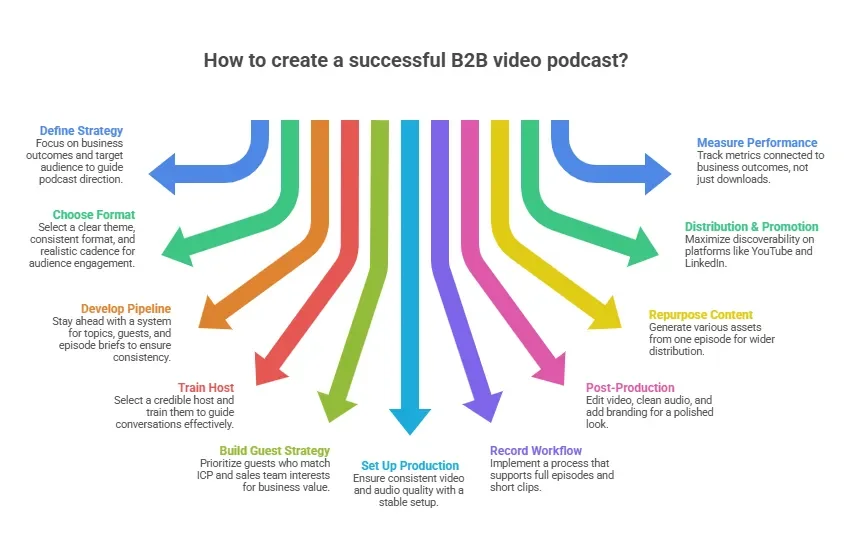
1. Define your strategy
Start with business outcomes rather than content ideas. First, get specific about:
Who you want to reach (ICP) in terms of job titles, industries, and deal size
What do you want to drive? This could be pipeline, partnerships, or brand authority.
How you’ll measure success using metrics like influenced revenue and meetings booked, instead of only downloads.
Ask yourself, if your podcast disappeared tomorrow, what business impact would you lose? The answer helps you focus your strategy.
2. Choose your format and show concept
Once your strategy is clear, the next step is shaping the show itself.
Your concept should be clear within seconds to the right audience. Instead of a generic show, aim for something like: “Conversations with VP-level SaaS leaders on scaling revenue teams”
Lock in three things early:
A clear theme tied to your ICP’s problems, a consistent format (such as interview, solo, or panel), and a realistic cadence (weekly is ideal, but biweekly might be more sustainable)
Clarity matters more than creativity here. We have experienced that shows built around a narrow theme attract a more relevant audience and are easier to grow over time. However, broad shows mostly struggle to build traction because the value isn’t obvious.
3. Develop your episode pipeline
After your format is set, you need a system to keep everything moving. Strong teams don’t plan episode by episode. They operate a few weeks ahead.
We suggest staying 4 to 6 weeks ahead with a simple system.
Build a simple system based on a running list of topics tied to real sales conversations, an editorial calendar with confirmed guests, and a repeatable episode brief (this should include, at minimum, key questions, angles, and outcomes).
This way, you’ll always know what’s coming next and you’ll be able to plan ahead and minimize stress. On top of that, you’ll have relevant, valuable topic ideas. If you’re ever wondering “what should we record next?”, that means your system isn’t working.
4. Choose and train your host
Once your pipeline is in place, the next step is choosing your host.
Your host is the face of your podcast and can make the difference between success and being forgotten. They don’t need to be a seasoned professional, but they do need to be intentional.
Focus on picking someone credible, like a founder, exec, or subject expert. Train them to guide conversations, not interrogate, and avoid over-talking. Great hosts create space for guests.
A simple improvement is to have hosts review past episodes and refine their delivery. Small tweaks compound quickly, and it’s often hard for hosts to identify their own mistakes and areas for improvement.
If you want to learn more about hiring and training the right host, check out this video from our Founder, Jake Jorgovan.
5. Build your guest strategy
With the host in place, your guest strategy becomes the next priority.
This is where many B2B podcasts start to generate real business value. Instead of chasing big names, prioritize guests who match your ICP, people your sales team wants to meet, and existing customers or target accounts.
In practice, this usually involves:
Personalized outreach as opposed to mass invites
A short pre-interview to align on talking points
Clear expectations for the episode
When done well, your podcast becomes a consistent way to build relationships while creating relevant content your audience actually cares about.
6. Set up your production environment
At this stage, your focus is consistency across both video and audio.
For in-studio recording, lock in your camera angles, lighting setup, and audio levels early. Keep framing, background, and composition consistent across episodes so your content feels recognizable at a glance, especially when clips are shared on social platforms.
For remote recordings, reduce as much variability as possible. Share a simple setup guide with guests that covers camera position, eye level, lighting direction, and audio quality. Small details like poor framing or backlighting can make your content feel unpolished, even if the conversation is strong.
A stable setup makes editing easier and helps your final output look consistent across platforms.
7. The recording workflow
Once your setup is dialed in, your recording process needs to support both the full episode and short-form content.
Before recording, run a quick tech check and share a loose run-of-show. This isn’t a script, just a rough outline that tells your guest what to expect and what to prepare for.
During recording:
Start with a short off-camera or pre-roll conversation to help the guest settle in.
Guide the discussion naturally, while keeping an eye on clarity and structure.
Create a few moments that can stand alone as short clips, with clear statements or strong opinions.
Pay attention to visual cues like eye contact, posture, and reactions, since these shape how clips perform.
Video podcasts work best when the conversation feels natural but still produces clear, usable moments. In our experience working with various teams, we have observed that some of the strongest clips come from unplanned parts of the discussion, but they only work if the setup and flow support them.
8. Post-production and editing
This is where you take the raw material of your podcast and shape it into an asset that’s ready to publish. A strong post-production workflow covers clean multi-camera video editing, where angle switches help maintain visual interest, along with audio cleanup and sound design to improve clarity. It also includes branded elements like intros, outros, and lower thirds that make your content feel consistent across episodes.
Plus, here you identify and extract the strongest moments from each episode. These clips become the building blocks for everything that comes next.
9. Repurposing your content
Once your episode is edited and your key moments are ready, the focus shifts to distribution.
From one full-length video episode, you should consistently generate:
Audio podcasts distributed via RSS feed (Apple Podcasts, etc.)
Short clips for LinkedIn and other social media platforms
A blog post with SEO optimization and embedded video
Show notes, pull quotes, and newsletter content
The goal is simple: one recording that can be shared everywhere your audience is.
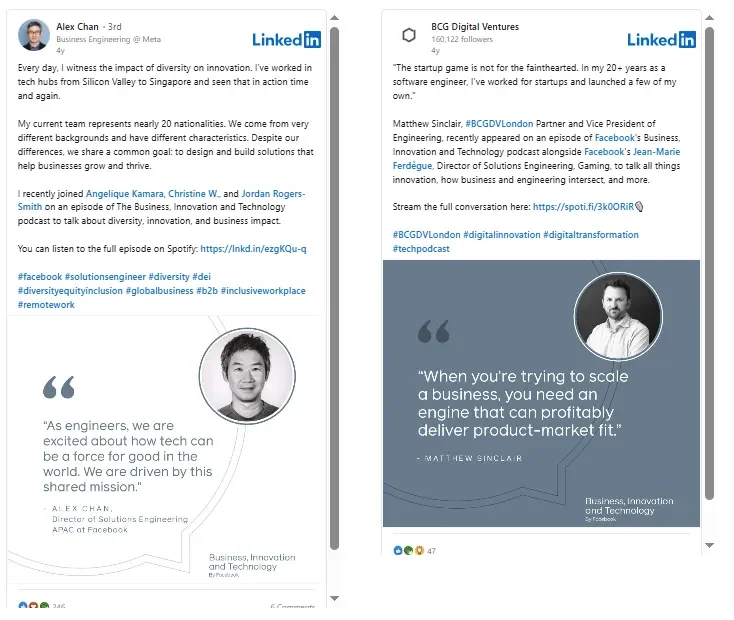
When we worked with Meta on their Meta Business, Innovation, and Technology podcast, we repurposed the episode to create thought leadership assets for LinkedIn. We helped them achieve 170,000 downloads in the first 6 months of working together and exceeded their initial 4-month download target by a factor of 7.
10. Distribution and promotion
Remember that publishing is only the beginning. The true work begins when you start to share and promote your podcast.
To get results here, you need to maximize discoverability on YouTube by creating SEO-friendly titles, thumbnails, and keywords that clearly show what your show is about and show up on your audience’s algorithms.
You should also natively post your videos on LinkedIn, instead of just posting links. And don’t forget to share your podcast episodes internally. Ask sales and leadership to share clips.
YouTube, in particular, should be treated as a search engine for video content rather than just a hosting platform.
Check out our guide to podcast promotion here.
11. Measuring performance
Vanity metrics like download counts aren’t enough when it comes to learning if your podcast is working.
Track metrics like watch time and retention to gauge how much your viewers enjoy your show. Engagement in the form of comments and shares is another strong signal here.
We suggest always connecting your tracking to the business outcomes. Are viewers turning into conversations, opportunities, or relationships? The strongest teams track podcast performance alongside pipeline and revenue, not just audience size.
Should you hire a video podcast production company or build in-house?
For most B2B teams, the real constraint is executing consistently at a high enough level to drive pipeline and brand credibility. That’s where the decision to partner or build internally comes in.
When to go in-house
Building internally makes sense when you already have the infrastructure to support it.
If you have an experienced content or video production team, access to a reliable studio recording setup, and a high publishing cadence, an in-house model can become cost-efficient over time. It also gives you full control over your content stack and production schedule.
That said, this approach only works if you can maintain consistent quality across audio production, visual content, and distribution. Otherwise, output quickly becomes fragmented.
When to outsource
For most teams, especially early on, outsourcing is the faster path to results.
If you’re launching your first show, lack internal editing or production expertise, or need your content to reflect a premium brand (particularly when targeting enterprise or Fortune 500 companies), a partner helps you avoid the typical trial-and-error phase.
It also allows your internal team to stay focused on strategy, guests, and business outcomes, rather than getting stuck in post-production or tooling.
What a full-service video podcast production partner actually does
A true production partner will plug into your entire content system.
At a high level, they take ownership of the full lifecycle. This means they shape your content strategy, manage video recording, handle post-production, and make sure your podcast episodes are distributed and repurposed effectively.
The key difference comes down to execution. The right partner helps you turn each recording into a scalable content engine.
How to evaluate and select a production partner
Not all providers are built for B2B outcomes. Many can produce clean video content, but fewer understand how to tie that content back to the pipeline.
Look for signals like:
Experience specifically with B2B video podcast production
Ability to support more than just editing (strategy, distribution, and repurposing)
Clear examples of shows they’ve helped grow, with metrics to back it up
A structured process for turning episodes into multi-channel content
Questions to ask before signing a retainer
Before committing, it’s worth digging into how they actually operate.
A few questions that tend to surface the difference between vendors and true partners:
How do you make sure the podcast drives business goals or a monetization strategy?
What exactly is included in post-production (this could be clips, show notes, or distribution)?
How do you approach content repurposing across social media platforms?
What does your workflow look like from recording to publishing?
What results have you driven for similar B2B companies?
If the answers are vague, you’ll likely end up managing more than you expect.
Interested in working with a podcast production partner? Take a look at our roundup of the best options out there.
Common Video Podcast Production Mistakes to Avoid
Even well-resourced B2B teams get video podcast production wrong. Usually, that’s not because they lack strategy, but because of execution gaps that compound over time.
Only 436,000 out of 4.64 million podcasts remain active, which means the vast majority fade out, and it’s often due to the issues below.
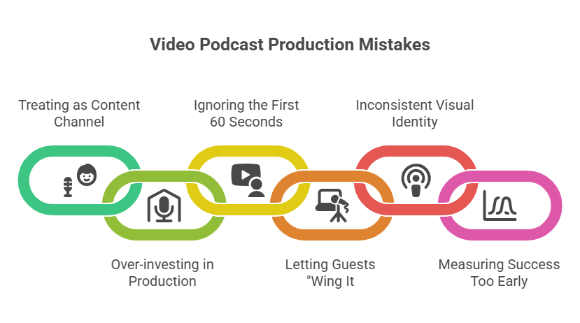
1. Treating the podcast as a content channel
Many teams focus on downloads and views, but overlook the bigger opportunity: who you’re building relationships with.
The highest-performing B2B podcasts are designed around:
Target accounts
Ideal partners
Strategic industry voices
If your guest list has no connection to your pipeline, it becomes harder to tie your podcast back to real business outcomes.
2. Over-investing in production before validating the concept
It’s easy to get caught up in cameras, lighting setup, and premium studio builds. But high production value won’t fix weak positioning.
Teams mostly invest heavily in video podcast equipment before confirming:
The content resonates
The format works
The audience actually cares
We recommend starting with a simpler setup to make it easier to test what works. Once you see traction, you can improve production quality with more confidence.
3. Ignoring the first 60 seconds of the episode
Most viewers decide whether to keep watching within the first minute, particularly on YouTube and social platforms.
If your opening is slow, too generic, or overly branded, viewers drop off before the value appears.
Strong episodes start with a clear hook, a compelling insight or question, and immediate relevance to the viewer
This has a direct effect on watch time, engagement, and how your content performs in recommendations.
4. Letting guests “wing it” instead of guiding outcomes
Even great guests need direction. Without it, conversations stay surface-level.
High-performing teams:
Run short pre-interviews
Align on key talking points
Guide the conversation toward specific insights
The difference is noticeable. You get episodes that feel sharper, more valuable, and more shareable.
5. Inconsistent visual identity and branding
A podcast should feel like a recognizable show and not a series of disconnected recordings.
Inconsistency in camera angles, lighting setup, and background or set design can make your content feel less professional and harder to remember. Strong visual consistency builds familiarity and trust over time.
6. Measuring success too early (or incorrectly)
Many teams expect quick results or rely too heavily on surface-level metrics.
Early on, downloads and views can be misleading. What matters more are audience retention, engagement signals, and building stronger relationships with guests.
B2B podcasts build momentum over time, so early performance doesn’t always reflect long-term impact.
Turn Your Video Podcast Into a Revenue Channel with Content Allies
By now, it’s clear that video podcast production is about building a repeatable system that drives relationships, content, and pipeline.
The challenge is that most B2B teams struggle with execution at scale. From guest sourcing and recording to video editing, repurposing, and distribution, the operational lift adds up quickly.
That’s where Content Allies comes in.
We work with B2B brands to turn podcasts into strategic growth engines. We support the entire lifecycle, from shaping your show’s positioning and guest strategy to handling production, post-production, and multi-channel distribution.
Our experts have helped companies like Gusto launch and grow podcasts that don’t just generate views but build relationships with decision-makers and influence real revenue. In their case, we helped them gain 9,400 unique listeners and rank for important SEO keywords.
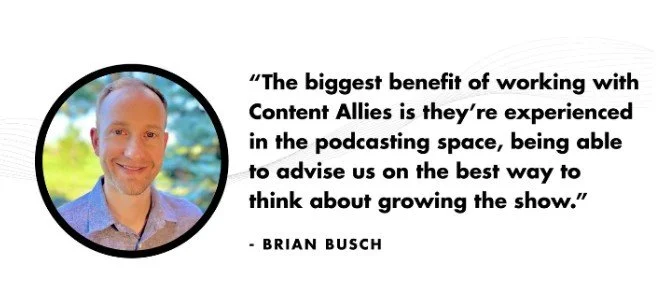
If you’re serious about using video podcasts for audience growth, thought leadership, and pipeline, working with a partner like Content Allies can dramatically shorten the learning curve and raise the ceiling on results.
Get in touch with us to learn more and get started.
FAQs
How long does it take to launch a podcast with Content Allies?
Most B2B podcasts can be launched within 4-8 weeks, depending on strategy alignment, guest pipeline, and production setup.
What equipment do I need to start a video podcast?
At minimum, you need a camera, a microphone, a basic lighting setup, and recording software; more advanced setups include multiple cameras, an audio interface, and professional video editing software.
How long should a B2B video podcast episode be?
Most B2B video podcasts perform best between 20 and 45 minutes, which is long enough for depth but short enough to maintain audience engagement.
How do I measure the ROI of a B2B video podcast?
Track metrics like watch time, engagement, pipeline influence, and guest-to-opportunity conversion, rather than focusing purely on downloads or views.
What’s the best platform to publish a video podcast?
YouTube is the primary platform for video podcasts due to its discovery engine, while audio versions should also be distributed via RSS feed to platforms like Apple Podcasts.
How many episodes should I produce before launching?
It’s best to have 3-5 episodes ready at launch to build momentum and give new listeners more content to engage with immediately.
What does Content Allies’ video podcast production service include?
Content Allies supports the full lifecycle, including strategy, guest sourcing, production, editing, and content repurposing to help turn your podcast into a growth channel.
Can Content Allies help with content repurposing and promotion, or just production?
Yes. Content Allies goes beyond production to handle repurposing, distribution, and promotion. This means each episode drives maximum reach and ROI.
Appendix
- YouTube surpasses 1 billion monthly podcast viewers (2025): https://variety.com/2025/digital/news/youtube-2025-monthly-podcast-listeners-viewers-1236319232/
- Edison Research Gen Z Podcast Listener Report: https://www.edisonresearch.com/wp-content/uploads/2023/09/Gen-Z-Podcast-Listener-Report.pdf
- Edison Research The Podcast Consumer 2024: https://www.edisonresearch.com/the-podcast-consumer-2024-by-edison-research/
- GTM 8020 B2B Podcast Marketing Statistics: https://www.gtm8020.com/blog/b2b-podcast-marketing-statistics
- eMarketer – Video's rise, CTV growth, and what it means for advertisers (2026): https://www.emarketer.com/content/faq-on-podcasting--video-s-rise--ctv-growth--what-means-advertisers-2026
- RSS.com – Current state of podcasting — global listener and platform data: https://rss.com/blog/the-current-state-of-podcasting/
- Podnews / Signal Hill Insights – Branded Podcast Report 2025 (61% more favorable toward a brand): https://podnews.net/press-release/branded-podcast-report-signal-hill-2025
- Cumulus Media & Signal Hill Insights (via Westwood One) – Podcast Download Fall 2024 (platform shifts and video podcast preferences): https://www.westwoodone.com/wp-content/uploads/2025/06/Cumulus-Media-and-Signal-Hill-Insights-Podcast-Download-Fall-2024_WWO.pdf
- The Atlantic – How YouTube ate podcasts and TV (Charlie Warzel quote source): https://www.theatlantic.com/podcasts/2025/12/how-youtube-ate-podcasts-and-tv-with-rachel-martin-ashley-carmen-and-derek-thompson/685230/
- FireBrand Media – Video podcast production pricing guide (2026): https://mydallasvideographer.com/podcast-production/video-podcast-production-guide/