
Podcast Host Training: Elevate Interviews and Storytelling
Podcasting has shifted from niche to mainstream. Today, 73 percent of Americans aged 12+ have consumed a podcast, 55 percent listen monthly, and more than 584 million people tune in worldwide. With an audience this large, your role as a host has a real impact on how people connect with your message.
If you run a B2B brand or lead expert interviews, your voice sets the tone of the show. Listeners pay attention to how you shape questions, guide guests, and pull out stories that hold attention. Strong hosting helps you create moments that build trust, spark conversation, and support long-term growth.
This guide shows you how to improve those skills. You’ll learn how to prepare with clarity, build strong outlines, work with your production team, lead smoother interviews, avoid common mistakes, and deliver episodes people want to return to.
Here’s what we’ll cover:
Why strong hosting matters in B2B podcasting, from authority to relationships to pipeline
The core skills every B2B host must master, like strategic listening, questions that dig, presence, pacing, and flow
How to prepare like a world‑class host with guest research, smart outlines, and pre‑call etiquette (yes, we cover how to work with your team or partner like Content Allies).
Interview techniques that separate the amateurs from the pros
How to make episodes memorable with structure, micro‑stories, guest prompts, and avoiding common mistakes.
Remote/virtual recording skills every modern host needs, like tech, video clips, and post‑production optimisation
How to practice, improve, and when to bring in a production partner
P.S. Struggling with hosts that look great on paper but don’t drive conversations, relationships, or pipeline? Let Content Allies be your training and production partner so you show up, hold top‑tier interviews, and we handle everything else.
Why Strong Hosting Matters More in B2B Podcasting
Great hosting is about creating a space where your guest shines and your audience leans in. In B2B podcasting, that matters more than ever because you’re trying to build trust, relationships, and revenue.
Strong hosts know how to position their guests as experts, guide conversations that deliver real value, and build rapport that opens doors. Done right, hosting becomes a business development tool that generates leads, nurtures buyer confidence, and cements your brand’s authority.
And the data backs it up:
Podcasts now make up 11% of daily audio listening in the U.S., up from just 2% in 2014.
According to a 2025 B2B podcasting trends report, 78% of business leaders now consume podcasts weekly, with 54+ minutes daily for audio content that influences strategic thinking.
The Edelman–LinkedIn 2024 report shows that 73 percent of buyers rely on thought leadership more than traditional marketing when they assess potential vendors.
79% of hidden buyers (those internal influencers who shape decisions) say they’re more likely to support proposals from vendors who consistently publish strong thought leadership.
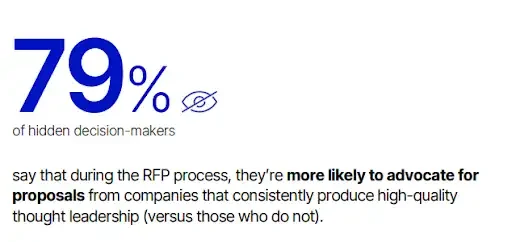
Image Source: Edelman
In other words, B2B podcasts aren’t niche anymore. They’re a frontline channel for influence, and the host is the face of that channel.
Whether you’re trying to spark new relationships, accelerate deal flow, or deepen trust with your ICP, your host needs to show up as both a sharp interviewer and a credible brand ambassador. Because when the host is dialed in, the whole podcast becomes a revenue engine.
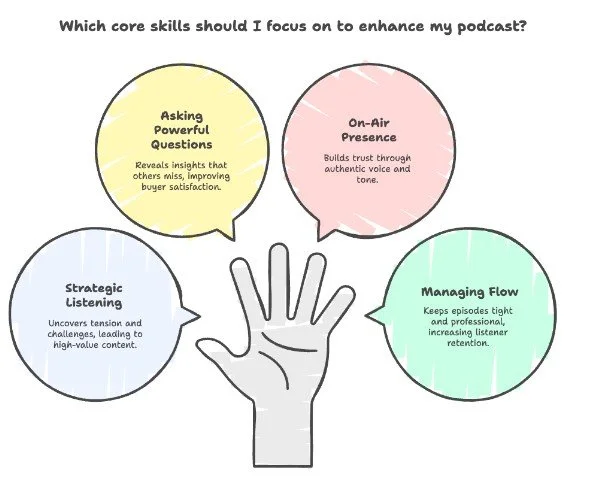
Core Skills Every B2B Podcast Host Must Master
Being a podcast host goes far beyond just chatting into a mic. It’s about mastering a set of skills that drive real business outcomes. You need to figure out how to include deeper insights, stronger stories, and more meaningful conversations.
Here are the must‑haves.
1. Strategic Listening
Strong hosts don’t just hear words. They track patterns in real time.
McKinsey’s 2024 B2B Pulse shows that buyers expect richer, more thoughtful conversations from vendors, and they disengage quickly when a brand doesn’t provide it.
A strategic listener:
Detects inflection points, where a guest’s voice shifts or they pause
Notices micro-tension, like hesitation or vague wording
Spots' story anchors (“We almost lost the deal…” “We had to change everything…”)
Follows emergent threads that weren’t in the outline but carry real value
Recognizes buying signals (pain points, misalignments, future plans)
This is how you pull out episodes that reveal genuine expertise, not rehearsed talking points.
Example:
Guest: “That quarter nearly broke our team.”
Weak host: “That sounds tough. Next question…”
Strong host: “What made that quarter so challenging? What changed after that?”
Strategic listening turns vague statements into compelling stories.
2. Asking Questions That Pull Out Powerful Insights
Great B2B hosts treat questions as a way to reveal how leaders think and make decisions.
Question ladders help you shape that process. You begin with a simple anchor question, then move through layers that uncover context, internal pressure, key decisions, turning points, and final takeaways.
Forrester’s State of Business Buying 2024 notes that 86 percent of B2B deals stall because buyers struggle to find clear insight. Another 81 percent believe vendors don’t understand their challenges. Strong questioning addresses this directly because it uncovers the details buyers want to hear.
A ladder might begin with, “What was happening before this shift?” then move to, “What pushed you to act?” followed by, “Where did the internal friction appear?” before closing with, “What should other leaders learn from your experience?”
This structure helps your guest surface stories and operational knowledge they rarely share elsewhere, which gives your episode more authority and long-term value.
3. On‑Air Presence: Voice, Tone, Pacing, and Authenticity
Your presence shapes how listeners interpret every moment of the conversation. B2B audiences look for confidence, clarity, and intention, and they judge that through your delivery as much as your questions.
A strong on-air presence comes from specific habits:
Steady vocal control that keeps your tone even and reduces distractions for the listener
Pacing that matches the guest’s energy, slowing down during moments of tension and speeding up when the conversation needs momentum
Clean mic discipline, including consistent distance, minimal movement noise, and intentional breathing
Eye contact on video that shows you’re engaged and signals to the guest that it’s safe to expand
Authentic reactions that respond to real emotion rather than a scripted persona
Pauses after key statements so the guest feels space to add more depth
Each of these cues helps your guest relax and encourages them to share meaningful stories instead of polished talking points. That shift elevates the entire episode.
4. Managing Flow: Transitions, Tangents, and Closing Strong
A great conversation still needs structure. Flow is the skill that turns a guest’s raw insight into an episode that feels intentional, clear, and worth listening to. When you control the flow, you keep the audience engaged and help your guest deliver their strongest material.
Strong hosts use specific techniques to guide the arc of the interview:
Smooth transitions that move the conversation without breaking energy (“That connects to something you mentioned earlier. Let’s go there next.”)
Confident redirection that brings a guest back when they drift (“I want to revisit your earlier point because it connects directly to this challenge.”)
Segment cues that signal a shift into examples, stories, metrics, or lessons (“Let’s anchor this in a real moment from your team.”)
Clarity checkpoints that help the listener follow complex ideas (“So far you’ve shared the challenge and the decision. What came next?”)
A strong close that ends the episode with a single takeaway and a clear next step for listeners
Flow turns a conversation from a loose discussion into a predictable rhythm. When listeners feel that rhythm, they stay longer, and your episodes perform better across retention, replay rates, and clips for social distribution.
How to Prepare Like a World‑Class B2B Podcast Host
Preparation is the secret weapon of great hosts. The more deliberate your guest research, outline, and pre‑call setup, the sharper the episode, and the more impact the interview has with your audience and your business goals.
Research Your Guest Like a Strategist
Surface-level research is not enough for B2B hosting. Strong hosts dig for signals that reveal how the guest thinks and what their audience cares about.
You look for patterns in:
Past interviews to understand what they repeat and what they avoid
Company news that shapes their priorities or pressure points
Customer pain points they solve and the gaps they fill in their industry
Moments of tension in their story that can anchor the episode
This type of research helps you create questions that feel tailored, not generic. When a guest realizes you understand their world, they relax. That’s when they offer detail, nuance, and experience your audience can actually use.
A well-prepared host doesn’t try to impress the guest; they set the guest up to shine. This shift builds credibility for your brand and creates a conversation that feels sharp and intentional rather than improvised.
Build an Episode Outline That Guides the Conversation
Your outline acts as the spine of the episode. It keeps the conversation focused while giving you enough flexibility to follow valuable threads that appear in real time. Strong B2B hosts treat the outline as a strategic roadmap, instead of a script.
Start by setting the core purpose of the episode. This helps you decide what the conversation should reveal for your ideal listener.
Then shape the flow around 3 anchors: context, challenge, and outcome. These anchors help you guide the guest toward stories and insights that carry weight.
Mapped questions support each anchor, and your follow-ups sit underneath them. This structure allows you to move deeper without forcing the guest in a direction that feels unnatural.
The “3 Insight Rule” also keeps you aligned: define three takeaways the listener should remember, and use the outline to steer the conversation toward those moments.
When your outline works like this, you reduce filler, tighten the arc of the episode, and make post-production faster because the conversation already has a clear rhythm and direction.
Prepare Your Guest Before the Recording Starts
A short pre-call sets the tone for a stronger interview. It helps the guest understand your style, reduces on-air friction, and gives you insight into what they’re comfortable sharing. When the guest feels guided, they deliver clearer stories and more useful details.
Use the pre-call to set expectations and build trust:
Warm connection: Start with a light conversation to relax the guest and understand their communication style.
Clear structure: Walk them through the episode flow, how long each segment usually runs, and the type of examples your audience values.
Aligned angles: Confirm the themes you want to explore and ask about any areas they want to highlight or avoid.
Confidence cues: Reassure them about editing, retakes, and pace so they feel safe going deeper during the interview.
This short preparation step gives both sides clarity and reduces surprises once the recording starts.
Want to streamline your workflow for podcast creation, from guest interviews to audio editing software and hosting platforms? Head to the Podcast Scripting Made Easy: Real Agency Examples and Templates resource from Content Allies.
P.S. In case you’re thinking about hiring a host instead of training one, we’ve broken down exactly what to look for in our YouTube video, “How To Hire a B2B Podcast Host.” It covers the traits, questions, and evaluation steps that help you choose someone who can lead sharp, insight-driven interviews.
Interview Techniques That Separate Amateur Hosts from Pros
When you’re hosting a B2B podcast, the difference between good and great often comes down to how you interview. The techniques you use determine whether your guest delivers a memorable story or just a predictable soundbite.
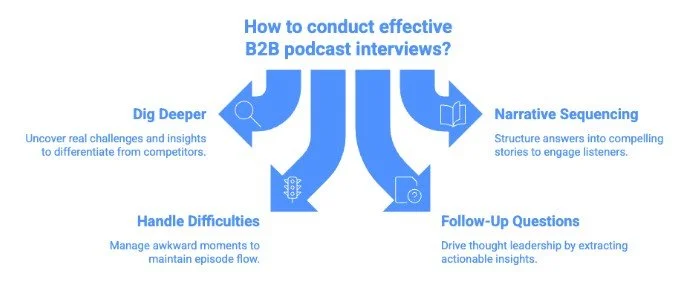
The Art of Digging Deeper (Without Interrupting)
Surface-level questions lead to surface-level answers. A strong B2B host guides the guest toward the real challenge, the moment of tension, or the shift that changed their approach. When you do this well, the conversation feels valuable instead of predictable.
According to a B2B podcast benchmark study, B2B podcasts that achieve a 67% average audience retention rate indicate listeners are engaged and trust the content, which matters when you’re aiming for deep insights rather than surface soundbites. It comes from questions that help the guest unpack meaningful decisions, turning points, and lessons.
When you guide the guest into these layers without interrupting their flow, you give your audience something competitors rarely offer: a clear look behind the scenes of how leaders think. This is the difference between a guest sharing something memorable and a guest repeating the same talking points they’ve given everywhere else.
Narrative Sequencing: Turning Raw Answers into a Story
A raw answer gives you information, but a structured arc gives your audience clarity. Strong hosts use narrative sequencing to turn scattered thoughts into a story that lands with impact. The goal is to help the guest walk listeners through what happened, why it happened, and what changed as a result.
A simple and effective sequence is Context → Challenge → Change. This moves the conversation from setup to tension to resolution in a way that keeps the listener focused.
For example, instead of accepting a generic response, guide the guest with prompts such as:
“What was happening inside the team when this problem first appeared?”
“What forced you to take action at that point?”
“What shifted after you made that decision?”
This sequence turns a flat explanation into a journey. It highlights stakes, choices, and outcomes, the material B2B listeners value most. When you shape answers into a clear arc, the episode holds attention longer and becomes far easier for your audience to remember and share.
Handling Difficult Guests, Long Answers, or Low‑Energy Sessions
Every host eventually runs into awkward moments. A guest might drift off topic, speak in circles, or lose energy halfway through. These moments can break the flow if you don’t step in with intention. Strong hosts keep control without making the guest feel corrected.
Use these on-air techniques to keep the conversation sharp:
Redirect with clarity: When a guest rambles, guide them back without shutting them down. “That’s helpful context. Let’s narrow in on the moment when things shifted.”
Re-energize with a targeted prompt: Low energy often lifts when you ask a question that moves them into memory or emotion. “What was the biggest surprise you encountered once everything changed?”
Protect the usable portion of the answer: If the response starts drifting again, tighten the moment. “Let’s pause there for a second. I want to pull on the earlier point you made…”
Anchor the conversation with a reset: Use a clean reset to regain structure.
“I want to make sure listeners follow this clearly. Let’s jump to the next step.”
These techniques keep the episode steady and prevent long sections from turning into editing headaches. When you guide a difficult moment with confidence, the guest feels supported, and the conversation stays valuable for your audience.
Pro Tip: Want to build a strong show concept and content plan that aligns with your business goals? Check out our guide on how to position yourself as an authority through podcasting.
Driving Thought Leadership With Follow‑Up Questions
One great question sets the scene, but smart follow‑ups dig deeper. After your guest answers, ask questions like, “Why did that matter?”, “What would you do differently now?”, and “How should other execs think about this?”
These follow‑ups turn content into insight. And in the B2B world, being able to deliver that kind of insight is a real differentiator. When your hosts ask questions that address these stalls and help clarify change, you’re giving listeners something they can act on.
Storytelling for B2B Hosts: Make Your Episodes Memorable
In B2B podcasting, your audience connects when you turn insight into a story. A host who can guide guests into narrative mode makes episodes stick, builds trust, and moves listeners toward action.
Turn Insights Into Stories Your Audience Remembers
Instead of presenting each insight standalone, use a clear arc, like the context, challenge, and change formula we mentioned earlier.
Start with what was going on, dig into the turning moment, then show what changed and why it matters. According to Forrester Research, B2B marketing professionals who use storytelling techniques (not just metrics) are far more likely to have their work perceived as strategic rather than just tactical.
When your host helps the guest narrate this arc, the episode becomes a story as opposed to just a conversation.
Use Micro‑Stories to Build Authority
Short, specific anecdotes beat broad overviews. When your guest says “Here’s a quick moment…” and then tells a 60‑second story about a misstep or turning point, listeners tune in.
You should include host stories, too, but keep them brief and relevant, so the guest remains the hero. This builds both authority for the guest and authenticity for your brand.
How to Guide Guests Into Story Mode
Most guests don’t naturally tell stories. You need prompts that move them into memory, tension, or reflection. Try questions that pull them back into a real moment:
“Tell me about the moment you realised everything had to change.”
“What do you wish you’d known right before that kick‑off?”
“What’s the one failure that taught you more than the win?”
These prompts shift the focus from what your guest did to what they became.
Avoid the Classic Storytelling Mistakes Hosts Make
A story loses impact when the host mishandles it. Keep these principles in mind:
Don’t over‑edit the guest’s story until it loses its real‑world grit
Don’t rush them. Good stories need time to breathe.
Don’t make it all about the host. The guest should still be the protagonist, with you as the guide.
When you respect the story’s rhythm, listeners engage longer and recall more.
P.S.: If you’re looking to improve discoverability across Apple Podcasts, YouTube, and social media with a full distribution strategy, check out the Enterprise Podcast Distribution Strategy Guide from Content Allies.
Remote‑Recording Skills Every Modern Host Needs
Recording remotely is now a must for B2B podcasts. Your guest might be halfway around the world, and the quality of the recording still needs to reflect your brand.
This section walks you through what it takes to sound (and look) professional.
Tech Setup for Clean, Professional Audio
The basics still matter, like a mic, headphones, and a quiet space. Use a USB or XLR mic, monitor with closed‑back headphones, and record in a quiet room. Make sure each guest records a local track (so internet hiccups don’t ruin audio). Use wired internet when possible.
Video Presence for High‑Value B2B Clips
Remember that, in many cases, your host is also visible. For LinkedIn and YouTube clips, you’ll need: decent lighting, good framing (eye-level camera), minimal background distractions, and stable internet. For B2B podcasts with video snippets, this matters because your clips could land on execs’ feeds and build brand authority.
Reducing Retakes and Post‑Production Fixes
It’s easier to record clean than to fix sloppiness later. Prep your tech with a mic check, monitor during recording, and have a backup like a local device or a second recording.
One podcasting survey says 60% of corporate podcasts use dedicated recording platforms, which reduces quality hiccups. Less editing means faster production, lower cost, and more episodes.
How to Practice and Improve as a B2B Podcast Host
Turning a good podcast into a great one is less about luck and more about repetition, review, and refinement.
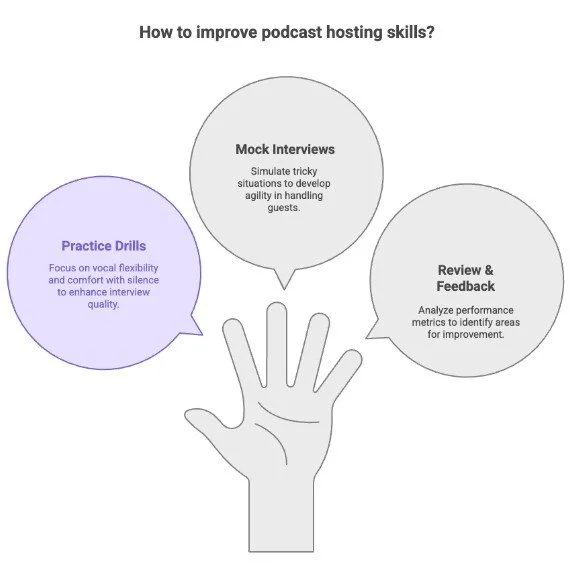
The key practice areas to build your skills over time are:
Practice Drills
Practical repetition builds confidence faster than theory. These drills help you strengthen your delivery, sharpen your timing, and get comfortable guiding conversations in real conditions.
Record short mock interviews of about 10‑15 mins with internal team members or guests. Review them for filler words, pacing, and clarity.
Try a “silent host” drill where you ask a question and then stay silent for 5‑7 seconds to let your guest fill the space. This builds comfort with silence and can lead to deeper answers.
Use voice‑training warm‑ups. Read a paragraph while changing your volume, pace, and tone, and repeat with emphasis on key words to build vocal flexibility.
Mock Interviews & Role‑Play Scenarios
Real improvement comes from practicing situations that throw you off balance. Role-play gives you the space to test reactions, refine redirects, and build confidence before you face these moments in a live recording. If an executive is hosting your show or appearing as a guest, our guide to executive podcast media training covers how to prepare.
Simulate tricky guest situations, like if a guest starts rambling or goes off‑topic. Practice redirecting with phrases like “That’s a great insight, let’s zoom in on…”
Try rapid‑fire follow‑ups where you pick 3‑5 answers from a previous episode transcript and craft 2‑3 follow‑up questions for each. This sharpens your agility in the moment.
Review & Feedback Loop
Skill growth depends on honest evaluation. Reviewing your episodes with specific metrics in mind helps you spot patterns, reinforce strengths, and correct habits that hold the conversation back.
After each episode, review the transcript. Look at how often you asked “yes/no” questions, how long your questions were, how many transitions you used, and whether you ended with a strong takeaway and CTA.
Compare analytics like consumption rate, click‑throughs, and demo requests from the episode’s links. Use these numbers to identify what parts of your hosting style drove or lost engagement.
Set monthly goals. These could be to reduce filler words by 25%, increase guest‑story segments to 40% of episode runtime, or improve mid‑roll CTA response by 15%.
When You Should Work With a Podcast Production Partner
As your B2B podcast grows in scope and ambition, there comes a point where DIY production just doesn’t cut it anymore. Bringing in a partner can free your team to focus on strategy and guest conversations, while the production machine gets to work behind the scenes.
Signs it’s time to partner up:
Your episode schedule is inconsistent or frequently delayed
Audio or video quality is visibly weak
Guests struggle with flow, or the episode lacks dynamic direction
You’ve got minimal repurposing of content into clips, blog posts, or social content
Analytics don’t show engagement or pipeline metrics improving
You want your show to drive relationships, leads, and business outcomes
How Tonkean Created the #1 “Operations” Podcast on Apple by Partnering with Content Allies
Tonkean, a business process management platform, wanted to establish itself as a serious player in the enterprise tech space. Their goal was to launch a high-quality podcast that would attract business leaders and boost their brand authority in the world of operations and automation.
Initially, Tonkean considered producing the show internally, but quickly realized it wouldn’t be sustainable long-term. They needed a partner who could take over the heavy lifting, from strategy to production, and make the podcast feel enterprise-grade.
What Content Allies Delivered:
Developed and launched the Modern Business Operations podcast
Handled branding, guest outreach, scheduling, and ongoing production
Delivered full post-production, clip creation, and episode promotion
Created a complete brand identity package for the show
The Results:
In just 6 months, the podcast became the #1 operations podcast on Spotify
Unique listeners grew by 174.36% in one quarter
The audience included top brands within Tonkean’s target market
Briana Okyere (Tonkean team) said:
“In six months, we became the top podcast in our category on Spotify, and that was through the work of Content Allies. We wouldn't have been able to hit that spot without them, and it is a huge win for us.”
This is a perfect example of how strategic podcasting can create brand authority, reach the right audience, and drive measurable business growth. See the full case study here.
Get Professional Podcast Host Training With Content Allies
Most B2B hosts have the insight, but lack the structure, coaching, and production support to deliver standout interviews that build authority and generate demand consistently.
That’s where we Content Allies come in.
At Content Allies, we turn executives and marketers into confident, skilled podcast hosts. We guide you through guest prep, hosting techniques, and storytelling frameworks, while handling all the behind‑the‑scenes production so you can focus on what you do best: building relationships and having great conversations.
If you're ready to level up your podcast with expert training and production support, let’s talk.
FAQs
1. What’s the difference between an audio podcast and a video podcast, and which is better for B2B?
Audio podcasts are easier to produce and consume, while video podcasts tend to perform better on social media platforms like LinkedIn and YouTube. The best choice depends on your content plan and where your audience spends their time.
2. How do I get my podcast on Apple Podcasts and other podcast directories?
You’ll need a hosting platform that distributes your show to directories like Apple Podcasts, Spotify, and Google Podcasts. Most podcast software handles this with one-click distribution during podcast creation.
3. What podcast equipment and audio recording tools do I need to get started?
At a minimum, a good microphone, headphones, and stable internet. Many B2B teams also use external audio editing software to improve quality, especially when creating internal podcasts or professional guest interviews.
4. How do I come up with a strong show concept and interviewing strategy?
Start with your audience and business goals. Build your show concept around topics they care about, and develop interviewing skills that bring out insightful stories and takeaways from each podcast episode.
5. What role does a podcast play in a broader marketing strategy?
Podcasts build authority, spark relationships, and fuel other content formats. You can turn one podcast idea into blog posts, audio playlists, digital products, lead magnets, and more, all while aligning with your show strategy.
6. How does Content Allies support strategic podcast development?
We don’t just launch shows; we help clients define their show strategy, guest interview skills, content development plan, and distribution model. Every decision ladders up to real business outcomes.
7. Can Content Allies help with podcast creation and editing?
Absolutely. From podcast equipment selection and audio recording to editing and final post-production, we handle the full workflow. Our team uses pro-level podcast software and editing tools to make sure every episode sounds polished.
8. What makes the Content Allies client experience different?
We offer more than just production. You’ll get help with peer review of interview questions, refining your podcast idea, and building a scalable system that supports media brands and lead-gen campaigns.