
How to Build a B2B Podcast Content Strategy That Actually Supports Sales

A B2B podcast is a powerful content engine that can drive leads, boost authority, and move the needle on sales.
But only if you build it right.
When we partnered with Meta, for example, we built a B2B podcast content strategy that nailed this alignment, and it worked.
We 7x’d their expected downloads by tying each episode to the right audience, sales stage, and business goal.
In this guide, we’ll show you how to build that same kind of results-driven content strategy from the ground up.
Pro tip: If you’re looking for expert help, working with a specialist like Content Allies can help you build alignment from day one.
What Is a B2B Podcast Content Strategy?
A well‑crafted B2B podcast content strategy is your roadmap for creating and disseminating content to fuel your show. If you follow a data-driven approach, your branded B2B podcast becomes a strategic marketing channel.
So, your content should speak to your target audience, support your marketing teams and sales funnel, and take you closer to your broader revenue goals.
A strong strategy involves planning persona‑driven topics, integrating content creation and guest bookings, and treating your show as part of the wider content lifecycle.
For a short breakdown of podcast content strategy, see this YouTube video.
Why Do You Need a B2B Strategy for Your Content?
If you’re running a branded B2B podcast without a clear content strategy, you’re basically throwing episodes into the void and hoping something sticks.
A content marketing strategy for your podcast ties it into your broader marketing team’s goals.
That’s because it considers your target audience, your buyer journey, and your sales funnel.
Here’s the problem:
According to the annual survey from Content Marketing Institute (CMI), only 29% of B2B marketers say their content strategy is “very or extremely effective.” That means a significant chunk of marketers know it’s falling short.
To avoid that from happening to you, think of your podcast as another marketing channel in your content ecosystem, much like social media, blog posts, or an email campaign.
When your podcast content speaks to your buyer personas, your sales teams will see you reach your quarterly revenue goals faster.
Besides, a good content strategy turns your podcast into a thought leadership engine, a lead‑gen tool, and a deeper touchpoint with your B2B brands. Without that coordination, it’s just content creation for the sake of it, and won’t necessarily drive pipeline or support your B2B goals.
Remember: Working with a specialist like Content Allies can help marketing teams hit that sweet spot from day one.
How to Create a B2B Podcast Content Strategy: Our In-house Plan
Here’s the exact, battle-tested framework we use to help B2B brands turn their podcasts into real revenue drivers.
1. Define Your Strategic Framework
Every successful B2B podcast content strategy starts by answering three simple questions:
Who are you talking to?
Where are they in the buyer journey?
What business outcome are you trying to work towards?
Mapping your podcast against those three helps you get content with direction and purpose.
Start with your personas. Your target listener might be a VP of Marketing in a B2B organization, or a procurement lead at a tech company. Knowing who they are and what they care about helps you steer your content toward their pain points and interests.
Next, align with the sales funnel.
48% of content marketers say aligning content with the buyer’s journey is a major challenge, so this is crucial. Where is your ICP in the sales funnel now?
Awareness: They need episodes that introduce big ideas, trends, or thought‑leadership to target audience members.
Consideration: Plan episodes that dig into how solutions work, feature guest stories, or discuss real challenges your sales teams hear.
Decision: Post episodes that highlight case studies, ROI, demos, or gate‑closer themes designed for folks ready to engage with your brand.
Here’s an example from one of our clients’ podcasts, Dots Loves Marketing:
| Episode title | Funnel stage | Why |
|---|---|---|
| B2B Podcasts Need Less B2B and Way More of This | Awareness | Discusses big-picture strategy, creative freedom, and audience-first content. |
| Steffen Hedebrandt — The Culture of Marketing Revenue Attribution in Go-to-Market Teams | Consideration | This one dives into real-world challenges like aligning marketing with revenue. Perfect for those evaluating solutions or partners. |
| High-impact Customer Stories That Build Brand Advocacy | Decision | This episode is packed with case study talk and shows how brands can turn customer wins into trust-building assets. Ideal for listeners close to making a decision and wanting proof of ROI. |
Then map to quarterly revenue goals. Maybe your goal this quarter is to enter a new vertical, upsell existing clients, or nurture mid‑market opportunities. Every pillar, series, and episode should tie back to one of those goals so you can measure business value.
Our team at Content Allies found that many B2B podcasts still chase downloads when the smarter play is to chase pipeline impact. However, your editorial calendar should be the bridge between high‑level strategy (personas & goals) and tactical episodes to create a growth machine.
2. Pillars and Series Planning
Once you’ve nailed down your personas, sales stages, and revenue goals, the next step is shaping your content calendar with pillars and series. This is where strategic planning meets creativity, and where your B2B podcast starts to feel like a real editorial engine.
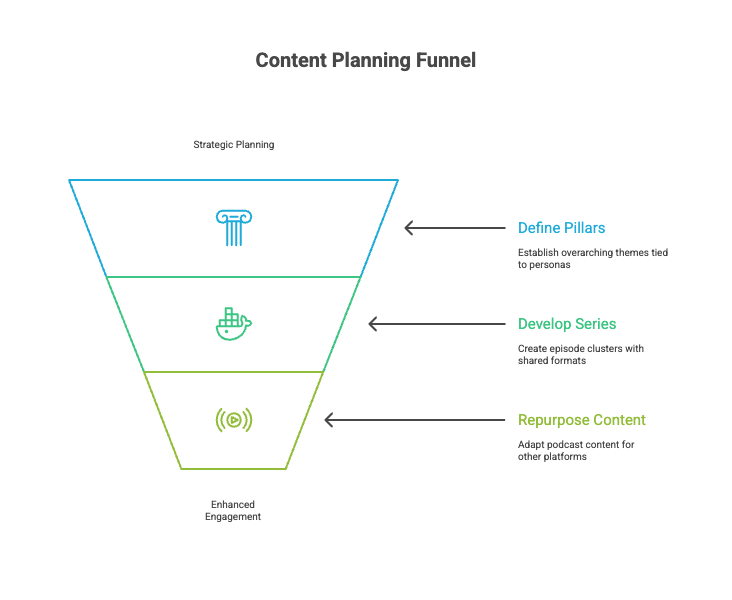
Pillars are your big, overarching themes. Each one is tied to a key buyer persona, a business goal, or a part of the customer journey. For example:
“Industry Trends” → Awareness for execs and thought leaders
“Customer Stories” → Consideration content for mid‑funnel leads
“Expert Advice” → Bottom‑of-funnel, decision-making content for technical buyers or committees
Take a look at another of the podcasts we helped produce, Leaders of B2B. Here’s how its episodes map to these points:
| Episode Title | ICP | Business Goal | Sales Funnel Stage | Content Pillar |
|---|---|---|---|---|
| Creating Human-Centered Workplaces in the Age of AI with Oz Rashid | HR leaders & Talent Strategy Executives | Build stronger, high-performing teams in an AI-driven era | Awareness | Future of Work & Leadership |
| Modernizing Impact Strategy with Neelima Grover of Q2Impact | Consulting & Transformation Leaders | Navigate business reinvention and transformation | Consideration | Strategic Resilience & Innovation |
| Making the Invisible Visible: Team Utilization Strategy with Michael Daoud | Ops & Service Firms Executives | Boost profitability through operational efficiency | Decision | Operational Excellence |
| Marketing That Moves the Needle with Amy Higgins of Cloudflare | B2B Marketing & Content Strategy Leads | Align sales and marketing to drive growth | Consideration | Marketing Strategy & Alignment |
| Breaking Through the Noise in Marketing with Matt Krebsbach of Acquia | Brand & Marketing Leaders | Stand out with authentic messaging and storytelling | Awareness | Brand Positioning & Thought Leadership |
Under each pillar, you’ll build out series, which are clusters of episodes with a shared format or narrative style. Maybe one series features client success stories, while another dives into tools and tactics with in-house experts, and a third brings in media brands or guest strategy roundtables with partners.
This structure keeps your content consistent, easy to plan, and more engaging for your target audience. It also makes your podcast easier to promote because you can group content by theme when repurposing into social media clips, email campaigns, or social media posts.
According to a recent Databox report, over 40% of B2B brands want to use their podcast as a thought leadership platform, for example. This is the kind of direction you can take if you have a clear strategy.
At Content Allies, we’ve seen this model work across industries.
Building with pillars and series helps with content planning and also makes it easier to track what’s working and adjust your strategy fast.
3. Topic Selection: Sales Intelligence and SEO
When you’re building a B2B podcast content strategy, topic selection isn’t just about what sounds interesting to you.
It’s about what moves your target audience and makes sense within your marketing channel goals. There are two key concepts here: sales intelligence and podcast SEO/ keyword research.
First, sales intelligence.
Talk to your sales teams, customer success leads, and front‑line reps. Ask:
What pain points customers raise
What objections keep coming up
What questions each buyer persona is asking
These conversations uncover topics your audience genuinely cares about, so you can map those insights to your personas and sales stages.
For example, a C‑suite exec may ask big‑picture “industry trend” questions (awareness), while a procurement lead may ask “how does this solve our problem” (consideration) or “why choose you” (decision).
Second, SEO/keyword research. Once you’ve got your sales insight, plug those topics into keyword tools like Ahrefs or Semrush to find what your audience is actively searching for.
For example, if your core keyword is “b2b podcast content strategy”, then discover related search terms like “guest strategy for b2b podcasts”, “podcast content calendar for b2b marketers”, or “how to track content ROI in b2b podcasting”. Use data on keyword volume and intent to prioritise episodes.
Workflow to follow:
Gather sales input (pain points, objections).
Map those to your buyer personas and sales stages.
Run keyword research for each mapped topic.
Pick episode topics that hit the intersection of audience need, search demand, and business value.
Pro tip: If you want a deeper dive into how to build a revenue-driven B2B podcast, Content Allies put together a free Enterprise Podcast Production Guide packed with templates, content planning tips, and real examples from shows we’ve launched for B2B brands across industries.
4. Guest Mix and Episode Templates
One of the most common mistakes in a branded B2B podcast is sticking to just one format, interview after interview. Over time, your target audience will notice because the show starts to feel predictable in the negative sense of the word.
At Content Allies, we’ve seen shows with varied guest formats and strong templates generate higher listener engagement, more social‑media clips, richer show notes, and better alignment with sales teams.
To keep things fresh, in line with your sales funnel, and valuable for your target listener, you’ll want a smart mix of guests and consistent episode templates.
Design your guest mix:
In‑house expert and external guest: Use these episodes to drive credibility and position your brand and guest as thought leaders together
Customer story: Bring on a client or partner who went on the kind of journey you help enable. This is perfect for the consideration stage of the buyer journey. Besides, according to the Databox report we mentioned earlier, 53.28% of survey respondents said getting more prominent guests was one of the best ways to boost podcast subscribers for B2B brands.
Panel discussion with multiple voices: A roundtable format adds dynamism, gives multiple points of view, and works well under your “Expert Advice” pillar.
Solo thought‑leader episode: The host takes centre‑stage on a high‑impact topic, which is ideal for awareness and establishing your brand’s voice as a media brand in the content ecosystem.
Episode template idea:
Intro (30–60 seconds): Set the context, name the guest(s), and tie to a pain point or insight
Main conversation (20–30 minutes): Structured around 3‑5 key questions focused on persona pain points, objections from sales teams, and business value
Key takeaways (2–3 minutes): “Here’s what we learned, what you can do next.”
Next‑step call‑to‑action aligned to the sales stage: For example, “If you’re exploring this challenge (consideration stage), talk to your team about this whitepaper; if you’re evaluating (decision stage), book a demo with…”
Mapping guest formats back to pillars keeps that content calendar tight. For example, under your “Expert Advice” pillar, you might run a regular panel. Under “Customer Stories,” you’ll alternate customer‑guest episodes.
5. Editorial Calendar and Production Workflow
Once you’ve set your pillars, series, and episode types, it’s time to map everything into a living content calendar, which is the operational backbone of your B2B podcast content strategy.
Start with a quarterly theme like “Expanding into vertical X”, then break it down into a monthly series (e.g., “Customer success stories”), and finally into weekly episode slots (e.g., Mondays: in‑house expert interview; Wednesdays: guest panel discussion).
Here’s what that might look like:
Sample Editorial Calendar Structure
| Timeframe | Theme/Series | Episode Format | Publishing Day | Focus Area |
|---|---|---|---|---|
| Q1 Theme | Expanding into Vertical X | New customer acquisition in Industry X | ||
| Month 1 Series | Customer Success Stories | Interview with existing client | Mondays | Consideration-stage content |
| Solo insights episode (host-led) | Wednesdays | Awareness-stage leadership | ||
| Month 2 Series | Industry Trends and Insights | Panel discussion with industry experts | Mondays | Awareness and early-funnel engagement |
| In-house expert on market data/trends | Wednesdays | Strategic positioning | ||
| Month 3 Series | Objection Handling and Differentiation | Customer case study with technical deep dive | Mondays | Bottom-of-funnel education |
| Product-focused guest and internal expert | Wednesdays | Decision support |
Your production workflow should clearly reflect these phases:
Recording dates and guest bookings: Reserve studio or remote time, confirm guest logistics, and block in‑house host prep
Editing windows: Post‑production must include editing, sound‑check, show notes drafting, transcript generation, and approval
Promotion windows: Schedule social‑media posts, email campaigns, embedded snippets, quote graphics, and distribution to your podcast app and media server
Repurposing windows: Each episode should feed your other marketing channels like blog posts, LinkedIn posts, email marketing, social‑media clips, and thought leadership pieces
Side note: Repurposing ties your show into your broader content marketing and social‑media strategy. According to research from Semrush, 42% of businesses say that updating and repurposing content leads to content marketing success.
By building your calendar this way, you link your content creation effort to the buyer journey and get measurable business outcomes.
Remember: as our team at Content Allies emphasises, view your podcast as the central piece in your content lifecycle and a driver of content ROI.
6. KPI Dashboard & Pipeline Impact
If your B2B podcast content strategy stops at “how many views we got,” you’re missing the real value. To make a branded B2B podcast a growth engine, you’ve got to tie it to leads, opportunities, and revenue.
Here are the B2B podcast KPIs we encourage you to follow by sales stage.
Awareness stage: downloads, unique listeners, and average listen‑through rate
Consideration stage: website visits driven from podcast, content downloads triggered by an episode, demo requests, or contact form fills coming from guest networks or podcast mentions
Decision stage: meetings booked, pipeline generated that can be attributed to podcast‑driven activity, and closed‑won deals influenced by a guest or topic featured in your show
However, you need to understand how those interactions contribute to your actual pipeline.
According to the 2024 “Marketing Measurement & Attribution Benchmark Survey,” only 28% of marketing professionals rate their attribution strategies as “very successful” in achieving strategic objectives.
That means most teams don’t tie their podcast content to business results correctly.
When you map KPIs to each funnel stage and track attribution across those interactions (like a demo request tied to a guest mention), you start uncovering what really moves deals forward. And that’s where your podcast becomes a true growth engine.
Pro tip: We advise you to build attribution models from the start. Set up custom UTMs for episode links, track referral sources in your forms (like “How did you hear about us?”), and tag CRM records when leads mention the podcast. That way, you’ll know which episodes or guests are actually influencing the pipeline
Best Practices for Your B2B Podcast Content Strategy
Even with a strong content calendar and strategy, the difference between a good B2B podcast and a great one often comes down to execution. Here are a few best practices we've learned from producing podcasts for B2B organizations across industries:
1. Plan 90 Days Ahead, But Stay Flexible
Build your content calendar in quarterly sprints. This gives your marketing team enough time for guest bookings, editing windows, and promotion, while staying nimble enough to pivot if market conditions change.
2. Set Interview Guardrails Rather Than Rigid Scripts
Structure your interviews with 3-5 anchor questions, but give guests room to go off-script. This gives a more natural feel, which is great for a deeper audience engagement. Plus, it even leads to better soundbites.
3. Invest in Production Quality
You don’t need a high-end recording studio, but bad audio or lighting can wreck credibility. Clean sound, good mics, and basic editing software are table stakes for branded B2B podcasting today.
4. Keep Episodes Tight and Intentional
Aim for 20-30 minutes unless the content truly needs more time. Think of it like a content format sweet spot that’s long enough to dig in but short enough to keep attention. Our blog post here goes into more detail about the perfect podcast episode length.
5. Repurpose Every Episode
Turn audio into quote graphics, short video podcasts, or social media clips, blog posts, and snippets for your email marketing. Use AI-powered repurposing tools like Repurpose.io to streamline the content lifecycle and boost ROI.
Build a Winning B2B Podcast Content Strategy with Content Allies
As we’ve learned, your B2B podcast can be a core part of your marketing strategy, a relationship-builder, and a real pipeline driver. But it only works if the strategy is right from the start.
Ready to turn your podcast into a growth engine?
Our team at Content Allies specializes in B2B podcast production, strategy, measurement, and repurposing.
Schedule a conversation to see how we can help you reach all your revenue goals with better content.
FAQs
What is a B2B podcast content strategy, and why does it matter?
It’s a plan that connects your podcast content to business goals by selecting topics fit for your target personas and the sales stages they’re in.
How often should we publish episodes in a B2B podcast?
Consistency is key to reaching your quarterly revenue goals. Weekly or bi-weekly works well for most B2B brands, as long as you can maintain quality.
How do we choose guests for our podcast to support sales goals?
Pick guests who can influence your target customers. These guests can include clients, prospects, industry experts, and partners aligned with your business objectives.
What metrics should we track to measure podcast impact?
Track metrics like listener engagement, website traffic from episodes, content downloads, demo requests, meetings booked, and pipeline influenced by specific episodes or guests.
How can we repurpose podcast content to support other channels (blog, social, email)?
You can turn each episode into blog posts, quote graphics, LinkedIn carousels, social clips, email campaigns, and more. Podcasts are one of the most efficient ways to fuel your entire content strategy.
How do we align our podcast topics with our sales funnel and buyer personas?
Start with sales team insights and keyword research, then map topics to personas and funnel stages: top for awareness, mid for education, and bottom for conversion.
What services does Content Allies offer for B2B podcast production and strategy?
We handle everything from strategy and content planning to guest outreach, production, editing, publishing, and repurposing, all tailored for B2B marketing teams.