
Podcast Compliance for Regulated B2B Sectors: Complete Guide
Podcasting can be a powerful tool, but in regulated sectors like finance and healthcare, you’ll hit trouble fast if you skip the rules.
With support from Content Allies, many enterprise brands are getting this right. In this guide, we’ll share our knowledge about podcast compliance from planning to publishing.
We’ll look at:
Legal checks
Data protection
Disclosures
And more
If you’re in a regulated industry, this is your guide to staying compliant without slowing down content.
Let’s dive in.
What Is Podcast Compliance?
Podcast compliance means making sure your podcast series meets the legal, risk, and marketing requirements that regulated industries demand.
The goal is to create content that aligns with regulatory standards (for industries like financial services, healthcare operations, the payments industry, and global business).
For that, you want to embed a strong culture of compliance, which is based on data privacy and information security.
Here’s a short video that covers the basics of regulatory compliance.
Why Does Podcast Compliance Matter?
Podcasting might feel casual, but in regulated industries, you have to follow certain best practices.
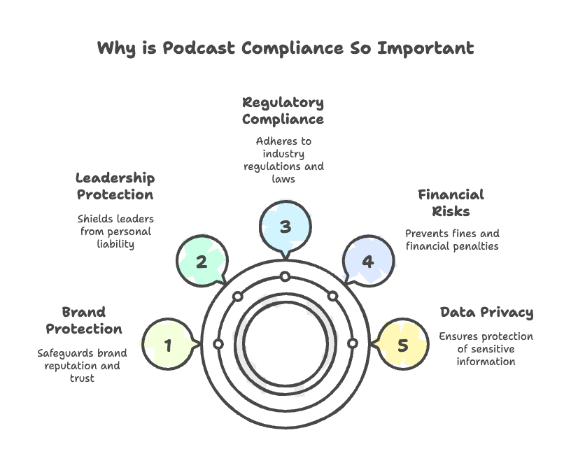
One offhand comment, unqualified claim, or mishandled data point can spark real trouble, apart from affecting user experience. You can expect anything from regulatory investigations to six‑figure fines and long‑term damage to your reputation. And this will affect your sustainable growth.
This matters even more today because compliance isn’t getting simpler.
According to PwC’s Global Compliance Survey 2025, 85% of respondents said that their compliance requirements have become more complex in the last three years.
For companies under strict frameworks like HIPAA, FINRA, GDPR, and international law, remember that your podcast is an extension of your brand. If it’s mishandled, the risks could extend to data privacy violations, biometric data exposure, or global compliance breaches.
That’s why you need to build trust with compliance leadership.
Following local laws protects your brand, your leadership, and your ability to use this powerful medium to engage decision‑makers in your niche confidently and securely.
How to Implement Podcast Compliance Step by Step
Let’s break podcast compliance into clear, manageable steps, from planning to publishing, so your team stays protected and aligned.
1. Pre‑Production: Setting the Foundation
Compliance starts in the podcast planning phase. Before your team even brings on a guest or writes the intro, the right foundation sets you up for a podcast that aligns with regulatory standards, mitigates risk, and supports your marketing goals.
Here are the pre-production steps you’ll want to take:
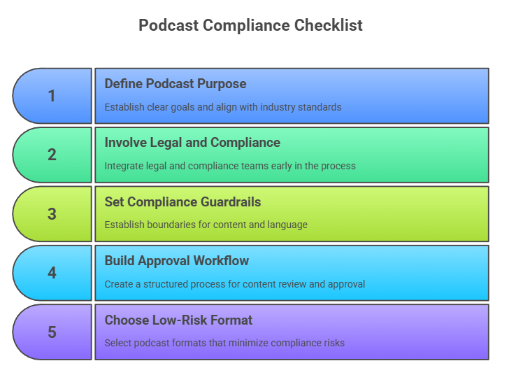
1) Define the podcast’s purpose.
Before scripting or guest outreach, determine the communication class your podcast belongs to, like:
Educational or informational content intended for peers or industry stakeholders
Internal alignment content for global teams
Thought leadership intended for prospects or partners
Insights related to the payments industry, healthcare operations, or financial markets
Each content class carries a different regulatory exposure. Compliance teams categorize content into risk tiers, such as:
Low-risk educational
Moderate-risk subject matter discussions
High-risk advisory or product-adjacent content
This determines the intensity of pre-approval, the disclaimer requirements, and the format limitations.
Pro tip: To avoid unintentionally crossing into regulated advisory territory, many enterprises position the show as “informational only” and restrict the host from making interpretive or promotional claims.
2) Involve legal, risk, and marketing teams from day one. When the Chief Compliance Officer, the legal counsel, and the marketing team sit together at the planning table, you build a culture of compliance and reduce friction later.
PwC’s Global Compliance Survey that we cited earlier also mentions that 51% of organizations now list cyber‑security and data privacy as top compliance priorities. While that is worrying, there’s also a silver lining: it shouldn't be too hard to get leadership's buy-in for these legal matters.
Side note: Getting compliance professionals involved is a great idea because they're up to date with regulatory changes.
3) Establish no‑go zones and guardrails.
Set the documented compliance parameters that guide all future production. These may include:
Categories of claims that require substantiation
Subjects that must never be discussed on-air
Language that triggers mandatory legal review
Guidance on referencing case studies, clients, or operational details
Expectations for how hosts should respond if a guest veers into restricted territory
This way, your podcast follows internal policies and meets regulatory standards.
Trigger Language Checklist
| Category | Examples (Triggers) | Why It Requires Review |
|---|---|---|
| Advisory or Guarantees | “You should…”, “We guarantee…”, “You will…”, “Best way to…” | Sounds like regulated advice or promises |
| Comparative Claims | “We outperform…”, “No competitor can…”, “Fastest way to…” | Requires substantiation and legal proof |
| Regulated Terms | “Investment strategy”, “Treatment”, “Diagnosis”, “Portfolio recommendation” | Implies regulated financial or medical advice |
| Real Clients or Cases | “One client…”, “A patient…”, “Internal incident…” | Can reveal identifiable info or confidential data |
| Forward-Looking Statements | “The market will…”, “We expect…”, “Next year we will…” | Predictions require qualifiers and legal review |
| Advice-Adjacent Statements | “The best approach is…”, “Companies must…”, “You need to…” | May be interpreted as guidance or instruction |
4) Set up your workflow and approval process. Build your content calendar, plan your guest selection, and prepare questions and outline review timelines.
You’ll also choose your format at this point.
Choose a podcast format that supports transparency, disclosure, and ease of moderation.
For regulated‑industry content, a more controlled format (like a moderated interview with pre‑approved questions) is much less risky than a free‑form conversation.
Remember: Consider your episode topics, guest pipeline, and review timelines before you hit record. For a concrete framework, check out our post on “B2B Podcast Content Calendar Planning”.
2. Claims Review & Content Accuracy
When you’re producing a podcast in a regulated B2B sector, getting your statements, data, and guest commentary right is essential. Misleading claims, unchecked endorsements, or unqualified forward‑looking statements can trigger regulatory risk, reputational damage, and legal liability.
That’s why we advise our clients to draft scripts or outlines with flagged claims.
Even if you don’t write out every word, you should prepare a detailed outline that highlights any statement that could be interpreted as a claim (“We guarantee X outcome”, “56% of companies do Y”). That way, your legal and risk team knows what to focus on.
Next, your legal/ risk team should review for data inconsistencies.
If you reference statistics, outcomes, case studies, or comparative claims, those need substantiation.
Many regulatory codes, like The Prescription Medicines Code of Practice Authority, require claims to be “accurate, balanced, fair, objective and unambiguous” and supported by evidence.
Check any statistics, comparative claims, and forward‑looking statements, too.
If you say “56% of companies do X”, you need to either cite the source (“According to …”) or include a disclaimer. Forward‑looking statements (“We expect the market to grow 20% in two years”) need qualifiers.
Here’s how that might look in practice. If you say “56% of companies do X”, you should follow with: “According to [Source, Year]” or “based on our internal survey of 500 organizations.”
That small step builds credibility and protects you.
Of course, you also need to check your guests’ info.
Guests can add richness and credibility, but they also introduce risk. Make sure their remarks that might sound like business or medical advice or guarantee outcomes are reviewed ahead of release (or at least red‑flagged for edits).
Pro tip: If a guest says, “We help 70% of users achieve X”, ask for proof or a qualifying statement.
Even better, you can prepare your guests before the podcast. Here are some tips to get you started:
By setting up a robust claims‑review process and empowering your legal, risk, and marketing teams to collaborate early, you’ll establish a culture of compliance around your podcast series and produce trustworthy, compliant content.
3. Data Handling, Privacy, and Confidentiality
When you’re producing a podcast in regulated industries, you’re handling sensitive data at every stage. That includes:
Guest details
Internal commentary
Transcripts
Even listener analytics
And just because it’s a podcast doesn’t mean it’s off the regulatory radar.
Remember: You can’t risk disclosing protected health information (PHI), personal financial data, or biometric identifiers.
A seemingly harmless story or casual mention could trigger compliance issues, especially if you’re discussing real cases, clients, or operational specifics.
Podcast Compliance Case Study Break
A well-known example of this risk comes from the S-Town podcast, which became the subject of a lawsuit after its release.
Even though the central figure, John B. McLemore, had actively cooperated with the production, his estate later claimed that the podcast violated his personality rights by commercially exploiting his story through advertising.
A judge initially allowed the case to move forward, leading to months of discovery before it was eventually settled.
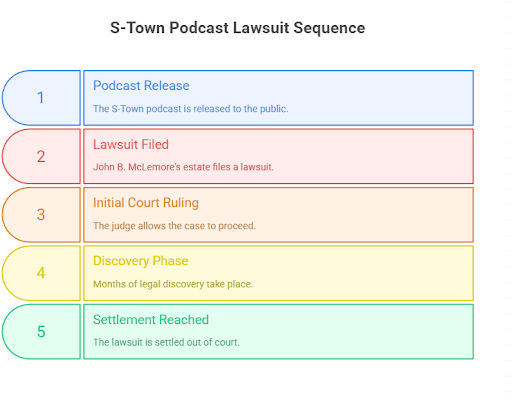
The takeaway is clear: even a story told with full participation can trigger compliance or legal issues once it reaches the public. That’s why you must treat real cases, clients, and operational details with extreme caution.
This means you need to communicate clear boundaries with hosts and guests before you hit record.
Then there’s how you store everything.
Recordings, transcripts, and analytics data need to be housed securely, with clear access controls, encryption, and audit trails. Everyone handling the files needs to understand the compliance protocols.
Regulatory frameworks like GDPR, HIPAA, and FINRA aren’t just for external campaigns or marketing teams.
⚠️Warning: Even internal podcasts, meant only for employees or partners, still fall under these rules if they involve sensitive information.
The difference between internal and external distribution might shift your publishing method, but it doesn’t change your compliance obligations.
You’ll also need to think through how and where you distribute your show.
Public platforms like Spotify or Apple Podcasts require clear disclaimers and appropriate messaging.
Gated or internal podcasts (say, for healthcare professionals) should use secure hosting platforms, login protections, and even region-based access if international law is in play.
And don’t forget about analytics. The moment you start collecting listener data like engagement metrics, location info, or usage patterns, you’re stepping into data governance territory.
Decide:
What you’re tracking
For how long you’ll store it
How it ties into your broader retention policy
Everything from raw audio to final transcripts needs a clear lifecycle.
If you handle data privacy right, it builds a strong foundation of trust with regulators and your audience. It shows your podcast is built for global compliance, data security, and a modern, risk-aware digital realm.
4. Disclosure Language, Guest Agreements & Editorial Controls
Clear disclosures, solid guest agreements, and structured editorial workflows are a key safety net when it comes to podcast compliance.
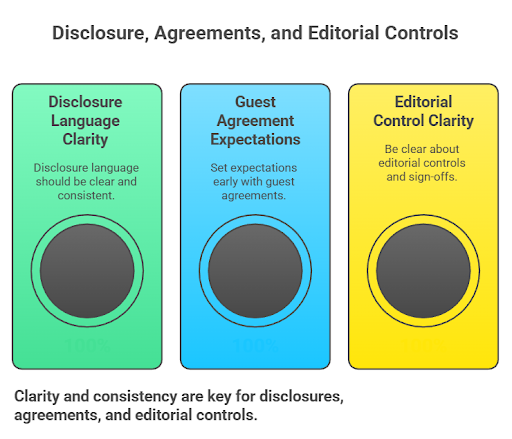
Disclosure Language Should Be Clear and Consistent
If there’s a sponsor, partnership, or affiliate link involved, your audience needs to know clearly and early. The Federal Trade Commission (FTC), for example, requires paid endorsements to be “clear and conspicuous.”
Some examples of disclosure language include:
“This episode is sponsored by [Company]. However, the opinions expressed are our own and not those of the sponsor.”
“The views expressed in this episode are those of the speaker and not of [Company]. This podcast is for informational purposes only and does not constitute legal/financial/medical advice.”
For regulated content, don’t skip this step, because disclosure language is non-negotiable.
Set Expectations Early with Guest Agreements
Guests bring credibility, but they also bring risk. A guest agreement helps protect everyone involved.
Your agreement should cover:
What guests can and can’t say (e.g., no forward-looking claims or guarantees)
Your right to edit or remove content as needed
Acknowledgement that their participation must comply with your company’s legal and compliance policies
Consent to record, edit, and publish the episode
These agreements give your legal and risk teams a strong starting point for compliance.
Be Clear About Who Editorial Controls and Who Signs Off On What
To get content right, you need to know who owns what. That means defining your editorial controls clearly:
Legal team reviews claims, disclosures, and liability risks
Risk team evaluates reputational impact
Marketing team makes sure messaging, branding, and audience are all in sync
Version control tracks all content edits and helps during audits or corrections
If an episode ever needs to be pulled, corrected, or updated, your version trail should show what changed, when, and why.
5. Retention Policies & Audit‑Readiness
Publishing a podcast is only part of the job. In regulated industries, what you do after an episode goes live is just as critical. Keeping clear records of your content, approvals, and changes is sometimes a legal requirement.
Why Retention Matters
Your podcast assets, like audio files, transcripts, show notes, guest approvals, and analytics, are considered part of your communications record. In industries like finance, healthcare, and global compliance, they can be subject to audit or regulatory review.
For example, under FINRA Rule 4511, firms must preserve required records for at least six years unless otherwise specified.
What to Retain and for How Long
You should have a retention policy that covers:
Raw audio files
Final edited episodes
Transcripts and show notes
Guest agreements and approvals
Content calendars and production logs
Analytics and listener data (if applicable)
Version Control: Track Your Changes
If you ever update or correct an episode, say, to fix a statistic or remove a guest claim, be sure to:
Document what was changed
Log when the change was made
Note who approved it
This kind of audit trail is critical during internal reviews or external audits.
Archival & Deletion Policies
Not everything stays live forever, but even offline content must be handled securely. Decide:
When and how episodes are archived
Who can access archived content
How files are encrypted or backed up
When and how old assets will be deleted
Make It Part of Your Governance Plan
Podcast content is part of your enterprise communications. That means it should be folded into your broader compliance and risk frameworks. If a regulator requests an episode from two years ago, you should be able to deliver it, and it should be clean, accurate, and documented.
Keep in mind: It’s easy to rely on download counts, but for regulated‑industry podcasts, you’ll want data tied to business impact, audience job roles, and pipeline influence. For a strong overview, see our guide to the “Top 10 B2B Podcast Analytics Platforms for Measuring Enterprise ROI”.
6. Platform Controls, Distribution Strategy & Monitoring
When it comes to podcast compliance, publishing is only one piece of the puzzle. How you distribute the show, control access, monitor performance, and respond to issues is just as important.
Here’s a breakdown of the key pieces your legal, risk, and marketing teams should keep locked in:
Distribution Channels: Public vs Private
Public platforms such as Spotify or Apple Podcasts offer a broad reach but also carry higher regulatory exposure, like global access and fewer access controls
Private or gated platforms (like internal portals, invite‑only channels, and behind‑a‑login) give you more control. This is useful for healthcare operations or payments‑industry content where compliance and data security matter.
Many regulated‑industry brands use hybrid models, where the main episode goes public and bonus or sensitive content is locked down
Platform Controls: Managing Access & Visibility
Define who can access each episode (all‑audience vs internal only)
Decide on subscription vs open access: is a login required? Are geo‑restrictions or segmentation needed (for example, “only U.S. listeners” vs “global business” distribution)?
Control visibility: scheduling when an episode goes live, whether it’s archived afterwards, and if it’s going to be downloadable or streaming only
Secure the podcast platform itself. Be careful about information security, data protection, and audit‑friendly logs. This is all part of your culture of compliance and information security posture.
Monitoring and Risk Signals
Track engagement metrics like listen‑through rate, drop‑off points, and the region of the listeners. These can give you early warning if something seems off. For example, if a large number of listeners suddenly drop off at the exact same timestamp, it usually means something happened there: a statement that sounded risky, a confusing claim, or an off-brand remark.
Monitor risk signals: whether guests stray into unapproved claims, whether comments/questions raise red flags, or whether a segment triggers reputational risk or regulatory scrutiny
Get clear on what happens if you detect a problem. Can you pull the episode, issue a correction, or update the show notes? A timely update is part of continuous compliance.
As a side note, you can view these engagement metrics on platforms such as Spotify for Podcasters, which displays retention, drop-off, and listener region data.
Here’s a tutorial you can use:
Update and Correction Mechanisms
If you publish and later discover an error, like a misstated statistic or unqualified claim, you need a process to fix it. You might update audio, refresh the transcript, amend show notes, and/or alert your audience if required.
Retain versions of the original and the corrected version, and always track who authorized changes. This ties back into your retention and audit‑readiness policy.
Global & Regional Compliance Considerations
If you distribute internationally, you may need geo‑blocking or regional disclaimers, since some zones will have stricter data privacy or financial advice rules
Make sure the podcast platform and distribution strategy comply with relevant laws around data protection, advertising regulation, and licensing in each jurisdiction
Pro tip: Whether you’re using public platforms or gated internal portals, your choice of platform matters for security, access control, and analytics. Our article on “Enterprise Podcast Distribution Strategy Guide” digs deeper into this.
Ready to Launch a Compliant Podcast? Let’s Make It Happen Together
We’ve covered a lot, like how to plan responsibly, review claims, protect sensitive data, write the right disclosures, and monitor distribution across public and private platforms.
Podcast compliance in regulated industries is about building trust, protecting your brand, and creating a repeatable system your whole team can rely on.
That means tight collaboration between marketing, legal, and risk functions. It means having workflows for pre-approvals, episode editing, retention, and audit tracking. And it means treating your podcast like any other high-visibility channel in your compliance ecosystem.
But here’s the good news: you don’t have to figure this all out on your own.
At Content Allies, we help enterprise brands build podcast programs that are strategic and engaging, while also being secure, well-documented, and fully compliant.
We’ve helped companies in healthcare, finance, and tech turn podcasting into a safe and repeatable process that works across legal, risk, and marketing.
From workflow design and claims review systems to secure hosting, retention policies, and version tracking, we’ve done it all.
So if you're thinking about launching a podcast, or if your existing one could use a compliance tune-up, we’re here to help you move forward with confidence.
Book a call with Content Allies and let’s build a podcast platform that delivers results and holds up under regulatory pressure.
FAQs
What does “podcast compliance” mean in a regulated industry?
It means making sure your podcast follows all compliance constraints that apply to your organization, from planning and content creation to data handling, disclosures, and retention. Legal and compliance teams, risk managers, and content creators are all involved, especially in industries that have strict AML processes or regulated industry affiliations.
Do we need a legal review for every episode?
Not always. Most companies use a tiered approach. Low-risk episodes follow pre-approved compliance guides, while any content that involves claims, advice, endorsements, or synthetic media goes through legal services or a full risk review. What matters most is having a clear roadmap that everyone follows.
Who is liable if a guest says something inaccurate or risky?
If your brand publishes the episode, the company is usually responsible. This is why guest agreements, editorial guardrails, and coordination with legal and compliance teams are essential.
Can we publish a podcast publicly if we work in healthcare or finance?
Yes, as long as the content stays educational and does not provide advice. Industry trends, expert interviews, and thought leadership topics are generally safe. Sensitive details, product discussions, or operational specifics may need to remain internal or gated.
What disclaimers should we include?
A simple one works well:
“This content is for informational purposes only and reflects the views of the speakers, not the company. It is not legal, financial, or medical advice.”
Tailor the wording based on your sector and compliance constraints.
How does Content Allies support compliance-first podcasts?
We work with legal and compliance teams to build workflows, approval steps, retention rules, and disclosures that fit your organization. Whether you use AI-powered tools, manage regulated guests, or plan a long-term content roadmap, we help keep your podcast aligned with your compliance needs.