
Future of Podcast Distribution: AI, Automation, and New Channels to Watch

As podcasting enters a new stage of its history, distribution is becoming less about “upload + wait” and more about orchestration, optimization, and adaptation across channels. The future of podcast distribution won’t reward the loudest; it’ll reward the smartest.
Here’s a quick snapshot to set the stage:
The global podcasting market is estimated at USD 30.72 billion in 2024 and projected to hit USD 131.13 billion by 2030 (CAGR ~27 %).
Meanwhile, the number of podcast listeners is expected to reach 504.9 million by the end of 2024, up from 464.7 million in 2023.
That kind of growth is wild. But more shows, platforms, and listener expectations bring friction. That’s why understanding how distribution is changing is mission-critical if your podcast is serious about scaling.
You’re on the right page to get started. We’re going to dig into:
The real challenges today: what’s slowing down scale and reach?
How AI and automation are already shifting the game
Which new channels are emerging (and which ones to bet on)
Data‑backed predictions for the next 3-5 years
How companies with podcasts can prepare now
Check out this YouTube video for some stats on the state of podcasting in 2025.
Tip: Plan content ahead. Ad‑hoc episodes and irregular schedules can kill momentum. Our “B2B Podcast Content Calendar Planning” shows you how a strategic content calendar helps keep audience trust, improves repurposing, and links episodes to real business outcomes.
The Big Challenges in Podcast Distribution Today
Even as podcasting booms, distribution is becoming more complex. Unfortunately, the road is littered with friction: things you might already feel but maybe haven’t named.
Here are the key challenges:
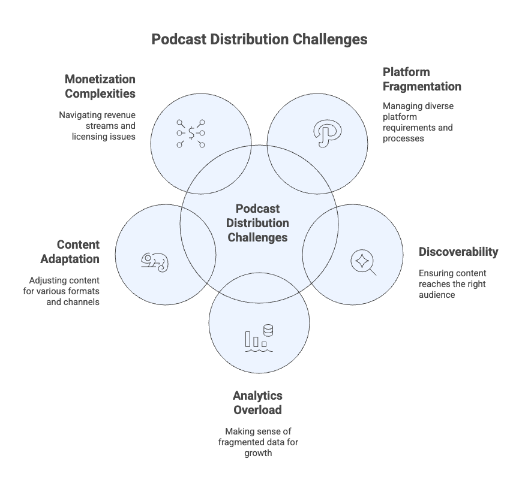
1. Platform Fragmentation and Operational Overhead
You can’t just upload to one place and call it a day anymore.
Each podcast directory (Apple, Spotify, Overcast, Google, Stitcher, etc.) has its own requirements like cover art size rules, episode metadata fields, RSS validation, and sometimes submission delays.
When you expand to new channels (YouTube, smart speakers, short‑form snippets, audio networks), you multiply the number of steps, formats, and processes.
For most mid‑to-big creators, distribution becomes cluttered with too many steps: export X formats, run Y metadata checks, schedule errands, monitor failures, or fix errors.
All this overhead eats time, introduces errors, and forces tradeoffs between speed and quality.
2. Discoverability: Even Good Content Gets Buried
Your content isn’t valuable if nobody finds it.
A listener survey by The Podcast Host found that 27% of listeners say discovering new podcasts that actually interest them is not easy.
Besides, a lot of discovery still happens inside apps: in that same survey, 50% of people said they first open their preferred podcast app to hunt down new shows.
That means algorithms, internal search, and featured placements inside the app gate a lot of your reach. If your show doesn’t get surfaced, you lose before you even get started.
The problem is that recommendations on non‑podcast channels like social, search, and cross‑promotion are fragmented, usually weak, and rarely integrated.
3. Analytics Overload & Data Gaps
You can get data, but making sense of it is another story.
Most creators get basic metrics (downloads, listens, and maybe geographical stats). But real growth needs more information about where listeners drop off, what topics they skip, and which discovery paths lead to retention.
Many analytics systems are siloed: your hosting provider has one view, Apple another, Spotify another, and third‑party tools yet another. Stitching them into a coherent view is tricky. Even worse, some analytics are lagged or aggregated, which limits real‑time decision-making.
Besides, podcast platforms seem to shift their ranking algorithm toward value engagement metrics more than downloads. Some creators struggle to adapt. Interpreting “playthrough rates,” “unique listeners,” or “listening depth” is not standardized.
4. Content Format Mismatch and Adaptation Stress
Your podcast content was made for audio. But audiences expect a multi‑format presence.
So, as your distribution channels diversify, you need alternate versions of content like audiograms, video versions, clip extras, transcripts, subtitles, and teaser snippets.
There are two problems here:
Converting from full audio to optimized snippets involves tough editorial choices around what to clip, how to preserve context, whether to include intro/outro, and more.
In some cases, channels (YouTube, social, voice assistants) come with constraints on things like length, aspect ratio, and visual elements that force you to rethink structure.
5. Monetization and Licensing Complexities
Growth costs money, and revenue paths are messy. Here’s what you can expect:
If your podcast is monetized via ads, dynamic ad insertion, or sponsorships, distribution expansions can complicate rights, targeting, and measurement.
Some platforms may demand exclusivity or altered ad contracts. Others may demand revenue splits or cut “platform fees.”
Licensing issues: if your show includes music, quotes, or third‑party content, distributing to more regions/ platforms can bump against regional licensing rights.
Finally, when your audience splits across many platforms, attributing ROI becomes harder.
Why These Challenges Amplify for Scaling Podcasts
For small, niche creators, you might get away with keeping things manual. But for companies aiming to scale:
The friction compounds: 5 platforms × 20 episodes/month leads to 100 “upload + metadata + QA” operations.
Mistakes multiply: Even small metadata typos or upload failures cost reach, which costs money.
Slower experimentation cycles: Adding a new channel or trying a new format becomes risky because your team is already stretched.
Loss of agility: When your system is brittle, you can’t pivot quickly and adapt to trends.
This is what makes the future of podcast distribution such a high‑stakes problem. If you can solve or reduce this friction, you’ll unlock reach, scale, and new formats with less headache. Now let’s look at how AI and automation are already stepping in to unclog these bottlenecks.
What’s Next: Podcast Distribution Automation
Podcast distribution automation can solve some of the challenges we’ve seen above. As tools mature and confidence grows, here are some of the shifts we can expect:
Agentic AI & orchestration will become standard. Automation tools will reason across processes, make decisions, and adjust pipelines. Forrester calls out that “agentic AI” (AI systems that can act and make decisions), combined with process orchestration, are emerging as differentiators in automation platforms.
Convergence of automation stacks. Expect tools like RPA, DPA, and process intelligence to merge. Forrester predicts these independent automation tool markets will consolidate by around 2026.
Real-time adaptation. Instead of “publish now, wait for feedback,” pipelines will dynamically route versions of episodes (or clips) depending on early engagement signals.
Augmented content editing. Tools will suggest better clips, highlight engaging segments, surface moments that are likely to go viral, or even auto‑edit for flow or platform constraints.
Feedback loops into content strategy. Automation and analytics will feed data back into content planning: e.g., “topics 1 and 3 drove retention among Segment A: double down next season.”
Risks & Limits in Podcast Distribution Automation
Because no tech is perfect, and misapplication can backfire, these are the key pitfalls you need to guard against:
Overdependence and loss of creative control. Letting AI make all your decisions can dull your voice or mismatch your brand with what the algorithms think is optimal.
Bias and algorithmic distortion. AI models carry inherent biases when it comes to topic, language, and listener behaviors, which may skew recommendations toward safe “echo chamber” paths or favor big players.
Data privacy, consent, and licensing. If your show has guest voices, music, quotes, or third‑party content, AI systems’ reuse, transcriptions, or remixing may run into rights issues.
Quality erosion and AI hallucination. Auto‑generated transcripts or summaries can err, misattribute, or introduce errors.
Adoption and change management. Your team has to trust and understand the tools. If AI pipelines fail subtly, it’s up to humans to detect and correct in time.
Vendor lock-in and platform risk. If your whole distribution is built on a proprietary AI stack, you run the risk of being locked in or vulnerable if that vendor changes terms.
Why Podcast Distribution Automation Matters for Your Podcast
For companies with podcasts that want to scale, the benefits are profound:
You can expand to new formats and channels without multiplying headcount or operations
You can iterate faster: test new channels, formats, snippets, or promo cuts at scale.
You can be smarter about what content works for whom and push it to those people, not hoping for random discovery.
You can make mistakes less costly: things like flawed uploads and botched clips are reduced.
Tip: Treat distribution like a system.
Many podcasts struggle because they think the process is simply record → upload → done. Our guide on “Enterprise Podcast Distribution Strategy Guide” explains how distributed publishing (audio, video, social, and owned media) should be part of a repeatable, scalable workflow.
Emerging Podcast Distribution Channels You Need to Watch
The future of podcast distribution is going to involve new places, formats, and surprising crossovers. If you want to scale, your job is to see which channels are turning into must‑have windows. Here are some that are already changing the rules.
1. YouTube & Video Podcasting (Full Episodes and Clips)
YouTube is no longer just a “video version” side hustle. It’s becoming a primary podcast platform. Recent data shows YouTube podcast use grew 10% in 18 months, while platforms like Spotify and Apple remained flat or dropped slightly.
In the U.S., YouTube now leads as the most-used platform for podcast listening, with 34% of weekly podcast consumers saying it’s their #1. That puts it ahead of Spotify (17%) and Apple (11%).
The rise of video also opens doors. Podcast episodes can be watched on living room screens, smart TVs, or be discovered via YouTube’s search and recommendation engine. In fact, 32 % of weekly podcast consumers say they use a smart TV for podcasts.
YouTube is rolling out AI‑powered tools to let podcasters generate visual content like clips and dynamic visuals from audio transcripts, which lowers the video barrier. This helps when you don’t have a full video setup.
Netflix is partnering with Spotify to bring video podcasts onto its platform, opening yet another major screen for distribution.
For any serious podcast brand, YouTube is essential. Treat it as a main channel instead of an afterthought.
2. Smart Speakers & Voice Assistants (Alexa, Google, Siri, etc.)
Smart speakers act as a front door to audio content in homes. As adoption rises, their role in podcast discovery and listening solidifies.
Audio reporting shows a notable shift: more people in the UK are using smart devices like smart speakers for media consumption, contributing to podcast growth.
Other market reports in Europe also point to smart speaker adoption as one of the key growth drivers in the podcast sector.
As voice assistants get smarter, you’ll increasingly see voice-first podcast commands like “Play today’s episode of X,” “Give me 10-minute highlights,” or “Skip to the interview with Y.”
The twist: search via voice is different. Your metadata, transcripts, and episode titles need to be optimized for natural language queries over keyword stuffing.
This matters because smart speakers are a gateway into the home ecosystem. That’s a sticky environment. If someone says, “Hey Google, play [your podcast],” you want to make sure it works.
3. Short-Form Audio & Social Audio Hybrid Channels
Clipping and teaser ecosystems: those 30–60 second cuts of your episodes are becoming powerful drivers of discovery. Platforms like Instagram Reels, TikTok, and YouTube Shorts are hungry for them.
Some platforms are experimenting with audio-first social interactions like audio rooms and live conversations. A podcast could spawn side-channels or listener communities there.
Because these formats favor snackable, thematic, shareable moments, your editing and content structure may need to shift. You’ll want bite-sized moments built into long episodes intentionally.
4. Podcast Networks, Vertical Hubs & Curated Audio Apps
Instead of fighting platform fragmentation, some shows will lean into network/hub strategies. Think of curated apps or vertical networks like true crime, health, and tech that aggregate relevant shows, improve cross-discovery, and provide unified monetization.
These hubs work like mini-ecosystems: creators get built-in traffic, centralized ad deals, and collaborative promo opportunities. For brands, it means distribution becomes clustered because audiences are easier to target, and listeners self-select into topic-specific environments.
Some audio apps are moving toward “super apps” for all voice content (podcasts, audiobooks, and voice skills). Super apps collapse multiple audio formats into one interface, which means podcasts won’t live in isolation anymore. Shows might appear next to book summaries, AI-generated explainers, or interactive voice tools.
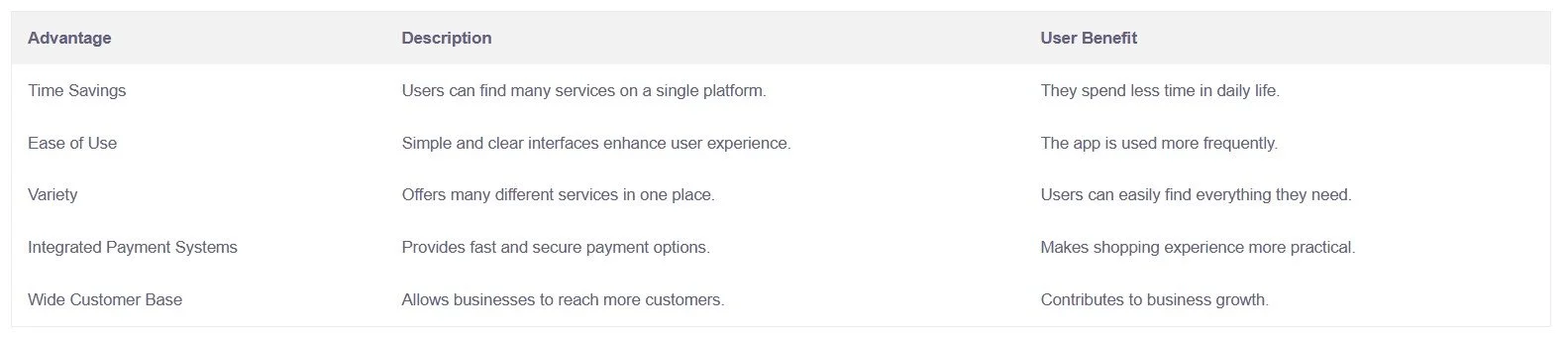
Distribution here might require a special approach to integration. Podcasters will need metadata-rich feeds, flexible formats, and stronger SEO so these apps can surface their episodes correctly.
Also, regional or niche hubs may gain traction. For example, an app specific to Latin American podcasts, or industry‑vertical aggregators in the B2B space.
Localization solves a real distribution gap: audiences in non-US markets want content discovery tailored to culture, genre preferences, and language. Meanwhile, B2B hubs give niche podcasts higher visibility where general platforms bury them. This shifts distribution from “one giant platform for everyone” toward micro-platforms optimized for specific audiences, which can radically improve engagement.
5. Immersive & Interactive Formats (Spatial Audio, Branching Narratives)
As devices support richer audio like spatial and 3D audio, podcasts could become more experiential. Imagine listeners “tuning in” to a newsroom, a soundscape, or a dramatized environment.
This isn’t mainstream yet, but it’s creeping into experiments.
For example:
Apple announced Dolby Atmos spatial audio a while back. The idea is for creators to upload multichannel mixes so listeners can literally feel the environment around them.
QCODE is known for Hollywood-grade 3D audio using binaural recording, making the listener feel "inside" the scene. These formats are prototypes for what future immersive fiction may look like.
BBC R&D engineers also carried out various 3D sound experiments. Here’s what they sound like (hint: start at 4:52):
Choose-your-own-adventure or other interactive formats might find a home in narrative or nonfiction shows.
Integration with other media is also getting more popular: think crossovers with AR/VR experiences, or audio that complements visual and immersive content.
How These Channels Tie into the Future of Podcast Distribution
These depend on intelligent orchestration. You need to repurpose, adapt, and optimize for each channel. Keep in mind that some channels will cannibalize others. For example, video might reduce audio-only listens on platforms. You’ll need to monitor that balance.
At Content Allies, we’ve been in the podcasting business long enough to know that, no matter the calendar year, one thing holds true:
Success in new channels depends on early experimentation and iteration. The first movers get audience attention and platform favor. As these channels proliferate, your distribution strategy needs to shift from “one to many” to “many to many with smart routing.”
Predictions: Where Podcast Distribution Is Headed
Now that we’ve seen the current podcast distribution trends, let’s make some predictions.
AI‑First Platforms Will Become Normal in Podcast Distribution
We’re moving toward a world where your podcast host is a smart engine. Imagine uploading a master episode and having the system automatically transcribe, clip, tag, format video versions, distribute snippets, and even decide which version to push where.
These distribution engines will let humans think more strategically. The World Economic Forum already discusses how generative AI is reshaping not only content creation but distribution and curation of media.

Podcast Feeds Will Personalize, Not Just Chronologize
Instead of one-size-fits-all episode lists, listeners may get feeds that adapt to them. One listener sees a full interview, another gets a two-minute highlight, depending on their history, skips, or preferences. Platforms are already leaning hard into recommendation systems, and this next level of feed-personalization is likely the next frontier.
Streaming and Audio Worlds Will Merge
The boundary between podcasts and video shows is collapsing. As we learned, Spotify and Netflix recently struck a multi-year distribution deal that will put a slate of Spotify’s video podcasts on Netflix starting in early 2026.
This suggests that podcasts are becoming part of broader media ecosystems, where your distribution might depend on negotiation and platform partnerships just as much as creative quality.
Monetization and Rights Will Fragment (In a Good Way)
As your show spreads across formats and platforms, revenue models will need to multiply. Don’t expect just audio ads. You’ll see context-aware dynamic inserts, premium tiers and memberships, microtransactions, licensing per region/format, and creator-fan monetization pathways (like tip jars and paywalls for bonus episodes).
The trick here is designing rights, splits, and revenue flows that adapt alongside your distribution model.
Want a smarter monetization strategy? Content Allies builds podcast programs and ads designed to scale across every platform. Explore our services to find out more.
Immersive and Interactive Audio Gets Real
Audio will stop being passive. Spatial audio (so that you feel “in the room”), branching narratives where listeners choose paths, and interactive segments (voice commands, questions) will creep in.
Even AI-generated long-form spoken content is on the horizon, with experiments like MoonCast exploring how AI might synthesize multi‑speaker podcast-like content from text sources. While not mainstream yet, this is the kind of experiment worth watching.
RSS & Open Distribution Stay Essential (Even if Under Pressure)
Despite the rush toward platform control, the open RSS feed model is still the backbone of podcasting since it delivers reach, portability, and creator leverage.
That said, closed ecosystems (especially video or subscription domains) will push for exclusivity. Savvy creators will maintain both: broad, open distribution for reach alongside selective engagement with closed systems for monetization or audience reach.
Challenge: Monetization can’t depend on ads alone. With ad CPMs falling and listener expectations rising, relying only on sponsorships or static ads is risky.
Our guide to the “Top 10 Advanced Podcast Monetization Strategies” shows how combining revenue streams, like memberships, dynamic ads, and gated content, turns a podcast into a sustainable business asset.
How to Prepare for the Future of Podcast Distribution: Tips for Brands and Creators
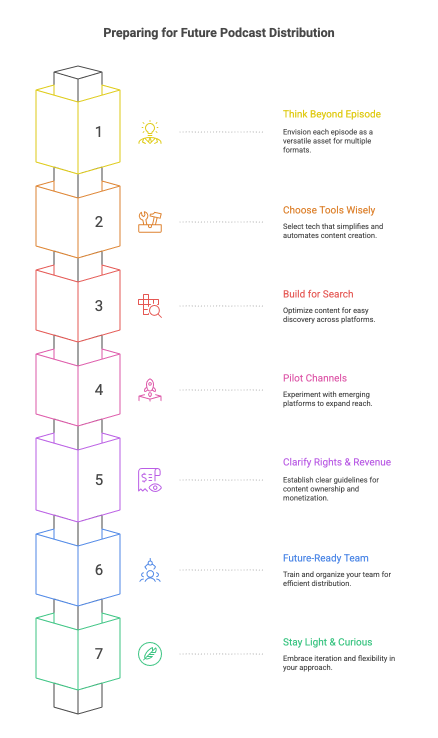
If the future of podcast distribution is smarter, faster, and everywhere all at once, then how do you actually prepare for it? Here’s your roadmap for staying ahead.
Do Podcast Distribution Beyond the Episode
Start seeing each episode not as a standalone audio file, but as a launchpad. One episode can become a full video, a handful of short clips, audiograms for social, a transcript for SEO, a newsletter segment, and even a voice-assistant-ready version. The more you treat your content as a flexible asset, the easier it becomes to adapt for new channels and formats.
Choose Podcast Distribution Tools That Multiply Your Efforts
It’s tempting to bolt on more tools, but the real magic happens when your tech stack actually simplifies things. Look for platforms that can automate transcription, tagging, and even generate dynamic clips and previews using AI.
And yes, that’s genuinely in your advantage ROI-wise. For example, new research shows that LLM-generated previews can lift content engagement by over 4.6% compared to older methods.
Still, automation isn’t a strategy. You still need human judgment to shape your content, decide what’s worth sharing, and steer your brand voice.
Build Your Podcast for Search and Discovery from Day One
The best content still gets lost if no one can find it. That’s why discoverability starts with metadata. Use clear, intent-driven titles and descriptions like “How to onboard remote teams” instead of just “Episode 27.”
Layer in rich transcripts and smart tagging by guest, topic, or theme. Your goal here is to make your content searchable on Google, Alexa, and even inside YouTube’s growing podcast search engine.
Don’t Just Pick Your Podcast Distribution Channels. Pilot Them
You don’t need to launch across every platform tomorrow. Instead, pick one or two emerging channels, like YouTube, smart speaker integration, or short-form audio for social, and run small experiments.
Try different formats, test out teaser versions, and see what actually brings you new listeners. Keep an eye on which channels add reach and which just duplicate effort.
Get Clear on Your Podcast Rights and Revenue
As you spread your content across more places, you’ll need a clear playbook for licensing, revenue splits, and ad formats. That means deciding:
Who owns what (especially with video or smart speaker distribution)
Which formats support dynamic ads
Where premium or subscriber-only content fits in
If you're collecting listener data, centralize it early, because it’ll become one of your most valuable assets when platforms start asking for exclusivity or partnerships.
Have Solid Podcast Distribution Workflows
You can’t future-proof your distribution if your team is stuck in 2019 workflows. Consider appointing someone to own the distribution strategy, someone who can think about audience flow, platform rules, and optimization. Train your team on how to interpret analytics from different platforms, and build feedback loops between content performance and future episode planning.
Keep Optimizing Your Podcast Distribution Strategy
If there’s one thing that’ll define winners in this space, it’s iteration. The best podcasts will be the ones that keep testing, learning, and adjusting fast, all without locking themselves into one platform or format too early. Keep your tech stack flexible, your mind open, and your audience data close.
Get Ready for the Future of Podcasting with Content Allies
The future of podcast distribution will be defined by AI orchestration, personalized feeds, immersive formats, and new platforms competing for listener attention.
What separates podcasts that scale from those that plateau will be how well they adapt. You’ll need to think of distribution as a strategic asset: combining high-performing formats, optimizing across channels, and constantly testing new paths. Your rights, revenue, and measurement frameworks have to flex, too.
If you’re ready to take this from theory to action, Content Allies can help you streamline your workflow and grow your reach, whether that means smarter distribution, content repurposing, or channel expansion.
Get in touch today and let us help you scale smarter.
FAQ
What is a Distributed Podcast?
A distributed podcast goes beyond one podcast feed. It’s designed for multiple formats like audio, video, and social media snippets, and spreads across platforms like Apple Podcasts, Pocket Casts, and video channels, making the most of every content drop.
Are AI tools replacing human creativity in podcasting?
Nope. AI tools boost speed and reach, but human creativity still drives storytelling and tone. Use AI for editing or AI-generated audio, but keep people in charge of the heart and voice.
What happened to Google Play Music, and does it matter?
Google Play Music is gone, but it reflects a larger shift in the podcasting landscape. Relying only on big apps is risky. A solid distribution process needs platform diversity and flexibility.
Why does video versus audio even matter now?
Because it’s not either/or. In the age of distributed everything, pairing the audio form with visual cuts and clips boosts reach, especially as video streaming dominates social feeds.
How does Content Allies support podcast generation?
We help brands build repeatable systems for podcast generation and distribution. This balances AI-powered platforms with strategy-first workflows that protect your brand identity.
Can Content Allies help navigate distributed authority and the future of work?
Yes. In a world shifting toward the future of work and distributed authority, we build podcast systems that align with modern teams and async content creation.
Does Content Allies help with assessment systems?
Absolutely. We use content assessment systems to optimize what formats, channels, and workflows drive the best ROI so your podcast stays effective.