
Podcast Trailer: How to Make One That Drives Subscribers (with B2B Examples)
You can spend months building a B2B podcast. You book guests, record interviews, refine your sound quality, and promote new episodes across social media. But when a potential listener lands on your show page in Apple Podcasts or Spotify, their decision to follow often comes down to one thing: your podcast trailer.
In roughly 60-120 seconds, a trailer episode has to explain what the show is about, who it's for, and why it's worth a place in someone's listening rotation. For B2B podcasts, this challenge is even more important. You're trying to reach a smaller audience of high-value decision-makers, including directors, VPs, founders, and C-suite executives.
A great podcast trailer acts as a conversion asset. It turns curious browsers into subscribers before they ever hear a full episode.
In this guide, we'll cover what to include in a podcast trailer, what mistakes to avoid, real B2B show trailer examples, and key findings from a new controlled study on what actually makes listeners want to follow a podcast.
What a Podcast Trailer Actually Is
A podcast trailer is a standalone episode that gives potential listeners a quick preview of your show. It is different from the recurring intro that plays at the start of every episode. A trailer sits separately in podcast apps and should be labeled correctly through your hosting provider.
Apple Podcasts defines three main types of podcast trailers:
Coming soon trailer: A short preview used before a show or new season launches.
Show trailer: A broader pitch for the podcast as a whole. This is usually the main show trailer pinned to the top of your page.
Teaser trailer: A shorter promo trailer used at the end of an episode to preview what comes next.
Remember, your hosting platform needs to tag the audio as a “trailer” episode. If you publish it as Episode 0, Apple Podcasts and Spotify may not treat it as a trailer.
Why B2B Podcasts Need a Strong Trailer
For many potential subscribers, your podcast trailer is the first real interaction they have with your show. Before they commit to a full episode, they want one question answered fast: is this worth my time?
Here are the main reasons a strong trailer matters for B2B podcasts.
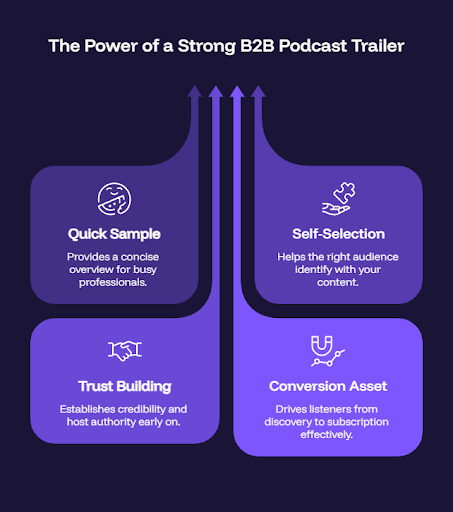
1. Gives Busy Decision-Makers a Quick Sample
Most B2B listeners are not going to test-drive multiple full episodes before deciding whether to subscribe.
A trailer lets them quickly hear the host, understand the premise, evaluate the tone, and decide whether the show is relevant to their role. A strong trailer can quickly communicate the value of an entire podcast.
2. Helps the Right Listeners Self-Select
A good show trailer makes the target audience obvious.
Whether your podcast is for SaaS founders, revenue leaders, healthcare executives, or product marketers, listeners should immediately know whether they belong. In B2B podcasting, audience quality matters more than audience size. The goal is to attract specifically the right people.
3. Builds Trust Before the First Full Episode
B2B podcasts depend on credibility, expertise, and host authority.
Before someone invests 30 or 45 minutes in a full episode, they want a reason to believe the show is worth their time. A trailer helps establish that trust early by showcasing the host's perspective, expertise, and communication style.
According to Pew Research Center, 65% of podcast listeners say they feel connected to the host of the show they listen to most, including 27% who feel "very" or "extremely" connected. The trailer is mostly where that connection begins.
4. Turns Podcast Page Visits Into Subscribers
Your trailer should function as a conversion asset. Its job is to move someone from "I found this podcast" to "I'm going to follow it."
This matters because listeners already have plenty of options competing for their attention. The same Pew Research Center study found that roughly half of U.S. adults have listened to a podcast in the past year, and 58% of podcast listeners regularly listen to two or more shows. A compelling trailer helps your podcast earn one of those limited listening slots.
For B2B brands, every subscriber could be a future customer, strategic partner, referral source, or champion. That's why a podcast trailer deserves the same attention as any other high-converting piece of marketing content.
What Makes a Good B2B Podcast Trailer?
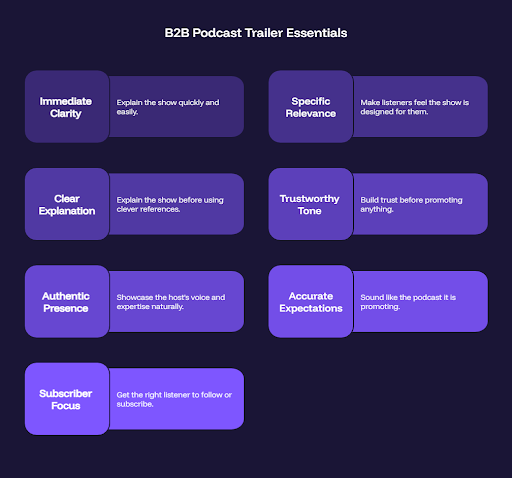
The best B2B trailers do a few things exceptionally well. They explain the show quickly, establish relevance, build trust, and make it easy for the right listener to say, "This is for me."
Immediate Clarity Over Production Hype
A strong B2B podcast trailer makes the show easy to understand quickly.
Busy executives, founders, and decision-makers will not sit through long music intros, elaborate sound design, or abstract storytelling before they know what the podcast is about. Within the first few seconds, listeners should understand:
What the show is about
Why it matters
Whether it is relevant to them
Coleman Insights’ 2026 podcast trailer research gives a useful signal here. In its Better Than Yesterday test, a simple explainer style trailer outperformed a faster highlight reel. The explainer version was rated easier to understand (66% vs. 46%) and more natural sounding (71% vs. 41%).
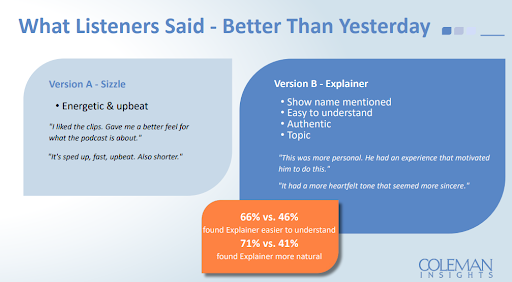
For B2B shows, this matters because clarity lowers the effort required to subscribe. A trailer does not need to sound like a movie promo. It needs to make the promise of the show easy to grasp.
Specific Business Relevance
A good B2B trailer should feel designed for a specific professional audience.
It should not sound like a generic business podcast trying to appeal to everyone. The strongest trailers make listeners think, "This is for people like me."
This relevance can come from:
The listener's role
Their industry
Their business model
Their pain points
Their growth stage
The decisions they make every day
For example, "for SaaS product leaders scaling enterprise adoption" is far more compelling than "for business leaders."
The more specific your audience statement, the easier it is for qualified listeners to self-select.
Clear Explanation Before Clever References
Creative hooks can work, but only if listeners understand the show first.
Pop-culture references, dramatic cold opens, and abstract storytelling usually create confusion when they appear before the premise. If listeners spend their first 20 seconds trying to figure out what they're hearing, you've already created friction.
The same Coleman Insights study tested two versions of a trailer for Binge or Cringe. The version that clearly explained the show upfront was rated significantly more authentic (57% vs. 36%).
The alternate version opened with a Netflix reference, which led some listeners to mistakenly believe the trailer was promoting Netflix rather than explaining the podcast.

B2B takeaway: if listeners misunderstand the premise, they are unlikely to stay long enough to subscribe.
Trustworthy Rather Than Promotional
A B2B podcast trailer should build trust before it promotes anything.
This is important for branded and company-owned podcasts. If the trailer opens with the company name, product pitch, or value proposition, it can immediately sound like an advertisement.
Instead, lead with the listener's problem, question, or desired outcome. Explain why the content matters before talking about who created it.
For example, a trailer that opens with "How are enterprise sales teams shortening longer buying cycles?" is more compelling than one that opens with a company overview.
The goal is for the trailer to feel like a useful show preview as opposed to a sales asset disguised as content.
Authentic Host Presence
For many B2B podcasts, the host is part of the value proposition.
Listeners should get a clear sense of the host's voice, perspective, and expertise. That does not mean the trailer needs to be casual or unscripted. It means the delivery should sound human, credible, and aligned with the actual show.
If the host is a founder, executive, operator, or subject-matter expert, the trailer should communicate that naturally through the content rather than through a long list of credentials.
People subscribe to hosts they trust, and the trailer is often the first opportunity to establish that relationship.
Accurate Expectation-Setting
A good podcast trailer should sound like the podcast it is promoting.
If the show is thoughtful and conversational, the trailer should not feel like a high-energy movie trailer packed with dramatic music and sound effects. If the show is highly produced and narrative-driven, the trailer can lean more heavily into storytelling, pacing, and immersive audio.
The objective is to attract subscribers who will continue listening after Episode 1.
When the trailer accurately reflects the listening experience, new subscribers are more likely to stay engaged.
Subscriber-Focused Intent
A strong trailer should be designed to get the right listener to follow or subscribe.
Many branded podcasts dilute their effectiveness by asking listeners to do too many things at once.
Avoid mixing your subscribe CTA with requests to:
Book a demo
Visit the website
Download a report
Follow the company on LinkedIn
Contact sales
Those actions can come later.
The trailer's job is simple: turn a qualified browser into a listener.
This YouTube video contains some more tips on creating a podcast trailer:
What to Include in Your Podcast Trailer
The best podcast trailers are short, focused, and intentional. Rather than trying to explain everything about the show, they cover a handful of key elements that help the right listener decide whether to subscribe.
1. An Opening Hook
Start with a problem, question, or outcome your target audience already cares about.
Keep it direct and specific. Avoid generic statements or lengthy setup.
For example:
"Enterprise sales cycles are getting longer, but the best B2B teams are still finding ways to create urgency."
The goal is to capture attention immediately and pull the right listener into the rest of the trailer.
2. The Show Name
Say the podcast name early and clearly.
Do not hide it behind a long intro, elaborate sound design, or multiple sound effects. Listeners should know exactly what show they're hearing within the first few moments.
3. An Audience Statement
Tell listeners who the show is for. This is where you identify your ideal audience directly:
For B2B SaaS founders
For revenue leaders
For healthcare executives
For product marketers selling into enterprise
A clear audience statement helps qualified listeners self-select and continue listening.
4. The Core Premise
Explain the show in one or two simple sentences.
Cover what the podcast is about and what listeners can expect from each episode. Avoid broad positioning statements like "a podcast about business growth."
Instead, focus on a specific niche, challenge, or perspective that makes the show distinct.
5. A Clear Listener Payoff
Answer the question every potential subscriber is asking:
"What's in it for me?"
Focus on practical outcomes such as:
Better decision-making
Sharper go-to-market strategy
Real operator insights
Lessons from experienced leaders
Examples from companies facing similar challenges
The payoff should feel tangible and relevant to the audience you're targeting.
6. A Credibility Proof Point
Give listeners a reason to trust the show. This could include:
Host experience
Notable guests
Industry expertise
Original research
Access to unique conversations
An established audience or community
Keep this section brief. Credibility should support the pitch without dominating it.
7. A Preview of the Listening Experience
Don't just tell listeners what the show is like. Let them hear it. Depending on the format, this could include:
A short guest clip
A host sound bite
A memorable insight
A compelling question
A quick highlight reel of episode moments
The preview should demonstrate the show's value and give listeners a realistic sense of the experience.
8. One Clear Subscribe CTA
End with a single call to action.
Examples include:
Follow the show
Subscribe wherever you listen to podcasts
Listen to the first episode now
Avoid stacking multiple CTAs together. Don't ask listeners to subscribe, visit your website, follow you on social media, download a report, and contact sales all at once.
Your podcast trailer has one job, which is to convert interested listeners into subscribers.
B2B Podcast Trailer Examples
Looking at real podcast trailers is one of the fastest ways to understand what works. These examples take different approaches, but each does a strong job of communicating value, establishing credibility, and giving listeners a reason to subscribe.

1. Masters of Scale
Masters of Scale is a great example of a highly produced show trailer that still maintains clarity.
What it does well:
Establishes host credibility immediately through Reid Hoffman
Uses strong story elements and narrative framing
Includes audio clips that preview the caliber of guests and conversations
Creates curiosity without becoming vague
Gives listeners a realistic preview of the show's production quality
The trailer uses professional sound design and a polished highlight reel format, but it never loses sight of the core premise. Even with immersive audio and multiple sound bites, listeners quickly understand what the show is about and why they should care.
Takeaway: Production value can improve a trailer, but clarity still comes first.
Listen:
2. Acquired
Acquired takes almost the opposite approach.
Rather than relying on dramatic editing or a promo trailer format, the hosts focus on clearly explaining the concept: deep dives into the stories behind successful companies, acquisitions, and business history.
What it does well:
Explains the premise quickly
Makes the audience obvious
Lets the hosts' personalities come through naturally
Sets accurate expectations for the listening experience
Prioritizes clarity over production hype
The trailer sounds very similar to the actual podcast, which helps attract subscribers who are likely to enjoy the long-form format.
Takeaway: A simple explanation can outperform a heavily produced trailer if it clearly communicates the show's value.

3. Marketing Against the Grain
Marketing Against the Grain is a useful example of a branded B2B podcast that avoids feeling like a company advertisement.
What it does well:
Clearly identifies the target audience
Focuses on practical marketing insights rather than brand promotion
Highlights the expertise of the hosts
Explains the listener payoff early
Uses a single, subscriber-focused call to action
Even though the show is associated with HubSpot, the trailer leads with content value rather than company messaging. The result feels more like a useful resource than a sales asset.
Takeaway: Company-owned podcasts perform better when they lead with audience value and establish trust before mentioning the brand.
Common Patterns Across All Three
Despite their different styles, these trailers share several traits:
They explain the show quickly.
They identify a clear audience.
They showcase authentic host presence.
They include a preview of the listening experience.
They end with a simple call to action.
Most importantly, none of them tries to be everything to everyone. Each trailer makes it obvious who the show is for and why that audience should subscribe.
Podcast Trailer Best Practices (and Mistakes to Avoid)
A strong podcast trailer should feel clear, credible, and easy to act on. These best practices will help you create a trailer that earns subscribers without wasting time or being too promotional.
1. Lead With Listener Value Rather Than the Company
This is important for branded B2B podcasts. Do not open with your product, service, company history, or value proposition. Lead with the listener's problem, question, or desired outcome first.
2. Use Audio Branding Without Letting It Take Over
Recognizable audio branding can make your podcast feel more polished.
This might include:
Intro music
Subtle sound effects
Branded transitions
Consistent sound design
A short audio signature
But clarity still matters most. Good sound design supports the message.
3. Use Your Strongest Content
If your show already has episodes, pull from the best material.
Use:
Memorable guest sound bites
Sharp host questions
Surprising insights
Strong opinions
A short highlight reel of episode moments
Avoid using generic clips that could belong to any business podcast. The trailer should prove the show has substance.
4. Create Trailer Versions for Different Channels
Your main podcast app trailer is only one version.
You may also want:
A website trailer
A short social media video trailer
A paid promotion trailer
A sales or nurture campaign version
A visual trailer for LinkedIn or YouTube
A trailer swap version for partner shows
The core message should stay the same, but the format can change based on where people discover the show.
How to Know If Your Podcast Trailer Is Working
Like any marketing asset, a podcast trailer should be measured against tangible outcomes. Here are the signals to watch.
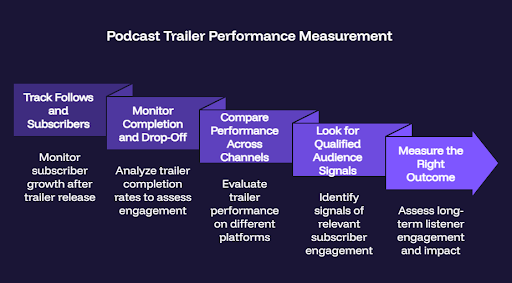
Track Follows and Subscribers
The most important metric is whether more people follow the podcast after hearing the trailer.
If you publish a new trailer or significantly update an existing one, compare subscriber growth before and after the change.
Look for:
Higher follow rates
More subscribers per show-page visit
Increased first-episode starts
A strong trailer should improve the browse-to-subscribe conversion rate.
Monitor Completion and Drop-Off
Pay attention to how much of the trailer people actually hear. If listeners consistently leave after the first few seconds, the opening hook may not be strong enough. If they drop off before the call to action, the trailer may be too long or unclear.
In general, high completion rates suggest the trailer is holding attention and delivering value.
Compare Performance Across Channels
Different audiences may discover your trailer in different places.
Compare performance across:
Apple Podcasts and Spotify
Your website
LinkedIn and other social media channels
Paid campaigns
Email campaigns
Partner promotions or trailer swaps
You may find that certain trailer formats or versions perform better in specific channels.
Look for Qualified Audience Signals
Subscriber growth matters, but subscriber quality matters more. A successful B2B podcast trailer should attract the people you actually want to reach.
Watch for signals such as:
More relevant subscribers
Increased inbound guest interest
More sales conversations mentioning the podcast
Better engagement from target accounts
More responses from prospects and partners
These indicators often tell you more than download numbers alone.
Measure the Right Outcome
The ultimate goal is to attract listeners who continue engaging with the show after Episode 1. If subscribers stay engaged, return for future episodes, and begin showing up in sales conversations, partnership discussions, and customer interactions, your trailer is doing exactly what it's supposed to do.
Let Content Allies Build a Podcast Trailer That Drives Subscribers
A great podcast trailer turns passive browsers into committed subscribers.
For B2B podcasts, that matters because every subscriber has the potential to become a customer, referral source, strategic partner, future guest, or internal champion. The right trailer helps you attract those people faster by clearly communicating who the show is for and why it's worth following.
At Content Allies, we help B2B brands launch and grow podcasts that support thought leadership, relationship-building, and pipeline influence. This includes strategy, guest booking, production, promotion, and creating a podcast trailer that converts listeners into subscribers.
If you're launching a new show or want to improve an existing trailer, contact us to learn how we can help.
FAQs
What's the difference between a podcast trailer and the recurring intro that plays at the start of every episode?
A podcast trailer is a standalone episode made to help new listeners decide if they should follow the show. A recurring intro plays inside every episode and helps current listeners understand that specific conversation. The trailer sells the show. The intro sets up the episode.
Should I record a new trailer for each season, or can one evergreen trailer cover the full show?
Most B2B podcasts can use an evergreen show trailer for years if the core audience, premise, and format remain the same.
However, it's worth creating a new trailer when:
Launching a new season
Changing the show's focus
Rebranding the podcast
Introducing a new host
Targeting a different audience segment
If the value proposition changes, the trailer should change too.
Do video trailers and audio-only trailers perform differently?
They serve different purposes. Audio trailers work best inside podcast apps, where listeners are already evaluating shows to follow. Video trailers typically perform better on LinkedIn, YouTube, websites, email campaigns, and social media because they can combine visuals, captions, guest clips, and branding.
Most B2B podcasts benefit from having both. Use an audio trailer for podcast platforms and a short visual trailer for promotion and distribution.
Can I run my podcast trailer as a paid ad inside other shows?
Yes. Many podcast advertising platforms allow you to run a promo trailer or trailer swap inside other podcasts that reach a similar audience.
This can work well if:
The target audience closely matches yours
The show has a strong subscriber conversion rate
The trailer clearly explains the value of the podcast
For B2B shows, targeted placements on niche industry podcasts often outperform broader advertising campaigns because audience quality matters more than raw reach.
Does Content Allies produce podcast trailers as part of a B2B podcast launch?
In most cases, we produce the trailer as part of a broader podcast launch or production engagement. The exact scope depends on the services involved, but trailer strategy, scripting, production, editing, and promotion can all be incorporated into a podcast launch plan. Contact Content Allies to discuss the specific needs of your show.
How does Content Allies approach trailers for executives and senior decision makers?
For executive audiences, our team at Content Allies focuses on clarity, credibility, and relevance. We believe a trailer should define the audience, explain the business value, establish host authority, highlight useful insights, and give busy professionals a clear reason to follow the show.
Can Content Allies re-cut an existing trailer if a show changes direction or launches a new season?
Yes, we can review an existing trailer and update it when the show changes audience, format, guest profile, positioning, or business goal. This can include revised messaging, new episode clips, a stronger structure, or a fully new trailer concept.