
Crafting a High-Converting Podcast Trailer That Hooks from Day One
Most podcast launches fall flat, not because the content’s weak, but because the podcast trailer didn’t hook anyone.
With 31% of listeners discovering new podcasts through social media, that first impression matters more than you think. Whether you're launching a new show or rebranding an old one, your trailer needs to grab attention, explain the value, and drive subscriptions, and it has a small window of time in which to do so.
In this blog, we’ll show you how to:
Use a 6-part trailer script that converts
Nail your hook, value prop, and sound design
Distribute your trailer across social media, internal tools, and your podcast website
Avoid common mistakes that kill trailer performance
P.S. Want help building a trailer that actually works? At Content Allies, we help B2B brands craft high-converting podcasts, from trailer scripting to voiceovers to full launch strategy.
The Power of First Impressions: Why Podcast Trailers Drive Subscriptions
A great podcast trailer is like a handshake. It sets the tone, builds trust, and tells your listener, “This is worth your time.” Because trailers auto-play on platforms like Apple Podcasts, they’re mostly the very first touchpoint for new listeners.
If your show is for internal use, like employee comms or partner training, it matters even more. Internal listeners are busy, and a strong show trailer helps them quickly understand the value, format, and tone before they commit to listening.
Plus, a trailer gives your team something tangible to share across social media channels, internal newsletters, and even during product launch meetings. It becomes a ready-made marketing asset and a flexible part of your content creation workflow, even before the production phase of your full season is done.
At its core, a good podcast trailer is a conversion tool. It builds curiosity, increases listener retention, and makes your first episode more likely to get played.
Check out this clip from Libsyn, which walks through exactly why a podcast trailer works as your first impression, how to use it on major platforms like Apple Podcasts, and how to make your message clear from the get‑go.
How to Craft a High-Converting Podcast Trailer That Wins
At Content Allies, we’ve refined our trailer playbook across dozens of B2B podcasts. We’ve learned that a great podcast trailer is an extremely powerful lever that moves subscriptions and first‑episode plays.
In this section, we’ll walk you through our proven framework so you can script, record, and launch a trailer that converts.
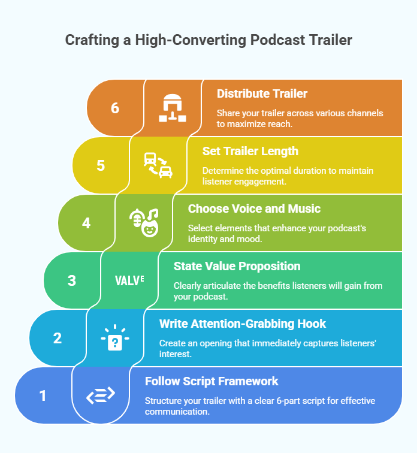
1. Follow a Clear 6-Part Script Framework
This structure works across teaser trailers, promo trailers, and “coming soon” launches. It keeps your message tight, listener-focused, and optimized for conversion.
The Hook (0:00–0:15): This is your chance to grab attention fast. Ask a bold question or drop a compelling soundbite. For example, “What if you could onboard a new hire in half the time, just by hitting play?”
The Why (0:15–0:30): What’s in it for the listener? Focus on outcomes they care about, like attracting new customers or making more sales.
The What (0:30–0:50): Share the type of content they’ll hear. Clearly and concisely break down the topics, formats, and standout guests you’ll be featuring.
The Who (0:50–1:05): Introduce the host briefly. Keep it human and relatable rather than just listing accolades.
The When & Where (1:05–1:20): Say when new episodes drop and where to find them (e.g., Apple Podcasts or your internal portal).
The Ask (1:20–1:30): Close with a simple call to action: “Follow us to catch the first episode.”
If you want more in-depth advice on how to script your podcast beyond the trailer, check out our Podcast Scripting Guide.
2. Write a Hook That Grabs Attention in 5 Seconds
Listeners decide fast. You have about 5 seconds (or at most the first 30 seconds) of your podcast trailer to stop listeners from hitting “skip.” Research suggests that 41% of podcast listeners decide whether to continue within the first five minutes, and that window is even smaller with your trailer.
So, what makes a great opening line?
Ask a bold question like, “What if your customers trusted your product before you even launched it?”
Drop a surprising stat or fact, something that’s highly relevant to your listener’s problems
Jump right into action or use a sound bite from an episode (you can use sound effects if this makes sense).
Use a tone that matches your brand. A confident, clear tone builds trust from the first second. Keep it casual and warm for internal shows or polished and structured for public-facing B2B podcasts. Your delivery should feel aligned with your brand’s overall voice.
Write for ears, not eyes. Most listeners are multitasking. They might be commuting, working, or browsing on their phone. This means your script needs short sentences, simple wording, and a clean rhythm. Avoid dense phrasing or long, winding intros that force a listener to work too hard.
3. State a Value Proposition That Makes Listeners Stay
Once your trailer grabs attention, it has one job: prove why the listener should keep going. A strong value proposition is clear. It answers: “What’s in it for me?”
Be clear rather than clever
Say explicitly what the audience will gain. For example, “Weekly episodes that help you reduce partner onboarding by 25%” is better than something vague like “Unlock next‑gen partner synergy.”
Avoid fluff. Terms like “insightful conversations” or “cutting‑edge strategies” feel empty and don’t really tell your listener anything concrete.
Don’t overload the trailer with details. The purpose is to give direction, not summarize an entire season.
Tailor your value prop to your audience. Make the benefit specific to who’s listening.
For employees: “One podcast that keeps you ahead of the product roadmap and the changes that impact your role.”
For partners: “A show that helps you sell more, train faster, and strengthen every client interaction.”
4. Choose Voiceover and Music That Fit Your Show’s Identity
When creating your podcast trailer, the right voice and soundtrack significantly influence how your audience perceives you.
Here’s how to get these elements just right.
Choose a voice that matches your audience.
Decide whether the trailer should feature a trusted internal voice, like a company leader, or a polished professional voice-over artist. Internal voices build instant familiarity for employees and partners. Professional voices create a clean, public-facing feel for external B2B audiences.
Use music that supports, not distracts
Background music should set the mood and give your podcast an upbeat, serious, or playful vibe, depending on your tone. But be sure to keep it subtle. Clarity is everything on Apple Podcasts and Spotify, so reduce music levels if it competes with the VO.
Quick dos and don’ts:
Do keep the voice‑over crisp and prominent, and remember that your message comes first
Do choose licensed music (royalty‑free or properly cleared) to avoid copyright breaches
Do test the trailer with earphones, on mobile, and in quiet/noisy environments to make sure your audio quality is high
Don’t let the music overpower the voice (reduce music level if it competes)
Don’t repeat the same music cue multiple times unless it’s part of your brand identity, as this can feel stale
Don’t make the trailer overly long. Shorter trailers tend to perform better in listener retention.
Your voice‑over and music should support and strengthen your show’s identity. They are there to enhance your message but never distract from it.
5. Set the Right Trailer Length and Test Before Publishing
Trailer length directly affects retention and subscriptions. Most industry data points to a sweet spot of 60–90 seconds, which gives you enough time to hit all six parts of your script without losing momentum.
Why 60–90 seconds works:
It’s long enough to hit the six‑part script (hook, why, what, who, when/where, ask) and still keep momentum
Many listeners browsing new shows will make a split‑second decision whether to play or skip, and shorter trailers reduce drop‑off
Longer trailers often feel tiring and lower interest before the first episode even airs.
How to test effectively:
Create two cuts: a tighter 60-second version and a longer 90–120-second version. Share them with employees, partners, or a pilot group during your soft launch. Track completion rate and subscription conversions to see which version keeps listeners engaged.
On social, consider a 30–45 second micro-trailer. It works well as a teaser and builds early awareness before sharing the full version on your podcast site or social channels.
After finalizing, upload your trailer to major platforms and tag it as a “Trailer” on Apple Podcasts. Also embed it in internal portals, partner newsletters, and launch communications to maximize reach.
6. Distribute Your Trailer Everywhere Your Audience Lives
To drive real subscriptions, you need to place your trailer in the channels your audience already uses. Make it unavoidable and make it one-click simple to follow.
Start with internal channels: Post the trailer in Slack or Microsoft Teams, embed it in LMS modules, and include it in internal newsletters. Always link directly to Apple Podcasts, your main platform, or a universal smart-link so every device is covered.
Expand to external and partner channels: For partner-facing or public shows, embed the trailer on your podcast website and repurpose short audio snippets for social media. A quick teaser or highlight clip helps widen your reach and gives teams an easy asset to share.
Re-promote it, don’t retire it. Keep using the trailer after launch. Reshare it when a new season drops, during product rollouts, or when you’re re-engaging lapsed listeners. A well-placed trailer resets expectations and boosts early episode momentum.
When you distribute consistently and across the right channels, your trailer becomes the anchor that drives subscriptions, plays, and long-term listener engagement.
Common Mistakes That Kill Podcast Trailer Conversions
Even if your podcast trailer is slick, you can lose traction fast with these missteps. One critical piece: retention matters.
Industry data shows that strong shows aim for completion rates of 50% or more. This means half of your audience stays through the piece. If your trailer is weak, you’re losing listeners before episode one even launches.
From our experience at Content Allies, here are common traps and how to sidestep them.
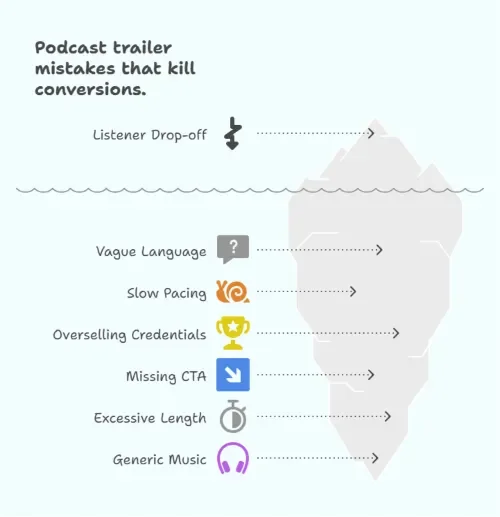
Vague language is a killer. If your trailer says “we discuss topics your team cares about” without actually saying what those topics are, the drop‑off starts early. Having no clear value proposition will leave the audience wondering “why me?” and disconnecting before the first episode.
Slow pacing also kills momentum. You’ve got to get to the point fast. The shorter the intro, the sharper the impact, especially when listeners are scanning feeds.
If you find yourself overselling your credentials or diving too deep into the host bio, that’s a miss for internal shows or partner‑facing launches. Listeners care about what you’ll do for them, not just how many awards you’ve won. Similarly, omitting a straightforward call to action (CTA) can leave your trailer wandering without direction.
And if your trailer runs over two minutes, even if well produced, you’re risking drop‑off before your message hits. Meanwhile, generic stock music signals low production values and quietly undermines engagement.
Best Podcast Trailer Examples
Here are a few examples to inspire your next podcast trailer.
1. Cirque Du Soleil podcast video trailer
In the Cirque Du Sound podcast trailer from Cirque Du Soleil, we get a high-quality look at what to expect from the show, with colorful, bright video footage overlaid with a clear and succinct intro from the host himself.
2. The Healthy Practice
In the trailer for The Healthy Practice podcast, we get a lesson in simplicity and clarity. In less than a minute, we meet our host, find out what the podcast is all about and who it’s for, and learn where to listen. There are no wasted words, and all the key questions are answered.
Ready to Craft a High-Converting Podcast Trailer with Content Allies
If you’re serious about launching a podcast trailer that drives results like subscriptions and first‑episode plays, we can help.
At Content Allies, we’ve helped numerous B2B brands and internal teams craft trailers that get shared and hook listeners. From scripting to voiceover to launch strategy, we’ve got you covered. Check out our resources for proven frameworks, examples, and ready-to-go templates.
Want hands-on support? Contact us to create a trailer that actually drives listeners to hit follow.
FAQs
What makes a podcast trailer effective for internal audiences like employees or partners?
Clarity and relevance. Speak directly to their role, show what’s in it for them, and keep it concise and relatable.
How long should a podcast trailer be for maximum impact?
The sweet spot is about 60-90 seconds, long enough to deliver value but short enough to keep attention.
Should I use music and a professional voiceover in my podcast trailer?
Yes, when it fits your brand. Internal shows may benefit from familiar voices, while public shows often shine with polished production and strong sound design.
When should I release my podcast trailer, before or with the first episode?
Ideally, before. A trailer builds anticipation, drives early subscriptions, and gives you a marketing asset ahead of launch.
How can I promote a private podcast trailer to drive subscriptions?
Use internal tools like Slack, LMS, and newsletters. Also, share clips on social media channels and embed on your podcast website or partner portal.
What’s the best way to measure the success of a podcast trailer?
Track completion rates, subscription upticks, and how many listeners go on to play your first full episode.
How can Content Allies help with scripting my podcast trailer?
We’ve built proven trailer frameworks and can put together a script that hooks your audience and drives action.
Does Content Allies offer voiceover and music production support for trailers?
Absolutely, our team handles audio quality, voiceover, and music selection to match your brand tone.
Can Content Allies help distribute a private podcast trailer to employees or partners?
Yes, we help clients plan and execute internal distribution across platforms like email, intranets, LMS tools, and more.