
Podcast Production Agency vs Podcast Studio: Key Differences Explained

When should you hire professional help with your podcast?
Well, let’s say your podcast has a loyal niche following. People tune in week after week, but growth has stalled. You’re juggling editing, booking guests, promo, and measuring analytics, and you’re stretched thin. You know the content’s good. You know there’s more potential. But going solo around this corner feels like trying to sprint uphill.
This is the point where a lot of companies start to explore bringing in a professional partner.
Here’s the thing, though: not all partners are the same.
Understanding the difference between a podcast production agency and a podcast studio is crucial. Your choice can mean the difference between plateauing and scaling.
You’re on the right page, though, because in this article, you’ll learn:
The real, day-to-day problems that growing podcasters face
What a podcast production agency really brings to the table
What a podcast studio does (and doesn’t do)
A side-by-side breakdown: production agency vs studio
How to decide which fits your goals (and when a hybrid makes sense)
What to look for when choosing a partner
Let’s figure out how to go from solo grind mode to seeing your podcast run like a well-oiled growth machine.
Who we are (and why you should listen to us)
At Content Allies, we’ve helped brands turn their podcasts into growth engines. From strategy and storytelling to production and promotion, we’ve worked with companies across industries to build shows that actually move the needle. Whether you're hitting a wall with growth or just tired of doing everything in-house, we know what it takes to scale a podcast the smart way.
The Real Struggles of Scaling a Podcast
Creating a podcast (correctly) can bring you a range of advantages.
Podcasts aren’t a niche side hustle anymore. In 2025, they’re a serious, high-growth medium. In 2024, podcast ad revenue surged 26.4 % year over year, hitting about $2.4 billion in the U.S. market.
Meanwhile, podcast reach is at an all-time high. In 2025, 55 % of Americans (age 12+) reported listening to a podcast in the last month, which is also a record.
In other words, there’s a big opportunity, but only if you have the right machinery behind you.
And for most teams, growing your podcast is where things start to break down. What starts as a passion project or a branded content experiment can quickly turn into a logistical nightmare.
Here are the biggest blockers we see (and maybe you've felt these too):
Consistency takes a hit. That weekly episode schedule starts to slip. Between meetings, deadlines, and approvals, episodes start dropping late or not at all.
No clear growth strategy. You might be putting out great content, but without a plan for podcast distribution, audience development, and conversion, it doesn’t gain traction.
Editing becomes a bottleneck. That “quick” edit ends up eating half a workday. And let’s be real: your marketing lead probably didn’t sign up to fine-tune audio levels.
Guest management is chaotic. Booking, prepping, recording, and follow-ups all go together to make up a whole job in itself.
Your team’s bandwidth is maxed out. Everyone's busy. Adding podcast tasks to someone's already-full plate usually means corners get cut.
In a recent survey on content production workflows, nearly half (47 %) of marketers said that even for a single content asset, 51 to 200 people are involved in creating, reviewing, approving, and activating it. That trend is true for podcasting too, especially when you layer in audio, guests, branding, and promotion.
Check out this video for a quick breakdown of what podcast production involves:
This is the tipping point. You know the podcast has potential, but to unlock it, you need more than just a mic and editing software. You need the right kind of partner.
Which brings us to the big question.
Podcast Production Agency vs Podcast Studio: what’s the real difference, and which one makes sense for you?
What Is a Podcast Production Agency?
You can think of a podcast production agency as a behind-the-scenes partner for all things podcasting, from planning to publishing and beyond. It’s built for companies that want to grow and nurture their podcast over time.
Here’s what a good agency typically brings to the table:
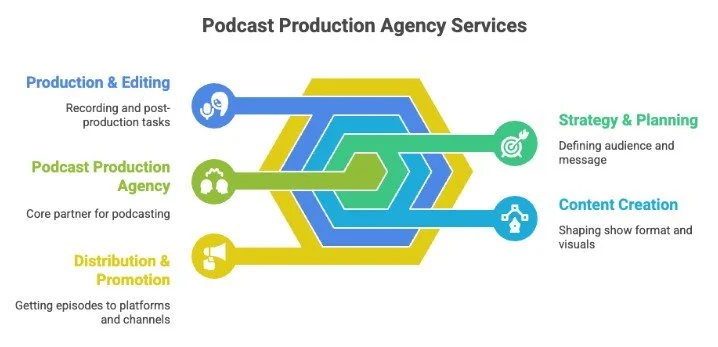
They’ll help define your target audience, clarify your message, and build a plan to grow listenership over time
From show format to episode structure to visual branding, they help shape a cohesive experience that reflects your brand
No more searching for guests or chasing down bios and headshots. Many agencies handle this end-to-end.
Recording support, editing, mixing, mastering, sound design, and show notes
They get your episode in the right places (Spotify, Apple, YouTube, etc.) and help you amplify it across other channels
You’ll get reporting that shows you what’s working, what’s not, and how to improve
Unlike studios, agencies can also work remotely or hybrid, which makes them accessible no matter where your team is based. That flexibility is a big benefit, especially when you’re balancing content across teams or locations.
Besides, a podcast production agency can help you reach your business goals faster, from lead gen to thought leadership, and brand awareness.
For example, here’s how we helped Zendesk achieve their goals with a branded podcast:
What Is a Podcast Studio?
A podcast studio is usually a physical space where you go to record your episodes. It’s designed to give you high-quality sound with pro-level equipment, without having to set up a mini studio in your office or living room.
Here’s what you typically get with a podcast studio:
A professional recording environment with soundproof rooms, high-end mics, and clean acoustics. That means you won’t have to deal with background noise or Zoom audio cutting out.
In-house engineers to run the board, monitor audio levels, and make sure your recording doesn’t go off the rails
Recording equipment included like XLR microphones, audio interface, acoustic panels, and more
Some studios offer editing and post-production services as an add-on, though it’s usually light-touch
What studios don’t usually offer:
Strategic support (Who’s your audience? What content will grow your reach?)
Marketing and promotion
Guest outreach or booking
Analytics and reporting insights
In short, a podcast studio is great if you want help with recording, but you’ll likely be on your own when it comes to planning, promoting, and scaling your show.
That makes studios a better fit for hands-on teams or creators who already know what they’re doing and just want access to good gear and a clean recording space.
Pro tip: If you’re recording remotely, gear setup and mic technique matter, but so does workflow. Check out our post on podcast content calendar planning.
Podcast Production Agency vs Podcast Studio: Key Differences (in plain view)
When you're deciding between a podcast agency and a studio, the differences tend to revolve around how much support vs. control you’ll have.
Podcast Production Agency Pros and Cons
A podcast production agency acts like a full partner in your show’s journey. They help you shape the show, grow the audience, and make decisions grounded in strategy.
With an agency, you get creative direction around things like branding, format, and tone, guest booking and logistics, full editing and post-production, distribution support, and data-driven insights on performance.
They can act like an extension of your marketing or content team to help with amplification, repurposing content, and growth tactics.
On the downside, you may be less involved in the process and the cost is higher. You also have to work around the agency’s schedule, especially during certain holidays.
Podcast Studio Pros and Cons
A podcast studio is more specialized.
Its main job is to give you professional space and gear to record. You get soundproof rooms, high-end microphones, and in‑studio engineering to make sure the recording is clean and smooth.
Sometimes studios offer editing or mixing as an add-on, but they rarely build in strategy, promotion, or growth support.
The question is, do you need that support?
Here’s one data point to illustrate why having a growth-minded partner is relevant.
The global podcasting market is projected to grow at a 27% compound annual growth rate (CAGR) from 2025 to 2030, climbing from about USD 30.7 billion in 2024 to over USD 131 billion by 2030.
That kind of growth is a sign of great opportunity, but to ride the wave rather than get swept by it, you’ll want more than gear and microphones. You need a partner who sees both the mic and the market.
Podcast Production Agency vs Podcast Studio: Which One’s Right for You?
Here’s how to choose between an agency and a studio based on your needs, and why that choice matters more than you might think.
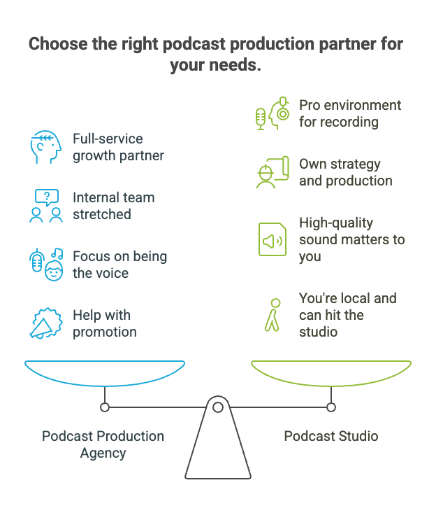
Go with a Podcast Production Agency if:
You want a full-service growth partner rather than someone who fixes your audio
Your internal team is already stretched (or missing skills in strategy, guest outreach, analytics)
You’d prefer to focus on being the voice of the show
You need help with promotion, audience development, and performance metrics
A Podcast Studio Might Be the Right Call if:
You already have your content plan mapped out and just need a pro environment to record
You like owning the strategy and production yourself (or have someone internally doing it)
You’re local and can hit the studio in person often
High-quality sound is your biggest hurdle, rather than a strategy for growth or reach
Why this decision matters (and the real pressure behind it)
In a recent Content Marketing Institute report, 58% of B2B marketers said lack of resources is their top challenge when trying to execute their content strategy.
So yes, calling up a studio solves a lot of your technical challenges. But if your bottleneck is bandwidth, execution, or growth, an agency offers the extra arms, brainpower, and muscle you’ll need.
Pro tip: A lot of brands plan their first few episodes, then stall because they haven’t lined up consistent guest scheduling and booking. Learn how to build a steady guest pipeline here.
What to Look for in a Podcast Partner
Choosing a podcast partner is about finding someone who delivers on what matters.
After all, podcasting is still growing fast. In 2024, 67% of people aged 12+ in the U.S. said they'd listened to a podcast before, up from 64% in 2023, and 47% reported listening monthly, a 5-point increase year over year.
This means more people are open to podcasts than ever. That makes the difference between just producing and scaling with intention even more important.
Here’s what to look for in a podcast production company:
Clear, strategic communication
You want someone who asks good questions, lays out the plan, and gives you regular and specific updates.
Demonstrated success & relevant experience
Look for partners who have scaled podcasts before, especially in your niche or at your size level. They should be able to show clear and relevant results here.
For example, we took business-process-management software Tonkean to the #1 position on Spotify in just six months. Here’s how they decided to bring us on and why our partnership made them industry leaders:
A strategy-first mindset
The partner should help you with more than just audio. You want someone who thinks about how the podcast ties into content, distribution, metrics, and business goals.
Transparent pricing
Avoid surprise add-ons. A trustworthy partner will be upfront about what’s included, like editing, guest booking, and marketing, and what costs extra.
Data-driven insights and growth focus
You’ll want to know what content works, what doesn’t, and how to double down. If your partner isn’t monitoring performance and suggesting changes, that’s a red flag.
Flexibility and hybrid options
Maybe you’ll sometimes record in-studio, sometimes remote. The ideal partner adapts to your workflow rather than forcing you into theirs.
Podcast Production Agency vs Podcast Studio: What Will You Choose?
Here’s what we’ve learned: a podcast production agency is your all-in-one growth engine, while a podcast studio is more like your production-quality toolbelt.
Neither is better universally; what matters is which one fits where you are now and where you want to go.
But keep in mind that podcast listening keeps climbing.
In their 2024 report, Edison Research found that podcasts now consume about 11 % of all audio‑listening time (up from just 2 % in 2014). That shift means people are committing serious time to podcasts. If your show doesn’t have the support to grow, you’ll get squeezed out.
So, what should you do next?
Audit your podcast’s biggest pain points. Is it consistency? Poor audio? No audience growth? Be honest.
Decide which gaps you’re okay handling yourself and which you want off your plate
Vet potential partners based on the criteria above. Ask for case studies, communication style, and flexibility.
Test a small project first. Don’t commit to a full long-term contract without seeing early results.
Measure, iterate, and scale. Make sure your partner is always pushing you toward smarter, more sustainable growth instead of just churning out more episodes.
Ready to Scale Your Podcast the Smart Way?
If you're serious about growing your podcast, it might be time for a true production partner. One that gets strategy, content, guests, promotion, and business outcomes.
That’s what Content Allies does.
We help B2B companies build revenue-generating podcasts from the ground up. From strategy and scheduling to editing and promotion, our team handles everything so you can focus on the conversations that matter.
Get in touch with Content Allies and find out how we can help you scale without burning out your team.
FAQs
What does a podcast production company do?
A podcast production company handles everything from concept development, guest sourcing, and host coaching to audio production, video editing, and project management. It’s ideal if you want a team that drives strategy and growth.
Can a production company help with social media and marketing assets?
Yes, a modern full-service podcast production agency will often help turn your episodes into marketing assets, social content, and even host-read ads. This ties everything back to your content marketing strategy.
Is podcast production only for content creators and influencers?
Not at all. Many B2B brands and companies use podcasts as part of their marketing strategy. With a full-service agency, you don’t need to be a creator; just bring your ideas and let the team guide the production process.
Do podcast production companies handle analytics reporting?
Yes, many offer analytics reporting to help you track episode performance, listener trends, and engagement over time. This insight helps shape future content and improve your podcast strategy.
What’s involved in episode publishing?
Episode publishing includes finalizing your edited audio/video, writing show notes, uploading to your distribution platform, and scheduling it to go live. A good production company handles this entire workflow.
Can I grow my show without a strong podcasting community?
You can, but tapping into the podcasting community, through guest features, cross-promotions, and social engagement, can really boost reach. A smart marketing strategy helps you plug in where it counts.
Do agencies create social media clips from podcast episodes?
Yes. Many full-service podcast production agencies turn key moments from your episodes into short, engaging social media clips for LinkedIn, Instagram, and more. This is perfect for boosting audience engagement.
What makes Content Allies different from other agencies?
Content Allies is a full-service podcast production agency built for B2B brands. From episode ideas and host training to remote recording, audio engineering, and media campaigns, they handle it all, so your team doesn't have to.
Does Content Allies support video podcasting and social clips?
Yes. Content Allies manages full video production alongside your audio, including video podcast editing, formatting for platforms, and repurposing episodes into scroll-stopping social media content.
I’ve been using a DIY approach. Can Content Allies still help?
Absolutely. If you’ve been managing audio software, podcast mixing, and specialist equipment on your own, Content Allies can take over with a structured production planning process, expert audio quality control, and a dedicated content strategist to drive results.