
ABM Podcast Strategy: How to Use Podcasts to Get More SQLs
Podcasts, as well as being amazing for brand awareness, are also a powerful tool to reach your top-tier accounts directly.
Just ask Meta, who hit 7× their initial download goal in 6 months by partnering with us at Content Allies.
With average daily podcast listening among U.S. daily listeners of about 105 minutes, you too could be getting unmatched attention from hard-to-reach buyers.
In this guide, we’ll show you how to use an ABM podcast strategy to land meetings with ideal accounts, accelerate deals, and align sales and marketing around a content machine built for business outcomes.
Let’s start.
What Are ABM Campaigns?
Account-Based Marketing (ABM) campaigns target a specific list of high-value accounts (in other words, your dream customers) with personalized strategies that engage them.
Instead of casting a wide net, ABM focuses your marketing and sales teams around one effort to win over those key accounts with tailored messaging, content, and outreach.
Here’s a quick ABM explainer video that breaks it down.
Next up, we’ll talk about how podcasts fit into that account-based approach, and why they’re quickly becoming a must-have in your ABM toolkit.
What Is an ABM Podcast Strategy?
An ABM podcast strategy is a focused way to use a B2B podcast as a tool to reach, engage, and build relationships with your most important target accounts. You’ll be creating a direct line to decision-makers inside your ideal customer profile (ICP) accounts.
As such, you invite key roles from your ABM list onto your show. That means CMOs, VPs, and Directors: people who influence buying decisions.
The podcast becomes a relationship-building touchpoint that complements your broader ABM strategy, from outbound campaigns and events to SDR sequences and ads.
You can think of it as another layer in your go-to-market strategy, but one that’s personal, high-trust, and built around real conversations.
Pro tip: If you want a shortcut, Content Allies specializes in building branded podcasts specifically for lead generation.
Why Do You Need an ABM Podcast Strategy?
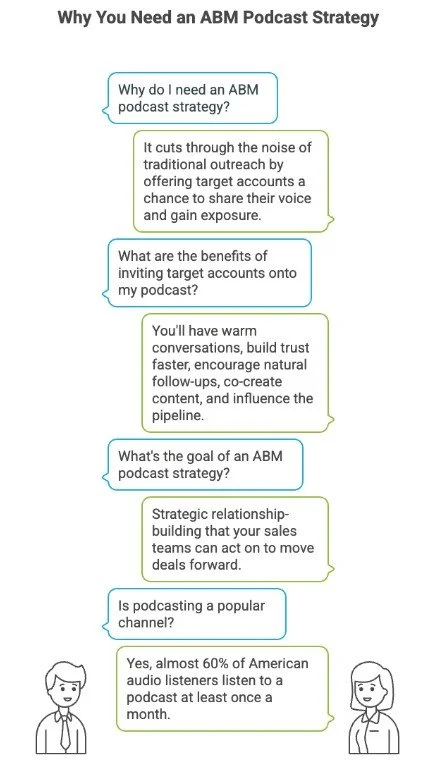
Traditional outreach is noisy. Your dream accounts are being bombarded with cold emails, ads, and LinkedIn DMs every day.
Some even admit to deleting 100 such DMs per day:
But an ABM podcast strategy gives you something they’ll actually say yes to: a chance to share their voice and gain exposure. You’re offering them something tangible instead of just pitching like everyone else.
By inviting target accounts onto your podcast, you open the door to:
Warm, peer-level conversations that go far beyond impersonal pitches
Faster trust-building during the buyer journey
Natural follow-ups that lead to real meetings
Content co-created with your key accounts, instead of about them or their presumed pain points
Tangible pipeline influence and deal acceleration
The goal here is strategic relationship-building that your sales teams can act on. For companies running full-funnel ABM, podcasts are becoming a high-value and high-attention way to move deals forward.
Since almost 60% of American audio listeners listen to a podcast at least once a month, this is a solid channel to get your brand and your target accounts in front of the right audience.
How Does an ABM Podcast Strategy Work?
Your goal with your ABM podcast strategy is to build a system that moves your target accounts through the marketing funnel and into your sales process. It’s one of many tools in your overall sales arsenal.
Here’s how it works:
Invite key decision-makers from your ABM list to be podcast guests. Use firmographic data to identify company names first.
Record thoughtful, peer-level conversations to build rapport.
Publish and promote content that positions them as thought leaders (and makes your brand look good, too).
Follow up with valuable resources like content kits, social clips, and shared distribution.
Turn that trust into traction by opening doors for sales conversations when the time is right.
This approach gives your marketing and sales teams a shared tool for targeted prospecting while creating genuine engagement.
And it works: senior executives are more than twice as likely as the average podcast listener to be “power listeners,” spending 5+ hours a week with business podcasts.
For ABM-focused teams, this is a golden opportunity to grab real attention from the right people when they’re already tuned in.
How to Build an ABM Podcast Strategy Step by Step
Here’s the playbook you can follow to launch an effective ABM podcast strategy.
At Content Allies, we’ve used this exact playbook across dozens of B2B shows.
For example, with our Leaders of B2B podcast, we featured 94 C-level execs and generated 43 sales opportunities, which led to $100,500 in closed revenue within just four months.
What you’re about to read is that same framework of guest mapping, outreach, content co‑creation, enablement kits, and measurement, applied specifically to help you land meetings with your ICP and accelerate pipeline growth.
Below are your five strategic steps:
Step 1: Map ABM Target Accounts to Your Podcast Guest List
The first step in any solid ABM podcast strategy is guest mapping, and it’s also where most companies either nail it or miss the mark.
Instead of picking guests based on popularity or industry buzz, start with your target account list. These are your dream clients: the companies your sales and marketing teams are actively trying to land.
From there, you’ll want to zoom in on the buying committee. Which specific people within those organizations actually make or influence the decision?
Think about roles like CMOs, VPs of Operations, and Heads of Digital. These are your podcast guest targets. Match job titles to firmographics, then prioritize based on fit and timing in the buyer journey.
When we work with clients at Content Allies, we build guest maps that link each podcast episode directly to key accounts. This makes every recording a strategic move, turning podcast content into revenue.
Pro tip: Aim for a mix of Tier 1 and Tier 2 accounts. This keeps your pipeline flowing while still targeting high-value prospects. If you get this right, your guest list will become a warm intro machine that your sales process can naturally build on.
Step 2: Create Value-First Outreach to Invite ICPs as Guests
Getting decision-makers from target accounts to say “yes” to your podcast invite starts with how you reach out. You shouldn’t treat this as a cold pitch; think of it more as a warm invitation to collaborate. Your message needs to offer clear mutual value, framed around thought leadership and visibility, not a sales agenda.
Use a simple but powerful messaging framework:
Context: Open with who you are and a quick social proof point (talk about past guests, your audience, or client base).
Personalization: Why are you contacting them specifically? Tie it to their role, expertise, or recent work. You want to stand out from generic, copy-pasted bulk outreach.
Value: Clearly explain what the episode will focus on and how it highlights them. Make it impossible for them to refuse.
CTA: A friendly, low-friction next step to book the recording.
People love to talk about their journey, challenges, and wins. And when you offer them a platform that feels legit, they’ll take it.
At Content Allies, we write dozens of these invitations every month, and we always prioritize authenticity over automation. You can grab our guest outreach template here.
Remember: You should make the outreach feel like an opportunity rather than an obligation. When done right, this approach can grab the attention of even the busiest executives and get your ABM podcast strategy off the ground fast.
Step 3. Co-Create Podcast Content to Build Trust With Target Accounts
Once your guest is booked, it’s time to start the recording process. This is where all your work so far starts to bear fruit, and it’s your opportunity to create an experience that builds trust and sets the stage for long-term connection.
Here’s how we run it at Content Allies:
Pre-call: A quick chat to align on the episode theme, flow, and what your guest wants to highlight. It also helps shake off any nerves.
Recording: Keep it conversational and peer-level. Ask thoughtful questions that draw out your guest’s perspective and encourage thoughtful, original answers.
Debrief: After the mics are off, that’s when many of the best follow-up opportunities emerge. Thank them, recap what stood out, and float ideas for future content or collaboration.
This co-creation process is what turns a podcast from a one-off interview into a relationship builder. When your key accounts feel heard and respected, the door opens naturally for your sales team to continue the conversation.
Think of this as immersive storytelling combined with sales segmentation. It’s a smart, human way to stay top-of-mind across the buyer journey.

Step 4. Turn Podcast Episodes Into ABM Sales Enablement Content
Over 60% of brands are repurposing podcast episodes, which is a smart move. From our experience, repurposing your content into shorter social clips or animation is one of the most effective promotion tactics.
So, don’t stop once your episode is published. A well-run ABM podcast strategy turns every episode into a library of assets that support your sales and marketing functions.
After the episode goes live, create a content kit that helps your team re-engage the guest’s company and others like it.
Side note: At Content Allies, we build these content kits into every podcast we produce. This helps us turn each episode into a reusable, full-funnel experience that lines up perfectly with your ABM campaigns.
Here are some examples of social media posts we created:
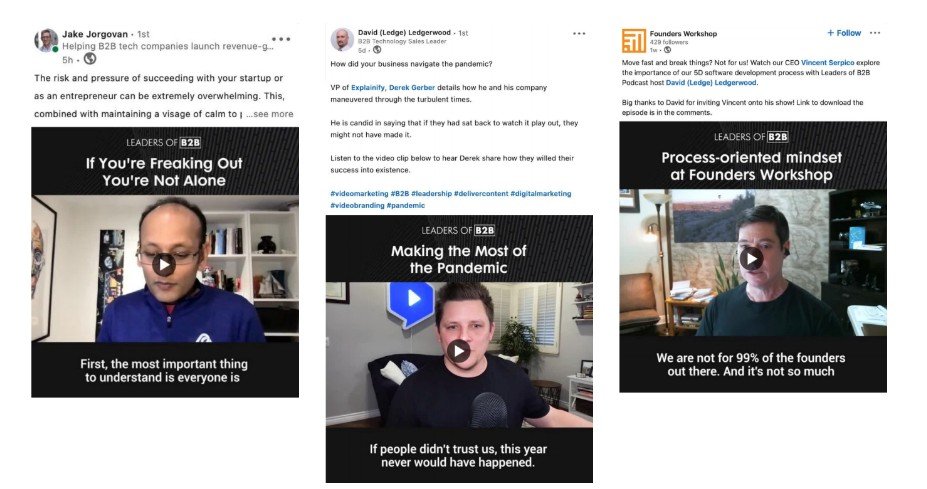
That said, your content kit should include:
Email snippets your sales team can personalize and send
Short video or audio clips with strong insights or soundbites
Quote graphics featuring the guest’s takeaways
A short write-up or mini case-style summary
LinkedIn posts that tag the guest and boost visibility
This gives your sales team high-value, hyper-relevant content that you can use in outreach and follow-up without sounding like a cold pitch.
It also supports your demand generation and marketing strategy by giving you authentic, account-specific content that you can share across channels like social media and
Step 5. Track ABM Influence and Measure Podcast Impact
If you're only tracking downloads, you're missing the real value of your ABM podcast strategy. In an account-based approach, success looks like meetings booked, pipeline influenced, and deals accelerated, all of which matter more than vanity metrics like subscriber counts.
Here’s what to track:
Guest engagement: Did the guest share the episode? Comment on it? Follow up afterward? These are all important signals that show that your guest found the experience valuable and wants their network to know about it.
Account progression: Did the podcast open a door to a sales convo, or move the account deeper into the sales cycle? Remember, your goal here is more sales, so you want tangible proof that your account is moving closer to that goal.
Content performance: How did the repurposed content (like clips, graphics, and posts) perform with similar accounts?
Sales enablement use: Is your sales team actually using the assets in their outreach?
Also, integrate your podcast touchpoints into your CRM. Tag accounts where podcast participation or content engagement influenced the deal. When you combine these insights with predictive analytics or market intelligence, you get a much fuller picture of how your show is impacting business outcomes.
Examples of ABM Campaigns Powered by Podcasts
Here are two examples of how we at Content Allies helped our clients turn podcasting into a relationship-driven channel that fuels ABM strategy, sales enablement, and customer success.
‘How People Work’ Podcast
When Fringe came to us, they were already redefining employee wellbeing with the world’s first lifestyle benefits marketplace.
What they didn’t yet have was a platform big enough to match the size of their vision. They wanted founders, CEOs, and culture-driven decision-makers to know who they were.
Jordan Peace, Fringe’s Co-Founder and CEO, had already recorded episodes internally, but the show wasn’t growing the way it deserved.
We worked shoulder-to-shoulder with their team to relaunch the podcast with intention: dialing in timing, stacking a backlog of episodes, refining the recording setup, and rebuilding the show’s go-to-market strategy from the ground up.
The relaunch hit exactly the way it needed to.
We had nearly 5,000 downloads across 43 episodes, and these people were the exact ICP Fringe wanted to reach.
On the guest side, we aligned with Jordan on the right profiles: founders, executives, and culture-driven leaders.
Next, we did the heavy lifting.
35+ high-value guests were scheduled, each one a new relationship for Fringe, each one a potential customer, partner, or brand advocate.
And because the show deserved visibility, we amplified everything on social.
With direct access to Jordan’s LinkedIn and Instagram, our team wrote and published consistent content: five posts per episode, quote graphics, videograms, strategic hashtags, and tags that kept Fringe front-of-mind with every guest.
Leaders of B2B Podcast
We teased this podcast a bit above, but now, here’s the full story.
When we launched the Leaders of B2B podcast, it was built as a revenue engine. At Content Allies, we’ve always believed in using our own playbook, so we put our podcast strategy to work on ourselves exactly the way we do for our clients.
Very quickly, the show became our most predictable, most scalable growth channel.
We published three episodes every week, intentionally mixing two types of guests:
Target prospects: the exact kind of B2B executives who could benefit from our service
Strategic partners: with audiences full of our ideal customers
That rhythm created a steady pipeline of conversations with the right people.
The results came fast.
94 B2B C-level executives engaged, each one a real, high-value interaction.
Out of those relationships came 43 new sales opportunities, all originating directly from the show.
And in the first four months, the podcast generated $100,500 in attributable revenue.
But the momentum didn’t stop at deals.
The podcast opened doors to partnerships we wouldn’t have accessed otherwise.
One of the biggest wins: becoming the official sponsor of SaaS Connect, an opportunity that expanded our reach and planted Content Allies squarely in front of thousands of ideal clients.
Disruptive Innovators Podcast
When David first came to us, he had one clear goal: bring real IT leadership into the spotlight.
These were C-suite executives who could tell real stories about innovation inside the enterprise. So we built a show that would attract exactly that caliber of guest… and it worked.
The Disruptive Innovators podcast found true visibility. It even landed on the Nasdaq billboard in Times Square, a surreal moment that instantly became a cornerstone of their marketing. That single image of their show lit up in Times Square is now used across their decks, social media, and outreach, acting as a credibility engine for everything they do.
On the performance side, the numbers tell the story even better. Across the first 53 episodes, the show pulled in 5,281 downloads, climbing to #1 in multiple podcast SEO categories.
Behind the scenes, the outreach machine kept feeding the pipeline:
5.3k targeted recipients reached
311 engaged
63 booked calls
31 new leads added to their CRM
This clean, consistent funnel started converting at over 20% from interest to scheduled conversation.
Wrap-Up: Launch Your ABM Podcast Strategy with Content Allies
An ABM podcast strategy isn’t about churning out as much content as possible. It’s about using your podcast to build real relationships with the people who matter most: your target accounts.
By mapping guests to key roles, co-creating valuable conversations, turning content into sales fuel, and measuring impact the right way, you’ll build trust, pipeline, and long-term business outcomes.
Ready to launch a podcast that gets you real meetings?
At Content Allies, we specialize in podcasts built from the ground up for ABM, sales alignment, and actual results. We’ve helped dozens of B2B brands turn their shows into revenue-generating machines.
Talk to us today to find out more and get started.
FAQ: Using Podcasts to Power Your ABM Campaign Strategy
How long does it take to see ABM results from a podcast strategy?
Most clients start seeing traction within 60–90 days, typically after a few episodes go live and outreach follow-ups begin. Results can accelerate quickly when the podcast is integrated into your go-to-market strategy and sales process.
Do you need an established audience for an ABM podcast to work?
No, you don’t need an established audience. An ABM podcast strategy is about building relationships. Even with a smaller, but highly qualified audience, you can start booking guests from your target accounts and turn those conversations into sales opportunities.
How does Content Allies help with podcast guest outreach for ABM campaigns?
We build your guest list based on your ICP and sales segmentation, write custom outreach messages, and manage all guest booking logistics to make sure every episode aligns with your account-based approach.
What makes Content Allies different from other B2B podcast production companies?
Unlike other podcast agencies, we don’t make editing our entire focus. We help turn your podcast into a content machine that supports your ABM, sales, and demand generation goals. It’s a full-service solution, from strategy to content creation to measurement. Here’s what one of our clients has to say about us:
Can Content Allies help repurpose podcast episodes into content for sales teams?
Absolutely. We create full content kits for every episode. That includes email copy, social clips, quote graphics, and more, so your sales team has ready-made assets to re-engage guests and similar key accounts.