
Podcast Audiograms: How to Make Them + 6 B2B Examples

Podcast audiograms have become one of the best ways to turn long-form audio content into short, engaging social media assets.
Instead of asking audiences to click into a full episode, an audiogram packages one strong podcast moment with captions, branding, and a moving waveform for platforms like LinkedIn, YouTube Shorts, and Instagram Reels.
Instead of asking audiences to click into a full episode, an audiogram packages one strong podcast moment with captions, branding, and a moving waveform for platforms like LinkedIn, YouTube Shorts, and Instagram Reels.
This matters because audio-only podcast promotion rarely performs in visual-first feeds. Research from WNYC found that podcast audiograms outperformed static images by 58% and links by 83% on Facebook.
For B2B brands, they’ve become a scalable way to turn expert conversations into thought leadership content and visibility.
At Content Allies, we help B2B brands turn podcast episodes into strategic content assets through production, promotion, and repurposing.
In this guide, we’ll break down what podcast audiograms are, how to create them, which tools to use, and seven B2B podcast audiogram examples worth learning from.
Podcast Audiograms vs Podcast Video Clips
Podcast audiograms are audio-led social clips that combine a podcast snippet with captions, branded visuals, and a waveform animation. Podcast video clips, on the other hand, use actual speaker footage from a recorded podcast and often feel more native on platforms like LinkedIn, YouTube Shorts, Instagram Reels, and TikTok.
Both formats help turn long-form podcast content into short, social-ready assets, but they are not the same. Podcast audiograms are easier to scale from audio-only episodes, while podcast video clips are stronger for showing personality, trust, and conversation dynamics.
| Feature | Podcast Audiograms | Podcast Video Clips |
|---|---|---|
| Format | Audio-led | Video-led |
| Visual style | Waveform, captions, and branded graphics | Speaker footage, captions, and motion |
| Best for | Audio-only podcasts | Video-recorded podcasts |
| Production | Faster and easier to scale | Requires video recording and more editing |
| Engagement potential | Good for quick, scalable social content | Often stronger because viewers can see the speaker |
| Strongest use case | Turning one episode into multiple social assets | Creating native short-form video clips |
Which Should B2B Brands Use?
Most B2B brands should use both because audiograms and video clips solve different distribution needs.
Use podcast audiograms when you need fast, scalable repurposing from audio-only episodes. And use podcast video clips when speaker footage is available, and the goal is to build trust, show personality, or drive stronger engagement.
The strongest podcast distribution systems combine both formats across different aspect ratios and social media platforms. This gives B2B teams more ways to turn one episode into LinkedIn posts, short-form videos, newsletter assets, and sales-friendly content.
As Elissa Craig of Headliner explains,
“Audiograms are powerful, versatile, and easy-to-use tools. They are effective assets that support podcast growth while also fostering audience engagement.”
What Makes a Good Podcast Audiogram?
A good podcast audiogram delivers one strong idea quickly in a format built for silent social media viewing. The best-performing clips combine a compelling audio clip, readable captions, clean visuals, and subtle motion that keeps attention without distracting from the message.
Let’s break down those factors in a little more detail.
Strong Audio Clip
The clip itself matters most. Strong podcast audiograms are usually 15 to 90 seconds long and focus on one clear takeaway, strong opinion, or curiosity gap. We suggest avoiding long setups or context-heavy intros.
Clear Captions
Captions make podcast audiograms easier to understand in silent autoplay environments. They should support the audio without overwhelming the screen, helping viewers follow the main idea even if they are scrolling without sound.
Simple Visual Design
Good podcast audiograms are branded but not cluttered. Use consistent fonts, colors, and layouts with one clear focal point. Speaker names, titles, and branding should support the content rather than overpower it.
Motion That Supports the Message
Waveform animation, audio waves, and progress bars help make audio content feel dynamic. Keep motion subtle. Over-designed waveform videos often hurt retention instead of improving it.
Platform-Ready Formatting
Different social media channels require different aspect ratios. In most cases, 1:1 works well for feed posts and cross-platform flexibility, while 9:16 is better for full-screen placements like Instagram Reels, TikTok, and YouTube Shorts.
For B2B brands, this is even more important on LinkedIn, where short-form video is already a strong engagement format. According to Sprout Social, 27% of LinkedIn users are most likely to engage with short-form video from brands. This means podcast audiograms need to be formatted like social video, not just exported as audio clips with graphics.
Your hook should also appear within the first 1–3 seconds, captions should be readable on mobile, and the layout should make the main idea clear before someone decides to scroll.
Why Podcast Audiograms Work So Well for B2B Brands
Full podcast episodes require a high level of time and attention. Podcast audiograms lower that barrier by turning long-form conversations into short, accessible clips built for busy professionals.
Instead of asking someone to commit to a 45-minute episode, audiograms give them a quick entry point into the conversation.
But more podcast listens are not the only goal. For B2B brands, strong audiograms can also help:
Build trust with future buyers
Increase executive visibility
Support thought leadership
Keep the brand consistently visible
Give sales and marketing teams reusable content
This matters because most B2B buyers are not ready to purchase immediately. According to the 2024 Edelman/LinkedIn B2B Thought Leadership Impact Report, 95% of buyers are out-of-market at any given time. Repeated exposure to expert-led audio content helps brands stay familiar until buying intent appears.

Here’s where audiograms create the most value for B2B podcast distribution.
1. Leads With the Best Idea
A common mistake in podcast promotion is asking people to listen before giving them a reason to care.
Audiograms reverse that order. They surface the strongest insight first, whether it is a founder POV, customer pain point, industry trend, or contrarian take. That makes the content easier to engage with even for people who are not actively looking for a podcast to listen to.
2. Gives Each Episode More Distribution Angles
One podcast episode usually covers several ideas, but a single launch post can only highlight one of them.
Audiograms let you break the episode into separate angles for different audiences. One clip might speak to executives, another to practitioners, and another to a specific pain point your buyers already recognize.
This helps each episode work harder across LinkedIn, newsletters, sales follow-ups, and other content channels.
3. Creates Content Sales Teams Can Actually Use
B2B podcast clips are not only useful for marketing. Sales teams can also use them to support conversations with prospects.
For example, a short clip can help explain a market shift, answer a common objection, introduce a subject-matter expert, or reinforce a point after a sales call. This makes the podcast more than a brand awareness channel. It becomes a library of useful moments your team can share when the context fits.
4. Makes Complex Topics Easier to Understand
Many B2B topics are hard to explain in a single static post. Audiograms make those ideas easier to follow by combining spoken explanation with captions, visual hooks, and simple motion.
In fact, according to Meta internal research cited by Storyblocks, captions can increase video view time by 12%, which makes them important for silent autoplay environments like LinkedIn feeds.
5. Keeps Content Visible After Launch
Without repurposing, a podcast episode often gets attention for a few days and then disappears.
Audiograms extend the life of each episode by giving teams more moments to publish over time. Instead of treating the episode as one asset, B2B brands can turn it into an ongoing source of thought leadership, social content, and sales enablement material.
How to Create a Podcast Audiogram: Step-by-Step Guide
Effective podcast audiograms start with the right moment: a clear idea, a strong hook, and a format built for the social platform where the clip will live.
The process below will help you turn a full podcast episode into short, focused clips that are easier to watch, share, and repurpose.
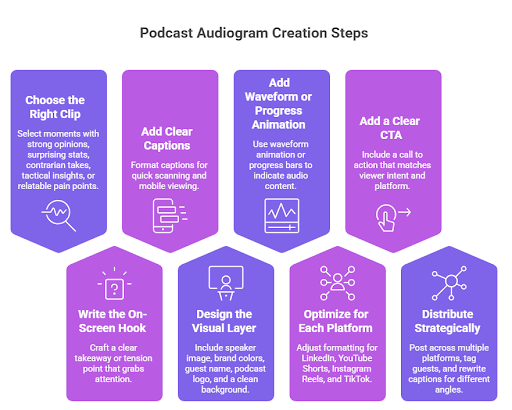
1. Choose the Right Clip
Most podcast moments do not make good audiograms, and finding out which ones do is a skill in itself. The strongest clips usually contain:
A strong opinion
A surprising stat
A contrarian take
A tactical insight
A relatable pain point
Good clips create curiosity quickly. For example, “Most B2B podcasts never influence the pipeline because nobody distributes them properly” is stronger than a generic educational explanation about podcast marketing.
At Content Allies, we usually clip for curiosity. The goal is to make someone want the next layer of the conversation.
2. Write the On-Screen Hook
Your hook determines whether someone keeps scrolling.
Avoid generic overlays like: “New podcast episode”, “Episode 42 is live”, or “Check out our latest interview”.
Instead, lead with a clear takeaway or tension point. That could be:
“Why most B2B podcasts fail to drive pipeline.”
“The mistake SaaS brands make with thought leadership.”
“Your podcast clips should not just promote episodes.”
The best hooks immediately tell viewers why the clip matters to them.
3. Add Clear Captions
Once you choose the clip and write the hook, format the captions for quick scanning and mobile viewing. Keep each line short, avoid tiny text, break sentences naturally, and clean up any errors from automatic transcription.
For example, if a guest says:
“Most companies publish clips without any distribution strategy behind them.”
You might format it as:
Most companies publish clips
without any distribution strategy
This makes the idea easier to process on a small screen while scrolling and keeps the caption layout from feeling crowded.
4. Design the Visual Layer
Most podcast audiograms only need a few visual elements:
Speaker image or video still
Brand colors and fonts
Guest name and title
Podcast logo
Clean background
Simple static backgrounds mostly outperform over-designed visuals because the message stays clear. If the clip is insight-heavy, your goal is to reduce distractions instead of adding more motion graphics or visualizer styles.
5. Add Waveform or Progress Animation
Waveform animation (a visual representation of sound) instantly tells the viewer that the content is audio-led. Progress bars can also improve retention because viewers understand how much of the clip remains.
Keep motion subtle. If the audio waveform becomes the focal point instead of the conversation, the design is doing too much.
6. Optimize for Each Platform
Different social media channels reward different formatting styles.
LinkedIn: Square or vertical format with professional hooks and strong text captions
YouTube Shorts: Vertical video with fast pacing and immediate topic clarity
Instagram Reels: Strong first frame and visual movement
TikTok: Faster pacing and less polished editing style
Before publishing, preview the audiogram on mobile. Make sure the captions are readable, the speaker's name is not cropped, and the main hook is visible within the first few seconds.
7. Add a Clear CTA
Your CTA should match the viewer’s intent and the platform.
Examples:
Listen to the full episode
Watch the full conversation
Follow for more B2B podcast insights
Read the full breakdown
Send this to your content team
At Content Allies, we’ve found that CTA framing often matters more than small design changes. Not every clip needs to push for a full episode listen. Some clips are better suited for engagement, education, or sales enablement.
8. Distribute Strategically
A strong audiogram with weak distribution usually underperforms.
To extend reach:
Post across multiple platforms
Tag guests and their companies
Repost clips from founder or executive profiles
Rewrite captions for different audience angles
Include clips in newsletters
Share clips internally with sales teams
The most effective B2B brands build a weekly repurposing system where one podcast episode generates multiple social assets over time.
6 Podcast Audiogram Examples B2B Teams Can Learn From
We’ve put together some podcast audiogram examples that show different ways to turn business conversations into social-ready clips. Some come from traditional B2B brands, while others come from business media, industry podcasts, or professional thought leadership shows that B2B teams can still learn from.
1. Bloomberg Odd Lots Audiogram
Use case: Packaging complex finance and market commentary
Bloomberg’s Odd Lots is a strong example for B2B teams because it shows how complex topics can be packaged into a clean, professional social asset. The format uses simple branding, captions, and visual structure to make finance, markets, economics, and business commentary easier to consume while scrolling.
While Bloomberg is a business media brand rather than a traditional B2B company, this example is still useful for B2B teams. You can use it as a model when your podcast covers technical, financial, strategic, or industry-specific topics that need a polished visual frame.
Why it works for B2B?
It keeps the focus on expert commentary instead of overloading the clip with unnecessary design. This makes the audiogram feel credible, clear, and easy to follow.
2. Podnews Audiogram
Use case: Turning industry news into lightweight podcast clips
Podnews is a useful example for teams that publish frequent updates, industry commentary, or news-style podcast content. The format is simple: a clear headline, static visual, and waveform animation that keeps the focus on the audio.
This works well for B2B teams because not every audiogram needs heavy production. If your podcast covers market updates, platform changes, trend analysis, or industry news, this style can help you create clips quickly without making the design feel crowded.
Why it works for B2B?
It proves that clarity matters more than visual complexity. The simple layout helps the audience understand the topic fast.
3. Change Makers Audiogram
Use case: Turning business-change conversations into thought leadership clips
Change Makers works well as a thought leadership example because it centers on business, leadership, change, and impact-driven conversations. This type of audiogram is useful when the goal is to highlight a guest’s perspective rather than simply promote a new episode.
For B2B brands, this format can work well for interviews with founders, executives, advisors, policy voices, or industry leaders. A short clip can turn one strong idea from the conversation into a standalone social asset.
Why it works for B2B?
It gives the audience a clear reason to care about the guest’s perspective before asking them to listen to the full episode.
4. Defining Moments of Leadership with Marsha Acker
Use case: Repurposing leadership and team-development conversations
This example is useful for B2B brands in leadership, coaching, HR, consulting, and organizational development. Instead of treating the podcast as only an interview, the audiogram can pull out one leadership lesson, team challenge, or coaching insight.
You can use this style when your podcast includes practical advice from experts or conversations around management, culture, decision-making, or team performance.
Why it works for B2B?
It turns leadership advice into short-form content that executives, managers, and team leads can quickly understand and share.
5. Innovating Leadership: Co-Creating Our Future
Use case: Creating audiogram-style podcast videos for YouTube
Innovating Leadership: Co-Creating Our Future is a good example of how audiograms can go beyond short social clips. Some B2B teams use audiogram-style videos on YouTube when they have strong audio but no speaker footage.
This format is useful for leadership, consulting, professional services, and advisory brands that want to make audio-only conversations more visible on video-first platforms.
Why it works for B2B?
It gives audio-led content a visual format, which makes it easier to publish on YouTube and reuse across other channels.
6. Powered by Search Podcast Testimonial Audiogram
Use case: Using podcast audio for SaaS remarketing and sales enablement
This is one of the strongest true B2B use cases. Powered by Search turned a podcast mention from a client into an audiogram and used it as remarketing content for sales-qualified leads.
That makes this example different from a normal podcast promo. Instead of only trying to drive listeners, the audiogram becomes proof, validation, and sales-support content.
Why it works for B2B?
It shows how podcast audio can support the buyer journey. You can use customer praise, guest mentions, or third-party validation as short clips for remarketing, sales follow-ups, or nurture campaigns.
Best Podcast Audiogram Tools
There’s no shortage of tools for creating podcast audiograms. The right choice depends on your budget, production workflow, and how much content you plan to publish consistently.
Beginner-Friendly Tools
Canva is one of the easiest ways to create simple podcast promo assets. It offers drag-and-drop templates, basic waveform videos, subtitle styles, and social media aspect ratio presets. It’s a good fit for small teams that want lightweight content creation without advanced video editing software.
Headliner is one of the most widely used podcast audiogram tools. It’s built specifically for turning audio clips into social-ready videos with captions, sound waves, and audiogram formats optimized for social media platforms.
Wavve focuses heavily on podcast repurposing and visualizer styles. It’s useful for creating consistent branded clips quickly, especially for teams publishing multiple episodes each month.
AI-Powered Tools
Podsqueeze uses AI clipping and automatic captions to speed up podcast repurposing. It can identify impactful moments from full project audio and quickly turn them into bite-sized clips for social media channels.
Descript combines transcription, audio editing, video editing, and audiogram creation in one workflow. It is useful for teams that want to edit audio tracks and transcribed text together. Descript also has some neat collaboration features for content teams.
Riverside started as a recording platform but now includes clipping and repurposing tools designed for video podcasts and short-form social content. It works well for remote podcast production workflows.
Advanced and Scalable Workflows
Larger brands mostly use Adobe tools or fully custom motion design workflows for more polished visual storytelling. These setups allow for more advanced animation, custom brand styling, and scalable content systems across multiple shows.
That said, the tool itself usually matters less than:
Choosing strong clips
Building a consistent publishing cadence
Pairing clips with a strong distribution strategy
How to Measure Podcast Audiogram Performance
Podcast audiograms should not be judged only by direct podcast listens. For B2B brands, they typically serve as visibility, trust-building, and demand-generation assets long before someone becomes a buyer.
Start by measuring awareness metrics like impressions, reach, video views, and guest reposts. These show whether your content is getting distributed effectively across social media platforms.
Then look at engagement quality. Comments, shares, saves, average watch time, and completion rate usually reveal more than raw view counts. If viewers consistently drop after a few seconds, the hook or pacing may need improvement.
Finally, track business-level signals where possible. This can include clicks to the full episode, newsletter signups, LinkedIn profile visits, website traffic, influenced sales conversations, and even pipeline impact for larger campaigns.
At Content Allies, we mostly see podcast audiograms generate far more reach than the full episode itself because short-form clips are easier to discover, consume, and share.

How Content Allies Uses Podcast Audiograms for B2B Growth
Content Allies helps B2B brands turn podcast episodes into scalable content systems. Instead of creating one-off podcast promo clips, we repurpose each episode into multiple social assets designed for LinkedIn growth, visibility, and demand generation.
In many cases, one episode can produce 10-20 short clips covering different pain points, insights, or audience segments. The focus is less on flashy editing and more on clip selection, positioning, and distribution strategy.
We also help with audiograms, for example, in the Talent Acquisition Leaders Podcast we helped produce for Sagemark HR, which helped them secure 9 new clients in just one year. Here’s an example of one of their audiograms.
Get in touch with us to find out how you can get more out of your B2B podcast content.
FAQs
What is a podcast audiogram?
A podcast audiogram is a short, social-ready video clip that combines a podcast audio snippet with captions, branding, and waveform animation for sharing on platforms like LinkedIn, YouTube Shorts, Instagram Reels, and TikTok.
How long should a podcast audiogram be?
Most high-performing podcast audiograms are between 15 and 90 seconds long, with the strongest clips often landing under 30 seconds.
Where should I post podcast audiograms?
Podcast audiograms work best on LinkedIn, YouTube Shorts, Instagram Reels, TikTok, and other social media channels that prioritize short-form video.
Do podcast audiograms actually drive listens?
Yes, podcast audiograms can increase podcast discovery and engagement by giving audiences a low-commitment entry point into longer conversations.
How does Content Allies create podcast audiograms at scale?
Content Allies combines clip selection, captioning, branding, and distribution workflows to turn each podcast episode into multiple reusable social assets.
Can Content Allies help with distribution and promotion?
Yes, we help distribute podcast content across LinkedIn, newsletters, SEO content, and other demand generation channels.
Appendix of Sources & References
-
Simmons, D. (2016). The Future of Social Audio is Here, Presenting the Audiogram Generator. WNYC / Medium.
URL: https://medium.com/@WNYC/socialaudio-e648e8a5f2e9 -
Alexandra (2026). 2026 Social Media Video Sizes for Every Platform. SocialBee Blog.
URL: https://socialbee.com/blog/social-media-video-sizes/ -
Zote, J. (2026). 30 LinkedIn Statistics That Marketers Must Know in 2026. Sprout Social Insights.
URL: https://sproutsocial.com/insights/linkedin-statistics/ -
Edelman & LinkedIn (2024). 2024 B2B Thought Leadership Impact Report. Edelman.
URL: https://www.edelman.com/expertise/Business-Marketing/2024-b2b-thought-leadership-report -
Miller, K. (2025, updated 2026). Why Not Adding Captions Is Hurting Your Video Engagement. Storyblocks Blog.
URL: https://www.storyblocks.com/resources/blog/video-captioning -
Statista (2024). LinkedIn Ideal Video Length by Account Size. Statista.
URL: https://www.statista.com/statistics/1460668/linkedin-ideal-video-account-size/