
Podcast Release Schedule: What Works for B2B (with Data)
Most B2B podcasts don’t fail because the content is bad, the host is unengaging, or the sound quality is poor.
They actually fail because the podcast schedule becomes inconsistent, unsustainable, or disconnected from their listener’s habits.
At Content Allies, we see this often while producing podcasts for B2B companies: even the best podcast ideas only work when they’re backed by a release cadence your team can realistically maintain.
But despite how important podcast publishing frequency is, most advice online is still based on generic creator trends rather than the realities of B2B production.
In this article, we’ll break down what the data actually says about release cadence, publication times, podcast seasons, and listener behavior. We’ll also cover how different industries, team sizes, and content production calendars should influence your posting schedule and long-term growth strategy.
How Often Should a B2B Podcast Publish?
Most B2B podcasts should publish at least twice per month. Weekly publishing can work, but consistency matters more than frequency.
The best podcast schedule is the one your team can sustain long term without sacrificing quality, guest experience, or promotion. A reliable biweekly release cadence will usually outperform an inconsistent weekly posting schedule.
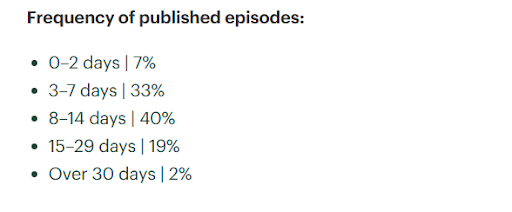
The data supports this. Buzzsprout’s 2024 podcast statistics show that 40% of podcasts publish every 8–14 days, making a biweekly-style cadence the most common publishing rhythm in its sample. Another 40% publish weekly or more often, while 21% publish every 15 days or less frequently.
B2B-specific research shows similar trends. Share Your Genius analyzed analyzed more than 3,000 podcast episodes across 80+ B2B shows and recommended publishing at least two episodes monthly to maintain audience engagement and support subscriber growth.
For most B2B teams:
Weekly publishing works best when you have strong batch recording, editing, and promotion systems.
Biweekly publishing is usually the most sustainable and effective cadence.
Monthly publishing can work, but it needs stronger social media, email, and repurposing support between episodes.
Production reality matters. A single episode usually includes guest coordination, research, recording, editing, show notes, social media graphics, email promotion, and distribution across every hosting platform and RSS feed.
So, the goal is to choose a podcast release schedule your team can maintain long enough to build trust, listener habits, and measurable growth.
Here’s our guide to choosing a podcast posting frequency:
Recommended B2B Podcast Cadence by Company Type
Not every B2B podcast needs the same posting schedule. Your ideal release cadence depends on your production bandwidth, target audience, content length, and internal resources.
| Company Type | Recommended Cadence | Why It Works | Main Challenge |
|---|---|---|---|
| Founder-Led or Executive Brand Podcasts | Biweekly | Maintains thought leadership consistency without overwhelming executive schedules. | Limited recording availability |
| Small B2B Marketing Teams | Weekly or biweekly | Weekly publishing is possible with strong batch recording and podcast content repurposing systems. | Operational discipline and editing workload |
| Enterprise or Media-Led Brands | Weekly or multi-format publishing | Larger teams can support guest interviews, short-form videos, news updates, and podcast seasons simultaneously. | Managing production challenges |
| High-Consideration Industries (legal, healthcare, manufacturing, infrastructure) | Monthly or biweekly | Audiences value expertise and depth over rapid publication times. | Longer research and approval cycles |
For many teams, meeting the reality of production matters more than ambition. A weekly podcast schedule sounds attractive, but maintaining guest coordination, show notes, social media promotion, and production calendars at that pace can become difficult quickly.
That’s why many successful B2B podcasts rely on batch processing, content planning, and schedule episodes features inside their hosting platform to maintain a reliable publishing cadence without constant last-minute production pressure.
Key factors that shape your B2B podcast publishing cadence
Your company type gives you a good starting point, but your final podcast cadence should still match how your team works. Before you commit to weekly, biweekly, or monthly publishing, make sure to check these factors:
Audience urgency: If your buyers need regular updates on market shifts, product changes, regulations, or category trends, a weekly show may make sense.
Content depth: If each episode needs research, expert input, technical accuracy, or legal review, a slower cadence will usually protect quality.
Episode format: Guest interviews take more coordination than solo episodes, short updates, or recap-style formats. The more complex the format, the more breathing room your schedule needs.
Approval process: If leadership, legal, compliance, or product teams review each episode, weekly publishing can become hard to sustain.
Promotion capacity: Your team needs time to repurpose each podcast episode into clips, LinkedIn posts, email content, sales assets, and newsletter mentions. If promotion gets skipped, your cadence is probably too aggressive.
In practice, start with the cadence your company type suggests, then adjust it based on these five factors. A schedule only works when your team can record, approve, publish, and promote each episode without rushing the process.
What Is the Best Time to Release a B2B Podcast?
The best time to release a B2B podcast is early morning, around 2AM to 5AM in your primary audience’s timezone. This gives podcast apps time to refresh before the main listening window, which starts around the morning commute and continues into the workday.
Edison Research data shows that 25% of daily podcast listening happens between 6am and 10am, while another 26% happens between 10am and 2pm. This means more than half of daily podcast listening happens before 2pm.

Source: Edison Research
For B2B podcasts, this lines up with how professional audiences usually listen:
Morning commutes
Gym sessions before work
Work breaks
Admin tasks
Light research during the workday
Publishing early helps your episode appear in podcast apps before these listening moments begin. Spotify, Apple Podcasts, and other podcast apps may take time to pull new episodes from your RSS feed, so a release time around 2AM to 5AM usually gives the episode enough time to appear before your audience starts listening.
For most B2B teams, the safer move is to publish early in the morning and then promote the episode later the same day through LinkedIn, email, and internal sales channels.
What Are the Best Days to Release a B2B Podcast?
The best days to release a B2B podcast are usually Tuesday, Wednesday, and Thursday. For most B2B shows, Tuesday or Wednesday morning is the safest starting point because it matches core workweek routines.
Research from Megaphone found that podcasts published on Tuesday at 5am received the strongest download performance, followed by Wednesday at 2am. Podchaser’s analysis of 50,000 podcasts also found that Thursday drives the highest total downloads.
The pattern makes sense when you look at listener behavior. B2B audiences are most active during the core workweek, when routines are more predictable and podcast listening is tied to commuting, desk work, and professional development.
For most B2B podcast schedules, the strongest release windows are:
Tuesday morning: Usually the best balance of visibility and listener attention
Wednesday morning: High platform activity and strong midweek engagement
Thursday morning: Strong total download performance as audiences catch up on episodes
Friday releases are usually less effective for B2B shows. Professional audiences are less likely to engage with business content heading into the weekend, which can hurt early download momentum and lead to lower visibility in platform algorithms.
“When a show is published is a crucial factor to its success. Our data shows that people listen to podcasts frequently and within their routine. During weekdays, podcast listening spikes in the early morning and evening—commute times—and stays consistent throughout the rest of the day.” Spotify
Should Your Release Schedule Vary Between Platforms?
For most B2B podcasts, your audio release schedule should stay consistent across Spotify, Apple Podcasts, and other podcast apps. Publish the episode on the same date so listeners know when to expect it, and so your team can keep the production calendar simple.
Where you can be more flexible is promotion, video, and platform-specific packaging. A podcast episode is no longer consumed only through a podcast app. Some listeners find it through YouTube, some see a clip on LinkedIn, and some click from an email or newsletter.
This is where the platform data matters. The 2025 Cumulus Media and Signal Hill Insights Podcast Download report found YouTube was the most-used podcast platform among weekly podcast consumers in Q3 2025 at 41%, followed by Spotify at 25% and Apple Podcasts at 11%.
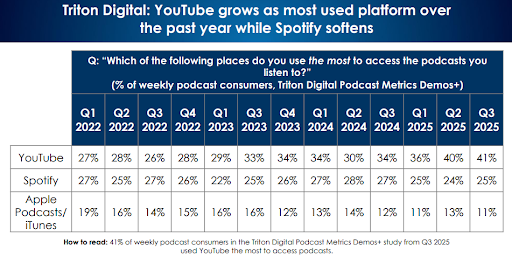
Image Source: WestwoodOne
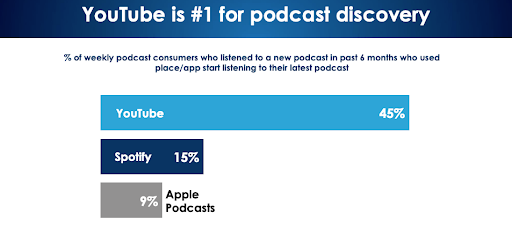
YouTube also plays a major role in discovery. In the same report, 45% of weekly podcast consumers who started a new podcast in the previous six months said they started their latest new show on YouTube.
Learn more about B2B podcasting on YouTube in our guide.
For B2B teams, this does not mean you need separate release dates for every platform. It means your audio can go live everywhere at once, while your YouTube version, LinkedIn clips, email promotion, and short-form videos can follow a timing that fits each channel.
In practice, this means:
Publish audio everywhere at the same time: Keep your podcast schedule consistent across Apple Podcasts, Spotify, and other podcast apps.
Delay YouTube when needed: If the video edit, thumbnail, title, or description takes longer, posting the YouTube version 24 to 48 hours later is fine.
Spread promotion across the week: Don’t put every LinkedIn post, email mention, audiogram, short-form clip, and sales share on release day.
Match each platform’s format: LinkedIn works well for insight-led clips and text posts. YouTube needs stronger titles, thumbnails, chapters, and search-friendly descriptions. Short-form video needs a clear hook and tight pacing.
Insider tip: Keep the core podcast release consistent. However, adjust promotion based on how your audience uses each platform.
Should You Use Podcast Seasons?
Podcast seasons can work well for B2B brands, particularly smaller teams, executive-led shows, and content-heavy podcasts. A seasonal format gives your team a defined production window instead of an endless weekly publishing cycle.
This matters because B2B podcast production can be more complex than creator-led shows. Guest interviews, approvals, editing, show notes, clips, and campaign planning all take time. Content Marketing Institute’s 2025 benchmarks found that only one in three B2B marketers say they have a scalable content creation model.
Podcast seasons can solve part of that problem. Your team can plan a focused run of episodes, record in batches, promote each episode properly, then pause before the next season.
Podcast seasons work well for:
Smaller marketing teams. Batch recording several episodes at once reduces production pressure and improves consistency.
Theme-based series. Product launches, industry trends, or campaign-driven content naturally fit a seasonal structure.
Longer B2B sales cycles. Some brands build podcast seasons around quarterly campaigns, events, or demand generation efforts.
Importantly, seasonal podcasts do not stop generating value during breaks. Cumulus Media and Signal Hill Insights found that 65% of weekly podcast consumers go back and listen to older episodes they missed. This means strong evergreen content can continue attracting listeners between seasons.
The key is staying visible during hiatus periods. Between seasons, successful shows typically focus on:
Promoting older podcast episodes
Sharing short-form videos and social media graphics
Maintaining email list engagement
Publishing podcast trailers or season previews
Driving traffic back to the episodes page and back catalogue
Practical Tips to Maintain a Consistent B2B Podcast Schedule
Maintaining a reliable podcast schedule is usually more about systems than motivation. Small operational tweaks often make the biggest difference over time.
Here are a few practical ways to stay consistent:
Record ahead whenever possible. Keeping 2-4 finished podcast episodes in reserve takes pressure off scheduling and protects against delays.
Use a shared content calendar. Make sure to track recording dates, publish dates, guest deadlines, social media promotion, and show notes in one place.
Standardize your workflow. Having reusable templates for guest research, script writing, social media graphics, and episode uploads save time every week.
Reduce unnecessary production complexity. Not every episode needs a professional studio setup or heavy editing. Simpler production often improves sustainability.
Measure sustainability, not just growth. The best podcast schedule is the one your team can realistically maintain for the next 12 months and not just the next 12 weeks.
How Content Allies Helps B2B Brands Build Sustainable Podcast Growth
There is no perfect podcast schedule that guarantees growth. For most B2B shows, the stronger path is a cadence your team can maintain with consistency, quality, and clear audience focus.
But choosing the right cadence is only one part of the work.
Your team still has to manage guest outreach, recording calendars, editing, approvals, show notes, publishing, LinkedIn promotion, email sends, short-form clips, and audience development. When those pieces are scattered, even a strong podcast idea can lose momentum.
This is where Content Allies helps.
We help B2B brands build podcast systems your team can actually maintain. From production calendars and guest coordination to editing, publishing, promotion, and growth strategy, we create a process that keeps your show moving without putting extra pressure on your internal team.
If you want a podcast strategy that fits your team, your audience, and your growth goals, let’s talk!
FAQs
How long should a B2B podcast episode be?
Most B2B podcast episodes perform best between 20 and 45 minutes, depending on the topic depth and audience expectations.
What is the best time to post a B2B podcast on YouTube?
According to IQFluence data , the best time to post a B2B podcast on YouTube is early morning on a midweek day, around 5am to 7am in your core audience’s timezone.
For B2B shows, Tuesday, Wednesday, or Thursday morning is usually the safest window. It gives the full video podcast time to appear, process, and start gaining traction before your audience moves into their workday routine.
What is the best time to post a B2B podcast on Spotify?
The best time to post a B2B podcast on Spotify is typically between 2am and 5am on weekday mornings, with 5am usually generating the strongest download performance.
How many episodes should a B2B podcast launch with?
Most B2B podcasts should launch with at least three episodes to improve subscriber growth and give new listeners more content to explore immediately.
Is weekly publishing too much for most B2B podcasts?
For many B2B teams, weekly publishing is difficult to sustain long term without strong batch recording, editing, and content planning systems.
Should B2B podcasts release video and audio simultaneously?
Most B2B podcasts should publish audio across podcast platforms first and release video later if additional editing or post-production is required.
Appendix
- Buzzsprout — Podcast Statistics
- Share Your Genius — B2B Podcast Data & Benchmarks for Success
- Edison Research — When Do People Listen to Podcasts?
- Lower Street — Best Day to Publish a Podcast
- PodRewind — Best Days to Release Podcast Episodes
- Cumulus Media & Signal Hill Insights — Podcast Download Fall 2025 Report
- Spotify for Creators — Podcast Publishing Schedule Guide
- Podcast Marketing Academy — Podcast Marketing Trends Report 2025
- Content Marketing Institute — B2B Content Marketing Trends Research 2025
- IQFluence — Best Time to Post on YouTube