
Podcast Guest Release Form: Free Template and Guide
A podcast guest release form gives podcast hosts, producers, and branded podcast teams written permission to record, edit, publish, distribute, and repurpose a guest’s appearance.
That matters more now because a single podcast interview can become a YouTube video, social clip, transcript, newsletter, blog post, AI-assisted summary, or sales asset. If your release form only covers the recording itself, it may leave gaps around how the content can be used later.
AI has added another layer to this conversation. The U.S. Copyright Office received over 10,000 comments on its AI and copyright notice of inquiry, which shows how quickly questions around ownership, consent, and content reuse are changing.
In this guide, you’ll learn what a podcast guest release form is, how it differs from recording consent and a podcast guest contract, whether verbal consent is enough, what the agreement should include, when legal waivers matter, and how to use a free release form template.
What Is a Podcast Guest Release Form?
A podcast guest release form is a written permission document that allows a podcast host, company, or producer to record a guest and use that recording for publishing, promotion, and repurposing.
It helps establish a clear legal agreement between podcast guests and whoever is producing the content.
A standard guest release form can cover:
Audio recording
Video recording
Editing and formatting
Publishing and distribution
Promotional use
Name, image, voice, and likeness usage
Social media clips and marketing assets
Transcripts, captions, and AI-assisted summaries
Many podcast production companies now include release forms as part of their booking logistics and recording process.
For a deeper dive into podcast release workflows and permissions, watch this video:
Podcast Guest Release Form vs. Podcast Guest Contract
Many podcast hosts use the terms interchangeably, but a podcast guest release form and a podcast guest contract are not the same thing.
A podcast guest release form gives you permission to record, publish, edit, promote, and repurpose a guest’s appearance. A podcast guest contract, on the other hand, is broader and usually covers payment, sponsorships, confidentiality, approval rights, cancellation terms, and other business terms.
Many podcast hosts use these terms interchangeably, but they are not always the same document. For most standard podcast interviews, a guest release form is usually enough because the main goal is to document consent and usage rights.
A fuller podcast guest contract makes more sense when the guest appearance involves payment, sponsored content, confidential information, approval rights, enterprise compliance, or more complex legal and business terms.
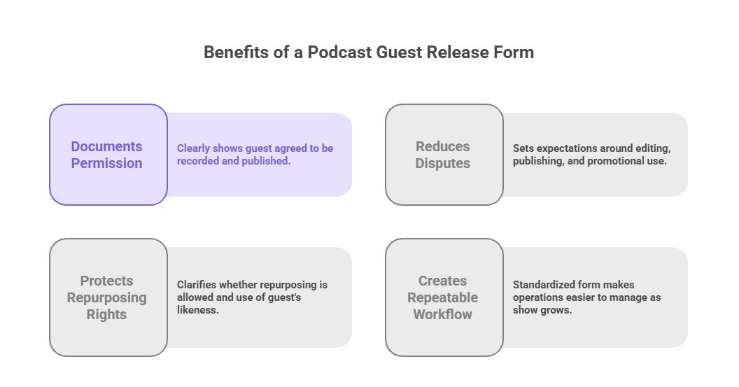
Why Do You Need a Podcast Guest Release Form?
A podcast guest release form helps protect both the podcast producer and the guest. More importantly, it creates clear expectations before the recording starts.
1. Documents permission clearly
A written release helps show that the guest agreed to be recorded and have the episode published. This can help reduce confusion around consent clauses, promotional use, and content ownership later.
2. Reduces disputes over editing and publishing
Podcast guests may later object to how an episode was edited, delayed, clipped, or distributed. A guest release form helps set expectations upfront around editing, publishing schedules, transcripts, and promotional use.
This is more important for podcasts that create social clips, remove background noise during post-production, or edit audio recording quality for a better listener experience and sound quality.
3. Protects repurposing rights
Modern podcast interviews rarely live in one place. Episodes are usually repurposed into YouTube videos, LinkedIn clips, newsletters, blog posts, quote graphics, and other marketing assets.
A podcast guest release form helps clarify whether such repurposing is allowed and whether the producer may use the guest’s name, likeness, and statements in promotional materials.
Media and entertainment organizations are increasingly formalizing written consent standards for AI-assisted reuse and digital replicas, including SAG-AFTRA’s 2023 agreement requiring “clear and conspicuous” consent before creating or using digital replicas of performers.
4. Creates a repeatable guest workflow
A standardized guest release form makes podcast operations easier to manage as a show grows. Instead of chasing approvals through email address threads or manually collecting consent during content calls, teams can build repeatable workflows around booking forms, web form submissions, and centralized document storage.
This becomes more valuable for branded podcasts, agencies, public radio teams, event organizers, and enterprise marketing departments that manage multiple podcast guests each month.
Is Verbal Consent Enough for a Podcast Interview?
No. Verbal consent may help show that a guest agreed to be recorded, but it is usually not enough for a professional podcast workflow. A written agreement is easier to document later and creates clearer expectations around publishing rights, editing, promotional use, transcripts, video clips, and AI-assisted content.
Written releases also support internal compliance and approval processes, which is important for regulated industries, enterprise brands, and larger media productions. If you’re handling sensitive interviews, you should also get familiar with broader podcast compliance requirements before recording.
Recording consent laws vary by location, so podcasters should check the rules that apply to their guests and recordings. Several U.S. states, including California, Florida, Maryland, Massachusetts, and Pennsylvania, require all parties to consent before a conversation is recorded. This means podcast recordings without explicit prior consent could potentially violate state law.
As entertainment attorney Gordon Firemark puts it:
“Best practice: Get explicit written consent from anyone whose voice you use — real or synthetic.”
What Should a Podcast Guest Release Form Include?
A podcast guest release form should include consent to record, permission to publish and edit, rights to use the guest’s name and likeness, repurposing permissions, ownership terms, compensation details, guest confirmations, governing law, and signatures.
A good release form should be clear, practical, and easy for podcast guests to understand. The goal is to document permissions before recording starts without overwhelming guests with unnecessary legal language.
The following are the key sections to include in a podcast guest release form:
1. Producer and guest information
Include the names of both parties, company details, podcast name, host name, and contact information, such as an email address.
2. Episode or recording details
Document the episode topic, recording date, and recording format. This may include audio recording, video recording, remote interviews, in-person interviews, webinars, or live event recordings.
3. Consent to record
Include clear permission to record the guest’s voice, appearance, image, likeness, and statements during the interview.
4. Permission to publish and distribute
State where the content may appear, including podcast platforms, YouTube, websites, newsletters, social channels, and other approved distribution channels.
5. Editing permission
Clarify that the producer may edit, trim, caption, transcribe, format, and enhance the recording for clarity, pacing, sound quality, or background noise reduction without materially misrepresenting the guest’s meaning.
6. Name, image, voice, and likeness permission
Include permission to use the guest’s name, title, company affiliation, headshot, video clips, quotes, and likeness in connection with the episode and related promotional use.
7. Promotional and repurposing rights
Define whether the producer can create social clips, audiograms, quote graphics, blog posts, show notes, newsletters, and other marketing assets from the interview.
8. AI and transcription usage
Many podcast teams now use AI-assisted tools for transcription, captioning, summarization, editing, and workflow automation. The release form should clarify whether those tools may be used and should explicitly exclude synthetic voice cloning or misleading AI-generated replicas without separate consent.
There are now lots of legal considerations when you use AI content. Tennessee’s 2024 ELVIS Act became the first state law to explicitly protect voice likeness rights in AI-generated content, a sign of growing legal scrutiny around AI voice cloning and synthetic media.
Also, the U.S. Copyright Office has identified AI impersonation, deepfakes, and unauthorized digital replicas as emerging harms that may require stronger consent protections for individuals appearing in recorded media.
9. Ownership
Clarify who owns the final edited episode and related assets, including clips, captions, transcripts, thumbnails, summaries, and promotional materials.
10. Compensation
State whether the guest's appearance is unpaid, compensated, or governed by a separate legal agreement.
11. Guest confirmation
Include a statement confirming that the guest has the authority to participate and will not knowingly share confidential, defamatory, unlawful, or copyright-infringing material.
12. No obligation to publish
Clarify that the producer or hosting provider is not required to publish or distribute the episode after recording.
13. Governing law and signatures
Add signature fields, dates, and governing law provisions for both parties. Many teams now collect these approvals through booking forms or a secure web form as part of their broader podcast launch process.
Free downloadable podcast guest release form template
You can use this podcast guest release form as a starting point to document recording consent, publishing rights, editing permission, promotional use, repurposing rights, ownership, compensation, and signatures.
P.S. If you are building a new show, this podcast launch checklist can also help you organize guest workflows, recording logistics, and publishing operations before launch.
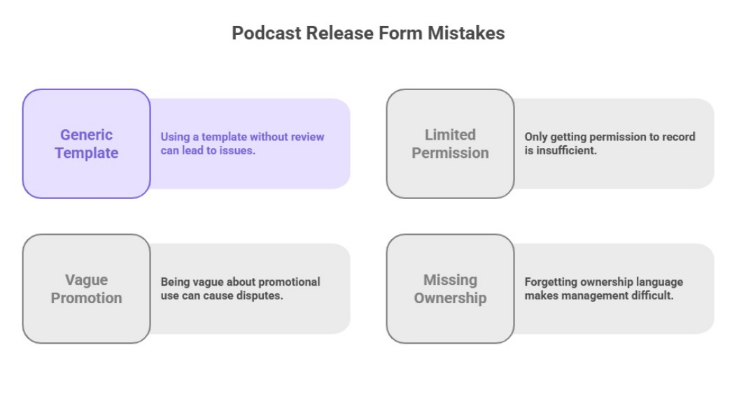
Common Mistakes to Avoid With Podcast Guest Release Forms
Even simple release forms can create problems when they are outdated, incomplete, or handled inconsistently. Here are some of the most common mistakes podcast teams make.
Using a generic template without review
Many free templates were written before podcast teams regularly used video distribution, AI-assisted production, short-form clips, and multi-channel repurposing. They may also leave gaps around ownership, likeness rights, paid promotion, and generated content.
If your show is tied to a branded podcast, enterprise company, or regulated industry, have legal counsel review the language periodically.
Only getting permission to record
Some podcasters only document consent to record the interview itself. This can create confusion later around editing, publishing, distribution, clips, or commercial use.
Your release form should clearly define what the producer can do with the content after the recording ends.
Being vague about promotional use
Problems mostly arise when guests find out their interview is being used in paid ads, sales materials, or marketing campaigns they did not expect.
To avoid this, we suggest using clear language when outlining how you plan to promote the podcast. This helps reduce disputes over clips, paid promotion, and other marketing uses.
Forgetting ownership language
The release form should clearly define who owns the final edited episode and related assets, including transcripts, clips, captions, summaries, and promotional materials.
Without ownership language, removal requests and future reuse questions become harder to manage.
How Content Allies Helps B2B Brands Manage Podcast Guest Workflows
Managing podcast guest workflows gets more complicated as a show grows. Teams quickly end up juggling guest coordination, booking logistics, release forms, approvals, publishing schedules, content repurposing, and distribution across multiple channels.
At Content Allies, we help B2B brands build repeatable podcast systems so teams are not manually chasing guests, files, approvals, and publishing tasks every week.
This includes:
Guest coordination
Recording workflows
Production management
Publishing support
Content repurposing
Approval workflows
Distribution and promotion
Whether you are launching a new branded podcast or scaling an existing show, the goal is the same: create a reliable workflow that makes podcast production easier to manage.
Ready to make podcast production easier to manage? Talk to Content Allies.
FAQs
Do podcast guests need to sign a release form?
Not always, but it is strongly recommended for professional podcast workflows. A podcast guest release form helps document recording consent, publishing rights, promotional use permissions, and content ownership expectations before recording begins.
Can I use one release form for both audio and video podcasts?
Yes. Many podcast guest release forms cover both audio recording and video recording in the same agreement. If your show creates YouTube clips, social media content, or other visual assets, the form should explicitly address image and likeness usage as well.
Can a podcast guest release form be signed electronically?
Yes. A podcast guest release form can usually be signed electronically through tools like DocuSign, PandaDoc, Dropbox Sign, Google Forms, or a secure booking workflow. Just make sure the guest clearly agrees to the terms, and your team stores the signed copy with the episode files.
Do I need a guest release form for webinar recordings turned into podcast episodes?
Yes. If you plan to turn a webinar into a podcast episode, get a guest release form that clearly covers podcast distribution, editing, clips, transcripts, social posts, YouTube uploads, and use of the guest’s name, voice, image, and likeness.
Can Content Allies help with branded podcast production?
Yes. At Content Allies, we help B2B brands plan, launch, and manage branded podcasts from strategy through publishing. Our team supports show positioning, guest coordination, recording logistics, production management, editing, distribution, and promotion, so your internal team does not have to manage every moving piece alone.
Does Content Allies handle podcast repurposing and promotion?
Yes. We help turn each podcast episode into useful marketing assets, including short clips, social posts, newsletters, blog posts, show notes, and sales enablement content. We also help plan the promotion workflow so each episode has a clear path from recording to publishing to repurposing.
Appendix
- Sidley Austin — U.S. Copyright Office Issues Report on Artificial Intelligence and Copyrightability
- Congressional Research Service — Copyright and Artificial Intelligence Legal Overview
- U.S. Copyright Office — Copyright and Artificial Intelligence: Part 1, Digital Replicas
- Matthiesen, Wickert & Lehrer — Recording Conversations Laws by State
- Podnews — How to Use AI in Podcasting Legally
- Proskauer — The Elvis Act, Generative AI, and the Right of Publicity