
Top 10 Podcast Management Agencies (2025–2026)
Podcasting has earned a permanent spot in modern marketing, spanning lean teams and global brands. In CoHost’s State of Podcast Agencies 2026 report, agencies report working with small brands under 250 employees (69%) and large brands with 501+ employees (65%), showing consistent adoption across SMBs and enterprises.
This shift is also tied to executive-level goals.
Agency clients most often center podcasts on thought leadership (37%) and brand awareness (23%), signaling that podcasts are being used to build credibility and stay top of mind with the right audiences.
That broad adoption creates a predictable operational reality.
Podcasts need ongoing coordination across strategy, guest outreach, production, distribution, and performance reporting, all while protecting brand standards and maintaining a consistent publishing cadence.
Solid podcast management agencies can help you with all that. And in this article, you’ll meet the best.
Let’s dive in.
Best Podcast Management Agencies at a Glance
| Agency | Key Services | Best For | Notable Clients |
|---|---|---|---|
| Content Allies | Strategy + end-to-end production, guest outreach, promotion (organic/paid/SEO), analytics, repurposing, video | B2B teams that want a full-service, revenue-aligned podcast partner | AWS, Meta, Perplexity, Gusto, Zendesk |
| The Podglomerate | Podcast production, marketing, audience development, advertising sales, monetization | Full-lifecycle management that includes monetization | NPR, Netflix, CVS |
| Lower Street (incl. Pacific Content) | Branded podcast strategy, production, creative, promotion | Premium branded podcasts for enterprise teams | BCG, Adobe, PepsiCo |
| Quill | Enterprise podcast strategy and production, measurement and audience insights via CoHost | Enterprise branded podcasts that need reporting and analytics | PwC, Expedia Group, Walmart |
| Fresh Air | Branded podcast strategy, audio & video production, creative podcast partnerships | Established brands launching high-quality branded podcasts | WWF, Royal Botanic Gardens Kew, The New York Times, Wall Street Journal |
| Fame | B2B podcast production, guest booking, repurposing, promotion, subscription model | Teams that want a subscription model for B2B podcast growth | Dell, Workday, Ideo |
| Ideablossoms | Podcast editing & management, SEO show notes, episode planning, content repurposing | Women leaders, coaches, service-based founders who want full delegation | Nina Gibson (Elevated Visibility), Laura Aura (The Gutsy Podcast), Ash McDonald (Shamelessly Ambitious) |
| True Native Media | Podcast ad sales representation and monetization, campaign management | Established shows that want ad sales handled | Hello Fresh, LandRover, Shopify |
| Ginni Media | Production, coaching, content strategy, custom studio design and build | High-volume production | Allure, Siemens, TheTradeDesk |
| Earworm | End-to-end podcast management, guest booking, PR, content repurposing, marketing strategy | Teams that want production plus PR and booking in one partner | KPMG, LUCKY SAINT, proteintech |
What “Podcast Management” Means (and What It Should Include)
Podcast management agencies make podcasting sustainable inside busy marketing teams because they are built around a simple operating model: your leaders show up and speak, and the agency runs everything else.
This is the raison d'être of Content Allies. We always tell our clients:
“You show up to hold great interviews and build relationships with your guests. We handle everything else.” (The Content Allies informal credo)
That said, a podcast management agency is a specialized partner that runs the end-to-end operations of a podcast, covering strategy, production, publishing, and performance reporting so your company can ship high-quality episodes consistently without building a full in-house team.
In practice, “podcast management” should include:
The “show up and speak” operating model (for CMOs and Directors)
Strategy + show positioning (audience, format, messaging)
Producer-led operations (calendar, run-of-show, guest flow)
Production (remote/in-studio/on-site)
Post-production + QA (editing, mix/master, revisions)
Publishing + distribution (Spotify/Apple + YouTube workflow)
Content repurposing (clips, captions, blog/newsletter assets)
Growth (SEO metadata, cross-promo, partnerships, paid)
Measurement (dashboards, listener insights, reporting)
Monetization (sponsorships, ad ops, brand partnerships)
What to read next: Podcast Agency for Brands: How to Build High-Impact, Audience-Ready Audio in 2026
Remember: The right partner brings a repeatable production system, specialized talent, and clear accountability so the podcast keeps shipping while internal teams stay focused on core priorities.
To help you pick a partner that fits your goals and resources, the next section compares the top podcast management agencies side by side, including what they do best and who they are best for.
How We Evaluated These Podcast Management Agencies
We evaluated the agencies below based on whether they can operate as a true extension of a marketing team, with ownership across the full podcast lifecycle and the systems to deliver consistently.
End-to-end ownership across strategy, production, publishing, distribution, and reporting.
Strategy depth: Ability to shape a clear brand narrative, define the audience, and lock in a format that fits your company’s positioning.
Process maturity: A defined producer role, documented timelines, quality assurance checkpoints, and a clear revision policy.
Proof: Verifiable client work, credible recognition, measurable outcomes, and public feedback signals.
Growth + measurement capability: Reporting that supports decision-making, with analytics, benchmarks, and attribution inputs that match your goals.
Monetization capability: Sponsorship packaging, ad operations support, and partner sourcing when monetization is part of the plan.
Red flags and misalignment risks
Scope clarity for management: Confirm the agency owns the operating system, including planning, coordination, publishing, and reporting.
Asset and IP handling: Confirm ownership terms for raw files, final exports, project assets, and access to hosting and channel logins.
Workflow and service standards: Ask for a documented workflow, response time expectations, and delivery timelines tied to your release cadence.
Growth and measurement link: Align growth plans to reporting, with a defined measurement approach and clear success metrics.
Monetization alignment and fee clarity: Align incentives in advance, and request transparent fee structures for commissions, placements, and ad ops work.
Top 10 Podcast Management Agencies
With all that in mind, let’s see how these agencies compare
1) Content Allies: Best for revenue generating podcasts
Website: https://contentallies.com
Core Services: Podcast strategy and launch, production and publishing across major platforms, analytics and BI dashboards with revenue attribution, host training and guest management, social clip creation and repurposing, and paid audience growth.
Review Rating: 5.0 out of 5 on Clutch
Notable Recognition: Case studies include Meta for Business and enterprise brands such as Siemens, Gusto, Cisco, and more
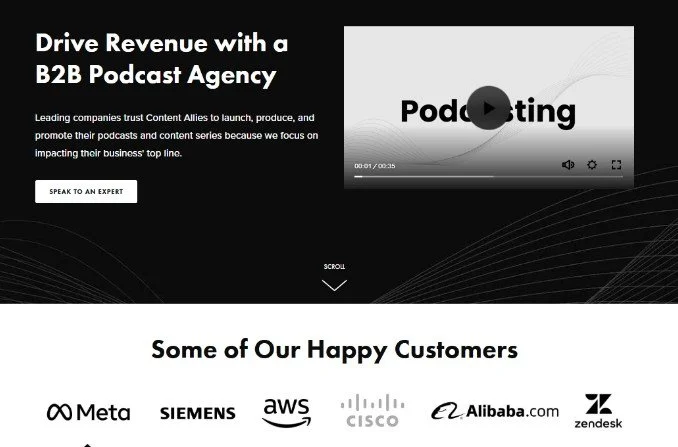
Content Allies helps B2B teams run a podcast as a demand and relationship channel, with a white glove workflow that covers strategy, guest scheduling, recording support, production, publishing, and promotion.
We add a measurement layer with QBRs, BI dashboards, and revenue attribution, plus distribution support across podcast SEO, YouTube, and optional paid download campaigns. Recording is remote first, and on site NYC sessions can be arranged through contracted studios when a local set is preferred.
Our case studies prove the kinds of results we bring to our clients:
Meta for Business: about 170,000 downloads in the first 6 months together, and exceeded an early download target by 7x
Tonkean: reported category traction including 174.36% growth in unique listeners in one quarter, plus a Spotify category ranking win
Sagemark HR: outcomes listed include three significant new clients plus six smaller accounts added
Leaders of B2B: published results include 43 sales opportunities and $100,500 revenue attributable to the podcast
| Pros | Cons |
|
|
2) The Podglomerate: Best for production + marketing + monetization under one roof
Website: https://podglomerate.com/
Core Services: Podcast production, podcast growth, monetization, video production, branded podcast services, white label podcast production, launch services
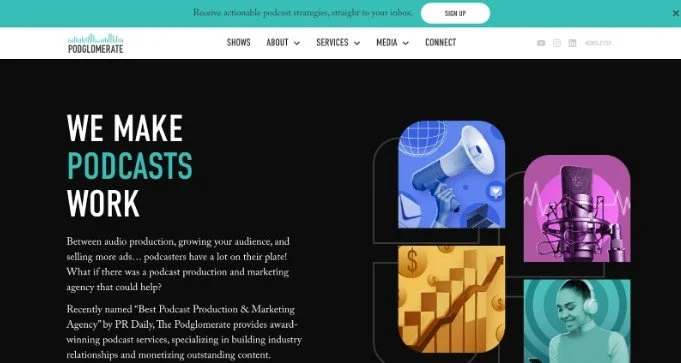
Notable Recognition: Named “Best Podcast Production & Marketing Agency” by PR Daily
The Podglomerate is built for teams that want a podcast to function as a growth channel with clear operational support across production, audience development, and monetization. Their services cover podcast production from concept through publication, with recording options that support studio, remote, and mobile setups.
They also offer branded podcast services and white label podcast production, which supports agencies and in-house teams that want delivery capacity paired with an established process. Video production is available for teams building a YouTube workflow alongside audio distribution.
| Pros | Cons |
|
|
3) Lower Street (incl. Pacific Content): Best for premium branded podcasts with elite case studies
Website: https://lowerstreet.co/
Core Services: Branded podcast strategy, research and concept development, production, launch support, audience growth and promotion, video podcast strategy and production, repurposed assets
Notable Recognition: Pacific Content pedigree through acquisition; award wins highlighted in published case studies
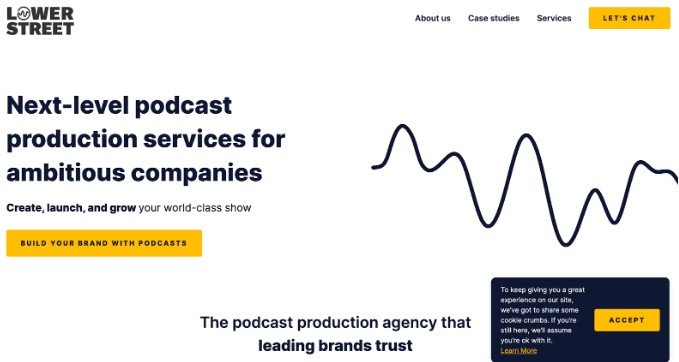
Lower Street is built for enterprise branded podcasts that need high creative and strategy integrated into the operating system. Their approach is research-led and story-driven, designed to align show positioning with brand goals, audience fit, and a defined format.
They also bring Pacific Content pedigree into their delivery model, which adds credibility for teams that want a proven branded podcast partner with editorial depth. Their growth stack includes PR, platform optimization, performance insights, and paid promotion options, plus video strategy for YouTube-forward workflows and repurposed content assets.
| Pros | Cons |
|
|
4) Quill: Best for enterprise branded podcasts + measurement (via CoHost)
Website: https://www.quillpodcasting.com/
Core Services: Full-service podcast production, podcast marketing, internal podcasts, video podcasts, distribution and analytics via CoHost
Quill Podcasting is built for marketing leaders who want enterprise polish paired with reporting, listener insight, and a clear measurement layer. Their agency offering covers branded podcast strategy, production operations from recording through publishing, marketing support, internal podcasts for private distribution, and video podcasts for teams running a YouTube workflow.
A core differentiator is the vertical integration with CoHost, positioned as a podcast hosting and analytics platform that supports publishing, distribution, analytics, and audience insights in one place. This makes Quill a fit for teams that want production support connected to dashboards and performance reporting.
| Pros | Cons |
|
|
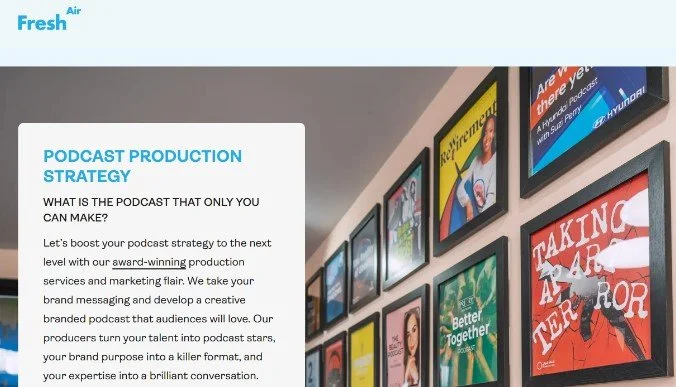
5) Fresh Air: Best for Creative Podcasts
Website: https://freshair.audio/
Key services: branded podcast strategy, broadcast-quality audio & video production, in-studio and remote recording, creative podcast partnerships, media buying & growth campaigns, impact measurement.
Notable recognition: British Podcast Awards, Audio & Radio Industry Awards, Webby Awards, New York Festival Radio Program & Production Awards, UK Audio Production Awards.
Fresh Air’s real differentiator is control. They own the full environment, from concept to campaign, and that shows in execution.
Their London studio delivers fully isolated, broadcast-quality audio and long-form vodcasts. At the same time, their remote production infrastructure allows them to record high-profile guests anywhere in the world while maintaining consistent branding, lighting, and sound standards.
On the growth side, they don’t rely on generic ad buys. They build creative podcast partnerships, handpicked across the podcast ecosystem, designed to drive deeper engagement.
| Pros | Cons |
|
|
6) Fame: Best subscription model for B2B production + guesting + growth
Website: https://www.fame.so/
Core Services: B2B podcast strategy, guest sourcing and booking, host training, production, promotion, repurposed assets, hosting and distribution tooling (Fame Host), content creation tooling (Fame AI)
Review Rating: 5.0 out of 5 on G2 from 2 verified reviews
Fame is built for teams that want a predictable monthly cost and a repeatable system for launching and growing a B2B podcast. Their operating model is “client hosts, Fame runs the system,” with delivery that spans strategy, guest booking, production, and promotion.
A defining differentiator is the growth benchmark they publish and operationalize. Fame positions its promotion process around the “7 Pillars of Podcast Promotion,” and they publicly claim a 10% month-on-month download growth goal that they track and report against.
They also build tooling that supports distribution and content workflows, including Fame Host for hosting and distribution plus Fame AI for generating written and social assets.
| Pros | Cons |
|
|
7) Ideablossoms: Podcast Growth & Management for Women Leaders

Key services: podcast editing & mixing, SEO-optimized show notes, episode scheduling, podcast management, SEO topic research, guest outreach, content repurposing, multi-platform distribution, podcast launch, podcast audit
Ideablossoms is a boutique podcast agency founded by Rosa Sarmento that helps women leaders turn their podcast into a strategic growth engine without adding more to their plate.
Ideablossoms builds a done-for-you ecosystem around your show, from production to SEO to repurposed content and growth strategy. The agency manages the backend, tech, SEO, scheduling, and reporting so the host can focus on visibility and revenue-generating work.
With packages like “Podcast Maven,” episodes become 4 long-form and 16 short-form assets monthly. One recording fuels your entire content ecosystem. A significant portion of their clients rank in the top 1%, 3%, and 10% of podcasts worldwide, reinforcing they can create performance-oriented growth.
| Pros | Cons |
|
|
8) True Native Media: Best for monetization representation (ad sales) only
Website: https://truenativemedia.com/
Core Services: Podcast ad representation, host read ad creative, advertiser to podcast matching, campaign strategy and management, testing and optimization, category based podcast roster access
Notable Recognition: Founder Heather Osgood is a Forbes Councils contributor and is listed as Founder and CEO of True Native Media
True Native Media is built for established podcasts and networks that want sponsorship sales and ad operations handled by a dedicated representation partner. Their focus centers on host read advertising, with an emphasis on ads that align with each show’s voice and audience expectations.
For advertisers, the value comes from matchmaking and campaign management. They position their team around pairing brands with independent podcasters across a roster organized by genre, then supporting campaign planning, testing, and optimization.
| Pros | Cons |
|
|
9) Ginni Media: Best for high-volume production, global team, and custom studio buildouts
Website: https://ginnimedia.com/
Core Services: NYC studio rentals, mobile recording (on-site audio and video capture), end-to-end podcast and video production, content coaching, custom studio design and build
Notable Recognition: “30+ shows produced weekly” and “award nominations & wins” highlighted on their site; reported 2025 Signal Awards nominations for Ginni Media productions
Ginni Media is built for brands scaling production output and leaders investing in studio-grade content. They position themselves as a premium, full-scale media production house in NYC with studio rental options, mobile recording for on-site shoots, and end-to-end production from live recording through polished edits.
They also support teams building long-term content infrastructure. Their services include content coaching plus custom studio design and build for companies that want an in-house recording environment with professional layout, soundproofing, and equipment.
| Pros | Cons |
|
|
10) Earworm: Best for end-to-end management including PR + guest booking
Website: https://earworm.co/
Core Services: Podcast production, guest booking, PR support, podcast marketing, strategy consulting, publishing and distribution, reporting and insights, add-ons like transcripts, show notes, scripting, sonic branding, video formats
Notable Recognition: Pledges to plant 5 trees for every podcast episode produced in partnership with One Tree Planted
Earworm is built for leaders who want production, PR, and guest booking bundled into one operating partner. Their offering combines podcast production with guest outreach and publicity support, which helps teams keep a consistent release cadence while building visibility beyond the podcast apps.
They also support ongoing optimization through monthly podcast reporting that includes audience and listenership metrics designed to inform future episodes and promotion. For teams that want extra support per episode, Earworm lists add-ons like scripting and research, publishing workflows, and branded enhancements like sonic branding.
| Pros | Cons |
|
|
Pricing: What Podcast Management Agencies Cost (and Why)
| Pricing model | Typical cost range | What the range usually covers |
|---|---|---|
| Monthly retainers (full management) | $3,000 to $25,000 per month | Producer-led ops + production + publishing, with strategy and growth scope varying by agency and episode volume |
| Subscription packages (predictable cost) | $1,500 to $7,000+ per month | Fixed monthly episode count and defined deliverables, often geared around consistent cadence |
| Per-episode pricing (production-heavy scopes) | $100 to $500+ per episode for editing | Editing, mix/master, and delivery basics, with complexity and turnaround shaping price |
| Commission-based monetization (ad sales representation) | 25% to 30% commission on sponsorship revenue | Sponsor outreach, deal negotiation, ad ops, and renewals under a rep model |
| Hybrid models (production retainer + growth add-on) | $500 to $2,500+ per month for boutique retainer bundles | A baseline monthly package with add-on growth services priced as a separate scope |
What drives cost (and where teams overspend)
| Cost driver | What it usually includes | Where teams overspend | How to keep it efficient |
|---|---|---|---|
| Video deliverables + clip volume | Multi-cam edits, color, audio polish, motion graphics, shorts, platform versions | Ordering a high clip count before having a proven distribution plan | Set a standard clip package per episode and scale volume based on performance data |
| Turnaround SLAs + revision rounds | Rush editing, priority scheduling, producer coordination, extra review cycles | Paying for fast turnaround while internal approvals move slowly | Lock a default SLA, define revision rounds per asset, and use rush only for priority episodes |
| Guest booking + outreach labor | Research, list building, outreach, follow-ups, scheduling, prep, reschedules | Changing guest criteria midstream or running booking without a clear ICP | Define guest criteria, set outreach volume per month, and assign one internal approver |
| Brand + compliance approvals | Legal review, brand checks, claim substantiation, stakeholder sign-off | Adding extra approvers without a workflow, creating re-edits and delays | Map approvals, set review windows, and pre-approve recurring language like intro and CTA |
| Analytics depth + reporting cadence | Dashboards, tagging, benchmarks, insights, attribution inputs | Paying for complex dashboards that do not drive changes in content or distribution | Tie reporting to decisions you actually make and choose a cadence that supports iteration |
| Repurposing scope creep | Clips, captions, blogs, newsletters, quote cards, asset formatting | Requesting many asset types without clear distribution ownership | Use a fixed monthly asset menu tied to active channels and define “done” for each asset |
| Growth add-ons | PR, cross-promo, partnerships, paid, SEO and PSO | Buying “growth” as a vague add-on without success metrics | Define goals, channels, and measurement before adding growth scope |
| Tooling and platform requirements | Hosting, analytics tools, scheduling, storage, review systems | Paying for multiple overlapping tools that the team does not use | Consolidate tooling, confirm exports and ownership, and standardize where content lives |
How to Choose the Right Podcast Management Agency
Start by treating your podcast agency like an operating partner, since they shape the show concept, the workflow, and the way results get tracked and reused across marketing and sales.
For a deeper dive, make this your next read; From Concept to Launch: Partnering with the Right B2B Podcast Production Agency.
Use these selection checks on calls and proposals:
Strategic fit and audience clarity: Look for an agency that can define your primary listener, the show promise, and an editorial plan tied to your campaigns and buyer journey.
Operational ownership and workflow maturity: Ask for named roles, a documented production workflow, clear review gates, and predictable turnaround targets that support your publishing cadence.
Distribution and repurposing system: Confirm they have a channel plan for Apple and Spotify plus a YouTube workflow, along with a repeatable asset menu for clips, copy, and web content.
Measurement that supports decisions: Prioritize agencies that define episode KPIs, provide consistent reporting, and connect performance to business activity your team already tracks.
Proof you can validate: Look for verifiable client examples, clear case studies, and review signals that match your industry, scope, and quality bar.
Grab the downloadable question list so you can run a clean, structured sales call with every agency you speak to.
Which Podcast Management Agency Will You Pick?
If you want a podcast that runs like a reliable marketing program, Content Allies is the best choice for podcast management.
Content Allies is built for B2B marketing teams that care about consistency, executive time, and measurable outcomes. Their model is designed around a “show up and speak” workflow, supported by producer-led operations that keep episodes moving from planning to publishing with a repeatable cadence.
If your goal is a podcast that strengthens positioning, builds trust with your market, and generates demand through consistent output, Content Allies is the partner to run it. Let’s talk.
Frequently Asked Questions
What’s the difference between a podcast management agency and a production company?
A podcast management agency runs the full operating system for your show, including strategy, producer-led workflows, publishing, and reporting. A production company focuses on execution tasks like recording support and editing. If you want one partner accountable for cadence, assets, and performance, you are looking for management.
Do agencies handle guest booking and scheduling?
Many do, usually as a core service or an add-on. Guest booking can include list building, outreach, scheduling, prep, and day-of coordination. The key is confirming who owns the guest pipeline, how outreach is approved, and how far in advance episodes are booked.
Can they manage YouTube podcasts and short-form clips?
Yes. Agencies often manage the YouTube workflow end to end, including video editing, titles, descriptions, chapters, thumbnails coordination, and publishing. Short-form typically includes platform-ready clips with captions, formatted versions for each channel, and a consistent posting schedule.
Who owns the podcast IP and raw recordings?
In most engagements, the brand owns the show IP, and the agency provides services under contract. Confirm in writing that you retain access to raw recordings, project files, final masters, and the accounts used for hosting and publishing. Also confirm file delivery cadence and where assets live long term.
How long does it take to launch a branded podcast?
A typical launch takes 4 to 8 weeks, depending on approvals, creative development, and scheduling. Launch speed increases when brand messaging, guest targets, and internal reviewers are decided early. Many teams also record several episodes before launch to protect the publishing cadence.
What KPIs matter for branded podcasts (brand vs pipeline)?
Brand-focused podcasts track reach and quality signals like target listener growth, consumption, and audience fit. Pipeline-focused podcasts track actions tied to the show’s call to action, including site visits, form fills, booked meetings, and self-reported attribution. The right KPI set matches the primary goal and the distribution plan for each episode.