
Branded Podcast Strategy: How Fortune 500s Build Audio Audiences
Branded podcasts have become one of the most powerful channels for companies that want to build long-term audience relationships.
Instead of interrupting people with ads, you can publish shows that educate, entertain, and earn attention over time. And there’s a lot of opportunity there. 43% of Americans say they would likely listen to a podcast about a favorite brand or product, and 15% say they’re very likely to do so.
But the companies that succeed with podcasts don’t treat them like marketing experiments. Fortune 500 brands approach them as audience engines, with consistent publishing, recognizable formats, distribution systems, and clear measurement.
That’s where many teams struggle. Launching a show is easy, but building a repeatable growth channel is harder. Partners like Content Allies help you turn podcasts into scalable, branded content programs by handling strategy, production, distribution, SEO, and repurposing.
This shift in mindset is exactly what separates branded podcasts from traditional advertising.
“I don’t consider it advertising. It’s a podcast show that just happens to be produced by a brand instead of a network.” — Nieman Lab (GE Podcast Theater)
In this guide, we’ll look at how leading brands design, launch, and grow successful branded podcasts.
What Is a Branded Podcast?
A branded podcast is a podcast produced and owned by a company or organization to build audience trust, share expertise, and strengthen brand authority. Instead of running ads within someone else’s show, the brand creates its own show and controls the editorial direction.
When done well, branded podcasts act as long-term audience assets rather than short-term campaigns. They allow companies to build relationships with listeners through useful, entertaining, or insightful content.
This approach can measurably improve brand perception. 61% of listeners say a branded podcast made them somewhat or much more favorable toward the brand that produced it, according to data from a Signal Hill Insights report shared by Podnews.
How Branded Podcasts Differ From Traditional Advertising
One way to look at the difference is this: traditional advertising interrupts attention, whereas branded podcasts earn it.
Instead of delivering short promotional messages, a branded podcast delivers full episodes designed to inform or entertain the audience first. Your brand takes the role of the producer rather than the main subject of the conversation.
This format gives you room to demonstrate expertise, share meaningful stories, and build deeper engagement with listeners. In our experience, this is where many teams start to see the real value of branded podcasts.
A Brief History of Branded Podcasts
Early podcasting positioned itself as the opposite of traditional advertising. The medium was creator-driven and largely free from the interruptions associated with radio ads, which made many brands cautious about entering the space.
This perception began to change around 2014-2017, when several branded shows proved companies could create compelling content rather than simple promotions. One well-known example was GE Podcast Theater, including the sci-fi series The Message, which showed that audiences would engage with brand-produced storytelling if it was genuinely interesting.
From 2018 onward, lots more B2B companies began launching podcasts focused on thought leadership, where they used interviews and expert conversations to build authority and share insights with their industries.
More recently, branded podcasts have converged with video and social distribution. Many shows now publish full episodes on YouTube alongside audio feeds and distribute clips across social platforms.
In fact, 33% of weekly podcast listeners now use YouTube to listen to podcasts, highlighting how video platforms have become major discovery engines for the medium.
Benefits of Branded Podcasts for Brands and B2B Companies
Branded podcasts work well because they bring together two things many marketing channels struggle to deliver: trust and sustained attention.
When someone presses play on a podcast, they usually spend 20 to 40 minutes listening to a conversation, story, or expert discussion. This level of engagement rarely happens with short-form content.
For many Fortune 500 companies, this turns a podcast into a compounding content asset. Each episode becomes part of a growing library of thought leadership that can support search visibility, social content, and even sales enablement.
Several benefits stand out here.
Trust and credibility. Guests, expert conversations, and consistent publishing help establish the brand as a knowledgeable voice in its industry.
Depth of insight. Podcast conversations allow brands to explore topics in far more detail than most short-form content.
High-quality attention. Listeners choose to press play. That opt-in engagement creates a very different dynamic than interruption-based advertising.
Repurposing potential. A single episode can fuel blog posts, video clips, newsletters, social posts, and sales content.
Research backs this up. 72% of brands say thought leadership and lead generation are the primary benefits of branded podcasts, and 64% plan to sustain or increase their investment in podcasting.
On the audience side, 63% of listeners say they would probably or definitely recommend a branded podcast to others (according to the Signal Hill data we shared earlier). This kind of recommendation can help a show grow organically.
This is where partners like Content Allies can make a real difference. On top of producing audio, we also help you build the repurposing and distribution systems that allow each episode to compound over time.

Do You REALLY Need a Branded Podcast?
Not every company needs a branded podcast. You should launch one when you can commit to consistent publishing, have a clearly defined audience, and treat the show as a long-term audience channel rather than a short campaign.
Many podcasts launch with excitement and then stall after a few episodes because the strategy was never clear.
You probably should not start a branded podcast if:
You can’t commit to consistency (a 12+ episode runway is a realistic minimum)
You don’t have a clearly defined audience and job to be done
You lack the distribution channels to promote it (owned, paid, and partnerships)
You need immediate, direct-response ROI within weeks
In those situations, a podcast is unlikely to perform well. However, branded podcasts can be extremely effective if your company operates in a category where trust, education, and expertise matter.
You should consider launching one if:
Your industry requires education or thought leadership (good examples are B2B, fintech, healthcare, and enterprise software)
You’re competing in a crowded market and need a way to stand out
You have access to interesting experts, customers, or proprietary insights
You want an always-on channel for community building and conversation
Modern buyers increasingly prefer to learn independently. In fact, 61% of B2B buyers now prefer a rep-free buying experience, which means educational content plays a larger role in the decision process.
At the same time, companies need the right operational support. The Signal Hill report we shared earlier says 58% of brands say resourcing is the biggest challenge when launching podcasts. If the only thing stopping you is resourcing, that’s exactly the problem our team of experts at Content Allies helps you solve.
Different Types and Formats of Branded Podcasts
There’s no single format that defines a successful branded podcast. In practice, Fortune 500 companies use several different styles depending on their audience, goals, and available resources. Most branded shows fall into a few common format families.

1. Interview or roundtable shows
This is the most common format for B2B podcasts. A host (often an executive, journalist, or industry expert) interviews guests about trends, strategies, and real-world experience. These shows work well for thought leadership because they bring outside voices and perspectives into the conversation.
2. Narrative documentary podcasts
Some brands produce story-driven series focused on innovation, history, or culture. These podcasts feel closer to traditional storytelling. They use narration, sound design, and interviews to create a compelling narrative. GE’s podcast theater projects are a well-known example of this approach.
3. Educational or explainer podcasts
These shows are designed to break down complex ideas, technologies, or industry shifts. Companies in technical sectors such as finance, cybersecurity, or AI often use this format to help audiences understand emerging topics.
4. Internal culture podcasts
Not all branded podcasts target external audiences. Some organizations produce shows for employees to share leadership updates, highlight internal stories, or support employer branding initiatives.
5. Hybrid video podcasts
Many modern podcasts are designed for both audio listening and video discovery, especially on YouTube and social platforms. This hybrid format allows brands to publish full video episodes while also creating short clips for promotion and social media distribution.
This shift toward video is accelerating. 27% of consumers now watch video podcasts (“vodcasts”) weekly. This shows how quickly visual formats are becoming an important discovery channel for podcast content.
Ultimately, the right format depends on the audience and the story you want to tell. The best branded podcasts choose a format that reflects their expertise, and stick with it long enough to build a recognizable show.
How Fortune 500 Brands Target Podcast Audiences
Successful branded podcasts rarely try to reach everyone. Instead, large companies start by defining a specific audience segment and building content that speaks directly to that group. This focused approach helps build relevance and loyalty over time.
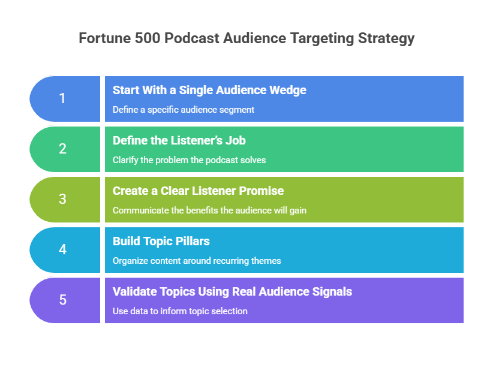
1. Start With a Single Audience Wedge
Many Fortune 500 podcasts begin with a tightly defined audience instead of a broad market. Instead of targeting “business leaders,” you might focus specifically on CFOs, developers, healthcare leaders, or marketing executives.
This type of targeting shapes everything from guest selection to topic ideas. When the audience is clearly defined, your show feels more relevant and valuable to the people you want to reach.
2. Define the Listener’s Job
Next, Fortune 500 brands clarify the problem the podcast helps listeners solve. That job-to-be-done might include staying up to date on industry trends, learning practical strategies, or understanding emerging technologies.
When the show solves a real, specific problem, listeners have a reason to come back and feel like all the content is relevant to them.
3. Create a Clear Listener Promise
Successful branded podcasts communicate what the audience will gain from listening. Fortune 500 brands mostly make this promise explicit in the show description, intro, and episode titles. When the benefit is clear, listeners quickly understand why the show deserves their time.
4. Build Topic Pillars
Many large companies organize podcast content around 3 to 5 recurring themes. These topic pillars guide guest selection, episode planning, and editorial calendars. From what we have seen, this structure helps teams maintain consistency and prevents the show from drifting away from its core audience.
5. Validate Topics Using Real Audience Signals
Fortune 500 brands rarely rely on assumptions when choosing topics. They validate ideas using signals from customer advisory boards, sales calls, support conversations, search demand data, and partner communities. These sources reveal the questions people are already asking.
How the Audience Actually Grows
Targeting defines who the podcast is for, but audience growth usually comes from distribution and consistency. Many Fortune 500 shows gain listeners through guest networks, company newsletters, social media clips, YouTube discovery, and SEO driven episode pages.
In our experience, the biggest difference between podcasts that stall and those that grow is the editorial system behind them. Teams like Content Allies help translate audience targeting into a repeatable process with topic pillars, guest sourcing, and publishing calendars that keep the show moving forward.
Real Examples of Fortune 500 Branded Podcasts
Tons of large companies are already using podcasts as long-term audience channels. While formats and topics vary, the most successful shows focus on industry insights, expert conversations, and storytelling that help showcase and promote the brand’s expertise.
Here are several examples of companies using podcasts effectively.
1. Content Allies: Leaders of B2B
At Content Allies, we run our own podcast called Leaders of B2B. The show follows the same strategy we implement for clients and has become one of our most predictable growth channels.
We publish 3 episodes per week and use the podcast in two primary ways:
Interview target prospects who may be a strong fit for our services
Interview partners and industry voices who already reach our ideal customers
This approach has produced clear results in a short time.
94 B2B C-level executives engaged
43 sales opportunities generatedz
$100,500 in revenue attributed to the podcast within the first 4 months
The show has also helped open strategic partnerships. For example, collaboration with SaaS Connect led to Content Allies becoming the official podcast sponsor for their community.
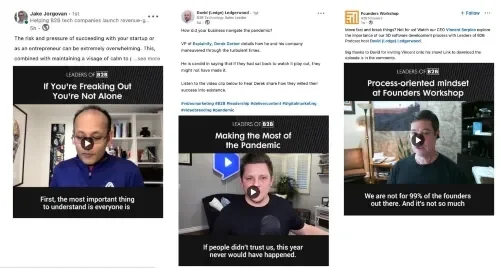
Examples of social media assets
The podcast also fuels short-form video and social media clips that expand reach beyond the audio platforms.
2. Goldman Sachs: Exchanges
Exchanges features discussions with Goldman Sachs experts on markets, economic trends, and global business topics. The show allows the firm to share insights from its analysts and research teams while positioning itself as a trusted voice in financial markets.
3. IBM: Smart Talks with IBM
Hosted by Malcolm Gladwell, Smart Talks with IBM explores technology, AI, and business innovation. The show blends storytelling and expert interviews to make complex technology topics more accessible.
4. Microsoft: The AI Show
Microsoft’s AI Show focuses on practical conversations about artificial intelligence, product development, and emerging technologies. It demonstrates how technical companies can use podcasts to educate audiences while highlighting industry expertise.
5. Salesforce: Blazing Trails
Salesforce’s Blazing Trails podcast highlights leaders who are building innovative companies and communities. The show aligns closely with Salesforce’s broader ecosystem and reinforces its brand values around innovation and leadership.
6. Deloitte: That Makes Cents
Deloitte’s That Makes Cents focuses on trends shaping the consumer and retail industries. The show shares insights from Deloitte researchers and industry experts, aimed at helping business leaders understand changes in consumer behavior.
Together, these examples show how branded podcasts can serve different goals, from thought leadership and education to storytelling and community building, all the while reinforcing a company’s expertise in its field.
What Should Your Branded Podcast Talk About?
One of the most common mistakes companies make with branded podcasts is making the show about themselves. The best branded podcasts follow a simple rule: your brand is the producer, not the main character.
Always remember that listeners press play because the content helps them learn something, stay informed, or hear interesting perspectives. In fact, 55% of podcast listeners say learning is a major reason for tuning in, while many also cite hearing other people’s opinions and staying up to date on important events as key motivations.
Fortune 500 companies mostly structure podcast topics around a few proven frameworks.
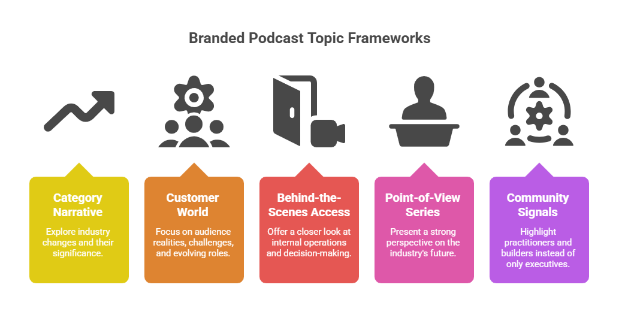
Category narrative
These episodes explore what is changing in the industry and why those changes matter. The podcast helps listeners understand new developments, trends, and shifts in the market. Over time, your brand becomes a source that helps people interpret what is happening in their field.
Customer world
Many successful shows focus on the everyday realities of the audience. Episodes may explore how people do their jobs, the challenges they face, and how their roles are evolving. When listeners recognize their own experiences in the conversation, they are more likely to keep coming back.
Behind-the-scenes access
These podcasts give audiences a closer look at how products are built, how teams make decisions, or how organizations operate internally. This type of content creates curiosity and transparency while still respecting legal and confidentiality limits.
Point-of-view series
Some podcasts revolve around a strong perspective on the future of the industry. For example, a show might explore how artificial intelligence could reshape business over the next decade. This approach helps position the brand as a voice with a clear viewpoint.
Community signals
Many Fortune 500 podcasts highlight practitioners, builders, and operators instead of focusing only on executives. Featuring people who are actively doing the work keeps the show grounded in real experience and practical insights.
To keep topic planning focused, many teams apply a simple three-question test:
Would the audience listen if your logo wasn’t on it?
Does the topic connect to a real business priority within the next 6-12 months?
Can you generate at least 25 episode ideas without stretching?
How Fortune 500 Brands Promote and Grow Branded Podcasts
Publishing a podcast is only the first step. The companies that successfully grow podcast audiences treat promotion as a structured distribution system rather than a one-time launch campaign.
In our daily practice working with enterprise teams, we see the same pattern repeatedly. The podcasts that grow are the ones supported by a clear distribution engine behind the scenes.
Fortune 500 brands usually rely on a layered growth stack that combines owned channels, partnerships, paid promotion, and search-driven discovery.
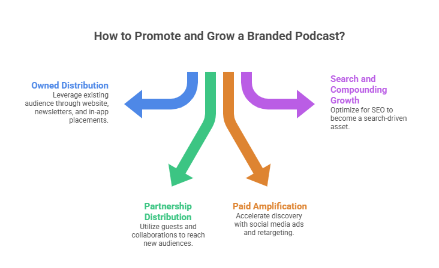
1. Owned Distribution: The Built-In Advantage
The biggest advantage large organizations have is their existing audience. Successful branded podcasts are mostly promoted across:
Homepage modules and blog posts
Product pages or resource hubs
Company newsletters and email lists
In-app placements or customer portals
Internal sales enablement tools
Many companies also build persona-specific episode playlists that sales teams can share with prospects.
2. Partnership Distribution
Guests themselves are often one of the most effective growth channels. When industry leaders appear on a podcast, they frequently share the episode with their own audiences.
Other partnership distribution channels include:
Guest podcast swaps
Newsletter collaborations
Trade associations and industry communities
Conference and event promotion
3. Paid Amplification
While podcasts often grow organically, paid promotion can accelerate discovery. Brands commonly boost short video clips or highlight moments on platforms like LinkedIn, YouTube, and other social channels. Retargeting website visitors with podcast content can also help introduce the show to audiences already familiar with the brand.
4. Search and Compounding Growth
Over time, podcasts can also become powerful search-driven content assets. According to Conductor research, organic search accounts for roughly 33% of website traffic across major industries. That makes SEO an important part of podcast growth.
A simple podcast SEO checklist includes:
Creating one indexable page for every episode
Writing clear, problem-focused episode titles
Publishing transcripts and key takeaways
Embedding both audio and video versions when possible
Linking episodes into topic clusters or resource hubs
This is the part many teams underestimate. As the number of episodes grows, the distribution workload grows with it. Content Allies helps you build the repeatable pipeline behind podcast growth by producing clips, posts, episode articles, newsletters, and SEO pages every single week.
How to Measure Branded Podcast Success
One of the biggest mistakes companies make when evaluating podcasts is focusing only on downloads. While downloads are useful, they’re better viewed as a health metric rather than the ultimate business outcome.
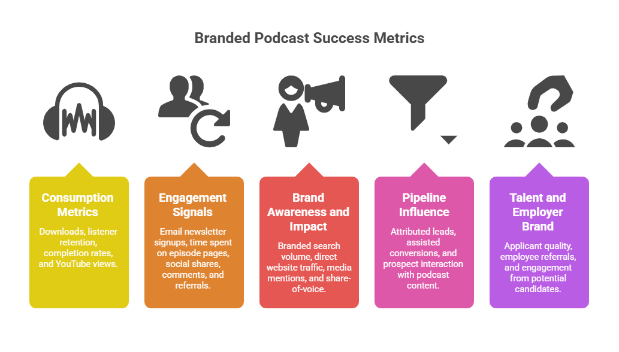
Fortune 500 companies typically measure podcast performance across several layers, similar to how they evaluate other content marketing programs.
Consumption Metrics
At the most basic level, teams track how audiences consume the content. This includes metrics such as downloads, listener retention, completion rates, and YouTube views for video episodes. These podcast analytics indicators show whether people are actually listening and how engaging the content is.
Engagement Signals
Beyond listening, companies also look for signs that the podcast is creating deeper interaction. These signals might include email newsletter signups, time spent on episode pages, social shares, comments, and referrals from podcast guests or partners.
When these signals increase, it usually means the podcast is resonating with the audience beyond the listening experience.
Brand Awareness and Impact
For many enterprise organizations, podcasts are primarily brand-building tools. Measurement may include changes in branded search volume, increases in direct website traffic, media mentions, or broader share-of-voice within an industry conversation.
These indicators show whether the podcast is helping the company become more visible and credible within its category.
Pipeline Influence
In B2B companies, podcasts typically support sales indirectly. Marketing teams may track attributed leads, assisted conversions, or whether prospects interacted with podcast content during the buying journey.
Talent and Employer Brand
Some brand podcasts also support recruiting and employer branding. In those cases, companies might measure applicant quality, employee referrals, or engagement from potential candidates.
This broader measurement approach reflects a growing shift toward data-driven marketing. In McKinsey’s analytics research, organizations that lead in data and analytics were 3 times more likely than others to say their initiatives contributed at least 20% to earnings before interest and taxes over three years.
In short, downloads tell you if people are listening, but the real value of a branded podcast shows up in brand growth, audience relationships, and business impact over time.
Build a Branded Podcast Audience Engine with Content Allies
The companies that succeed with branded podcasts treat them as long-term systems. They publish consistently, follow a clear format, and support each episode with strong distribution.
If you want to launch a branded podcast, start with one clearly defined audience. Identify the problem your show will help them solve and choose a format you can sustain for multiple episodes. Once the show launches, the focus shifts to building the systems that help it grow.
That’s where Content Allies comes in. We help you design, produce, and distribute branded podcasts that serve as long-term audience-growth channels. From strategy and guest sourcing to production, repurposing, SEO, and distribution, our team helps turn podcasts into scalable content engines.
Want to start building branded podcasts like the pros? Contact us today.
FAQs
What is a branded podcast, and how is it different from a sponsored podcast?
A branded podcast is a show created and owned by a company to share insights, educate an audience, and build brand authority. A sponsored podcast, in contrast, is when a brand pays to advertise inside an existing podcast produced by someone else.
How long does it take to see results from a branded podcast strategy?
Most shows start generating listener engagement, brand lift, and measurable return on investment after 3-6 months of consistent publishing aligned with audience needs.
How many episodes should a branded podcast launch with?
Plan a minimum 12-episode run to refine brand messaging, test audience needs, and establish a consistent audio narrative that strengthens brand personality.
What metrics actually matter for branded podcasts beyond downloads?
Key metrics include listener engagement, brand lift, subscriber growth on Apple Podcasts, and return on investment from branded audio content.
How does Content Allies help brands grow their podcast audience?
Our team at Content Allies helps you produce and distribute branded audio content that strengthens brand presence and brand messaging while aligning episodes with audience needs.
Can Content Allies handle both podcast production and distribution?
Yes, we manage the full workflow, from developing the audio narrative to publishing on Apple Podcasts and promoting clips that increase listener engagement and brand lift.
Is Content Allies a good fit for enterprise and Fortune 500 podcast strategies?
Yes. Content Allies supports enterprise teams building scalable branded audio content programs that strengthen brand personality, brand presence, and return on investment.
Appendix
- Sounds Profitable – The Power of Branded Podcasts
- Podnews / Signal Hill – 2025 Branded Podcast Benchmark Report
- Edison Research – The Infinite Dial 2025
- CoHost – Impact of Branded Podcasts Report
- Gartner – 61% of B2B Buyers Prefer a Rep-Free Buying Experience
- Pew Research Center – How Americans Use and Engage with Podcasts
- Conductor – Organic Website Traffic Industry Benchmarks
- McKinsey – Catch Them If You Can: How Leaders in Data and Analytics Have Pulled Ahead
- Nieman Lab – How GE’s Branded Podcast “The Message” Hit No. 1 on iTunes
- Deloitte / WSJ – Video Podcast Market Poised for Booming Growth
- Goldman Sachs – Exchanges Podcast
- IBM – Smart Talks Podcast
- McKinsey & Company – Future of Asia Podcast (Spotify)
- Deloitte – That Makes Cents: A Consumer Trends Podcast
- BCG – Think:Act Podcast (Spotify)