
Corporate Podcast Playbook: Internal Comms to Brand Building
Corporate podcasting is growing because it fits how people actually consume information today: while walking, commuting, exercising, or doing chores. Instead of adding to screen fatigue, podcasts let audiences learn and engage on the go.
For companies, this creates a powerful opportunity to reach two key audiences. Employees want clarity, context, and connection with leadership, while customers and prospects are looking for insight and trust. A well-run corporate podcast can deliver both.
But the space is becoming increasingly competitive. According to the 2025 Business Podcast Report by the Compliance Podcast Network, 48% of the top 100 business podcasts are new to the list, which shows just how quickly this space is changing all the time.
At Content Allies, we’ve seen the difference between launching a podcast and building a podcast system. This playbook shows how to do the latter by covering strategy, formats, hosts, production, promotion, and measurement.
TL;DR
Corporate podcasts are designed to support business goals such as employee communication, brand authority, and sales enablement.
Unlike creator podcasts, corporate shows often operate under brand guidelines, approvals, and compliance requirements.
Most successful corporate podcasts fall into three categories: internal communication, thought leadership, or hybrid formats.
The first step in launching a podcast is defining a single clear objective aligned with business priorities.
Understanding your audience and when they listen helps determine episode length, tone, and publishing cadence.
Simple, repeatable formats are more sustainable than complex production-heavy shows.
Choosing the right host is critical because listeners connect strongly with authentic voices.
Successful podcasts rely on consistent promotion workflows that repurpose each episode across multiple channels.
Measuring performance requires more than downloads. Leading teams connect podcast metrics to real business outcomes.
Companies that treat podcasts as structured programs rather than side projects see the strongest long-term results.
Corporate Podcasts vs “Regular” Podcasts
Corporate podcasts operate differently from typical creator-led shows. While creator podcasts often focus on entertainment or personal branding, corporate podcasts are designed to support broader business goals.
The biggest difference is audience intent. Employees listen for updates, context, and connection with leadership, while customers and prospects look for expertise and industry insight.
Corporate podcasts also operate under brand and legal constraints. Many companies require approvals, compliance reviews, or messaging guidelines, especially in regulated industries such as finance or healthcare.
Distribution can differ as well. Some corporate podcasts are public, while others are private internal shows delivered through secure feeds or internal platforms.
Success metrics are also different. Instead of focusing only on downloads, companies measure outcomes such as employee engagement, brand authority, thought leadership, and sales conversations.
Despite these constraints, the opportunity is enormous. YouTube alone now reports more than 1 billion monthly viewers of podcast content, showing just how mainstream the format has become.
Corporate Podcasts vs Creator-Led Podcasts: A Quick Comparison
| Factor | Corporate Podcasts | Creator-Led Podcasts |
|---|---|---|
| Primary Goal | Support business goals such as brand authority, employee engagement, and sales conversations | Build audience, entertainment value, or personal brand |
| Audience | Employees, customers, prospects, partners | General public or niche fan communities |
| Content Focus | Industry insights, company updates, leadership perspectives | Personality-driven content, opinions, entertainment |
| Brand Guidelines | Must follow company messaging, legal, and compliance requirements | Creators typically have full creative freedom |
| Distribution | Public platforms or private internal feeds | Mostly public podcast platforms and social channels |
| Success Metrics | Employee engagement, brand trust, thought leadership, business impact | Downloads, subscribers, ad revenue, audience growth |
The Main Types of Corporate Podcasts (and When to Use Each)
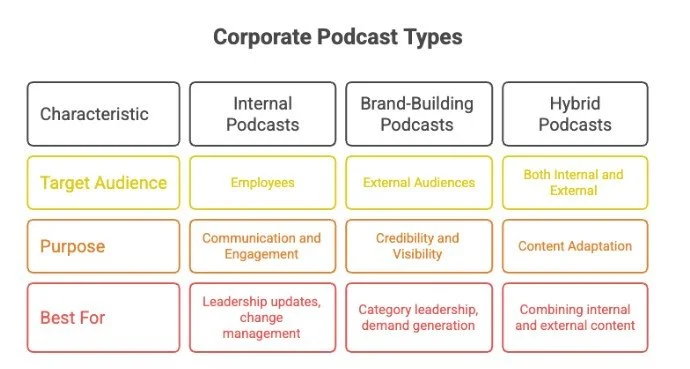
Remember that not all corporate podcasts serve the same purpose. The most successful programs start with a clear role within the organization. In practice, most corporate podcasts fall into three categories: internal communication, brand-building, or a hybrid of both.
Let’s break those down.
1. Internal Podcasts
Internal podcasts are designed specifically for employees. They’re a powerful way to communicate company strategy, leadership updates, and organizational change in a more conversational and accessible format.
According to the Edelman Trust Barometer, 78% of employees globally say they trust their employer. Internal communication channels, like podcasts, are a powerful way to maintain and strengthen that trust.
Best for:
Leadership updates and company news
Change management communication
Training and onboarding content
Reaching deskless or distributed teams
Because employees can listen while commuting, traveling, or between tasks, internal podcasts mostly achieve higher engagement than long written updates.
2. Brand-Building and Thought Leadership Podcasts
External-facing podcasts focus on building credibility and visibility in a company’s industry. Instead of direct promotion, these shows typically feature expert conversations, customer stories, or discussions about trends shaping the market.
They’re best for:
Establishing category leadership
Supporting demand generation and marketing efforts
Strengthening partnerships and ecosystems
Improving employer branding
When done well, these podcasts position a company as a trusted voice in its field.
3. Hybrid Podcasts
Some organizations combine the two approaches. A hybrid podcast might begin as an internal leadership conversation, with certain segments edited and repurposed for external audiences.
This model lets you create a single core piece of content and adapt it for different stakeholders.
At Content Allies, we often help you build a unified podcast engine that supports both internal communication and external brand-building. By designing formats that work for multiple audiences, organizations can maximize the impact of every episode without doubling their production workload.
How to Build a Successful Corporate Podcast
Launching a corporate podcast doesn’t have to be complicated. What you need is a clear plan. The most successful shows follow a structured approach that takes your business goals into account.
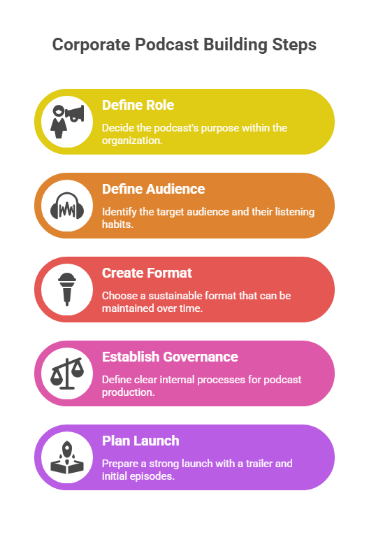
Step 1: Define the Podcast’s Role
Before thinking about formats or guests, decide what the job of your podcast is within the organization.
Common objectives include:
Reducing leadership communication friction
Improving employee engagement
Strengthening training or enablement programs
Building brand authority in your industry
Supporting sales conversations
Attracting and recruiting talent
The key here is focus. If a podcast has three primary goals, it effectively has none. Start with one clear objective and build the format around it.
Step 2: Define the Audience and Listening Moment
Next, identify exactly who the podcast is for and when they’re most likely to listen. Many companies skip this step, and the content ends up misaligned with how people actually consume podcasts.
Employees might tune in during commutes or while traveling between job sites, while external audiences may listen during workouts or downtime.
When you understand these listening moments, it becomes easier to determine the tone, episode length, and publishing cadence. In our experience, shows that match real listening habits usually keep attention much longer.
Step 3: Create a Sustainable Format
Consistency matters more than overcomplicating things. Many teams start with ambitious ideas and realize later that production becomes difficult to maintain.
Choose a format your team can realistically maintain over time, such as:
Leadership interviews
Industry conversations
Story-driven episodes
Short internal briefings
A simple, repeatable structure makes production smoother and helps listeners know what to expect.
In our daily practice working with podcast teams, the formats that last the longest are usually the simplest ones.
Step 4: Establish Corporate Governance
Corporate podcasts usually require clear internal processes. If you skip this step, production delays and last-minute approvals quickly become a problem.
Define a few key elements early:
Ownership: Who is responsible for the podcast overall
Approvals: Who reviews episodes before publication
Red-line topics: What subjects should be avoided or handled carefully
Crisis protocol: What happens if an episode needs to be paused or edited after release
We have noticed that teams that define these guardrails early move much faster once production begins.
Step 5: Plan the Launch
A strong launch sets the tone for the entire podcast. Keep it simple. Start with a trailer episode explaining the purpose of the show, and three initial episodes so new listeners can immediately explore the content
Then prepare two distribution toolkits:
Internal launch kit: Messaging for intranet, email newsletters, and leadership communications
External launch kit: LinkedIn posts, website placement, and promotional clips
The effort is worthwhile because podcast listening continues to grow. According to Edison Research’s 2025 Podcast Consumer Report, Americans now spend 773 million hours per week listening to podcasts.
How to Choose the Right Corporate Podcast Host
The host is one of the most important decisions in any corporate podcast. A strong host can guide conversations, put guests at ease, and represent the company’s voice authentically.
Host Options
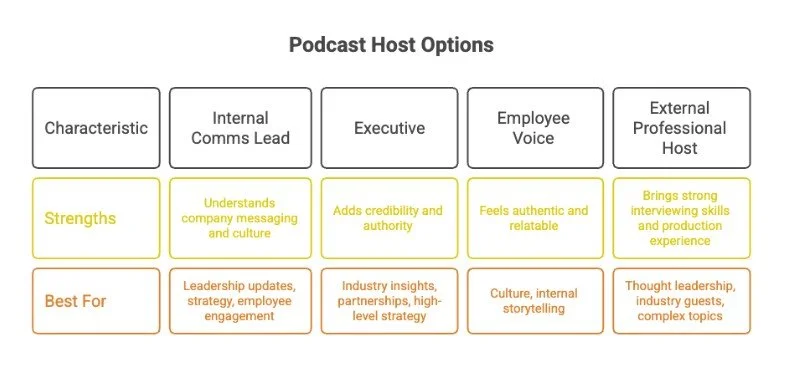
Remember that not all hosts are the same, though. You have options here, and the right choice depends on the podcast’s goals, audience, and format.
Internal Comms Lead
A communications leader is someone who understands the company's messaging and culture better than anyone. This makes them well-suited to host internal podcasts focused on leadership updates, strategy, and employee engagement.
Executive
Having a senior leader host the show can add credibility and authority. Executive hosts work best when the podcast is focused on industry insights, partnerships, or high-level strategy conversations.
Employee Voice
Some organizations choose an employee host who represents the broader workforce. This approach can feel more authentic and relatable, particularly for culture or internal storytelling podcasts.
External Professional Host
A professional host or moderator can bring strong interviewing skills and production experience. This option is particularly useful for thought leadership shows that feature industry guests or complex topics.
In our experience, professional hosts help conversations flow naturally, especially when guests are not used to speaking on podcasts.
Corporate Podcast Host Scorecard
When evaluating potential hosts, look for a few key qualities:
Clarity: Can they communicate ideas clearly and guide conversations smoothly?
Listening skills: Great hosts listen actively and ask thoughtful follow-up questions.
Comfort with sensitive topics: Corporate conversations sometimes require nuance and professionalism.
Consistency: The host should be available and committed to maintaining a regular publishing schedule.
Brand fit: The host’s tone and style should reflect your organization’s voice and values.
Choosing the right host matters because listeners respond strongly to authentic voices. According to Nielsen, 56% of listeners pay more attention to host-read ads, and podcasts achieve 71% aided brand recall, which shows how influential the host’s voice can be in building trust with audiences.
Equipment and Tools for Corporate Podcast Production
Producing a corporate podcast doesn’t require a complex studio setup, but it does require the right tools and workflows for consistency, reliability, and security.
Remote Recording Redundancy
Many corporate podcasts feature executives, employees, or external guests joining from different locations, so reliable remote recording is essential.
Platforms like Riverside, SquadCast, and Zencastr are designed specifically for podcast recording and capture separate local audio tracks, which helps maintain high sound quality even if someone’s internet connection drops.
Having backup recordings or secondary capture tools is especially important when coordinating busy executive schedules.
IT and Security Considerations
Corporate environments mostly have stricter technology requirements than independent creators. Recording tools may need to pass IT security reviews, and internal podcasts may require secure storage or restricted access.
Teams typically use editing and production tools like Descript or Adobe Audition, which allow collaborative editing and version control. Plan ahead with IT to make sure these tools align with company security policies.
Video-First Workflow
More and more, corporate podcasts are produced with video in mind from the start. Recording video allows teams to publish full episodes on platforms like YouTube and repurpose short clips for social media assets.
The trend toward video is accelerating. According to Spotify, there are now more than 250,000 video podcast shows on the platform, up from 100,000 in 2023.
Internal and Private Distribution Platforms
For internal podcasts, companies mostly use private podcast feeds or enterprise distribution platforms that allow secure listening for employees. Examples include uStudio and Storyboard.
These platforms allow organizations to distribute content securely while still giving employees the familiar experience of listening through standard podcast apps.
How to Promote a Corporate Podcast
Publishing an episode is only the first step. Successful corporate podcasts grow because they have repeatable promotion systems in place. Instead of relying on occasional posts or one-off announcements, the goal is to build a workflow that consistently turns each episode into multiple pieces of content.
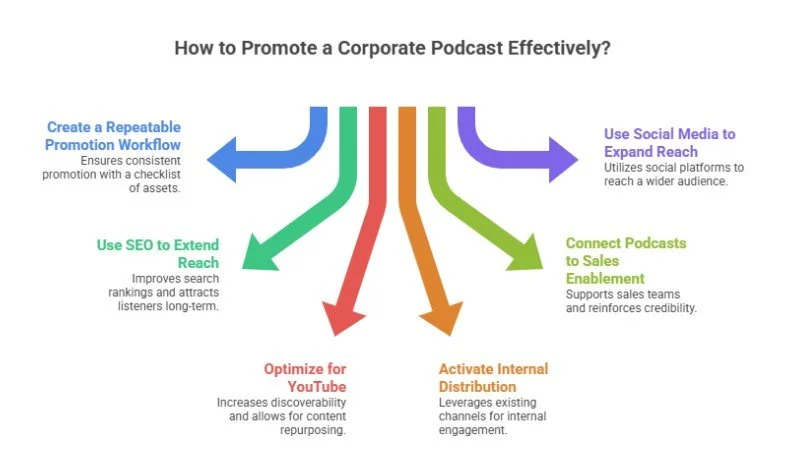
1. Create a Repeatable Promotion Workflow
Every episode should generate a predictable set of promotional assets. Many teams build a simple checklist that includes:
Short video or audiogram clips
Quote graphics or key insights
A newsletter mention
A LinkedIn post from both the company and the host
With this approach, promotion happens consistently without requiring a new plan every time an episode is released.
2. Use SEO to Extend Reach
Podcast episodes can also be valuable search-driven content. Publishing detailed show notes, transcripts, and episode summaries on your website helps episodes rank in search results and creates additional entry points for audiences discovering your brand.
From what we have seen, episodes that include strong written content often continue attracting listeners long after the original release date.
You can explore this further in our guide to podcast SEO.
3. Optimize for YouTube
YouTube has become one of the largest podcast discovery platforms. Posting full episodes with clear titles, thumbnails, and chapter markers makes it easier for viewers to find and navigate your content. Video also allows you to create shorter clips that can be repurposed across other platforms.
4. Activate Internal Distribution
For internal podcasts, promotion should use existing communication channels inside your organization. This can include intranet portals, internal newsletters, Slack or Teams channels, and leadership updates.
Managers can also share relevant episodes with their teams, which typically increases visibility and engagement.
5. Connect Podcasts to Sales Enablement
For external podcasts, episodes can support sales and marketing teams. Sharing relevant episodes with prospects, partners, or event audiences can reinforce credibility and spark conversations.
We have noticed that sales teams frequently overlook podcast episodes as a resource, even though they can be powerful conversation starters.
6. Use Social Media to Expand Reach
Social platforms also play a major role in podcast promotion. According to the 2025 Business Podcast Report we shared earlier, social distribution has become a standard part of podcast marketing:
95% of shows are active on Instagram, with 92% using Reels
89% maintain LinkedIn pages, the platform of choice for professional storytelling
86% are on X (formerly Twitter)
76% use TikTok, and 75% of them repurpose podcast content into short-form videos
When you build a repeatable promotion system around each episode, your podcast can reach far beyond its initial audience and continue generating value across marketing, communications, and sales channels.
How to Track Corporate Podcast Performance
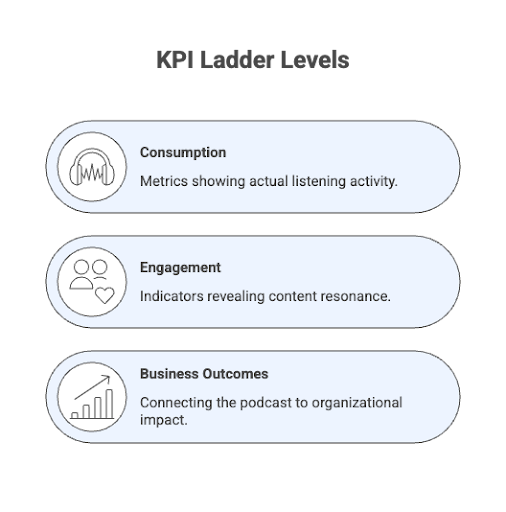
Measuring a corporate podcast allows you to find out what’s working, what your audience responds to, and where you should invest more time and effort. The most effective teams track performance through a KPI ladder, which connects listening data to real business outcomes.
Here’s what a KPI ladder looks like.
KPI Ladder
Level 1: Consumption
These metrics show whether people are actually listening.
Downloads or plays
Subscribers or followers
Episode completion rates
These indicators help you understand how many people your podcast is reaching.
Level 2: Engagement
These indicators reveal whether the content is resonating.
Comments and social shares
Website traffic from episodes
Internal feedback or employee engagement metrics
Level 3: Business Outcomes
At the top of the ladder are metrics that connect the podcast to real organizational impact. These will vary depending on the podcast’s purpose, but common examples include:
Sales influence: Episodes shared in sales conversations, deal touches, or opportunities influenced by podcast content
Lead generation: Demo requests, newsletter signups, or gated content downloads driven by podcast pages
Brand search lift: Increases in branded search queries after episodes or campaigns
Content amplification: Backlinks, media mentions, or citations generated from podcast discussions
Employee alignment: Internal survey results, episode completion rates among employees, or leadership communication engagement
Recruitment impact: Job applicants referencing the podcast or employer brand content derived from episodes
Partnership development: Inbound partnership requests or collaborations initiated through podcast relationships
In our experience, this is where many teams struggle. They track downloads but stop there, which makes it difficult to show the broader impact of the podcast.
Reporting Cadence
Consistent reporting helps keep the podcast aligned with leadership priorities.
Weekly operational reviews track downloads, releases, and promotion performance.
Monthly performance reviews identify trends across episodes and audience engagement.
Quarterly strategic reviews evaluate how the podcast is supporting broader business goals like audience growth and revenue.
Measurement remains a common challenge for marketing leaders. According to The CMO Survey 2025, 64% of marketing leaders say demonstrating financial impact is their top challenge.
At the same time, organizations that invest in stronger measurement frameworks see better results. Measurement front-runners are 44% more likely to exceed revenue goals, according to Deloitte Digital research.
When you connect podcast metrics to meaningful business outcomes, the show becomes a measurable communication and marketing asset rather than just another content channel.
Corporate Podcast Launch Checklist
Want a quick way to put all this process into practice? Download the Corporate Podcast Launch Checklist to make sure your podcast strategy, promotion, and measurement systems are set up correctly.
Common Corporate Podcast Challenges (and How to Avoid Them)
Even with a strong strategy, corporate podcasts can run into predictable obstacles. Knowing these challenges ahead of time makes them much easier to manage.
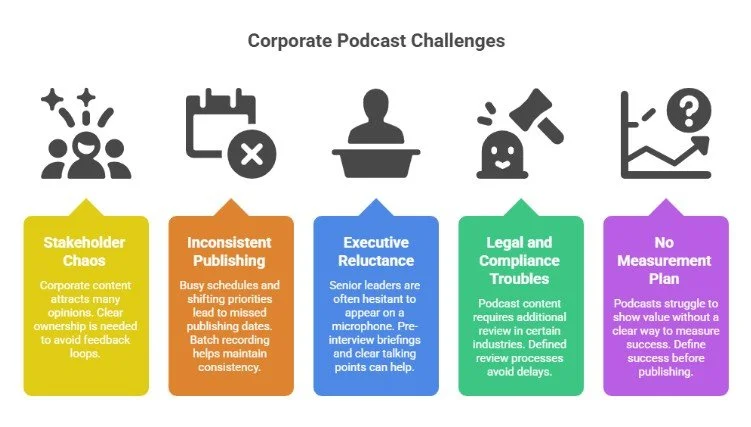
1. Stakeholder Chaos
Corporate content mostly attracts a lot of opinions. Without clear ownership, podcasts can get stuck in endless feedback loops or approval delays.
We have observed that this is one of the most common problems inside large organizations.
The solution is simple: appoint a single owner and an executive sponsor. One person manages day-to-day decisions while the sponsor provides leadership backing. This structure keeps the show moving and prevents it from turning into a committee project.
2. Inconsistent Publishing
Many corporate podcasts launch with enthusiasm but fade after a few episodes. Busy schedules, shifting priorities, and production problems often lead to missed publishing dates.
We believe consistency becomes much easier when you record in batches.
The best way to avoid this is to batch-record and build an episode backlog, so your team isn’t scrambling to produce content at the last minute.
3. Executive Reluctance
Senior leaders are usually key voices for corporate podcasts, but many are hesitant to appear on a microphone.
A simple pre-interview briefing, clear talking points, and a relaxed conversational format can go a long way towards making executives feel more comfortable.
4. Legal and Compliance Troubles
Podcast content sometimes requires additional review, particularly in industries such as finance, healthcare, or government. From what we have seen, delays usually happen when review processes are not defined early.
Establish red-line topics, pre-approved messaging guidelines, and a defined review process early on to avoid delays later. Your team can move much faster once these guardrails are in place.
5. No Measurement Plan
Podcasts usually struggle to show value when there is no clear way to measure success.
We suggest defining success before the first episode is published.
Your metrics might include employee engagement, brand authority, lead generation, or thought leadership impact. When you define these goals early, the podcast becomes easier to evaluate and improve over time.
Real-Life Examples of Successful Corporate Podcasts
Looking at real-world examples can help illustrate how companies use podcasts to support different goals, from brand storytelling to thought leadership and industry education.
1. The BragWorthy Culture Podcast (Fringe)
The BragWorthy Culture Podcast is a B2B show from Fringe, the wellbeing marketplace for lifestyle benefits, recognition, and stipends. The podcast helps the company connect with founders and decision-makers interested in building strong workplace cultures.
Content Allies partnered with Fringe to relaunch and grow the show. The work included refining the launch strategy, building an episode backlog, and improving the recording setup. The team also supported guest booking, host onboarding, and social media promotion to keep the podcast running consistently.
Across 43 episodes, the podcast generated nearly 5,000 downloads, clear proof of how a corporate podcast can support brand awareness and thought leadership in a niche B2B market.
2. Masters of Scale (LinkedIn)
Hosted by LinkedIn co-founder Reid Hoffman, Masters of Scale features conversations with founders and business leaders about how companies grow. The podcast positions LinkedIn at the center of discussions around entrepreneurship, leadership, and innovation.
3. The McKinsey Podcast
Global consulting firm McKinsey produces a long-running podcast exploring leadership, business strategy, and economic trends. The show reinforces McKinsey’s reputation as a trusted source of insight for executives and decision-makers.
4. Shopify Masters
Shopify Masters features interviews with entrepreneurs and ecommerce leaders who share practical lessons about building and scaling businesses. The podcast helps position Shopify as a central voice in the ecommerce ecosystem.
Should You Produce a Corporate Podcast In-House or With an Agency?
Once you decide to launch a corporate podcast, the next question is: Should your team produce it internally, or should you work with an external partner?
Remember that the right choice depends on your resources, internal expertise, and how important the podcast is to your broader communication strategy.
When In-House Production Makes Sense
An in-house approach can work well if your team already has the necessary production skills, available time, and leadership support. It’s most effective for simpler formats where marketing or communications teams can handle planning, recording, editing, and promotion.
In-house production works best when the podcast is relatively straightforward, and the team can dedicate consistent time to it.
When Working with a Partner Makes Sense
An external partner can help you launch faster and maintain consistent quality over time. This option mostly works better when the podcast is treated as a strategic communication channel rather than an occasional content experiment.
Vendor Evaluation Checklist
If you decide to work with an agency, evaluate potential partners across several areas:
Strategy support
Production quality
Distribution and promotion expertise
Operational reliability
Measurement and reporting

At Content Allies, our team focuses on building a complete podcast system that combines content strategy, production, promotion, and measurement. This way, your teams can run a high-impact podcast without building a full media operation internally.
Take a look at our article here for a more in-depth guide to in-house vs. outsourced podcast production.
Build a Corporate Podcast That Actually Drives Results with Content Allies
Corporate podcasts mostly fail when they’re treated as side projects.
The companies that succeed take a different approach. Instead of focusing only on recording episodes, they build a repeatable podcast system that connects strategy, production, promotion, and measurement.
That’s where Content Allies comes in. We help you design and run corporate podcasts from end to end, from defining the show’s role and format to managing production, promotion, and performance tracking.
The goal is to create a program that supports employee engagement, brand authority, and pipeline influence.
If you’re ready to turn your corporate podcast into a strategic communication and marketing asset, the next step is simple. Get in touch with us and start building your corporate podcast playbook.
FAQs
What are corporate podcasts?
Corporate podcasts are shows created by organizations to support internal communication, brand authority, and content marketing efforts while connecting with employees, customers, or industry audiences.
What makes a corporate podcast different from a traditional or creator-led podcast?
Corporate podcasts are tied to business goals and audience needs, often guided by listener demographics, brand guidelines, and a structured production workflow.
How long does it typically take to launch a corporate podcast from strategy to first episode?
Most corporate podcasts take 4-8 weeks to launch, depending on strategy development, host preparation, professional equipment setup, and the creation of a reliable production workflow.
How do you measure the ROI of a corporate podcast beyond downloads and listens?
ROI is measured through metrics like sales influence, lead generation, brand authority, and engagement with target listener demographics, not just download counts.
What types of companies does Content Allies typically work with on corporate podcasts?
Content Allies works with B2B companies and marketing teams that want to use podcasts as part of a broader content marketing strategy to reach decision-makers and niche professional audiences.
How does Content Allies help with promotion and distribution, not just production?
Content Allies supports the entire production workflow, including episode promotion, content repurposing, and distribution strategies designed to reach the right listener demographics.
What does the onboarding and strategy process look like when working with Content Allies?
The onboarding process includes defining goals, understanding target listener demographics, designing the podcast format, and building a repeatable production workflow supported by professional equipment and promotion systems.
Appendix
- The State of Business Podcasting 2025
- YouTube: 1 Billion Monthly Podcast Users
- Edison Research – The Podcast Consumer 2025
- Edelman Trust Barometer Global Report
- Nielsen Podcasting Today Report
- The CMO Survey 2025 – Highlights and Insights
- Deloitte Digital Measurement Research
- Spotify Newsroom – Growth of Video Podcasts
- The McKinsey Podcast
- Shopify Masters
- The BragWorthy Culture Podcast (Fringe)