
Dynamic Ad Insertion: What B2B Podcasters Need to Know
Dynamic ad insertion is changing how B2B brands approach podcast advertising. Instead of permanently embedding ads into an audio file, you can update ad creative across your podcast catalog based on audience targeting, campaign timing, or promotion goals.
This matters because B2B podcasts generate value long after publication. A single evergreen episode can continue driving webinar signups, demos, and pipeline months later when paired with the right DAI campaign strategy.
At Content Allies, we see dynamic ad insertion as part of a larger podcast marketing strategy built around long-term audience growth, attribution, and revenue impact.
If you are not using this method yet, you may be falling behind. IAB reports that dynamic ad insertion now represents more than 90% of podcast ad revenue.
In this guide, we’ll break down how podcast dynamic ad insertion works, where dynamically inserted ads fit best, and how B2B brands can use DAI to support lead generation without weakening listener trust.
What Is Podcast Dynamic Ad Insertion?
Podcast dynamic ad insertion (DAI) allows podcast hosts, advertisers, and podcast networks to insert or replace audio ads inside an episode after it has already been published.
Instead of permanently attaching an embedded ad to the original audio file, dynamically inserted ads are delivered in real time when someone streams or downloads the episode.
This gives podcast teams more control over campaigns, CTAs, and sponsorship inventory without changing the episode itself.

How Dynamic Ad Insertion Works
Dynamic ad insertion works by placing designated ad slots inside a podcast episode before you hit publish. These markers tell the podcast hosting platform or ad server where audio ads should appear during playback.
When a listener streams or downloads the episode, the system selects an ad based on campaign rules. These rules can include audience targeting, geography, device type, listening app, campaign window, or impression delivery requirements. The dynamically inserted ad is then stitched into the episode in real time using server-side dynamic ad insertion technology.
Many modern podcast hosting and advertising tools also connect with podcast advertising networks, demand-side platforms, and supply-side platforms to automate ad delivery and media planning across larger podcast campaigns.
Check out this YouTube video for a more in-depth breakdown of how podcast dynamic ad insertion works:
Common Dynamic Podcast Ad Placements
Most podcast advertising campaigns use three main ad spots: pre-roll, mid-roll, and post-roll placements. Each supports different campaign goals and creates a different listening experience.
Pre-roll Ads
Pre-roll ads appear before the episode starts. They usually run 15 to 30 seconds and work best for:
Brand awareness
Newsletter signups
Event promotion
Top-of-funnel campaigns
Many podcast advertising agencies use pre-roll inventory when a campaign needs broad reach, quick exposure, or lower-friction promotion.
Mid-roll Ads
Mid-roll ads appear during the episode, usually at a natural transition point. They typically drive the strongest audience engagement because listeners are already invested in the content.
These ad slots work well for:
Product demos
Webinar CTAs
Lead generation
Podcast sponsorship campaigns
Host-read ads
Mid-roll placements usually deliver the best balance of conversions and listener retention.
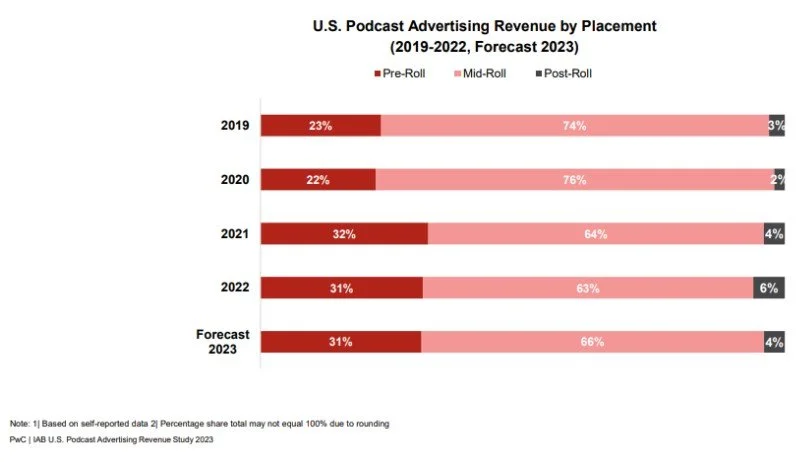
According to the IAB, publishers use roughly a 60% to 30% split between mid-roll and pre-roll inventory to meet advertiser demand.
Post-roll Ads
Post-roll ads play after the episode ends. Fewer listeners reach them, but they create less disruption.
They work best for:
Cross-promotion
Retargeting
Secondary CTAs
Additional offers
For B2B shows, post-roll works best when the CTA does not need full listener attention, such as promoting another episode, a newsletter, or a related resource.
Benefits of Dynamic Ad Insertion for B2B Podcasts
Dynamic ad insertion can support several long-term advantages for B2B podcast programs, from campaign flexibility to stronger use of evergreen content.
Let’s look at the key benefits.
1. Keeps Evergreen Episodes Useful
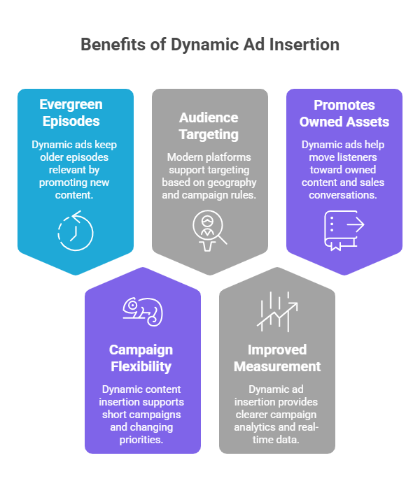
Most B2B podcasts build value over time. Dynamic ads help older episodes stay relevant by allowing you to promote new webinars, reports, product messaging, and event campaigns inside existing content.
This is valuable if you have large content libraries or evergreen thought-leadership content.
2. Gives Campaigns More Flexibility
B2B marketing teams rarely run the same offer all year. Dynamic content insertion makes it easier to support short campaign windows, seasonal promotions, and changing priorities across your podcast catalog without rebuilding episodes.
This flexibility also helps marketing teams align podcast advertising with broader paid media and demand generation campaigns.
3. Supports Better Audience Targeting
Modern podcast hosting platforms can support targeting based on geography, listening app, device, and campaign rules. This creates room for regional promotions, account-based marketing campaigns, and more personalized ad experiences.
The value is not limited to who hears the ad. It also affects what message they hear and when they hear it. As Bryan Barletta explained while discussing dynamic ad insertion:
“If you have the right targeting, you can say, ‘Thank you for downloading,’ as a dynamically inserted piece of content. You can encourage someone who is listening to an older episode who is streaming it to consider subscribing. There are really neat executions. You can link ads together so that a brand can tell a story between a pre-roll, mid-roll, and a post-roll.”
That personalization matters because podcast ads can influence consideration. An Edison Research/Triton Digital survey found that 54% of podcast listeners were somewhat or much more likely to consider a brand after hearing it advertised on a podcast.
4. Improves Measurement
Dynamic ad insertion gives you clearer campaign analytics and real-time analytics across ad impressions, downloads, landing page visits, promo code usage, and conversions. This makes podcast advertising easier to measure alongside other demand generation channels.
Podcast ads can also drive measurable action. Sounds Profitable’s research found that 33% of podcast listeners reported writing down a promo code after hearing a podcast ad, the highest response rate among surveyed ad-supported media channels.
5. Promotes Owned Assets
Many B2B brands use podcast ad inventory to promote their own content instead of outside sponsors. This is where dynamic ads become more than a monetization tool. They can help move listeners toward newsletters, reports, webinars, events, product demos, case studies, or sales conversations.
For enterprise teams, this makes podcast inventory part of the broader content and demand generation system. Dynamic ads can support a larger enterprise podcast strategy without turning the show into a sponsor-first channel.
Dynamic Ads vs Baked-In Podcast Ads
Dynamic podcast ads can be updated after an episode is published, while baked-in ads (also known as integrated ads) stay permanently attached to the episode audio. Dynamic ads work better for flexible campaigns and measurement, while baked-in ads are stronger when the goal is a highly natural host endorsement.
Baked-in ads are recorded directly into the episode by the host during production. Many podcasts still use them for long-term sponsorships and native brand integrations.
Dynamic ads solve a different problem. As mentioned earlier, they allow you to rotate CTAs, support campaign windows, and manage larger podcast catalogs without constantly editing old episodes.
| Factor | Dynamic Ads | Baked-In Ads |
|---|---|---|
| Flexibility | Can be updated anytime | Permanent |
| Scalability | Strong for large catalogs | Limited |
| Evergreen value | High | Lower |
| Listener experience | Can feel less natural | Usually more natural |
| Targeting | Possible | Limited |
| Measurement | Easier | Harder |
Best Approach for B2B Podcasts
The strongest B2B podcast strategies usually combine both formats.
Use baked-in ads for:
Core thought leadership
Long-term sponsor relationships
Native host endorsements
Important brand messaging
Use dynamic ads for:
Webinar promotion
Product launches
Lead-generation CTAs
Time-sensitive advertising campaigns
Retargeting and paid media support
Many B2B brands also use dynamically inserted host-read ads to balance trust, audience engagement, and campaign flexibility.
How to Set Up Podcast Dynamic Ad Insertion
Setting up dynamic ad insertion does not require rebuilding your podcast workflow. Most modern podcast hosting platforms already support DAI tools, ad slots, and campaign management features.
Below, we have shared a simple step-by-step process to get started.
1. Choose a Hosting Platform With DAI Support
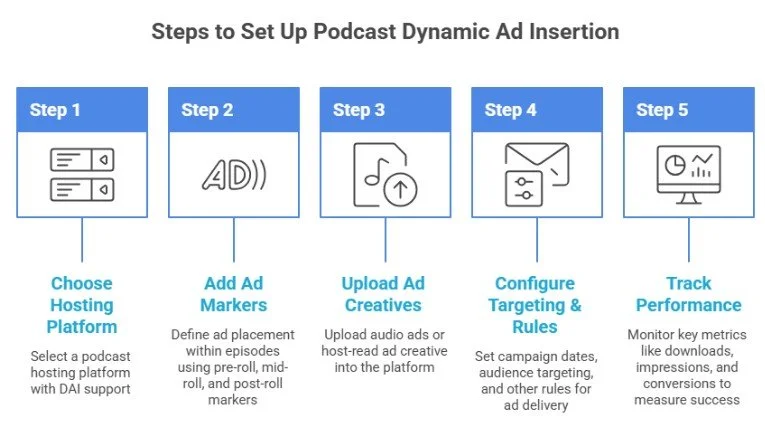
Start by checking whether your current podcast hosting platform supports dynamic content insertion, ad markers, campaign scheduling, and ad reporting. If it does not, you may need to migrate before you can run DAI properly.
Popular options include:
Megaphone
Libsyn
Simplecast
Captivate
Podbean
Spotify for Podcasters
For larger B2B podcast programs, also look for audience targeting, impression controls, attribution support, and integrations with podcast advertising marketplaces.
2. Add Ad Markers
Next, you need to decide where ad spots should appear inside the episode. Most teams use:
Pre-roll markers
Mid-roll markers
Post-roll markers
Insider tip: Based on our experience, mid-roll markers deserve the most attention for B2B shows. Place them between topic shifts, after a strong answer, or before moving into a new segment so the ad does not cut through an important guest insight.
3. Upload Ad Creatives
Next, upload your audio ads or host-read ad creative into the platform.
Strong ad creative should sound like it belongs in the episode. Keep the audio quality consistent, match the volume to the show, use a clear CTA, and avoid stuffing too many messages into one spot.
Poor transitions, loudness mismatches, or generic ad copy can make the ad feel disconnected from the listening experience.
4. Configure Targeting and Campaign Rules
Now set the rules for how your DAI campaign should run. For B2B podcasts, these rules should match the campaign goal, rather than just the available platform settings.
This may include:
Campaign dates
Audience targeting
Geographic targeting
Listening app rules
Frequency limits
Tagged ad content
For example, a webinar campaign may need a short campaign window and regional targeting, while an evergreen report may stay live across older episodes for several months.
Many podcasting platforms also support campaign pacing and media planning controls.
5. Track Performance
Once campaigns go live, track performance against the action you want listeners to take.
Key metrics include:
Downloads
Ad impressions
Fill rate
CPM
Landing page visits
Conversions
Audience engagement
For B2B teams, the most useful reporting connects podcast ad performance with broader demand generation activity. Look at which CTAs drive visits, which episodes create response, and which campaigns support the pipeline instead of stopping at downloads alone.
Best Practices for Dynamic Podcast Ads
A strong DAI campaign should support the podcast experience rather than compete with it. The best podcast ads feel relevant, well-timed, and aligned with the audience’s expectations.
Based on our experience producing and promoting B2B podcasts, here are the in-house best practices we recommend.
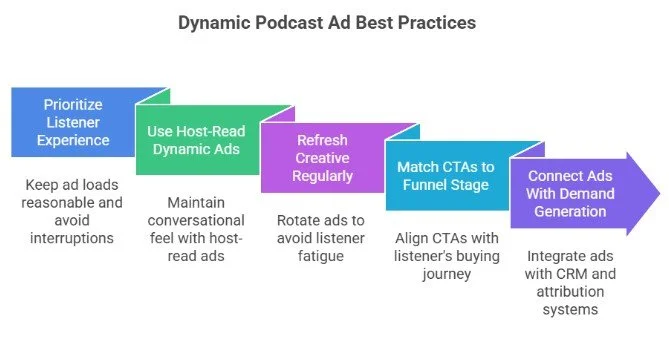
Prioritize Listener Experience
Too many ad spots can hurt audience engagement quickly, particularly in niche B2B shows.
Keep ad loads reasonable, avoid interrupting key moments, and maintain smooth transitions between content and ads. According to Statista, listeners are comfortable with an average of 3.8 ads in a 60-minute podcast and 2.2 ads in a 15-minute podcast.
Use Host-Read Dynamic Ads When Possible
As mentioned earlier, host-read dynamic ads give you the flexibility of DAI without losing the conversational feel of the show. Instead of dropping in a generic audio spot, the host can read the message in the same tone your audience already trusts.
For B2B shows, this works well for webinar promotion, product-led CTAs, partner offers, sponsorships, and thought leadership campaigns where credibility matters.
Refresh Creative Regularly
Listeners tune out repeated ads quickly when they hear the same CTA across multiple episodes.
In fact, SiriusXM Media found that 55% of podcast listeners skip ads because they have heard the same ad too many times.
Rotate your ad creative when a campaign ends, when an offer changes, or when performance starts to decline. This keeps older episodes useful without making the catalog feel stale.
Regular creative reviews should be part of your broader B2B podcast content strategy, so older episodes keep supporting current campaigns instead of sending listeners to outdated offers.
Match CTAs to Funnel Stage
Your CTA should match how much trust the listener has built with your brand. Someone hearing your show for the first time may not be ready for a demo, but they may download a report or register for a webinar.
Use top-of-funnel CTAs for:
Newsletters
Reports
Webinars
Use middle-funnel CTAs with:
Case studies
Product walkthroughs
Buyer guides
And save your bottom-funnel CTAs for:
Demos
Consultations
Trials
This matters for B2B podcasts because listeners may hear episodes at very different points in the buying journey. A new listener may need education, while a returning listener may be ready for a more direct offer.
That direct offer can work when the timing is right. Edison Research found that 46% of weekly podcast listeners have purchased a product or service after hearing a podcast ad.
Connect Ads With Broader Demand Generation
B2B podcast ads work better when they are tied to the same systems your team already uses to track demand.
Connect each campaign to CRM tracking, retargeting audiences, attribution reporting, campaign-specific landing pages, and sales follow-up.
That way, you can see which podcast CTAs drive qualified visits, influenced accounts, and pipeline activity instead of judging performance on downloads alone.
Read Next: B2B Podcast Best Practices That Boost Authority and Lead Quality
Is Dynamic Ad Insertion Worth It for B2B Podcasts?
For most B2B brands, the answer is yes, particularly when the podcast supports demand generation and long-term content distribution.
There is also a clear business case for managing podcast inventory more carefully. Libsyn Ads reported an average CPM of $21.63 for a 60-second podcast ad in May 2024. This shows why brands and publishers are paying closer attention to how podcast ad space is used.
As podcast programs mature, more B2B teams are treating shows as both a content channel and a measurable growth channel.
Turn Your B2B Podcast Into a Pipeline Channel with Content Allies
A successful B2B podcast does more than generate downloads. It creates trust, supports demand generation, and helps sales teams start better conversations with the right buyers.
At Content Allies, our podcast marketing services help B2B companies launch, produce, promote, and grow podcast programs tied to measurable business outcomes. This includes branded podcast production, long-term content strategy, audience growth, repurposing, and promotion that protects listener trust.
Whether you want to build thought leadership, support account-based marketing, or create a scalable content engine, our team can help you turn your podcast into a consistent pipeline channel. Get in touch to learn more.
FAQs
How many ads should a B2B podcast include per episode?
That depends on episode length and audience expectations, but most B2B podcasts should stay relatively light on ad load. For a 30 to 60-minute episode, one or two ad breaks are usually enough. Too many interruptions can hurt retention and make the show feel overly commercial.Are host-read ads better than pre-recorded podcast ads?
Host-read ads usually perform better when trust and credibility matter. The message feels more natural because it matches the tone of the conversation and comes directly from the host. Pre-recorded ads can still work for larger campaigns, but they tend to feel less integrated into the listening experience.What metrics should B2B brands track for podcast advertising?
Downloads and impressions matter, but they should not be the only focus. B2B teams should also track landing page visits, conversions, promo code usage, attributed pipeline activity, audience engagement, and influenced opportunities tied to podcast campaigns.
How long should a podcast ad be?
Most podcast ads run between 15 and 60 seconds. Shorter ads work well for quick awareness campaigns, while longer mid-roll placements give more space for storytelling, product context, or webinar promotion. The right length depends on the complexity of the offer and where the ad appears in the episode.
Can podcast ads support account-based marketing campaigns?
Yes. Dynamic ad insertion allows teams to target campaigns by geography, audience segment, or listening behavior, which can support broader ABM efforts. Many B2B brands use podcast ads to reinforce campaigns already running across email, paid media, and sales outreach.
How does Content Allies help B2B brands manage podcast advertising?
At Content Allies, we help B2B companies manage podcast advertising as part of a broader growth strategy. We support podcast production, dynamic ad planning, audience growth, campaign promotion, attribution, content repurposing, and podcast SEO. Our goal is to help your podcast support demand generation, audience development, and long-term pipeline growth.
Appendix
- IAB — Brand Building Now Accounts for 61% of Podcast Advertising
- Sounds Profitable — Podcast Ads Drive Action
- IAB — US Podcast Advertising Revenue Study 2023
- eMarketer — Podcasts: A Small but Significant Audience
- Statista — Number of Accepted Ads per Podcast in the USA
- SiriusXM Media — 5 Strategies for Fighting Podcast Ad Fatigue
- Edison Research — The Podcast Consumer 2024
- Sounds Profitable — 2024 IAB Podcast Upfront Takeaways and Advertising Rates