
Podcast Advertising Statistics: Performance, Benchmarks, and What It Takes to Win at Scale

Podcast advertising has officially moved past the “let’s test this” phase.
What started as an experimental line item for many brands is now a real, scalable channel with meaningful ad spend, real performance expectations, and growing scrutiny from leadership teams.
At this stage, success in podcast ads comes down to scale, predictability, and measurement.
Anecdotal wins and one-off success stories aren’t enough to justify ongoing investment.
That’s why podcast advertising statistics matter.
The right data can help you find out what actually works across formats, audiences, and campaigns.
At Content Allies, we operate podcasts across multiple industries and advertiser types, so we get to see these patterns play out in real time.
In this article, we’ll break down the most important podcast advertising statistics. We’ll look at performance benchmarks, pricing, formats, measurement, and what it truly takes to run podcast advertising at scale.
Keep reading below.
The State of Podcast Advertising: Market Size and Growth Statistics
When we talk to CMOs and media buyers about where podcast advertising sits in 2026, the first question we hear is almost always the same: “How big is this channel, really?” The data makes it clear that podcast advertising is a growing, investable media category with real scale and momentum.
In fact, according to the IAB’s annual U.S. Podcast Advertising Revenue Study, the U.S. podcast advertising market is projected to grow to nearly $2.6 billion by 2026, up from lower totals in previous years.

But the U.S. market is just part of the story.
Globally, the podcast advertising market is far larger and growing rapidly.
One industry research forecast estimated the worldwide podcast advertising sector at around $19.36 billion in 2024, with a projected compound annual growth rate (CAGR) of about 10% through 2030.
That means more money entering the channel, as well as deeper strategic investment across formats, industries, and regions.
This growth aligns with how audiences themselves are expanding.
By the end of 2025, there were hundreds of millions of podcast listeners worldwide, and the trend shows continued upward momentum. This makes podcast audiences a seriously promising target for marketers who care about reach and engagement.

And if you’re planning a B2B podcast, here’s an interesting stat for you:
59% of decision makers in companies listen to their favorite podcasts (and they do it during work hours).
Podcasts vs. Other Audio Channels
Part of the reason brands are shifting ad dollars into podcasts is the share of budget. Emerging research suggests podcast ad spend is now comparable to other established digital channels.
Some forecasts are even estimating that podcast advertising could represent around 3.6% of total digital ad budgets, which is about on par with digital out-of-home (DOOH) advertising.
Active Shows vs. Monetization Realities
The broader landscape of shows also matters. Industry estimates put the total number of podcasts in the multiple millions worldwide, but a much smaller percentage are active and driving consistent content, and an even smaller subset has established monetization through advertising. For example, research from Learning Revolution found that while there are millions of podcasts registered globally, there are only 436,000 active shows that have published episodes regularly during the past 90 days.
In other words, only 15-20% of Apple podcasts are active.
Remember: A good podcast production agency keeps your podcast alive with streamlined business advice, editing, and distribution to maintain a solid pipeline of leads.
Why This Matters for Marketers
For brands and marketing leaders, these macro trends give us two main takeaways:
Podcast advertising is growing faster than many other digital channels, and is not stagnating
A concentrated, professional inventory, which means shows with audiences and repeatable formats, commands the majority of advertiser attention and spend
At Content Allies, we’ve seen how this plays out firsthand.
Average advertisers who try to scale ad-driven podcasts without a structured strategy or production support hit performance ceilings quickly.
Scaling sustainably requires infrastructure, from ad operations and measurement to creative and campaign execution, that most independent creators simply don’t have on their own.
Podcast Audience Statistics That Explain Why Ads Convert
Understanding who listens to podcasts and how they behave is crucial for advertisers, because listener engagement is what makes ads work. When we talk about podcast audiences at Content Allies, we’re talking about a group that’s highly engaged, fairly wealthy, and receptive to advertising, and the primary research bears this out.
Let’s check out some audience stats from Edison Research’s The Podcast Consumer 2025 that directly tie into why podcast ads convert:
High Engagement and A Lot of Listening Time
One of the foundational reasons advertisers see results in podcasts is that listeners spend serious time with the medium.
According to Edison’s research, weekly time spent with podcasts has increased by 355% since 2015, with listeners now spending an average of hundreds of millions of hours each week consuming shows.
Longer listening periods mean more opportunities to hear ads and build familiarity.
Receptive and Ad-Friendly Audience
Podcast listeners aren’t passive consumers; they’re receptive to ad content:
88% of weekly podcast consumers agree that hearing ads is a fair price to pay for free content.
68% say they don’t mind hearing ads on podcasts, which is a big deal when compared to more interruptive formats like banner or pre-roll video ads.
44% of listeners are persuaded to buy after hearing a podcast ad, which is a 10 percentage point increase from 2020.

That level of goodwill toward ads is rare in digital media, and it helps explain why campaigns that respect listener experience tend to outperform expectations.
Audience Quality: Income and Education
Podcast listeners also skew toward demographics that matter for many advertisers:
Monthly podcast consumers are more likely to have college degrees compared to the general U.S. population.
They also tend to have higher incomes, with a greater proportion earning above key consumer spending thresholds.
That combination of engagement, economic influence, and education is part of why advertisers value podcasts as part of a performance and brand strategy.
Brand Discovery and Consideration
When it comes to conversion-oriented actions, there are solid indicators of influence too:
43% of podcast fans (a highly engaged subgroup) say they discover new brands while listening.
41% also pay attention to brands that sponsor or support their favorite shows, which is a key early step in the purchase funnel.
What This Means for Advertisers
Taken together, these primary research insights tell a compelling story. Podcast listeners are not only attentive and loyal, but they’re also willing to accept ads as part of the experience and are open to brand influence.
At Content Allies, we take advantage of this by designing campaigns that match podcast audience behavior. That means sequencing messages, integrating host reads thoughtfully, and optimizing for listener context.
Our clients’ performance often mirrors this trend. Well-executed ads in high-engagement environments drive strong brand recall and measurable downstream actions because the audience is already primed to listen.
Podcast Advertising Performance Statistics: What Results Look Like
When decision makers ask us at Content Allies whether podcast advertising actually works, the data tells a clear story: it does, and often better than advertisers expect when campaigns are executed strategically.
According to the 2025 Podcasting Today report from Nielsen, which draws on nearly 2,000 individual podcast advertising studies across categories and audiences, podcast ads consistently deliver measurable impact against key performance indicators.
Brand Awareness and Recall
One of the foundational goals of advertising is making a brand memorable, and this is one area where podcasts really excel. Nielsen’s data shows that well-executed podcast campaigns generate:
An average 10-point lift in brand awareness
A 70% aided brand recall rate among exposed listeners
66% of listeners reporting the advertised brand felt like a good fit for the show they heard
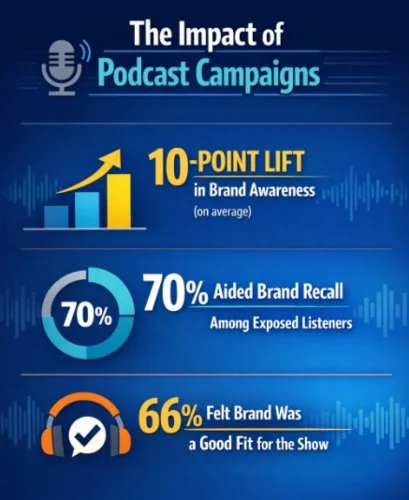
What this means in practical terms is that podcast ads reach audiences and stick with them. And because podcast ads are usually heard in a focused, uninterrupted environment, listeners retain brand messages at rates that are usually higher than other audio or display channels.
Purchase Intent and Consumer Action
Driving intent and action is central to both performance marketing and brand building. Nielsen’s research shows:
An average 6-point lift in purchase intent after exposure to podcast advertising
High levels of information-seeking behavior, with 62% of exposed listeners indicating intent to learn more
53% saying they’d share the ad with others
These metrics matter because they correlate strongly with important outcomes like search behavior, site visits, and ultimately conversions, even if the initial metric (audio exposure) doesn’t include direct clickListener Trust and Host-Read Impact
One reason podcast ads can be so effective is trust, particularly when hosts are involved. Nielsen’s data finds that listeners respond strongly to host-read messaging:
Host credibility perceptions: 62% describe hosts as likable, 42% as credible, and 39% as relatable
Podcast ad environments are described as authentic and natural by significant segments of listeners
From a performance standpoint, this is huge. It means campaigns that use host-read ads, especially when they’re tied to relevant segments of a show, tend to see stronger recall and engagement than static pre-produced spots.
How Podcast Performance Compares to Other Digital Channels
Accelerated brand lift data points to what many advertisers already feel intuitively: podcast ads can deliver stronger brand and intent lifts than many digital display formats when placed in engaged environments and read by trusted voices.
Podcast Ad Formats and Benchmarks (Host-Read vs Programmatic)
Ad format is one of the most important and most misunderstood variables in podcast advertising performance. While marketers sometimes frame host-read versus programmatic ads as an either-or decision, the data shows that each format plays a distinct role depending on campaign goals, scale requirements, and execution quality.
Host-Read Ads and Listener Trust
One of the clearest advantages of host-read ads is listener trust.
Podcast listeners consistently report higher levels of attention and receptivity when ads are delivered by podcast hosts themselves.
For example, a majority of podcast listeners (55%) say they pay more attention to ads when the host personally reads them, compared to announcer-read or generic audio spots.
This trust is built over repeated exposure to the same voice and show, which makes host-read ads feel more like recommendations than interruptions.
From our perspective at Content Allies, this is why host-read ads tend to perform best in campaigns focused on brand awareness, brand recall, and consideration, especially when hosts are given flexibility to deliver the ad script naturally.
Ad Placement: Pre-Roll, Mid-Roll, and Post-Roll
Placement also plays a meaningful role in performance. People listen longer than ever before, with sources reporting that Americans now spend 773 million hours per week listening to podcasts.
This means mid-roll advertising, which runs when listeners are already invested in the content, can be a really effective way to target audience members who are already deeply immersed in the show.
Pro tip: Pre-roll ads remain effective for early brand exposure, particularly in shorter episodes, while post-roll ads tend to reinforce messaging rather than serve as primary recall drivers.
Why Enterprise Advertisers Combine Formats
The data makes it clear that no single ad format wins in every scenario. Enterprise advertisers increasingly blend host-read mid-rolls for trust and impact with dynamically inserted ads for reach and operational control.
At Content Allies, managing this mix across multiple shows and campaigns is core to our framework. Doing it well requires real operational maturity, from trafficking and QA to creative coordination and reporting.
Measurement and Attribution: Podcast Advertising Statistics That Matter to CMOs
Podcast measurement frustrates a lot of CMOs because it doesn’t behave like click-first media. But the upside is: the industry has been standardizing how measurement works, and we now have solid, primary data on both consumer response and measurement infrastructure.
Measurement Is Standardizing (Slowly, but Measurably)
One hard indicator of standard adoption is the IAB Tech Lab Podcast Measurement Compliance Program. As of the current compliant-company list, there are 31 companies shown as holding an “Open Measurement SDK.”
Podcast ROI Can Show up Outside of Last-click
Edison’s Podcast Consumer 2024 highlights exactly why last-click can undercount podcast impact: listeners frequently take action later.
Edison reports that 46% of weekly podcast listeners have purchased a product or service as a result of hearing an ad on a podcast. That’s a direct, quantifiable “advertising worked” outcome, even when the conversion didn’t come from a click in the moment.
Brand Lift Is a Core Use Case
This is also why brand lift is so central to podcast measurement. On the market mix side, IAB reports that brand-building accounts for 61% of podcast advertising (per IAB’s U.S. Podcast Advertising Revenue Study follow-up).
If the majority of spend is aimed at brand outcomes, then measurement has to include brand awareness, recall, and consideration, not just last-touch conversions.
Multi-Show and Network Campaign Statistics
As podcast advertising matures, serious advertisers are moving beyond one-off sponsorships and toward multi-show and network-level campaigns. The data on listener behavior explains why this shift is happening.
Podcast Listeners Don’t Listen to Just One Show
According to Edison Research, listeners tune into an average of 8.3 episodes per week, which suggests they’re listening to multiple shows and even different genres.
This matters for advertisers because it changes how reach and frequency are achieved.
Buying a single show may deliver depth with a specific audience, but multi-show campaigns are how brands build frequency and reinforce messaging across a listener’s broader podcast diet.
How Many Podcasts Are Actually Active?
According to Podcast Index, which maintains an open, feed-level index of the podcast ecosystem, there are over 4.5 millions of podcast feeds indexed globally, but only a fraction are considered active, based on recent publishing activity.
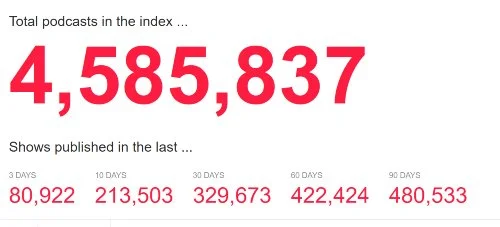
Podcast Index defines “active” podcasts as those that have released an episode within a recent time window, and their stats consistently show that active feeds number in the hundreds of thousands, not the millions.
Listen Notes, which operates its own large-scale podcast database, reaches a similar conclusion. While the two sources differ in exact counts, they agree on the underlying takeaway: consistent, ongoing podcast production is rare.
Why This Matters for Advertisers
From an advertising perspective, this has major implications. A single podcast, even a strong one, has natural limits like:
Finite episode output
Fixed audience size
Limited ability to build frequency quickly
This is why enterprise advertisers increasingly move toward multi-show and network-level campaigns. By spreading spend across multiple active shows, brands can:
Achieve reach faster
Build frequency without overexposing a single audience
Maintain consistency even when individual shows pause or publish less regularly
The Enterprise Takeaway
It’s clear that podcast audiences live across ecosystems of shows rather than individual feeds. At Content Allies, we design multi-show podcast strategies that reflect this reality by coordinating production, messaging, and measurement across multiple programs.
Why Enterprise Brands Work with Full-Service Podcast Partners
By now, one thing should be clear: podcast advertising works, but only when execution matches the scale of the investment.
Consistency Beats One-Off Wins
Enterprise brands don’t measure success by isolated campaign spikes. They care about repeatable results across quarters, teams, and budgets. That level of consistency comes from systems: standardized production, vetted hosts, and processes that deliver predictable outcomes across campaigns.
At Content Allies, we build those systems for enterprise podcasting intentionally. Our frameworks are designed to support ad-driven podcasts at scale, not just individual sponsorships.
Brand Safety and Compliance
As campaigns expand across multiple shows and platforms, brand safety and compliance become harder to manage. Disclosures, messaging accuracy, and creative consistency all require oversight. This is one of the biggest reasons enterprise teams lean on full-service partners, not to create ads, but to make sure nothing breaks as campaigns grow.
Scalable Production Is a Competitive Advantage
Scaling podcast advertising is about producing more content, coordinating more stakeholders, and maintaining quality across every touchpoint. Without centralized production and trafficking, scale can quickly turn into chaos. This is where experienced partners matter most.
Reporting That Leadership Can Trust
CMOs and finance teams, more than anything, want clarity. Translating podcast performance into metrics that make sense with broader marketing goals is essential for long-term investment. Full-service partners help bridge that gap, turning podcast data into insights that leadership can act on.
Turning Podcast Advertising Statistics into Results
The statistics are clear. Podcast advertising delivers attention, trust, and measurable impact, and it continues to scale as a serious channel for modern marketing teams. But the data also makes something else equally clear: results don’t come from the channel alone. They come from how podcast advertising is executed.
As campaigns grow, success depends less on individual shows and more on factors like consistent production, reliable ad operations, compliant execution, and reporting that leadership teams can trust.
At Content Allies, we specialize in turning podcast advertising strategies into repeatable, scalable programs. We work with enterprise teams to design, produce, and manage ad-driven podcasts and multi-show campaigns that deliver consistent performance without making things needlessly complicated.
Get in touch with us if you’re ready to move beyond test budgets and one-off sponsorships and start treating podcast advertising like the enterprise channel it’s become.
FAQ: Podcast Advertising Statistics
What are the most important podcast advertising statistics for marketers?
The most important Podcast Statistics for marketers include podcast downloads, listener demographics, household income, ad revenue, and advertiser ROI, since these metrics show how podcast ad spending translates into real business impact across podcast episodes.
How effective is podcast advertising compared to other digital channels?
Podcast advertising delivers a strong return on investment because it combines influencer marketing dynamics with high listener trust. This makes it effective for brand awareness and advertiser ROI compared to more saturated digital channels.
What CPMs and advertising rates should advertisers expect for podcast ads?
Podcast advertising rates vary widely based on campaign type, audience quality, and show consistency, with CPMs reflecting how ad spending supports brand safety, predictability, and long-term ad revenue rather than cheap impressions.
How is podcast advertising measured and attributed?
Podcast advertising is measured using brand lift studies, promo codes, dynamic ad insertion tracking, and cross-channel analysis, since podcast ads usually influence behavior beyond last-click attribution.
Which podcast ad formats perform best?
Host-read podcast sponsorships tend to perform well due to influencer-style trust, while dynamic ads and dynamically inserted ads enable scale across podcast platforms like Apple Podcasts and other major streaming environments.
Can podcast advertising scale for enterprise brands?
Yes, enterprise brands scale podcast marketing by running campaigns across multiple podcast episodes and shows, using network strategies that increase reach, frequency, and advertiser ROI without overexposing a single audience.
How do listener demographics affect podcast advertising performance?
Listener demographics, including household income, education level, and purchasing authority, directly influence campaign performance and help advertisers align podcast ad spending with high-value audiences.
How do video podcasts impact podcast advertising strategies?
Video podcasts expand advertising opportunities by increasing visibility across platforms like YouTube while still contributing to podcast downloads and audio ad revenue within the broader podcast industry.
How does Content Allies support ad-driven podcast strategies?
Content Allies helps brands turn podcast marketing into a repeatable growth channel by managing podcast sponsorships, ad operations, production, and measurement across multiple campaign types.
Can Content Allies manage multi-show podcast advertising campaigns?
Yes. Content Allies specializes in coordinating ad spending, dynamic ad insertion, and reporting across multiple shows and podcast platforms to support enterprise-scale podcast advertising.
What makes Content Allies different from traditional podcast production companies?
Unlike traditional producers, Content Allies focuses on advertiser ROI by combining creative production with podcast advertising strategy, compliance, and performance reporting designed for brands investing seriously in the podcast industry.