
How B2B Podcasts Get Found in AI Search: A Searchable Video Strategy
It’s not just regular folks who are turning to Artificial Intelligence (AI) for answers. B2B buyers are increasingly using generative AI to find solutions. Forrester reported in January 2026 that 94% of B2B buyers now use AI during the buying process. In fact, conversational search has become a more important source of information than traditional vendor-controlled channels.
And one of the most underrated assets for dominating AI search is a B2B podcast. If you already have a podcast associated with your B2B brand, especially a video one, you have a massive opportunity to earn AI citations and referrals through it.
But the trick is to make your B2B podcast more searchable for AI models. A strong B2B podcast AI search strategy turns each episode into searchable video, episode blogs, detailed show notes, video clips, landing pages, and properly structured metadata.
This guide will help you do exactly that. If you want to take a ’done-for-you’ approach, you can work with a qualified podcast promotion company.
But first, let’s talk about AI search and its role in B2B marketing as a whole.
Why AI Search Is Super Important for B2B Marketing
The simplest reason AI Search matters for B2B marketing is that buyer research is moving upstream into AI-powered interfaces.
Before a prospect visits your landing page, fills out a form, talks to the sales team, or even searches your brand name, they may already have asked ChatGPT or Claude what solutions exist and which vendors are worth considering.
That creates three big changes for marketers:
Discovery is becoming AI-mediated. Buyers can get a shortlist of vendors without having to scroll through traditional search engine results pages.
Zero-click research is growing. An answer engine can summarize multiple credible sources without requiring the buyer to visit each website. 72% of B2B buyers are encountering AI overviews, according to Trust Radius.
Content visibility now affects whether you enter the consideration set at all. If AI tools can’t find, understand, or validate your expertise, competitors with stronger digital footprints may be recommended instead.
All this is making answer engine optimization (AEO) a necessary part of B2B content marketing.
And B2B marketers are already heeding this trend.
10Fold’s recent study found that 52% of B2B tech marketers consider AI search and answer engines as their top content priority.
Podcasts are increasingly part of that AI-mediated discovery layer.
A growing share of Search Assistants pull directly from podcast transcripts and YouTube episode content when compiling an answer, treating spoken expert commentary as source material the same way they’d treat a blog post or product page.
Consider a B2B SaaS buyer researching customer success strategy.
Instead of searching Google for "customer success best practices" and sorting through articles, they can ask a Search Assistant: "What are B2B leaders saying about reducing churn through customer success right now?"
Generative AI search can pull from podcast transcripts, YouTube episodes, show notes, and quoted guest commentary alongside written content, then present a synthesized response within seconds. A podcast that never cracked page one of Google can still be the source cited in that answer, gaining visibility before the buyer ever visits a website or downloads an episode.
How Does a B2B Podcast Play a Role in AI Search-Led Discovery?
A B2B podcast can play an important role in making the brand more visible in AI search results because they establish your brand’s authority in the subject matter. Since large language models (LLMs) powering most mainstream AI platforms today can parse audio transcripts and videos, they can extract meaningful information from podcasts and cite them as sources in overviews and answers.
Unfortunately, many content marketers don’t prioritize B2B podcasts when they are pitching AI search optimization to leadership. That’s a mistake because B2B podcasts are exactly the kind of content that LLMs are looking for.
Mimi Turner, Head of Marketplace Innovation at LinkedIn, argues that the content that drives buyability for B2B buyers is the same content that powers LLM discoverability.
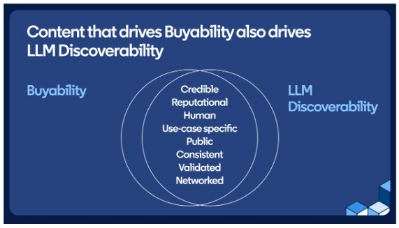
Source: LinkedIn
And we believe a B2B podcast meets the buyability requirements:
A good B2B podcast is essentially a library of expert answers. Every episode may contain explanations of industry problems, customer challenges, buying criteria, implementation advice, comparisons, predictions, and first-hand experience.
Those are exactly the kinds of questions potential buyers are now putting into ChatGPT, Perplexity, Google AI Overview, and other answer engines.
Why Video Makes B2B Podcasts More Searchable
Audio-only podcasts can build loyal audiences, but video gives each episode a much larger discovery footprint. Instead of depending mainly on Spotify, Apple Podcasts, and podcast directories, a video podcast can become searchable across YouTube, Google Search, video results, and increasingly AI-powered discovery experiences.
Let’s dive in:
YouTube Is a Search Engine and a Content Source
YouTube gives a B2B podcast access to both search behavior and recommendation-driven discovery. YouTube says its search and recommendation systems are a major way audiences discover new shows.
But in the context of AI search, YouTube is becoming the most influential playground. In a 2025 Semrush study, YouTube was among the top five most-cited domains by LLMs. That means podcasts and their clips posted on YouTube can be cited by AI models to support answers.
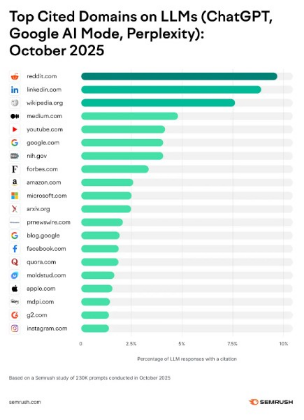
Source: Semrush
And don’t forget, YouTube itself is a search engine. In 2026, YouTube introduced Ask YouTube, a conversational search experience that can interpret complex questions, find relevant videos across YouTube’s catalog, and synthesize them into a structured response.
Video Creates More Context for Search Engines and AI
Video also creates a richer set of signals around what an episode actually contains. A well-published YouTube podcast can include a descriptive title, a detailed description, captions or a transcript, chapters, timestamps, speaker information, links, and other metadata related to the conversation.
Google can also identify key moments within videos and surface links directly to relevant segments. Creators can reinforce those signals by adding labeled timestamps to their YouTube descriptions.
That means a 45-minute podcast does not have to function as one indivisible piece of content. A five-minute discussion about reducing SaaS churn, for example, can become a clearly labeled section that aligns with a very specific search query.
Video Expands the Number of Searchable Assets
Most importantly, video dramatically expands what can be created from one podcast recording. A single episode can produce the full YouTube video, several topic-specific video clips, YouTube Shorts, an embedded video on an episode landing page, a transcript, detailed show notes, and LinkedIn clips.
That just creates more searchable content that can appear in Google search results and be cited in AI search results. Instead of a single audio episode per piece of content, video turns the podcast into a searchable content portfolio with many more opportunities to earn search rankings and AI visibility.
How to Make Your B2B Video Podcast More AI Search-Friendly?
Making a video podcast more visible in AI search means making each episode easier to understand, retrieve, and validate. Search engines and answer engines need clear signals around what the episode covers, who is speaking, which questions are answered, and where supporting information can be found.
So it’s not about chasing a new algorithm each month; your podcast should remain a podcast, after all.
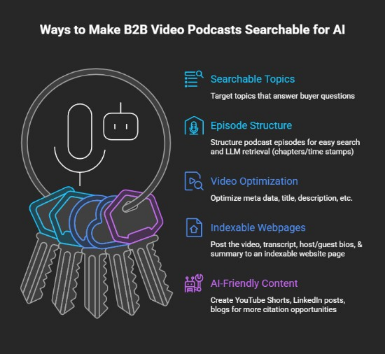
When planning, shooting, and publishing podcast content online, you can take a more strategic approach to better cater to AI models, without necessarily making it the sole goal.
Here’s how we go about doing that at Content Allies:
Start With Searchable Podcast Topics
When planning B2B podcast episodes, cover topics that are similar to what your potential buyers and audience are searching for. If an episode is built around a vague theme, it may be interesting to existing listeners but difficult for search engines and answer engines to connect with a specific query.
There are two ways to make your podcasts more interesting for AI search engines, too, and by extension, the users you’re trying to target:
Build Episodes Around Questions Your Buyers Actually Ask
Start with the questions your B2B buyers are already asking at different stages of the journey. That might include broad questions such as “What is account-based marketing?” as well as high-intent questions like “How should a B2B SaaS company measure marketing-sourced pipeline?” or “When should we replace our current customer success platform?”
Do the research using sources such as YouTube, Reddit, LinkedIn discussions, sales team feedback, and customer success conversations.
Framing episodes around these questions gives the content a clearer relationship to organic and conversational search.
Use Subject-Matter Experts to Add Information AI Can Cite
Bring in subject-matter experts who can add original experience, concrete examples, data, frameworks, customer lessons, or informed opinions that make the episode a more credible source. For example, a sales leader might explain how their team qualifies target accounts.
These first-hand insights strengthen content validation by giving search engines and generative AI systems something specific and attributable to work with. When those insights are captured in video, transcripts, show notes, and supporting pages, they are more likely to become useful source material for AI-generated search answers.
Structure Podcast Episodes for Search and AI Retrieval
AI tools are more likely to retrieve useful information when an episode contains clear answers, distinct topic segments, and language that makes the meaning obvious without requiring too much surrounding context.
Don’t be too rigid about the structure or the flow of conversations. But keep AI retrieval in mind when creating the podcast script or uploading the video on YouTube. Here are some suggestions:
Answer the main question early: Give a concise answer near the beginning, then use the rest of the conversation to add nuance, examples, objections, and supporting evidence.
Break the conversation into clearly defined sections: Structure the episode around clear subtopics. These divisions can later become YouTube chapters, timestamps, clips, headings in show notes, and sections on the episode landing page, giving search engines and answer engines multiple precise retrieval points.
Include quotable, self-Contained answers: Encourage hosts and guests to occasionally summarize important points in complete, standalone statements. These concise statements can also be reused in video clips, LinkedIn posts, episode blogs, and landing pages, creating consistent signals across the broader content system.
Optimize the Full Video Episode for Search
Once the episode is published on YouTube, optimize the full video as a searchable asset. The surrounding metadata helps YouTube, Google, and other AI Search systems understand what the episode covers and when it may be relevant.
Write a search-friendly video title: Use a title that clearly reflects the main question or topic buyers are likely to search for. Keep it specific and descriptive, like “How B2B SaaS Companies Measure Marketing-Sourced Pipeline.”
Create a detailed YouTube description: Summarize the key topics, questions, guests, and takeaways from the episode in natural language. A strong description gives search engines additional context and can include relevant terms (without keyword stuffing).
Add chapters and timestamps: Break long episodes into clearly labeled sections so viewers and search engines can identify where individual topics are discussed.
Upload accurate captions and transcripts: Captions make spoken content available in text, improving accessibility and giving search and AI systems a clearer record of what was actually said. Review automated transcripts for errors.
Link to supporting resources and related content: Use the description to connect the video with relevant episode blogs, research, landing pages, customer stories, related podcast episodes, and other credible sources.
Turn Every Podcast Episode Into an Indexable Webpage
Perhaps the cleanest way to make a B2B podcast episode easier for AI models to search and cite is to have a dedicated indexable page on your company or podcast website. That page provides search engines with a clear URL to crawl and AI tools with a structured, text-based version of the conversation that’s easier to retrieve than audio alone or even video.
At minimum, include:
An embedded video
A concise episode summary
Guest and host information
Full transcript (or key takeaways)
Links to any resources mentioned during the discussion.
The page should also be organized around the questions and topics covered in the episode. Use descriptive headings, break the transcript or summary into logical sections, and surface the most useful answers.
Pro Tip: Need help with full transcriptions? Check out the top transcription services for enterprises.
Repurpose Episodes Into AI-Search-Friendly Content
A full podcast episode can answer dozens of buyer questions, so don’t leave all of that value inside one 45- or 60-minute video.
Break each episode into smaller, topic-specific assets that can target different search queries and stages of the buying journey.
One conversation can become short YouTube clips, LinkedIn posts, episode blogs, and quote graphics built around individual questions or insights.
The key is to repurpose around topics and search intent. This approach also gives answer engines and your target buyers more formats and sources through which to discover your content.
How to Measure AI Search Visibility for Your B2B Podcast?
Measuring AI search visibility for your podcast comes down to three steps: track when and where your content gets cited across AI platforms, compare that visibility against competitors, and connect any resulting traffic back to leads and conversions. Here’s how to do each.
1. Set Up AI Citation Tracking Across Your Podcast Assets
Start by monitoring whether your podcast content (YouTube episodes, transcripts, web pages, blog posts, and show notes) is being surfaced or cited in AI overviews and chatbot answers. Tools such as Ahrefs Brand Radar and Semrush’s AI Visibility Toolkit can track brand mentions across platforms like ChatGPT, Gemini, Google AI, and Perplexity, so you’re not manually checking each one.
2. Benchmark Your AI Share of Voice Against Competitors
Once citations are being tracked, compare how often your podcast shows up in AI-generated answers relative to competing shows or brands in your space. Ahrefs Brand Radar reports this as an AI share of voice metric, which tells you whether you’re gaining or losing ground in AI-mediated discovery.
3. Connect AI-Driven Visibility to Actual Traffic and Leads
Citations alone don’t confirm business impact, so the next step is tying visibility to measurable outcomes. In Google Analytics 4, use Traffic Acquisition reports to segment sessions by source and medium, which shows you when visits are arriving via AI tools or overview links rather than traditional search.
4. Prioritize Conversion Data Over Mention Volume
Finally, weigh the results with the right priority in mind: a spike in AI mentions is a visibility signal, but session data tied to actual clicks, form fills, or downloads is what tells you whether that visibility is generating pipeline.
Track both, but let conversion data drive decisions about where to invest next.
From Podcast Production to Searchable Content Engine
The biggest opportunity with B2B podcast AI search is to make it part of the foundation of a searchable B2B content system. The insights, case studies, examples, and expert conversations can translate into answers AI models give to people (ideally your buyers).
Of course, a B2B podcast isn’t the primary tool for AEO, nor is AEO the objective of the podcast. But both can reinforce one another. A podcast episode and related content can help increase AI search visibility, and AI citations can bring more viewers to the podcast.
Done consistently, a B2B podcast becomes more than a brand-building channel: it becomes a growing knowledge base that gives Google, ChatGPT, Perplexity, and other answer engines more opportunities to discover, validate, and surface your expertise when potential customers are actively looking for answers.
When you work with Content Allies for your B2B podcast promotion, AI discovery is a key component of our SEO services. Through episode structuring, metadata, and content repurposing, we strategically create opportunities for AI-led discovery for the podcast and the brand behind it.
Contact us to discuss how we can make your B2B podcast AI-searchable.
FAQ
How do I get my business to show up in AI search?
Start with the same fundamentals that support strong SEO: make your content crawlable, indexable, useful, specific, and easy to understand. Create quality conversational content that’s easy for LLMs to understand.
Do LLMs cite podcasts in their answers?
Yes, but usually through the legible, viewable, and searchable assets around the podcast. ChatGPT Search can cite web sources, and AI systems can surface podcast episode pages, transcripts, show notes, YouTube videos, or articles derived from podcast conversations.
Can audio podcasts be found in AI search?
They can, if they’re publicly available, but audio-only podcasts generally have fewer searchable signals than video podcasts, which are supported by transcripts, episode pages, and optimized metadata.
How can Content Allies improve my B2B podcast’s visibility?
Content Allies can help turn a podcast into a broader distribution and search system through content repurposing (dedicated web pages, transcripts, short clips, optimized YouTube episodes, and articles). Its services include podcast promotion and SEO, including optimization for AI referrals and citations.