
YouTube Channel Management for B2B Brands: Agency vs. In-House
YouTube may just be the most underrated marketing channel in the B2B world. It has a massive audience, it’s central to search, and it’s a great place to upload educational content, founder insights, webinars, and, of course, a B2B podcast, if you have one.
We already know that video works great. In a 2026 WyzOwl survey, 82% of marketers reported that video marketing delivered a good return on investment (ROI).
But the problem for B2B companies, especially small and medium enterprises (SMEs) and startups, is that maintaining an active YouTube channel requires significant effort. Creating and posting videos, short and long, on a platform like YouTube needs a dedicated team.
That’s where the question arises: should you manage your B2B YouTube channel in-house or hire a B2B YouTube management agency?
Here, we make the case for an active B2B YouTube channel and help you compare managing that channel in-house vs. working with an agency, so you can pick the right lane for you.
Also, check out our guide on the best YouTube marketing agencies to find the best options for all sorts of YouTube goals like running ads, content creation, and organic channel growth.
YouTube Is An Underrated B2B Pipeline Channel
B2B marketers see YouTube as a brand awareness or content-hosting channel, while allocating most of their demand-generation budget to Google Ads, LinkedIn, and other performance channels. But buyer behavior suggests YouTube deserves a bigger role.
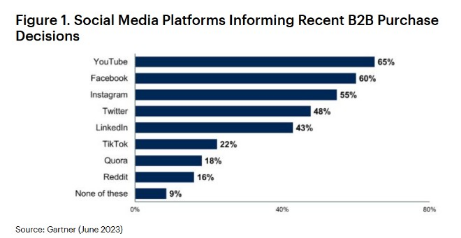
Gartner in 2023 reported that 65% of B2B buyers were influenced by YouTube during a recent purchase decision. In fact, Gartner labeled YouTube the leading platform for informing B2B purchase decisions. That even goes against the consensus that LinkedIn is the most important platform for buyers.
Google and Bain research found that 92% of B2B buyers already have a shortlist of preferred vendors before they formally begin the buying process. That makes early brand visibility especially important. And that’s where having a presence on YouTube can make a difference.
But there’s an even more important vector now in this whole B2B and YouTube scenario, and that’s search, both regular and AI. YouTube videos have been featured in search engine result pages (SERPs) for a while now. And LLMs are also increasingly turning to YouTube to search for answers. That means a new way to build authority, generate demand, and attract leads.
YouTube can also support buyers deeper in the funnel. There’s so much a B2B brand can do with a YouTube channel:
Build searchable educational content around industry problems
Publish product demos and webinars for active evaluators
Use customer stories to establish proof
Repurpose podcasts or interviews with industry thought leaders
All that content, one way or the other, feeds into the pipeline. But the opportunity doesn’t necessarily end when a deal closes. YouTube can help customers discover new use cases or get more value from a product after purchase. In one survey, 44% of B2B customers reported using YouTube post-purchase to find more information.
B2B companies with long sales cycles and complex products may find YouTube particularly useful across the full funnel: generating awareness, educating prospects, supporting sales conversations, strengthening customer relationships, and creating content assets that continue to attract relevant viewership over time.
How B2B YouTube Channel Management Differs From B2C
Before you decide whether to run your B2B or SaaS YouTube channel in-house or through a YouTube agency, you should understand that B2B content is different. Here’s how:
Longer content shelf life: B2B content such as webinars, demos, and explainer videos typically has a longer shelf life. They’re not about getting views or going viral, but about providing specific, useful information for years to come.
Smaller, more targeted audience: Unlike a regular YouTube channel that probably pushes out multiple videos per week, you only need to target a specific audience with high-quality content. Volume doesn’t matter here that much.
Content tied closely to sales enablement and product marketing: Most of your content should be product-focused, whether that’s tutorials, demos, or discussions by a panel of experts. After all, that’s what the buyers and users are interested in. Plus, that content doubles as sales enablement material.
Slower feedback loops: Don’t expect the same speed of results from your B2B YouTube channel as you would from paid advertising or account-based marketing. In fact, immediate engagement might be low. You should measure and focus on pipeline impact, which may take months to show up.
What Good B2B YouTube Channel Management Involves
Good B2B YouTube channel management covers six core areas: strategy and content planning, video production, YouTube SEO, publishing and channel operations, distribution and promotion, and analytics and performance optimization.
Good, effective B2B YouTube management produces results, making it a more strategic role. This is what you’re looking for:
YouTube Strategy and Content Planning
The foundation is a clear content strategy tied to business objectives. That means the steps are:
Defining target audiences
Conducting audience research
Mapping topics to the buyer journey
Building a content calendar around those themes
For B2B brands, this should also include full-funnel content mapping and buyer intent keyword research. Some videos may be designed to increase brand awareness, while others target prospects closer to a decision and support demand generation or lead generation.
A sustainable strategy also has a realistic content cadence, so the team can publish consistently without sacrificing quality.
Video Production
This is probably the area where most internal teams struggle. Production covers everything needed to turn an idea into a publishable video, including concept development, script writing, filming, artwork, video editing, graphics, and thumbnail design.
Of course, the required level of production varies by format.
A brand film or flagship customer story may need cinematic production quality and extensive creative support, while a podcast clip, webinar, or educational video may work better with a simpler Video Creation Pipeline
Artificial Intelligence (AI) has made it easier to create content, but you want to be intentional with it. AI-generated motion graphics can work for tutorials and explainers, but deeper topics like product benefits or industry trends should have the human element.
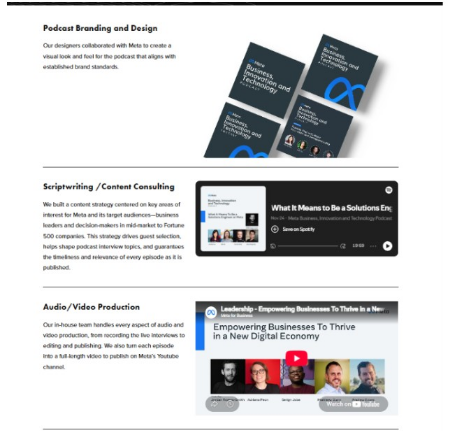
Content Allies' work with Meta shows what this looks like at scale: the team built a content strategy around topics relevant to business leaders and decision-makers, then handled the full production pipeline (recording, editing, and publishing) for a podcast that also gets turned into full-length video episodes for Meta's YouTube channel.
The results: roughly 170,000 downloads in the first six months of the partnership, exceeding Meta's initial download target by 7x.
YouTube SEO and Discoverability
YouTube is both a content platform and a search engine (the second-largest), so discoverability needs to be built into the process.
YouTube SEO typically includes:
Keyword strategy
Optimized video titles and metadata
Descriptions
Playlists
Chapters
Thumbnails
Strong video SEO can also improve visibility in Google search results and increasingly in AI search experiences that surface video content.
Publishing and Channel Operations
Publishing involves much more than pressing the upload button. Channel management services can include scheduling videos, uploading metadata, creating playlists, adding captions, organizing channel pages, maintaining consistent branding across thumbnails and artwork, and adding end screens with CTAs, such as channel subscription call-outs.
Ongoing content management also includes community management: responding to comments, maintaining brand safety, and monitoring subscriber growth.
These operational details help create a more consistent experience for viewers and make it easier for the channel to grow over time.
Distribution and Promotion
Distribution may include sharing videos across social media, email, sales enablement channels, websites, newsletters, and cross-channel promotional campaigns.
And if you want to go all out, you could promote the channel and its videos via YouTube Ads or Google Ads.
For B2B clients, distribution should ultimately support measurable business goals rather than simply maximizing views.
Note: Not all YouTube channel management services have paid media expertise. If you’re planning to run YouTube ads, make sure to select an agency that has experience with YouTube campaigns in addition to content production and channel management.
Analytics and Performance Optimization
A strong YouTube management process uses analytics to improve future content.
Core YouTube metrics are:
Watch time
Audience retention
Click-through rate
Subscriber growth
Traffic sources
Viewership
YouTube search performance (ranking and impressions for relevant keywords)
More advanced B2B teams may connect YouTube analytics tools with CRM and advertising data to track brand KPIs, revenue attribution, booked meetings, branded search, and other pipeline indicators.
Campaign monitoring and reporting can then identify which topics, formats, thumbnails, and distribution tactics are working.
This creates a data-driven optimization loop: publish, measure, learn, and adjust.
Agency vs. In-House B2B YouTube Channel Management
Choosing an agency or in-house for B2B YouTube channel management comes down to this: in-house works best when internal capabilities are already there; an agency works best when you want to scale output and reduce the operational burden on your marketing team.
Let’s review your options in more detail:
The Case for In-House Management of Your B2B YouTube Channel
Managing YouTube internally may make sense for B2B brands with strong content, creative, and video capabilities already in place. In other words, a company that already has a sizable creative department with video production expertise.
Let’s look at the advantages and shortcomings of this approach:
Advantages of an In-House YouTube Team
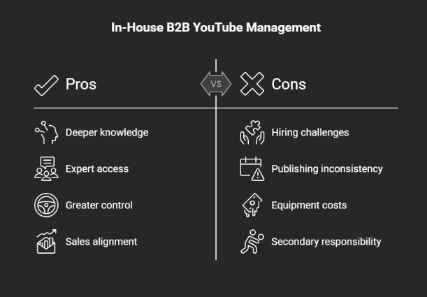
Deeper product and industry knowledge: Internal marketers generally understand the product, competitive landscape, buyer pain points, and sales cycles better than an outside partner initially will.
Easier access to internal subject-matter experts: Product leaders, engineers, executives, salespeople, and customer success teams are easier to involve when production is managed internally.
Greater control over messaging and approvals: An in-house team can maintain close control over brand storytelling, claims, compliance requirements, and brand safety.
Closer alignment with sales, product, and marketing teams: YouTube content can be built directly around campaigns, product launches, customer questions, demand generation priorities, and broader digital marketing initiatives.
Challenges of Managing YouTube In-House
Hiring specialists across multiple disciplines: Effective YouTube channel management can require skills in content strategy, script development, video production, video editing, and SEO. Finding all of those capabilities in one or two hires is difficult.
Maintaining a consistent publishing cadence: Production timelines, internal approvals, and competing priorities can make it difficult to sustain a reliable content cadence.
Production equipment and software costs: Cameras, lighting, audio equipment, editing software, analytics tools, and studio space can increase the true cost of building an internal operation.
YouTube can become a secondary responsibility: One of the biggest risks is assigning YouTube management to an already busy marketing team. Unless you have a separate dedicated YouTube team, your marketing or creative team may struggle with both YouTube and other marketing channels.
The Case for Agency Management
A B2B YouTube channel management agency can be a better fit when a company wants to grow the channel without building an entire video and YouTube function internally. The best agencies combine strategy, creative, production, publishing, optimization, and performance tracking into a single operating model.
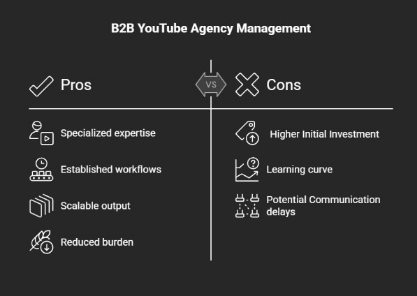
Here’s why this approach works and what it struggles with:
Advantages of Working with an Agency
Immediate access to specialized YouTube expertise: A capable YouTube agency already has people who understand the algorithm, audience retention, thumbnail design, and content performance. As such, they can build personalized, high-performing podcast strategies faster.
Established production and optimization workflows: Agencies typically have a repeatable video-creation pipeline that covers planning, scripting, production, editing, publishing, and performance analysis.
Ability to scale content output: An agency can help increase production for podcasts, webinars, customer stories, educational videos, and campaign content without the brand having to hire additional employees. They have more personal relationships with important names in your industry and can help you build revenue-driving relationships with your audience too. They can also handle content repurposing.
Less operational burden on internal teams: Instead of coordinating with each editor, producer, designer, and analyst individually, the internal marketing team can focus more on strategy, subject-matter expertise, approvals, and business priorities.
At Content Allies, we apply this same approach to our own podcast, Leaders of B2B, publishing three episodes a week and using it to interview both prospects and strategic partners.
The podcast generated over $100K in revenue within the first four months of running the show, and has since become the official sponsor of SaaS Connect through relationships built via the podcast.
Potential Drawbacks of an Agency
Higher external spend: A full-service YouTube management agency can be a significant initial investment.
Learning curve with complex products and audiences: B2B SaaS, technical products, and specialist industries can take time for an external team to fully understand.
Additional communication and approval processes: Content may need to move between agency and internal marketing teams, SMEs, and legal or brand stakeholders before publication.
B2B YouTube Management Cost Comparison: Agency vs. In-House
According to our internal analysis of podcasting costs, producing a B2B podcast in-house is $1,000-$8,000 per month, while hiring a podcast agency is $2,000-$20,000/ month. However, the comparison is not as simple as an agency retainer versus one employee’s salary.
A serious in-house operation may need people covering strategy, video production, editing, design, SEO, publishing, and analytics. An agency typically bundles several of those capabilities into one monthly fee.
Here is a directional comparison for U.S.-based B2B brands:
| Cost Area | In-House Management | Agency Management |
|---|---|---|
| Strategy and channel management | Usually handled by a marketing/content manager or dedicated YouTube lead | Usually included in the monthly retainer |
| Video production and editing | Requires internal staff, freelancers, equipment, and software | May be included or priced separately depending on production volume |
| Thumbnail/design support | Designer or freelance creative required | Commonly included in full-service plans |
| YouTube SEO, publishing, and analytics | Requires internal expertise or additional tools/support | Typically included in Channel Management Services |
| Indicative personnel cost | A three-person U.S. team of a marketing manager, video editor, and graphic designer represents roughly $334,460/year* in median wages, before benefits | Specialized management typically starts at a couple of thousand dollars per month and can go up depending on the scope of services (based on estimated hourly rates for YouTube agencies on Clutch). |
| Paid YouTube Ads | Ad spend and potentially an internal paid-media specialist are additional | Ad management and media spend are generally additional unless explicitly included |
| Scaling output | Usually requires more staff, freelancers, or production capacity | Handled by moving to a larger retainer or production package |
*Based on U.S. Bureau of Labor Statistics 2025 mean annual wages of $177,770 for marketing managers, $86,130 for film and video editors, and $70,560 for graphic designers.
When Should You Manage Your B2B YouTube Channel In-House?
If you meet the following conditions, you should run your B2B YouTube channel internally:
You publish frequently enough to justify a dedicated team
Video is a core component of your marketing strategy
You already have production and creative resources
Your subject matter requires extensive internal expertise
You want maximum control over the entire process
When Should You Hire an Agency to Manage B2B YouTube?
If YouTube is an important part of your B2B strategy (which it should be, in our opinion) and you meet the following conditions, you should hire a dedicated agency for channel management:
Your internal team lacks YouTube-specific expertise (production, editing, video SEO, etc.)
Publishing has been inconsistent (your team can’t make time for YouTube videos or simply repurpose videos meant for other platforms)
You need to increase production volume and get more leads through strategies like ABM
Your videos are not generating sufficient reach, retention, or engagement
You want to build a channel without hiring several specialists internally
What About the Hybrid Approach? When Does That Work?
A hybrid approach to B2B YouTube management is actually quite practical. It basically distributes the responsibilities between internal teams and an agency with more direct collaboration.
A hybrid model retains strategic ownership and subject-matter expertise within the company while engaging a YouTube agency for specialized execution, like video production, publishing, or YouTube ads.
A hybrid approach tends to work especially well when:
You already have a strong internal strategy but limited production capacity. The brand knows what it wants to say, but needs help turning ideas into a consistent stream of high-quality video content.
Your subject matter is highly technical. Internal experts can provide the depth and accuracy, while the agency translates that expertise into scripts, videos, titles, thumbnails, and searchable educational content.
You want to increase production without expanding headcount. An agency can provide the extra production and creative support needed to scale.
You want to keep ownership of the brand and pipeline strategy. Internal teams can define KPIs, target accounts, buyer priorities, and full-funnel content mapping, while the agency manages execution.
You are still proving YouTube as a channel. A hybrid model lets a company test formats, workflows, and the impact on demand before deciding whether to build a larger in-house function.
We actually recommend the hybrid approach because it solves the key issue B2B brands face: production and publishing.
As a B2B podcast agency, we’ve solved the same problem for our clients, but for podcasts specifically. Most SMEs and founders don’t have the time or expertise to create content for a channel like YouTube or actively get involved with the marketing team. And their voices usually matter most to B2B buyers.
When an agency takes over the planning, production, and publishing parts, all they need to do is show up for a short time.
That’s what the Gusto team got for their B2B podcast for demand generation and awareness. The Content Allies team made it easier for Brian Busch, head of marketing, to realize their B2B podcast strategy by supporting the team with production, publishing, and promotion.
How to Choose a B2B YouTube Channel Management Agency
If a dedicated agency for full YouTube channel management for your B2B brand makes strategic sense, this is what you need to do to find the best partner:
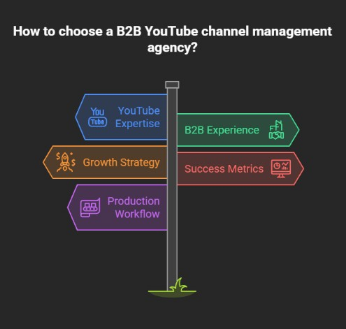
Look for Actual YouTube Expertise
First off, choose an agency that has real YouTube experience, ideally for B2B. Keep in mind that some agencies only handle video production, and some take over advertising. For complete channel management, you need help across the board.
Review Their B2B Experience
B2B YouTube works differently from consumer brand content because the audiences are narrower, products are more complex, and sales cycles are longer.
Ask whether the agency has worked with B2B clients, SaaS companies, professional services firms, or technical brands with similar buyer journeys.
Look at case studies and the actual content they have created for those brands to get an idea of what they’re capable of doing.
Content Allies, for instance, has produced ongoing content for enterprise and technical brands like AWS, Siemens Energy, Cisco, and Zendesk. These are companies with exactly the kind of long sales cycles and technical audiences B2B YouTube channels need to speak to. Plus, we report outcomes like exceeding download targets by 7x (Meta) and converting over 50% of podcast interviews into revenue (Upshift) for our enterprise clients.
Ask About Their Growth Strategy
A strong B2B YouTube channel management agency should be able to explain how it plans to grow both discoverability and meaningful viewership. In other words, they should excel at content strategy development, content promotion, and performance monitoring.
And their proposed growth strategy should be tied to your business goals.
Understand How They Measure Success
Views and subscribers matter, but they are rarely sufficient B2B success metrics on their own.
Ask how the agency measures metrics like watch time, audience retention, YouTube search keyword rankings, branded search, content performance, engagement, website traffic, booked meetings, and the number of generated leads.
Evaluate Their Production Workflow
Finally, understand how the work actually gets produced.
Ask about the production and editing workflow, design, distribution, content repurposing for other platforms, and reporting.
The best workflow should make it easy for internal SMEs to contribute without creating excessive meetings or approval bottlenecks. And it should produce a decent volume of content to be actively distributed on the YouTube channel, YouTube Shorts, and even other platforms like Meta and LinkedIn.
Don’t Sit on YouTube for B2B
YouTube is a crucial platform for B2B companies, considering its role in discovery and buyer research. Good quality content shared on the brand channel can work on so many levels: create brand awareness, answer product questions, share expert knowledge, and build a community.
And one of the best ways to leverage YouTube for B2B is through a podcast. A B2B video podcast basically brings together everything you need for a solid YouTube-focused pipeline strategy.
Podcast episodes can focus on the challenges your offering tackles, success stories with past clients, or just chit-chat with industry experts. Plus, one podcast episode can turn into multiple YouTube Shorts.
This is where Content Allies can help as a B2B podcast expert with a strong focus on YouTube. If you want a podcast-led YouTube channel for your B2B brand, our team can handle the conceptualization, production, promotion, and publishing.
In addition to podcasts, Content Allies can handle video production for YouTube, such as explainer videos and branded content, through its partner agency network (Fieldtrip).
Schedule a meeting to discuss YouTube strategy for your B2B company.
FAQ
What type of videos work best for a B2B YouTube channel?
The best videos for a B2B YouTube channel are educational tutorials, product demonstrations, customer case studies, expert interviews, webinars, and industry explainers. Match each video to the buyer journey, from educational content for awareness to case studies and demos for purchase decisions.
How much does YouTube channel management cost?
Full-service YouTube channel management typically starts at a few thousand dollars per month and can go upwards of $10,000, especially if heavy production services are required. Basic management may cost less but wouldn’t include video production, only editing, publishing, and SEO.
What services can an agency offer for a B2B YouTube channel?
Depending on the agency’s specialization and scope, you can get services such as video planning and production, organic channel growth, paid promotion, and complete channel management.
How to incorporate YouTube videos into B2B marketing?
The most effective way to use YouTube in your B2B marketing strategy is to make and share videos for each stage of the buyer journey. You can also embed educational videos in blog posts and landing pages, distribute them through email and social media, and give product demos and case studies to sales teams.