
Podcast vs. YouTube: Where Should B2B Brands Invest Their Content Budget First?
Podcasts and YouTube can both help B2B brands turn internal expertise into content that attracts the right audience. They can support thought leadership, generate leads, and give your team material to repurpose across email, social media, and your company blog.
The challenge comes when your budget cannot support both from day one.
B2B marketers are already investing in each format. In 2025, the Content Marketing Institute found that 27% of B2B marketers used podcasts as a distribution channel, while 31% increased their use of YouTube over the previous year.
So, which one deserves your content budget first?
If you’re choosing between an audio podcast and a YouTube channel, we’ll compare both in detail to help you decide where your budget should go first. We’ll also share practical ways to use both formats without significantly increasing your content spend.
Podcast or YouTube Channel First? A Short Answer for B2B
For many B2B brands, YouTube is the stronger first investment when discoverability, search visibility, visual education, and content longevity matter most. It works particularly well when buyers need product demonstrations, tutorials, explainers, or other visual content before moving further through the customer journey.
A B2B podcast can be the stronger first investment when the priority is executive thought leadership, relationship building, niche industry conversations, and staying relevant throughout a long or complex sales cycle.
You can also build the two formats around the same core content. For interview-led or thought leadership content, record each conversation on video, publish the full video on YouTube, and distribute the audio through podcast platforms. This gives you a video podcast while allowing each channel to match different audience habits without requiring two separate content programs.
Quick Comparison: B2B Podcast vs. YouTube
| Factor | B2B podcast | YouTube |
|---|---|---|
| Best for | Thought leadership, expert conversations, networking, and long sales cycles | Search visibility, visual education, demonstrations, and tutorials |
| Primary audience behavior | Listening to longer conversations and industry insights | Searching for answers, watching educational videos, or discovering content through recommendations |
| Discovery potential | Moderate, with discovery coming from podcast platforms, guests, search, and promotion | Strong, with discovery through YouTube search, recommendations, Google Search, and Shorts |
| Relationship building | Strong for interviews, guest relationships, and recurring expert conversations | Strong when the format features experts, interviews, recurring series, or community interaction |
| Search visibility | More limited, although transcripts and supporting pages can help | Strong when videos target relevant search intent and are properly optimized |
| Production complexity | Low to moderate for audio-only shows, but higher when video and guest production are added | Moderate to high depending on filming, editing, graphics, and format |
| Content lifespan | Can remain relevant for months or years when topics are evergreen | Can remain discoverable for months or years, particularly for tutorials, demos, and educational content |
| Lead generation potential | Strong when episodes reach a relevant niche audience and support a clear conversion path | Strong when videos address buyer questions and direct viewers toward the next step |
| Executive thought leadership | Well suited to in-depth conversations, interviews, and expert commentary | Well suited to explainers, interviews, presentations, and expert-led video |
| Repurposing potential | Strong, with episodes supporting clips, articles, newsletters, quotes, and social content | Strong, with long-form videos supporting Shorts, clips, articles, email, and social content |
| Measurement | Downloads, subscribers, consumption or completion data, website visits, and lead actions | Views, subscribers, watch time, traffic, conversions, and search performance |
| Time to see results | Usually requires consistent publishing and audience development | Varies by search demand, topic quality, distribution, and publishing consistency |
Podcast vs. YouTube for B2B Brands: More Detailed Comparison
The biggest difference between a podcast and a YouTube channel for a B2B brand isn't simply audio versus video. Each platform shapes how people discover content, how much attention they give it, how a marketing team produces it, and how easily that attention connects to leads and pipeline.
Let’s look more closely at the differences that matter when deciding where to invest your content budget.

1. Audience Behavior and Intent
The way people consume podcasts and YouTube content is quite different. That matters because audience behavior affects how long people stay engaged, what type of information they are ready to absorb, and how close they may be to taking the next step.
Podcast Has Passive but High-Attention Listening
Podcast audiences typically consume content while commuting, exercising, traveling, or completing other tasks. This makes podcasting well suited to long-form conversations that do not require constant visual attention.
For B2B brands, this can be useful when the goal is to build familiarity and trust over time. A listener who spends 30 or 45 minutes hearing an executive, customer, or industry expert discuss a topic may develop a stronger relationship with the brand than someone who encounters a short social post.
YouTube Is More Active and Intent-Driven Viewing
YouTube audiences are obviously more visually engaged. People visit the platform to answer a question, learn a skill, research products, watch demonstrations, or understand a complex topic, besides entertainment, of course.
This active behavior creates strong opportunities for B2B brands producing educational video content.
For example, a prospect may search for a software comparison, implementation guide, or industry explanation. That’s high intent that can translate into conversions.
2. Discovery and Platform Algorithms
Creating strong content is only part of the equation. You also need to consider how people will find it, since podcasts and YouTube rely on very different discovery systems.
Podcast Discovery Requires More Active Distribution
Podcast discovery, particularly for audio-only podcasts, happens through Spotify, Apple Podcasts, YouTube Podcasts, and other podcast apps. This gives you access to people who already consume podcasts, but reaching new listeners usually requires additional promotion outside those platforms.
Guest promotion, social media, email, your website, and word of mouth can all help introduce episodes to a wider audience. A clear distribution strategy becomes important because podcast platforms may provide less organic discovery than YouTube.
This is also where podcast promotion services can support distribution and audience growth.
YouTube Has Stronger Built-In Discovery
YouTube has a major advantage in algorithmic distribution. Its recommendation algorithm can surface videos on the homepage, alongside related videos, through Shorts, and in search results.
Also, YouTube operates as a video search engine, and its content can appear in Google SERPs.
But strong discovery potential for YouTube videos requires proper titles, descriptions, and thumbnails, which can help a video reach search results and recommendations.
3. Content Format and Depth
The format you choose affects how much detail you can cover and how that information is presented.
Podcast Is Best for Conversation and Nuance
Podcasting naturally supports long-form discussion. Interviews, roundtables, expert conversations, founder stories, and industry analysis can all work well in this format. This gives executives and subject-matter experts room to explain complex ideas in detail.
It can also make the content feel less scripted and more conversational, which helps with executive thought leadership and relationship building.
YouTube Supports Visual B2B Use Cases Better
YouTube can support the same long-form depth while adding a visual layer. Beyond conversation, YouTube also supports other B2B use cases that are important for lead generation and nurturing.
Video makes product walkthroughs, dashboards, software demonstrations, charts, presentations, diagrams, physical products, and step-by-step tutorials easier to explain.
You can also mix several formats on one channel, including interviews, webinars, explainers, Shorts, screen recordings, and customer stories. This gives B2B teams more flexibility to match the content format to the topic and the buyer’s needs.
4. Production Requirements and Costs
Your content budget needs to account for more than equipment. Recording, editing, design, guest coordination, and publishing all affect the time and money required to keep either format running consistently.
Podcast Has Lower Barrier to Entry
A basic podcast production setup can be relatively simple. You can launch a podcast for $100-$500.
At minimum, a business needs a good microphone, recording software, reliable audio quality, editing software, a podcast hosting service, and an RSS feed for distribution.
Podcasts usually cost more when video is involved, and you want higher production value. That can add costs like video production equipment, video editing software, and maybe even a professional studio.
YouTube Has More Production Variables
YouTube production costs depend heavily on the type of content you create. A screen recording or simple expert-led video may require relatively little equipment, while product shoots, interviews, and polished branded videos can involve cameras, lighting, locations, set design, graphics, and more extensive editing.
This means a B2B YouTube channel does not automatically require a large production budget. Teams can start with simpler formats such as screen recordings, presentations, webinars, or talking-head videos, then increase production quality as the channel grows.
5. Repurposing Opportunities
Repurposing matters because one strong piece of content can support several channels. The main difference is the type of assets each format gives you to work with after the original episode or video is published.
Audio Podcasts Offer Decent Repurposing Opportunities
A single podcast episode can become much more than an audio file. You can repurpose the conversation into blog articles, LinkedIn posts, email newsletters, quote graphics, and even audiograms for YouTube and other social media.
Video podcasts create even more possibilities because the same recording can generate both audio and video assets.
YouTube Gives You More Visual Repurposing Options
Within the YouTube ecosystem, you can turn a long video into different videos and YouTube Shorts. Similarly, you can share clips from YouTube videos on your LinkedIn and Meta accounts.
In fact, you can also repurpose product-focused videos, demonstrations, webinars, and explainers for sales enablement. This gives sales teams useful content they can share with prospects during different stages of the buying process.
6. Measurement and Pipeline Impact
Both formats give you useful performance data, but the path from content engagement to pipeline looks different. The key is connecting platform metrics with website activity, lead sources, and CRM data.
Podcast Can Generate Strong Relationship and Pipeline Signals
Podcast analytics usually include downloads, listeners, subscriber growth, completion data, and episode performance. These metrics can show whether an audience is growing and engaging. But you need attribution to connect those metrics to the pipeline to see whether leads come through the podcast.
Episode-specific landing pages, trackable links, and a discovery question on the lead form may help connect the podcast to the pipeline.
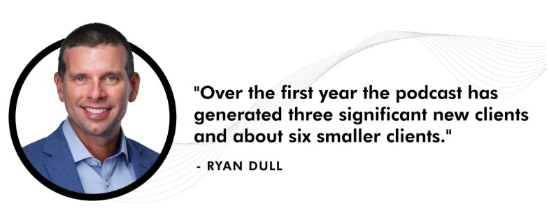
Podcasts can also contribute directly to client acquisition. For example, our client Sagemark attributed nine new clients to its podcast. Through guest outreach, targeted promotion, and production support, our team helped Ryan Dull create episodes designed to reach relevant prospects and strengthen industry relationships.
YouTube Provides More Detailed Behavioral Analytics
YouTube provides extensive analytics around views, viewing time, audience retention, subscribers, traffic sources, impressions, click-through rates, and engagement. These metrics help you understand which topics attract attention, where viewers drop off, and which videos send people to your website.
You can track clicks from video descriptions and connect website behavior with analytics and CRM systems. This makes it easier to identify which videos contribute to website visits, leads, and later-stage actions.
Views and subscriber growth are useful indicators, but they should not be treated as proof of pipeline impact on their own. For B2B teams focused on demand and lead generation, stronger signals include qualified website visits, conversions, lead quality, influenced opportunities, and revenue.
Your YouTube channel is also more likely to contribute to demand generation when the content closely matches the problems, questions, and buying needs of your target audience.
Podcast vs. YouTube: Which Works Better for Different B2B Goals?
The better choice can change depending on the specific outcome your content needs to support. Let’s compare how podcasts and YouTube perform across some of the most common B2B marketing goals.
Creating Brand Awareness
YouTube generally has the advantage when your priority is reaching people who have not encountered your brand before.
Search, recommendations, suggested videos, and Shorts give your content several ways to reach new viewers. This can make YouTube particularly useful for B2B brands trying to expand awareness beyond an existing audience.
A podcast can still be extremely effective for brand awareness, particularly within a narrow industry or professional community. However, awareness is more likely to grow through guests, existing subscribers, and active promotion.
Generating and Influencing Leads
For direct lead generation, YouTube can make the path from content to action easier.
YouTube videos' higher discoverability and visibility make them effective for lead generation (as long as your videos make it easy for potential leads to connect through a call to action and lead form links).
Podcasts influence leads less directly but can have considerable value during a long B2B customer journey. Someone may listen to several episodes before visiting the company's website, subscribing to its email list, contacting sales, or mentioning the business during a buying process.
We’d say one isn’t inherently better than the other for this goal, but in our experience, podcasts work well for B2B companies with complex sales cycles and highly discerning buying committees.
Building Executive Thought Leadership
Podcasting is a clear winner for thought leadership because the format creates the space to share a leader’s acumen and insight.
Long-form interviews give founders, executives, customers, and subject-matter experts enough time to develop an argument, tell stories, discuss industry changes, and demonstrate expertise without reducing every idea to a short sound bite.
Plus, inviting customers, partners, or other industry leaders onto the podcast can also turn the content project into a relationship-building opportunity.
For example, the Disruptive Innovators podcast combined host David Wright’s expertise with conversations featuring more than 60 C-suite executives from the IT industry, with Content Allies supporting guest scheduling.

Educating Buyers About Complex Products
YouTube usually has the clearest advantage when you need to show a product or service. For example:
Software companies can show workflows and interfaces
Manufacturers can show equipment in operation
Professional services firms can visualize frameworks and data
Technology brands can use diagrams, screen recordings, and animations to explain complicated concepts.
And there’s good evidence for prioritizing video within B2B education. Content Marketing Institute research we shared above has ranked video among the formats B2B marketers consider most effective for achieving content marketing results.
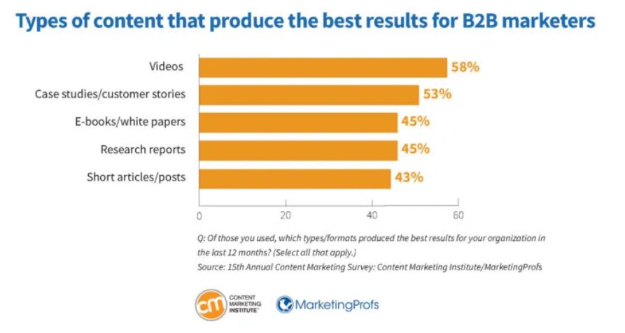
Source: CMI
However, that doesn’t make a podcast unsuitable for complex subjects. In fact, podcasting can be stronger when the complexity comes from ideas.
A cybersecurity executive discussing changing threats, a consultant explaining market dynamics, or a founder unpacking a new business model may benefit more from a 40-minute conversation than a product walkthrough.
How to Decide Where to Put Your B2B Content Budget First: YouTube Channel or Podcast?
If your budget only supports one format right now, use these questions to narrow the choice.
What does the content need to accomplish?
Choose YouTube when discovery, search visibility, visual education, or website traffic are the priority. Choose a podcast when you want to develop executive thought leadership, industry relationships, and deeper engagement with a niche audience.
Does your audience need to see the subject to understand it?
YouTube makes more sense for software walkthroughs, demonstrations, dashboards, diagrams, physical products, and other topics that depend on visuals.
Would long-form conversations support your sales process?
A podcast can be a stronger fit when buyers need time to understand your expertise, point of view, or approach before moving forward.
Which format can your team produce consistently?
Look at your existing skills, equipment, internal experts, editing capacity, and budget. A simpler format your team can publish consistently will usually be more useful than an ambitious format that becomes difficult to maintain.
Choose a podcast first if: your priorities are thought leadership, industry relationships, niche audience engagement, and long-form expert conversations.
Choose YouTube first if: your priorities are discovery, search visibility, visual education, and content that can answer active buyer questions.
Pro tip: You can add the second format later. Start with the one that best matches your audience, content strengths, and business goals, then expand once you have a repeatable production process.
Build Your B2B Podcast with Content Allies
If podcasting is the right starting point for your B2B brand, Content Allies can help you build the full program around it.
We support B2B companies with podcast strategy, production, guest scheduling, organic promotion, advertising, and performance measurement. We can also extend your podcast onto YouTube through video podcast setup and management, YouTube SEO, Shorts, and repurposed content.
That gives you one core content program that can reach listeners, viewers, and prospects across multiple channels without requiring separate production workflows for each one.
FAQs
Is a podcast or YouTube channel cheaper for a B2B brand?
A simple, audio-only podcast can be cheaper to produce than YouTube videos. Costs ultimately depend on available resources and the type of content. A YouTube-centric content strategy may require more production work, which can increase cost.
Which generates more B2B leads: podcasts or YouTube?
While there are no standard benchmarks for either podcasting or YouTube videos for lead generation, both can positively impact the pipeline. Podcasts can be particularly strong for gradual, long-cycle lead generation that requires thought leadership and expertise.
Can a B2B YouTube channel be monetized?
Yes, even a B2B YouTube channel can be monetized provided it meets the minimum threshold and consistently puts out videos. But typically, B2B channels with narrow niches don’t have significant viewership on YouTube, so ad revenue may not be significant.
Is YouTube better than LinkedIn for B2B content?
LinkedIn is a powerful platform for B2B content, but B2B marketers increasingly turn to YouTube to find solutions or evaluate contenders. Gartner’s 2023 B2B buyer survey found 65% of buyers said YouTube influenced a recent purchase (43% cited LinkedIn).
Can Content Allies help repurpose a podcast for YouTube?
Yes, Content Allies can distribute an audio podcast on YouTube and turn the conversation into short audiograms. If it’s a video podcast, we can turn the whole episode into multiple videos and short-form content for YouTube Shorts.
How does Content Allies measure pipeline impact with B2B podcasts?
Content Allies connects B2B podcast analytics to CRM for revenue attribution. Clients receive Quarterly Business Reports with detailed analysis of podcast performance, including its impact on pipeline and revenue.