
Executive Media Training for B2B Podcast Hosts and Guests
B2B podcast hosts and guests may be speaking from personal experience, but their words can also shape how customers, partners, and employees view the company they represent. A poorly handled question, unclear answer, or awkward delivery can affect the conversation long after the episode ends.
Executive media training helps leaders prepare for interviews, sharpen their messaging, and improve vocal delivery and body language.
Even confident, experienced executives can benefit from preparation before stepping behind a podcast microphone. Podcasts involve longer conversations, follow-up questions, and a more natural speaking style than many traditional media interviews. So, you need to sound prepared without sounding rehearsed.
As a podcast agency that has produced several executive-led B2B and leadership podcasts, we’ve seen what helps hosts and guests communicate clearly, stay on message, and feel comfortable during recorded conversations.
In this guide, we’ll share what executives and their support teams need to know about media training.
What Is Executive Media Training?
Executive media training is structured media coaching that prepares executives to communicate effectively in interviews, podcasts, press conferences, public speeches, and other media situations.
It typically focuses on message development, key messages, body language, vocal delivery, storytelling, and techniques for staying focused when conversations become challenging or unpredictable.
Depending on the format, training may include:
Mock interviews based on realistic questions
On-camera or microphone practice
Coaching sessions that simulate real media interactions
These sessions give you a chance to test your messaging, improve your delivery, and get comfortable responding before the real interview or recording begins.
Why Do Executives Need Media Training for Podcasts?
Executives can benefit from podcast-specific media training, whether they are hosting a show or appearing as a guest. Podcasts involve longer conversations, follow-up questions, and more room for unscripted discussion than many traditional media formats. For business leaders, every answer can also reflect on the company they represent.
Below, we’ve explained in more detail why executives should prepare before stepping behind the microphone.
1. Podcasts Are Longer and More Conversational
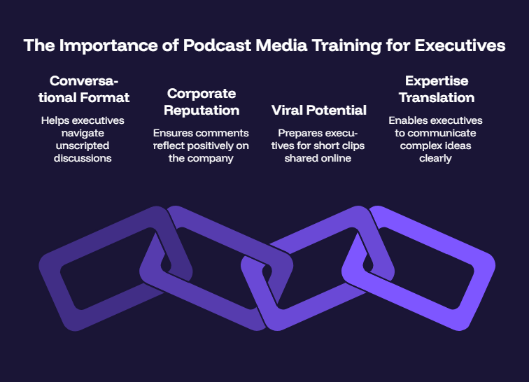
Unlike a short media interview, where an executive may only have a few minutes to deliver key messages, podcasts can run for 30, 60, or even 90 minutes of unscripted conversation.
According to Riverside, the average podcast length ranges from 30 to 42 minutes.
Hosts can follow interesting comments with unexpected questions, ask for examples, or move into topics that were not included in the original briefing.
This conversational format can be valuable, but it also makes traditional talking points harder to rely on. Media training for podcasting helps leaders develop enough message control to stay aligned with communication priorities without sounding rehearsed.
2. What Executives Say Can Reflect on the Company
When an enterprise leader appears on a podcast or hosts it, listeners may not always hear their comments as purely personal observations. Their position can make them a de facto spokesperson for the organization. This means comments about customers, competitors, employees, industry issues, or company strategy may affect corporate reputation and media relations.
For executives from regulatory industries, preparation is even more important. That’s because certain statements may carry legal, compliance, or reputational implications.
Media coaching can help executives distinguish between what they know personally, what they are authorized to discuss, and what requires careful messaging.
3. Podcast Clips Can Travel Far Beyond the Original Episode
A podcast appearance rarely stays confined to the full episode. Short moments can be repurposed across LinkedIn, YouTube Shorts, Instagram Reels, TikTok, or even picked up by media outlets. Spotify has also introduced Clips, which allows listeners to capture and share specific moments directly from an episode.
This raises the stakes for executives and their personal brand, as well as the company they’re associated with.
A 30-second answer can sometimes receive more attention than the hour-long interview it came from. That’s why training around concise answers, vocal delivery, body language, and on-camera presence matters even during long-form conversations.
4. Executives Need to Translate Expertise for the Audience
Strong B2B thought leadership depends on your ability to turn complex expertise into clear ideas, memorable stories, practical examples, and distinct points of view. Subject knowledge matters, but audiences still need to understand why your perspective is relevant to them.
The 2025 Edelman-LinkedIn B2B Thought Leadership Impact Report found that 71% of hidden B2B decision-makers considered thought leadership more effective than conventional marketing or sales materials.
The same report found that 64% said they trusted thought leadership more than marketing materials and product sheets when assessing capabilities.
Executive media training can help leaders turn their expertise into credible thought leadership by improving storytelling, messaging, and their ability to explain complicated ideas in language an audience will remember.
What Does Executive Podcast Media Training Cover?
Executive media training for podcasts should cover the following:
Message development and positioning: Training to help executives define key messages, supporting points, and clear positioning before an interview. This makes it easier to stay aligned with broader communication priorities without sounding scripted.
Interview and listening skills: Executives learn how to listen closely to the host/guest, identify the intent behind a question, and respond directly before bridging to relevant points.
Answer structure and storytelling: Media coaching helps leaders organize their answers using concise explanations, useful examples, and business stories that make complex ideas easier to follow.
Difficult question preparation: Mock interviews can expose executives to challenging, unexpected, or sensitive questions before the real recording. This builds confidence and improves message control in high-stakes moments.
Vocal delivery and pacing: Coaching may focus on tone, pace, pauses, emphasis, and reducing filler words so answers sound clear and natural.
Video presence for filmed podcasts: For video podcasts, training covers body language, facial expressions, posture, and even the camera setup. On-camera practice helps strengthen executive presence across YouTube, social media content, and other digital platforms.
Executive Media Training for B2B Podcast Hosts
Media training for executives hosting a B2B or thought leadership podcast should help with questions, follow-ups, listening, and overall control of the conversation that keeps both them and their guest on topic without sounding rigid or scripted.
Below, we’ve listed the key skills executive podcast hosts should develop through media training.
1. Learn How to Ask Better Questions
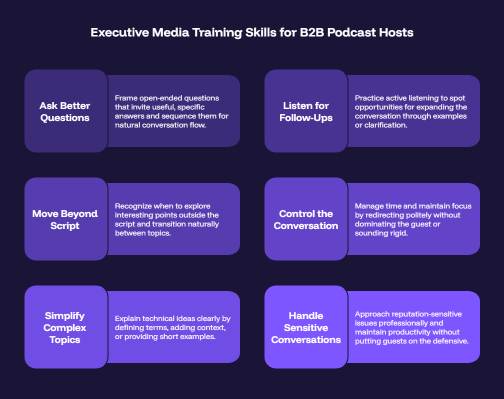
Podcast hosts should ask questions that invite useful, specific answers. That said, they should ask more open-ended questions because podcasts are about conversations.
Media training can help hosts frame such questions, avoid overly complicated wording, and sequence questions so the conversation develops naturally from broad context into deeper insight.
Pro Tip: Besides media training, executives hosting podcasts can also benefit from a podcast episode script that gives them direction.
2. Listen for Strong Follow-Up Opportunities
The best follow-up questions come from what the guest says, and that requires active listening and spotting opportunities to expand a conversation. For example, hosts can ask for examples or clarification when a guest makes a claim.
Media training helps hosts listen for examples, contradictions, or interesting details worth exploring, which can make interviews feel more spontaneous and valuable to the audience.
3. Know When to Move Beyond Prepared Questions
A question list or podcast script gives the conversation structure, but hosts also need to know when to move beyond it. If a guest raises an interesting point, media training can help you recognize when it is worth exploring with another question instead of immediately moving on.
You also learn when a topic has run its course and how to transition naturally into the next part of the conversation without making the shift feel forced.
4. Control the Conversation Without Dominating It
B2B hosts need to manage time, maintain focus, and prevent answers from drifting too far off topic.
Executive media training can strengthen these moderation skills by teaching hosts how to redirect politely, interrupt when necessary, and keep the interview aligned with its core messaging and audience needs without making the exchange feel rigid.
5. Make Complex Topics Easier to Understand
Enterprise podcasts typically cover technical products, business strategy, regulation, AI, finance, or other complicated subjects. Even an experienced industry audience may need context when a topic becomes too technical or detailed.
Media training can help hosts explain complex ideas more clearly and step in when a guest introduces unfamiliar terminology. This may mean defining a technical term, adding context, or giving a short example that makes the discussion easier to follow.
6. Handle Sensitive Conversations Professionally
Some interviews may touch on layoffs, legal disputes, market failures, crisis response, competitors, or other reputation-sensitive issues.
Training in crisis communication and media relations can help hosts approach these topics fairly and professionally, ask direct questions without becoming unnecessarily confrontational, and understand when additional context or clarification is needed. It can also prepare hosts to handle disagreement calmly, challenge a point when needed, and keep the conversation productive without putting the guest on the defensive.
Media Training for B2B Podcast Guests
Media training can also help executives prepare for podcast guest appearances. We recommend including some form of media coaching or guidance to the guest in the preparation process before the episode is recorded.
A well-prepared guest usually gives clearer answers, tells better stories, and feels more comfortable during the conversation. That can also make the episode more useful and engaging for listeners.
Here’s what we’d cover in a media training session for a B2B podcast guest:
1. Define the Goal of the Appearance
Before the interview, the guest should be clear on what the appearance is meant to achieve. In B2B podcasts, that might be building executive visibility, strengthening thought leadership, supporting a product category, reinforcing corporate positioning, or improving trust with a specific audience.
2. Understand the Podcast and Its Audience
Guests should review the show’s format, typical topics, host style, and audience before recording. This helps them choose examples, language, and talking points that will make sense to the people listening.
3. Develop Two or Three Core Messages
Most guests don’t need a long list of talking points. Two or three clear key messages are usually easier to remember and repeat naturally throughout the conversation, particularly when the interview moves into unexpected areas.
Tie these core messages to their goal for the appearance. For example, if the goal is to promote a product as an industry leader, the core messaging can cover its unique value proposition and existing case studies to support claims.
4. Prepare Stories, Examples, and Proof Points
Strong B2B podcast answers usually become more credible when they include a specific example, customer scenario, data point, or short story.
Media training helps executives build a bank of proof points that support their messaging without sounding over-rehearsed. This can take the form of easy-to-remember internal statistics or case studies.
Pro Tip: Keep talking points, numbers, and examples written down on a screen or notepad for easy reference.
5. Practice Answer Structure
Guests should practice answering questions with a clear beginning, middle, and end. This prevents the speaker from wavering off topic or spending too much time on a single question.
A simple structure such as direct answer, explanation, example, and takeaway can improve clarity, pacing, and overall media performance.
6. Prepare for Difficult or Unexpected Questions
Media training for executive podcast guests should also anticipate questions on sensitive and confidential topics like performance, competitors, failures, pricing, layoffs, and regulation.
Mock interviews and spokesperson coaching work great for this. These training exercises can help executives practice calm, accurate responses while maintaining message control and protecting corporate reputation.
They should be coached to set clear boundaries when information can’t be shared and to bridge back to an appropriate key message.
The following presentation from the Stanford Graduate School of Business shares effective ways to handle tough questions.
Podcast Delivery Tips for B2B Executives
If you’re a B2B leader preparing for a podcast, here are a few delivery tips from our team at Content Allies:
Speak more conversationally: Avoid delivering answers like you’re giving a keynote, board presentation, or formal public speech. Aim for a natural tone that sounds like a thoughtful conversation.
Control your pace: Slow down when explaining technical or complex ideas. Short pauses can also give listeners time to absorb an important point.
Improve vocal variety: Vary your tone, emphasis, and pacing so your delivery doesn’t become flat or overly rehearsed.
Build confidence without sounding overconfident: Speak with clarity and conviction, but avoid overstating certainty or dismissing alternative perspectives. Strong executive presence comes from being composed, credible, and comfortable.
Use eye contact naturally: During an in-person interview, keep your attention mainly on the host rather than constantly looking at the camera. For a remote recording, look toward the camera at key moments while still interacting naturally with the person on screen.
Use body language to emphasize important points: Natural gestures, posture, and facial expressions can make your delivery clearer and more engaging. This matters even more for video podcasts.
Choose clothes that work well on camera: Wear something professional but comfortable, and avoid very small patterns, distracting graphics, or anything that may interfere visually with the camera setup or background.
Keep remote recording backgrounds simple: A clean, uncluttered background keeps attention on the speaker. That doesn’t mean a black-and-white wall. You can use a simple backdrop and even add branding cues like a company-name banner or a book you’ve written.
How Podcast and Communications Teams Can Support Executives
Podcast and communications teams can strengthen executive appearances by handling preparation before the recording. Before recording, the team can research the show and host, identify likely discussion areas, develop key messages, gather supporting proof points, and create a concise briefing document with the context the executive needs.
Teams can also run through likely questions, sensitive topics, transitions, and potential crisis scenarios before the interview. This gives executives a chance to refine their answers and feel more prepared for unexpected turns in the conversation.
For filmed podcasts, production preparation matters too. Teams should check the camera setup, lighting, audio, background, and other technical details in advance. The same preparation applies to remote recordings.
After the interview, communications teams can review the episode and any planned social media content to identify strong clips, quotes, and thought leadership moments.
Launch Executive-Led B2B Podcast with Content Allies
For B2B executives, a little preparation can make a noticeable difference in how confidently a host or guest speaks, how clearly they explain complex ideas, and how well the conversation supports wider thought leadership goals.
Content Allies works with B2B leaders to plan, produce, and market executive-led podcasts. Our team supports hosts and guests with episode briefs, preparation materials, production guidance, and a clear structure for focused, engaging conversations.
If your goal is to build an executive’s personal brand, strengthen thought leadership, or use podcasting to support lead generation, we can help you develop a show around that objective.
Book a meeting with us to discuss your executive-led B2B podcast idea.
FAQs
Should you hire an executive media trainer?
Hire an executive media trainer when the executive regularly appears on podcasts, in media interviews, or in other high-visibility situations. A trainer can provide structured feedback on messaging, delivery, difficult questions, body language, and overall media performance.
Do experienced executives still need media training?
Yes. Even executives with strong public speaking skills can benefit from media training because interviews require different skills from presentations, board meetings, or public speeches. Training is especially useful before high-stakes appearances, sensitive announcements, or unfamiliar interview formats like podcasts.
What should an executive do if they are asked a question they cannot answer?
They should avoid guessing or inventing an answer. Instead, they can acknowledge they don't have the information, explain what they can address accurately, or offer to provide the correct information afterward, where appropriate.
Is media training different for video podcasts?
Yes. Beyond messaging, video training adds on-camera considerations such as body language, eye line movement, lighting, and camera setup. On-camera practice can help executives become comfortable managing both what they say and how they appear visually.
Does Content Allies handle executive media training before podcast production?
Content Allies can train executives to host a podcast, including walking them through the format, providing messaging guidelines, and sharing tips on moving the conversation. For guests, we coordinate interview questions so they can come prepared for the interview or panel discussion.
Can Content Allies train both podcast hosts and executive guests?
Yes, Content Allies can provide training and technical support to podcast hosts and their guests, specific to the podcast format and length. This helps both parties carry conversations that are actually informative for the listeners.