
Enterprise Podcast Best Practices & Mistakes to Avoid
In 2025, the global podcast market is estimated at US $30.72 billion and projected to soar toward US $131 billion by 2030. That’s massive growth, but it also means more competition, more channels, and more noise.
Enterprise podcast distribution is, in that context, a strategic move because it puts you in front of a larger audience on different channels.
However, enterprise brands have it hard: multiple platforms, shifting formats, fragmented data, and stakeholder pressure can pile up fast.
You’re on the right page, though.
Over the rest of this piece, we’ll walk through:
What enterprise podcasting actually means
Key platform best practices (Spotify, Apple, YouTube, internal feeds)
How to centralize your analytics to get a relevant picture
Scaling challenges (teams, workflows, versioning)
And more
Pro tip: Want to turn your podcast into a true business engine instead of just a content channel? Our guide on enterprise podcast distribution shows you how a strong guest strategy, distribution plan, and enterprise podcast services can help you engage senior audiences and drive pipeline.
What Is Enterprise Podcasting?
Enterprise podcasting refers to audio (and even video) content that is created, managed, and distributed by organizations for strategic business purposes. It plays a role in communication, training, brand building, and stakeholder engagement.
Enterprise podcasting is different than independent podcasting because:
The audience is usually internal (employees, global teams) or B2B (partners, business‐owners, clients) rather than the mass consumer.
Governance matters: you’ll follow clear governing principles around access controls, permissions, and compliance with brand and corporate policy.
Distribution must be reliable, secure, and scalable. Think enterprise mobility management, private feeds, SSO logins, and multi‐location roll‐out.
Content usually supports AI‐driven transformation or change programs. Basically, this kind of B2B podcasting becomes part of how leadership shares strategic direction, innovation, or culture shift.
Including enterprise podcasting in your digital strategy has a slew of benefits.
You can speak in a consistent voice across geographies, building trust and alignment among business owners, teams, and clients.
Builds engagement in a way that is more personal and scalable (“listening on the go” vs long memos or webinars).
Supports internal learning or external thought leadership without the cost or barrier of producing full video-broadcast content.
Gives you a channel you own, meaning you control analytics, access, and how content is archived or reused.
Enterprise Podcast Production Best Practices
Here’s a step-by-step action plan to institutionalize the enterprise podcast production process, guide growth, and stay sane while doing it.
Step 1. Define Your Primary and Secondary Channels
One of the biggest mistakes enterprise podcast teams make is trying to publish everywhere at once. It feels productive, but it stretches your workflow thin and scatters your audience instead of concentrating it. The reality is that most companies don’t need to be on every platform; they need to be intentional about where they show up.
So the first step is to clearly distinguish between:
Primary platforms, where your core audience already spends time and expects to find you, and:
Secondary platforms, where you experiment, repurpose, or test new formats without diluting the main show.
Here’s why this matters.
Your primary platforms are your home base: the channels where your ideal listeners (buyers, partners, technical stakeholders, or internal teams) naturally consume long-form audio. For many enterprise podcasts, that’s Apple Podcasts or Spotify. For others, especially internal shows, the “primary platform” might actually be your internal communications hub or LMS.
When we onboard enterprise clients, we always ask: Where does your audience already listen to content they trust? If your engineering leaders rely heavily on Spotify but barely touch YouTube, that’s your answer. If your employees are trained to consume content in Workday or SharePoint, those become more important than public platforms.
Secondary platforms, on the other hand, give you room to play. This is where you can test shorter clips, turn episodes into YouTube Shorts or LinkedIn posts, or repurpose audio for recruitment, onboarding, or sales enablement. These platforms are valuable, but they should never drive your strategy; they should only amplify it.
Getting this right keeps your operations lean and prevents the “let’s publish everywhere just because” chaos that burns teams out. It also makes your analytics cleaner: you know which channels to measure for growth and which ones to treat as experimental.
Once you know your primary and secondary channels, everything else (workflow, templates, analytics, and distribution) becomes easier to standardize. Clear channel focus turns a scattered podcast into a strategic asset.
Step 2. Build a Repeatable Publishing Workflow
At the enterprise level, podcast success means running a smooth, predictable operation that doesn’t crumble when one team member is out of the office or when production volume increases. A repeatable workflow turns your podcast into a reliable communication engine.
The most common bottleneck we see in new clients is that responsibilities are tribal knowledge. One person “usually edits,” someone else “typically posts to platforms,” and metadata checks happen “somewhere along the way.” This works fine for three episodes, but then it falls apart.
Instead, you need a publishing workflow that maps every step from raw recording to final distribution, with zero ambiguity about who does what and when.
Start by breaking down the entire lifecycle:
1) Who edits, writes show notes, and checks metadata?
Editing means more than cleaning audio. Here, you need to decide how the episode flows, what gets emphasized, and what your audience will remember. Show notes and metadata determine whether the episode is discoverable and aligned with your brand voice. Defining this ownership upfront ensures quality doesn’t fluctuate episode to episode.
2) Who uploads to each platform?
Publishing across Apple Podcasts, Spotify, YouTube, your intranet, and your CMS each has its own nuances. Small differences (like episode categorization, title formatting, or thumbnail sizing) can compound into big inconsistencies. So, we advise you to assign clear owners.
3) Who handles internal distribution vs. external outreach?
Enterprise podcasts typically have two audiences:
Your internal teams, and
Your external listeners (customers, partners, prospects)
These groups need different messaging, formats, and even release timing. We’ve seen internal podcasts fail simply because no one “owned” the communications plan. When responsibilities are clearly defined, distribution becomes strategic instead of improvised.
Once you’ve mapped the entire pipeline, document everything in a shared workspace like Notion, Asana, or Airtable.
This way, your teams can onboard faster, production becomes more resilient, and your show becomes something you can scale
Step 3. Templatize Everything
Consistency is one of the biggest blind spots in enterprise podcasting. Teams know they should “stay on brand,” but without templates, every episode is formatted differently, and even worse, it’s dependent on whoever happens to be producing that week.
That inconsistency shows up everywhere: in your titles, summaries, thumbnails, transcripts, and even how you promote episodes internally.
Templatizing your workflow removes that friction.
It creates a shared language across teams from marketing to communications, design, and production, so everyone is working from the same playbook.
Start with the obvious components that are repeated every single episode:
Episode titles and descriptions: Strong titles follow a predictable structure: clear hook, strong keyword, and a promise of value. Descriptions should offer context, takeaways, and guest credentials in a format that can be filled in.
Pro tip: When we build templates for clients, they’re structured enough to enforce brand standards but flexible enough to adapt to different topics and guests.
Intros: You need to hook listeners from the start, but also help them understand what your show is about. Here’s a good way of doing that:
Cover art and thumbnails: Visual inconsistency is one of the fastest ways to make a podcast feel amateur, even if the content is excellent. Templates ensure every episode looks like it belongs to the same series. That’s why we advise you to focus on a consistent color palette, typography, framing, and hierarchy. This matters even more when you’re repurposing episodes as YouTube videos, LinkedIn teasers, internal town-hall clips, or LMS modules.
Social and internal comms snippets: Every episode needs multiple promo variations: short-form, long-form, internal-facing, partner-friendly, and platform-specific. Without templates, these assets vary wildly in tone and structure. With them, your messaging becomes streamlined, scalable, and much easier to delegate.
Transcripts, captions, and summaries: Accessibility, podcast SEO, and internal knowledge-sharing depend on having reliable, structured text outputs. Templates ensure every transcript includes timestamps in the same way, every summary follows the same format, and every caption meets platform standards. This dramatically improves your downstream workflows, from repurposing content to mapping insights across departments.
Step 4. Centralize Your Podcast Analytics
Podcast analytics are deeply fragmented.
Each platform reports different things, in different formats, on different timelines. It’s hard to get a good picture of your subscriber trends.
There’s a lot at stake if you get this wrong.
According to Edison Research’s The Podcast Consumer 2024, 46% of weekly podcast listeners in the U.S. say they’ve purchased a product or service as a direct result of hearing an ad in a podcast. That shows podcast audience engagement can be powerful, but only if you can measure it meaningfully.
So what’s the fix?
There is no single, perfect dashboard (yet). But you can:
Centralize your analytics. Use tools like Podscribe or Spotify Ad Analytics to pull in data from multiple platforms. These won't give you everything, but they’re a start.
Pick one source of truth. Choose a few key metrics to focus on across the board, like episode listens over 60 seconds or the number of downloads, and track them consistently. Be clear about what success looks like for your specific goals.
Segment by channel. Make a distinction between internal vs. external performance, or client-facing vs. employee-facing content. You can’t optimize what you can’t compare.
Connect to business outcomes. Tie podcast insights to larger metrics like engagement, retention, lead gen, and NPS. Your podcast doesn’t exist in a vacuum.
Here’s a more in-depth look at how to analyze your podcast analytics:
Even if the data isn’t perfect, owning your approach to analytics helps shift the conversation from “we think it’s working” to “here’s what we know, and here’s how we’ll improve.”
Common challenge: Many teams treat internal podcasting separately from their public shows and end up duplicating workflows. Our post on corporate podcast strategy shows you how to unify the approach across private podcasts and public listening platforms.
5. Create Feedback Loops
One of the biggest advantages of enterprise podcasting is that you have direct access to the people listening. But most teams underutilize this. They look at downloads, maybe skim a few comments, and call it “feedback.”
In reality, the most successful enterprise shows operate like product teams: they build structured, predictable feedback loops that guide the direction of the show.
Start with your audience, both internal and external.
Survey your internal and external listeners. Audience research should reveal what’s resonating: which segments they replay, what topics influence their decisions, which guests they trust, and what problems they’re hoping the show will help them solve. For internal podcasts, the feedback can uncover cultural gaps, communication blind spots, or training needs the show can directly support.
Run regular post-mortems with your team. Think of this as your editorial retrospective. Once a month or once a season, sit down as a team and ask:
What episodes overperformed and why?
Where did production bottlenecks appear?
Did our messaging feel aligned with our broader communications strategy?
What feedback came in that we haven’t acted on yet?
Track which episode formats or topics get shared the most. In enterprise environments, the quality of the shares can be more important than the number of downloads. A 30-minute episode sent around internally by a VP of Engineering or linked in a sales deck can be far more valuable than a spike in public listenership. Pay attention to patterns: the types of stories, guests, or insights that spark internal forwarding or Slack chatter.
6. Optimize Over Time
Once the foundation is strong, you can start evolving from “a show” into a flexible content engine that supports multiple strategic goals.
That will help you find new layers of value, slowly and intentionally. So, we advise you to start simple.
First, add dynamic ad insertion.
This allows you to update calls to action across your entire episode library instantly. For enterprise teams, this is gold. If your messaging changes (like a new product launch, new campaign, or a new internal initiative), you don’t have to re-edit 60 episodes.
You update once and push it everywhere. Basically, your back catalog becomes an evergreen asset in your content calendar.
Then, you can introduce short-form or teaser formats because micro-content boosts discoverability. Whether it’s 60-second highlights, teaser clips for socials, or internal “executive summary” versions, short-form formats help your show reach new audiences who might never commit to a full episode.
Pro tip: We’ve seen clients use teasers to prime sales calls, onboard new hires, or update global teams asynchronously.
You can even promote your show on other podcasts:
Experiment with video podcasts, too. Video opens doors that audio alone can’t:
Improved engagement on LinkedIn
Better retention on YouTube
Richer internal training
Not every episode needs video, but even occasional video episodes can create anchor content for campaigns, product launches, or storytelling moments.
Once you know what’s resonating, you can double down with promotional series, like:
A mini-series around a major industry shift
A spotlight on internal experts
A campaign built around customer stories
These bursts of thematic content can activate new listeners, re-engage stale ones, and give your internal teams a narrative framework to rally around.
The key to optimization is sequencing: starting with stability, then layering sophistication one piece at a time. The strongest enterprise podcasts scale by expanding intentionally, guided by data, audience signals, and clear business goals.
Enterprise Podcasting Best Practices for Each Platform
Every platform has its own rules, strengths, and blind spots. Knowing how to play to each one can make or break your distribution strategy.
Here’s a quick rundown of the major players and how to get the most out of them:
Spotify
Strength: Discoverability via algorithmic playlists and search
Watch for: Limited show note formatting. You’ll need to keep descriptions tight and clear.
Pro tip: Spotify’s listener analytics are some of the best in the space. Use them to fine-tune episode length, release timing, and topics.
Apple Podcasts
Strength: Still a top platform for podcast discovery, especially in the U.S.
Watch for: When it comes to Apple SEO, titles, subtitles, and categories matter. Choose them strategically.
Pro tip: Encourage ratings and reviews early. They directly affect visibility in Apple’s ranking algorithm.
YouTube (for Video Podcasts)
Strength: Massive reach and visual format boost engagement
Watch for: YouTube isn’t optimized for audio-first content, so consider visual overlays, captions, or even light animation
Pro tip: Don’t just upload the podcast. Chop it into short, searchable clips that drive back to the full episode.
LinkedIn and Other B2B Social Platforms
Strength: High-value, professional audiences. Great for repurposed snippets.
Watch for: Engagement is algorithm-driven, and text posts or native video typically perform better than outbound links
Pro tip: Tag guests and executives. Employee shares can boost organic reach exponentially.
Internal Channels (Slack, SharePoint, Private RSS)
Strength: Powerful for employee engagement, onboarding, and internal comms
Watch for: Security, access controls, and mobile playback experience
Pro tip: Create a branded internal podcast portal that’s clean, searchable, and accessible via SSO
Remember not to treat every platform the same. Distribution means tailoring the delivery while keeping the core message intact.
In the next section, we’ll look at how to make sense of the chaos with better analytics and finally get a full picture of what’s working.
Enterprise Podcast Distribution Best Practices
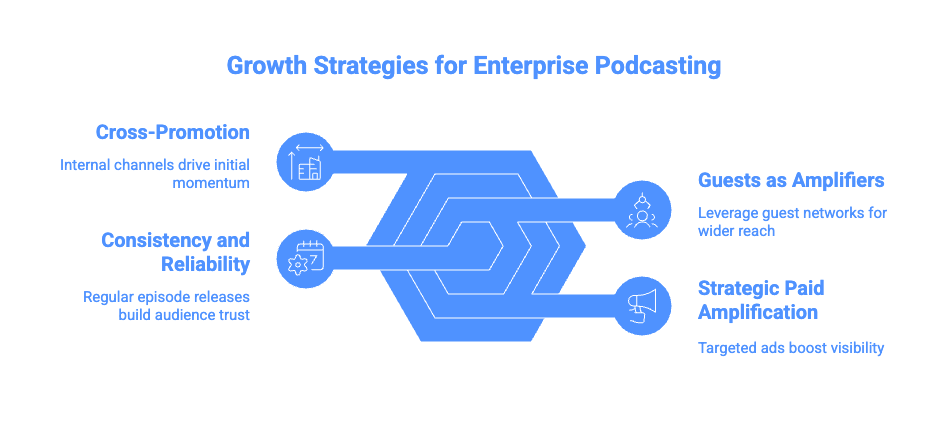
Growth in enterprise podcasting comes from smart distribution, amplification, and consistency. Here’s what really moves the needle:
1. Do Cross‑Promotion Within Your Organization
You’re sitting on your own built‑in distribution engine made up of your employees, internal comms, and intranets. Use them. Drop episodes in internal newsletters, Slack/Teams, and staff portals. Internal momentum can lead to external buzz.
2. Use Strategic Paid Amplification
Organic reach is great, but to scale, you’ll need to invest. But don’t waste money everywhere. Focus on monetization strategies like:
LinkedIn ads for B2B episodes
Sponsored placements via podcast networks
Short social clips (e.g., 30-60 second cuts) turned into paid social
Boosting episodes with high-profile guests or topical relevance
3. Leverage Guests as Amplifiers
Your guests, especially industry leaders, thought leaders, and executives, are natural boosters. But they won’t do it unless you make it easy.
Give them social copy and visuals
Tag them in posts
Follow up after publishing with share assets
Feature them in “guest highlight” content
Pro tip: Explore more relationship marketing tactics in our guide on how to leverage guest content for long-term relationships.
4. Post Consistently
No one remembers the viral one-off as much as the show that reliably drops great episodes week after week. Shows with inconsistent schedules tend to get forgotten.
Enterprise Podcast Mistakes + How to Solve Them
It’s one thing to publish a podcast across a few channels, but it’s another thing entirely to do it every week, in multiple formats, with multiple hosts, for multiple audiences… and still sound like one cohesive brand.
Here are some of the biggest friction points enterprise teams hit, and how to keep them from spiraling:
1. Too Many Hands in the Kitchen
As your podcast grows, so does the team: hosts, producers, marketers, legal, exec sponsors. Everyone has opinions, and they’re not always aligned.
What helps:
A clear approval process
Role definitions for who owns what
Pre-built templates for intros, outros, and show notes
2. Inconsistent Content Across Channels
It’s common for an episode to get published to Spotify with one title, LinkedIn with another, and YouTube with none at all. When this happens, branding, tone, and messaging start to drift.
What helps:
A centralized content calendar
Shared brand guidelines (yes, even for your podcast)
Cross-platform templates for title formats, thumbnails, descriptions, etc.
3. Workflow Chaos
Enterprise teams rarely publish to just one platform. A single episode must be adapted to five or more distribution channels. And each has its own file specs, metadata rules, transcript formatting, thumbnail dimensions, and scheduling logic.
Without a unified workflow, every handoff becomes a risk point: duplicated work, inconsistent assets, missed deadlines, and version control failures across teams or regions.
What helps:
Automation tools like Descript, Opus Clip, Casted, or Zapier
Reusable episode workflows (prep → record → edit → distribute → measure)
Versioning: create 2-3 variations of each episode (for example, full, short-form, and internal)
4. Brand Dilution
The more voices, guests, and hosts you bring on, the harder it is to maintain a consistent tone, look, and strategic purpose.
What helps:
Have a “north star” doc: who your show is for, what it sounds like, and what every episode should deliver
Use consistent music, voiceover, visuals, and structure
Onboard every new host or guest with a quick “how to be on-brand” guide
Scaling is about multiplying output without multiplying confusion. The best way to do that is with strong, repeatable systems.
Pro tip: Struggling to pick the right hosting platform that supports both public and private podcasts? Check out our guide on the top enterprise podcast solutions.
5. Manual Workflow Overload
Without the right systems, your team ends up manually editing titles, re-uploading audio, tweaking thumbnails, and rewriting captions for each platform. That’s fine with one episode a month, but not when you’re doing weekly uploads across five channels.
6. Broken Analytics
In enterprise podcasting, every platform measures performance differently, and that fragmentation kills visibility. One dashboard counts a “listen” at 3 seconds, another at 60, and another inflates numbers through auto-downloads.
That leads to:
Data that can’t be reconciled
No reliable single source of truth
Teams forced to make decisions on incomplete signals
This challenge isn’t unique to audio. In Forrester’s 2022 State of B2B Content Survey, only 10% of marketers said their organization was “advanced” in content performance and operations.
That gap shows why sophisticated, cross-channel measurement is so rare, and why podcasts can become the blind spot in an otherwise mature analytics stack.
How Content Allies Helps You Become A Distribution Machine
Podcasting is growing fast. If your enterprise podcast is going to cut through, it needs more than good content. It needs relentless distribution, smart systems, and clear measurement.
Nail those, and it will be a whole lot easier to grow and amplify your brand.
If you’d rather skip the trial and error, partner with a team that lives and breathes podcast growth.
At Content Allies, we help enterprises launch, scale, and monetize podcasts with a full‑service, data‑driven approach.
Contact us to find out more and get started.
FAQs
What should I look for in an enterprise podcast solution?
Look for a platform that’s reliable, secure, and easy for your team to manage. At the enterprise level, you need stable hosting, private feed options (if you run internal shows), solid analytics, and a clean workflow for publishing and approvals. A good solution should help you measure engagement and make distribution simple.
Can I manage podcast content across multiple channels with automation?
To a degree, yes. Many teams use scheduling and repurposing tools to help publish episodes to social channels, internal platforms, or YouTube. Automation can streamline distribution, but you still need a human editorial layer to maintain quality and brand voice.
How can podcasts generate revenue through ad opportunities?
Podcasts can monetize through ad opportunities like host-read ads, sponsorships, and branded promotional content. These formats work especially well when paired with a strong content strategy and distribution plan that aligns with your target audience.
What tools improve podcast sound and reach at scale?
You don’t need a studio full of equipment. A good microphone, basic acoustic treatment, and a reliable remote-recording setup go a long way. For production, most teams use standard audio editing software, transcription tools, and templates that keep the show consistent. Strong distribution and repurposing are what actually extend reach.
How does Content Allies support full-scale podcast management?
Content Allies handles the full production process—from preparing guests and recording sessions to editing, writing show notes, and publishing episodes. We also help with distribution, repurposing, and keeping your content aligned with your internal or external communication goals. Our team manages the details so you can focus on the conversations.
What enterprise podcasting tools does Content Allies use?
We work with a mix of industry-standard recording, editing, analytics, and project-management tools. The exact stack depends on the client’s needs, existing systems, and whether the show is internal or public. Our goal is to integrate smoothly into your workflows rather than push a proprietary platform.
Can Content Allies help with internal communication and content promotion?
Yes. We support internal and external shows by helping craft messaging, producing episodes, and creating repurposed clips or summaries for the channels your teams already use (like YouTube, LinkedIn, your intranet, or another internal platform). We make sure your podcast supports the larger communication strategy.