
Podcast Survey Template: 20 Questions to Understand Your B2B Audience
B2B podcast teams have more audience data than ever. Hosting platforms track downloads and estimated listeners; some platforms also report completion. B2B analytics can estimate which companies tune in. Surveys add listeners' own accounts of their needs, challenges and buying roles.
This matters because podcast listeners have purchasing influence. Edison Podcast Metrics data from Q4 2023 found that 53% of weekly podcast listeners participate in purchase decisions at work.
Below is a bank of 20 podcast survey questions to adapt for your audience, plus guidance on turning responses into episodes, guest choices, and potential sales conversations.
At Content Allies, we incorporate listener feedback into our B2B podcast production services to help brands create shows that resonate with their target buyers.
What Is a B2B Podcast Survey?
A B2B podcast survey is a short questionnaire that asks your listeners who they are, what they need from the show, and where they sit in a buying process. It's a structured way to collect listener feedback that your hosting dashboard can't capture.
Listener surveys can cover favorite episodes, listening apps and audience demographics.
For a B2B show, add four areas:
Firmographics: job function, seniority, company size and industry.
Buying role: whether the listener decides, influences, or uses the solutions your company sells.
Business priorities: the problem they're working on this quarter and the tools they're evaluating.
Consent for follow-up: an explicit opt-in for anyone who wants to talk to your team.
A podcast guest questionnaire, the form you send guests before an interview, is a separate tool with a separate job. We cover it briefly in the FAQ.
Podcast Analytics vs. a Podcast Survey: What Each One Measures
Podcast analytics measure consumption and engagement, while surveys collect self-reported preferences, challenges and intent. Use both to understand your B2B audience.
Your hosting platform reports downloads and estimated unique listeners; completion data depends on the platform and its integrations. CoHost estimates which organizations engage with episodes. LinkedIn Ads reporting describes promoted-clip engagement and cannot establish full-episode listening.
At Content Allies, we review audience data with clients every quarter. Our guide to tracking podcast listenership explains the measurement stack.
Even the best dashboard leaves the "why" column empty:
| Question you need answered | Hosting analytics | Company-level analytics (CoHost) | Podcast survey |
|---|---|---|---|
| Which companies listen? | No | Estimated company matches | Partly (self-reported) |
| What job role and seniority? | No | Estimated professional profile | Yes, per respondent |
| What is the listener's top challenge? | No | No | Yes |
| What role do they play in purchase decisions? | No | No | Yes |
| Which topics do they want next? | Indirectly, where completion data is available | No | Yes |
| Which guests do they want to hear? | No | No | Yes |
| Would they talk to your team? | No | No | Yes, with opt-in |
20 Podcast Survey Questions to Ask a B2B Audience
Use this question bank to collect listener profiles, buying context, discovery channels, content preferences and reported actions.
The table groups the 20 questions into five sets. Replace the bracketed placeholders and complete the answer choices before publishing. Choose the questions that serve your survey's goal.
| # | Question | Answer format | What it tells you | Decision it drives |
|---|---|---|---|---|
| 1 | Which best describes your job function? | Single choice | Function mix of the audience | ICP check |
| 2 | What is your seniority level? | Single choice | Decision-making altitude | Guest seniority and episode depth |
| 3 | How many employees work at your company? | Single choice (bands) | Company-size fit | ICP segmentation |
| 4 | Which industry is your company in? | Single choice + other | Vertical concentration | Vertical episodes and guests |
| 5 | What role do you play in buying [category] solutions? | Multi-select | Buying-committee position | Buying-role segmentation; sponsor profile |
| 6 | What's your biggest challenge with [topic] this quarter? | Open, 280 characters | Live pain points in their words | Episode angles; messaging |
| 7 | Which [category] tools or services are you evaluating in the next 6-12 months? | Multi-select + none | Self-reported evaluation plans | Potential buying signals to qualify |
| 8 | Would a 20-minute conversation with our team on [topic] be useful? | Yes / no; optional contact form | Hand-raisers | Sales follow-up |
| 9 | How did you first find the show? | Single choice | Acquisition channel | Promotion budget |
| 10 | Where do you usually listen or watch? | Multi-select | Format and platform mix | Video, clips and distribution plan |
| 11 | How many episodes have you played in the last 30 days? | Single choice | Engagement depth | Segmenting loyal and new listeners |
| 12 | How much of a typical episode do you finish? | Single choice | Self-reported completion | Episode length and structure |
| 13 | Which episode was most valuable to you, and why? | Open | What "value" means to them | Formats to repeat |
| 14 | Pick up to three topics you want us to cover next. | Multi-select (max 3) | Topic demand | Next quarter's calendar |
| 15 | Which roles or companies would you most like to hear as guests? | Open | Guest demand | ABM guest outreach |
| 16 | Which episode format do you prefer, and what duration suits you? | Two separate single-choice fields | Format and duration preferences | Production plan |
| 17 | What have you done after an episode? | Multi-select | Downstream action | Reported actions to investigate |
| 18 | How likely are you to recommend the show to a colleague? | 0-10 scale | Loyalty (NPS) | Benchmark over time |
| 19 | What other podcasts or newsletters do you rely on for [topic]? | Open | Competitive set | Cross-promotion; sponsor fit |
| 20 | What's one thing we should change? | Open | Blind spots | Quick fixes |
Podcast Survey Questions About Listener Role and Company (Q1-Q4)
Questions 1 to 4 collect the B2B audience details that matter most: firmographics and professional demographics. Job function, seniority, company size, and industry help you identify which listeners match your ideal customer profile (ICP). They also let you segment later responses to see how content preferences and business challenges differ across your target accounts.
Q1. Which best describes your job function? Offer 6-8 functions that match your buyers (marketing, sales, operations, finance, IT, HR, executive leadership, other). Q1 also works as your routing question: send students or job seekers past the buying section.
Q2. What is your seniority level? Use LinkedIn's seniority levels (entry-level, senior, manager, director, VP, CxO, partner, owner) so you can compare answers with your LinkedIn audience data.
Q3. How many employees work at your company? Bands such as 1-50, 51-200, 201-1,000, 1,001-5,000 and 5,000+ work for most B2B ICPs.
Q4. Which industry is your company in? List your top five target industries, plus "other (please specify)".
Pro tip: Keep these four optional. A respondent who skips company size still gives you useful topic and format data, and forced fields are where B2B respondents abandon.
Podcast Survey Questions About Buying Role and Business Priorities (Q5-Q8)
Questions 5 to 8 turn a content survey into a commercial one. Edison's data puts 32% of weekly listeners in the primary decision-maker seat for work purchases, so it's worth asking each respondent where they sit.
Q5. What role do you play in buying [category] solutions? Options: final decision maker, part of the buying team, I recommend tools, I use the tools, not involved. The "not involved" option matters: without it, people guess.
Q6. What's your biggest challenge with [topic] this quarter? Keep this open, cap answers at 280 characters, and expect the best episode ideas of the year to come from it.
Q7. Which of these are you evaluating in the next 6-12 months? List 5-8 solution categories adjacent to your offer, plus "none". Category-level options keep the question neutral and avoid a sales-pitch feel.
Q8. Would a 20-minute conversation with our team on [topic] be useful? Pair it with an unticked consent box and an email field that only appears on "yes".
Q8 is the question most podcast surveys never ask. In our experience, it's also the one that makes the survey pay for itself, as long as the follow-up stays as useful as the show. If you're building a show for senior buyers specifically, our guide to engaging decision-makers with an enterprise podcast covers the content side.
Podcast Survey Questions About Discovery and Listening Habits (Q9-Q12)
Questions 9 to 12 cover listening habits and tell you which promotion channels to fund. They're also the questions where self-reported data fills gaps in your platform data.
Q9. How did you first find the show? Options: LinkedIn, a colleague, a guest's post, newsletter, search, YouTube, podcast app browse, event, other.
Q10. Where do you usually listen or watch? Include YouTube and LinkedIn clips alongside audio apps. Edison Research reports that video consumption overtook audio consumption in its podcast metrics for the first time in Q3 2025, so an audio-only list will undercount your audience.
Q11. How many episodes have you played in the last 30 days? Bands of 0, 1, 2-3 and 4+ let you separate loyal listeners from new ones when you analyze results.
Q12. How much of a typical episode do you finish? Compare the answer with completion data in your host. A big gap usually means people listen to clips and skim full episodes.
Podcast Survey Questions About Content and Guest Preferences (Q13-Q16)
Questions 13 to 16 feed your editorial calendar and your guest list.
Q13. Which episode was most valuable to you, and why? Asking about a favorite episode is standard. Asking "why" is what tells you whether value meant a framework, a named guest, or a contrarian opinion.
Q14. Pick up to three topics you want us to cover next. List 8-10 candidate topics. Capping picks at three forces trade-offs and gives you a ranked list.
Q15. Which roles or companies would you most like to hear as guests? This is the bridge between audience and account-based marketing. Requested guests are mostly the people your sales team would like to meet too, which is why we treat podcast guests as relationship marketing.
Q16. What episode format and length suit you best? Options such as a 20-minute solo breakdown, a 30-40 minute interview, or a panel cover most B2B shows.
Podcast Survey Questions About Actions, Loyalty and Open Feedback (Q17-Q20)
Questions 17 to 20 measure whether the show changes behavior, and they leave room for what you didn't think to ask.
Q17. What have you done after an episode? Options: shared it with a colleague, visited our website, changed how we do something, reached out to a guest, booked a call with you, none of these.
Q18. How likely are you to recommend the show to a colleague? This is the standard net promoter score question. Score it the way Bain defines Net Promoter Score: the percentage of 9-10 answers minus the percentage of 0-6 answers.
Q19. What other podcasts or newsletters do you rely on for [topic]? The answers become your cross-promotion list and show sponsors where your audience already pays attention.
Q20. What's one thing we should change? Keep it last and optional.
How to Build a Podcast Survey in 6 Steps
To build a podcast survey, define your goal, select 8-12 relevant questions, use neutral wording, add follow-up options, and test before publishing. Google Forms, Typeform and Tally support setup. Aim for a completion time under seven minutes.
These six steps keep it short enough to finish and clean enough to analyze.
Choose one primary goal. Pick one of four: plan next quarter's content, validate that the audience matches your ICP, build a sponsor media kit, or surface pipeline signals. The goal decides which questions survive.
Pick 8-12 questions from the bank. SurveyMonkey's analysis of over 25,000 surveys on its SurveyMonkey Audience research panel found completion rates of 89% at 10 questions, 87% at 20 and 79% at 40. These panel results do not predict your podcast's performance. Test longer versions and use Q5 to skip inapplicable evaluation questions. Keep content feedback available to everyone.
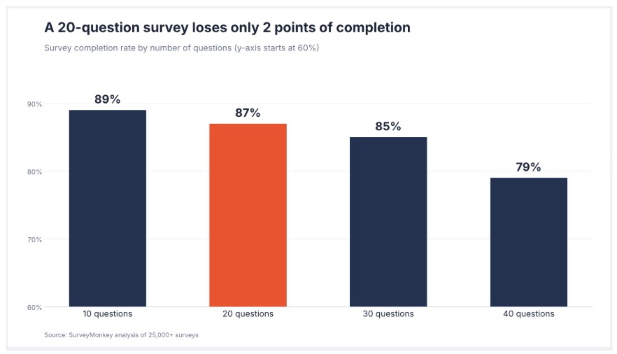
SurveyMonkey Audience panel completion rates by question count. These findings do not predict your podcast survey's completion rate. Source: SurveyMonkey
3. Open with a closed question and select up to three open-ended questions from Q6, Q13, Q15, Q19 and Q20. In SurveyMonkey's panel analysis, multiple-choice openers had 89% completion, compared with 83% for open-ended openers. Pew Research Center's American Trends Panel analysis found average item nonresponse of 1-2% for closed questions and about 18% for open-ended questions. These findings describe the studied panels.
4. Write neutral wording. Avoid leading phrasing such as "How much did you love this episode?" Ask one thing per field and include "other", "none", "not applicable" or "not involved" where each fits.
5. Explain how you will use responses and link to privacy information. The UK regulator's guidance says survey submission alone does not establish consent for further uses. For Q8, add an unticked box: "I agree that the Content Allies team may contact me about the conversation I requested." Adapt the team name and collect email only when needed. Typeform URL parameters can record referral source.
6. Pilot with five people and time it. Pew budgets about 10 seconds for an ordinary stand-alone question; more demanding open-ended questions can take minutes. Aim for under 7 minutes. SurveyMonkey's survey-length analysis found abandonment increased beyond 7-8 minutes.
| Question type | Time to answer | Item nonresponse context | Best use |
|---|---|---|---|
| Single choice | About 10 seconds | Pew ATP closed-question average: 1-2% | Firmographics, buying role, discovery |
| Multi-select | Pilot to estimate | Varies by question | Topics, platforms, actions taken |
| Rating scale (0-10) | About 10 seconds | Varies by question | NPS, episode satisfaction |
| Open-ended | Can take minutes | Pew ATP open-question average: about 18% | Challenges, guest requests, one change |
Routing rule: use Q5 to skip evaluation questions that do not apply. Keep business-challenge and content feedback available to relevant non-buyers, and show the optional contact form only after a "yes" to Q8.
Which Tools Can You Use to Run a Podcast Survey?
Google Forms, Typeform and Tally have free options and support branching. Check response limits and integration requirements before choosing a plan.
| Tool | Free plan | Branching | Best for |
|---|---|---|---|
| Google Forms | Free with a Google account | "Go to section based on answer" | Teams already working in Google Workspace and Sheets |
| Typeform | 10 responses/month across all forms; URL parameters included | Branching included | Tracking the source of each response and syncing answers to a CRM |
| Tally | Unlimited forms and submissions, free within fair use | Conditional logic, free | Small teams that want branching without a paid plan |
How to Get B2B Listeners to Complete Your Podcast Survey
Ask personally, make the link easy to find and test channels against completed responses. Survey wording, length, distribution and any reward can all affect participation.
| Channel | How to ask | What to test |
|---|---|---|
| Host call to action | A 20-second ask in three consecutive episodes, near the start | A direct invitation within the episode |
| Show notes | A short link (yourshow.com/survey) at the top | Catches listeners who act after the episode |
| Host and guest posts with a clip and the link | Feedback from professionals engaging with your clips | |
| Newsletter | A dedicated send plus one reminder | Responses from your existing subscriber list |
| Guest networks | Ask each recent guest to share it once | Borrowed credibility, new respondents |
| Sales and success teams | A personal note to listeners at target accounts | Turns existing relationships into responses |
Track completed responses from LinkedIn alongside other channels. Our LinkedIn strategies for B2B podcast growth explain how to promote clips.
A meta-analysis of 46 randomized trials in PLOS ONE found cash incentives increased survey response rates by 25% relative to no incentive (risk ratio 1.25), and vouchers by 19%. Neither figure is a percentage-point gain. The paper also discusses evidence that prepaid incentives can outperform conditional payments.
The monetary-incentive findings do not establish the effect of noncash rewards. For your B2B audience, test options such as:
A benchmark report built from the survey results
Early access to an upcoming episode
A seat at a small, private roundtable with the host
A donation to a charity respondents choose
Run the survey for 10-14 days with two reminders, then close it.
How Many Podcast Survey Responses Do You Need?
There is no response count that makes a voluntary podcast survey representative. Aim for enough responses to identify recurring themes and compare relevant listener groups. A conventional margin of error requires sampling assumptions that an open survey link does not automatically meet.
Treat voluntary responses as directional feedback:
Prioritize recurring patterns and large differences. Check respondent counts before acting on small gaps.
Expect small subgroups to be less stable. Pew's research on online opt-in samples shows that a larger sample alone does not remove selection bias.
Consider strategic fit separately from response counts. A target buyer's specific request may inform your editorial judgment, but it does not justify assigning arbitrary statistical weights.
How to Analyze Podcast Survey Results by ICP Fit
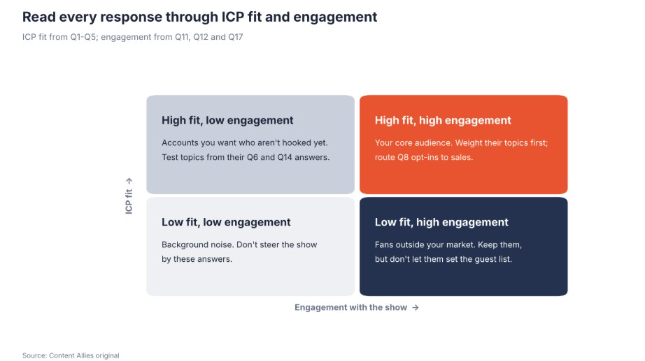
Split respondents into ICP and non-ICP groups, then compare answers within each group. This helps separate target-buyer preferences from overall survey patterns.
We use the same split in client reporting, and our breakdown of B2B podcast ROI metrics shows how survey data sits next to listener and pipeline numbers.
Tag ICP fit using your target function, seniority, company size and industry. Track buying role separately. Mark skipped profile answers as "unknown".
Cross-tab Q14 selections and Q18 NPS by ICP tag. Report selection frequencies, scores and respondent counts for each group.
Code open answers into recurring themes. Separate business challenges, episode value, guest requests, other content sources and suggested changes.
Keep commercial follow-up separate from content analysis. Apply the Q8 permissions described in the setup section before any sales handoff.
Compare ICP fit with reported engagement. Treat each group as a set of respondents whose preferences you can test, and check sample size before drawing conclusions.
You can use this diagnostic table to turn patterns into decisions:
| What you see | What it likely means | What to do next |
|---|---|---|
| ICP listeners rank tactical "how-to" topics highest | Buyers want implementation detail | Add a tactical segment or episode type |
| Non-ICP share keeps rising | Respondent mix may be changing; check distribution and response bias | Review the sample before changing guest mix or targeting |
| High NPS, but few Q17 actions | Respondents recommend the show but report few listed actions | Add one clear next step per episode |
| Several Q15 requests name the same company | Listeners want to hear from that company | Consider a relevant guest; check fit with your target accounts |
| Q7 shows active evaluations in your category | Potential buying signals requiring qualification | Qualify relevant respondents who requested follow-up |
How to Turn Podcast Survey Results Into Episodes, Guests and Pipeline
Survey results earn their keep in four places: the next quarter of episodes, the guest list, the sales handoff, and sponsor conversations. Use the survey to refine content first, then let the commercial uses follow.
1. Build the Next Quarter of Episodes
Start from the answers, and borrow formats from our list of B2B podcast ideas only when you need them.
Take the top three Q14 topics among ICP respondents and pair each with the most common Q6 challenge. This gives you three episode themes, each anchored in a problem your buyers named.
Fill the rest of a 90-day calendar from Q13's "why" answers. Recurring Q6 questions also make a ready-made Q&A episode.
2. Invite the Guests Your Audience Requested
Turn Q15 requests into a guest shortlist and cross-check it against your target account list. Guests your audience asked for give listeners a reason to tune in, and when they work at accounts you want, the interview opens a relationship.
The Disruptive Innovators podcast we produce illustrates the guest-outreach approach. Our published ABM account reports 63 booked calls from 311 engaged recipients, a conversion rate slightly above 20%. That result concerns guest outreach; it does not measure listener-survey conversion.
3. Route Buying Signals to Sales
Send relevant Q7 and Q8 responses to sales under the agreed follow-up permissions. Include the listener's challenge, evaluation plans and valued episodes. Qualify needs and timing before recording a sales opportunity.
Pro tip: Have the team named in the opt-in make first contact. Reference the episode the listener valued and the conversation they requested.
4. Add Audience Data to Your Sponsor Media Kit
Aggregated Q1-Q5 answers describe the survey respondents' professional profile: seniority, buying involvement and industry mix. Include the survey period, response count and recruitment channels in your sponsor media kit. Avoid presenting voluntary responses as the profile of every listener. Our guide to building a podcast media kit for B2B sponsors shows where these details go.
How Often Should You Run a Podcast Survey?
Run a full podcast survey once a year and a three-question pulse survey each quarter. The annual survey resets your audience picture, and the pulse (one topic question, one NPS question, one open question) tracks changes between them.
Time the quarterly pulse to land two weeks before your quarterly review, so the results shape the next quarter's plan.
Close the loop: share three findings in an episode and say what you're changing. Listeners who see their answers used are more likely to answer next time, and it's the same feedback loop that keeps a podcast community active.
Track the survey numbers alongside the other B2B podcast KPIs you already report.
Build a B2B Podcast Your Audience Asked For with Content Allies
A podcast survey is valuable when its findings shape your episodes, guest selection, and audience strategy. At Content Allies, we use listener insights to help B2B brands create podcasts that speak to their target buyers.
Schedule a call with our team to review your audience data, discuss how we'd survey and segment your listeners, and explore how those insights could inform your podcast strategy.
FAQs
Should a B2B podcast survey ask for company name and email, or stay anonymous?
Keep listener feedback anonymous only when your collection settings support it. An email field in the same submission can identify the person's other answers. For anonymous feedback with optional follow-up, use a separate contact form that does not link back to survey responses. Collect any context the contact needs there, and keep it within the permissions described above.
How do you survey listeners who mostly watch clips on YouTube or LinkedIn?
Place the survey link in pinned YouTube comments, LinkedIn posts and video descriptions, with a brief invitation in clips. Use channel-specific links to record referral source. Ask separately whether respondents watch clips or full episodes; the referral link alone cannot establish that habit.
Should you send podcast guests a separate questionnaire?
Yes. A podcast guest questionnaire should collect the guest's professional background, areas of expertise, preferred discussion topics, and any subjects to avoid. A listener survey, meanwhile, measures audience preferences and feedback. Keep the two separate, and use these podcast interview questions to prepare relevant discussions.
What should you trust when podcast survey answers and CoHost company data disagree?
Review both sources before deciding which findings to act on. CoHost's company-level analytics estimate which organizations engage, while surveys collect respondents' roles, challenges and preferences. Differences may reflect response bias, coverage gaps or metric definitions. Check those factors before changing your strategy.