
Podcast Workflow: From Guest Booking to Publishing and Promotion(+ Free Copyable Template)
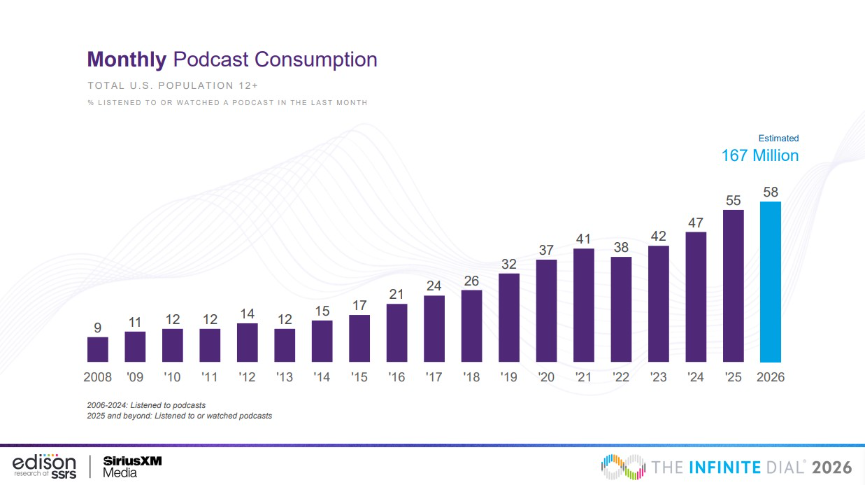
Podcasts have never had a bigger audience. 58% of Americans 12 and older listened to or watched a podcast in the last month, an all-time high in Edison Research's Infinite Dial 2026.
Sustaining a show takes a reliable process. A guest who never confirms, an edit stuck in review, or an episode that gets one LinkedIn post can disrupt the workflow.
This guide covers the full podcast workflow for B2B interview shows: seven stages, a field-by-field podcast workflow template, a day-by-day production schedule, and a RACI chart.
P.S. Need a team to manage your podcast from start to finish? Explore our B2B podcast production services; our team handles everything from guest outreach to episode promotion.
TL;DR
A B2B podcast workflow has seven stages: plan, book, prepare, record, edit and approve, publish, and promote.
Guest booking is a sales motion. Build the guest list from your target accounts and log every guest in your CRM.
Approvals are a stage with an owner and a deadline. Episodes can miss release dates when reviewers have no clear deadline.
Plan for roughly five weeks from first outreach to publish, and keep two to four finished episodes in the buffer.
Measure two things: whether the workflow runs on time, and whether guests and listeners turn into pipeline.
What Is a Podcast Workflow?
A podcast workflow is the repeatable sequence of stages, owners, and handoffs that takes an episode from guest booking to published and promoted. It tells everyone involved what happens next, who does it, and what "done" looks like at each step.
Guest interviews add outside dependencies: calendars, release forms, guest assets, and comms reviews. In the 2025 Independent Podcaster Report, 31% of active respondents produced interview shows.
Three terms get mixed up here:
| Term | What it covers | How often you use it |
|---|---|---|
| Podcast launch checklist | One-time setup: name, artwork, hosting, trailer, first episodes | Once per show |
| Podcast production process | Recording and editing a single episode | Every episode, mid-workflow |
| Podcast workflow | Everything from guest outreach to promotion and follow-up, with owners | Every episode, end to end |
If you're still setting the show up, start with our podcast launch checklist. This guide assumes the show exists and you need it to run every week or two without heroics.
What Are the 7 Stages of a Podcast Workflow?
The seven stages are plan, book, prepare, record, edit and approve, publish, and promote. For B2B interview shows, give approvals and guest promotion clear owners alongside production tasks.
| Stage | Goal | Primary owner | Output that triggers the next stage | Illustrative working time estimate |
|---|---|---|---|---|
| 1. Plan | Pick guests and topics that map to target accounts | Producer + marketing | Approved guest list and 12-week calendar | 2-3 hours per season |
| 2. Book | Get guests confirmed on the calendar | Producer or booker | Confirmed recording slot + completed intake form | 30-60 minutes per guest |
| 3. Prepare | Brief the guest and host | Producer | Signed release + brief sent | 45-60 minutes |
| 4. Record | Capture a clean 45-minute conversation | Host + engineer | Raw audio and video files uploaded | 60 minutes |
| 5. Edit and approve | Produce a finished, signed-off episode | Editor + approvers | Approved masters, transcript, show notes, clips | 3-6 hours |
| 6. Publish | Get the episode live everywhere | Producer | Live links on audio apps, YouTube, and website | 30-45 minutes |
| 7. Promote | Distribute the episode and activate the guest | Marketing + sales | Guest kit sent, clips scheduled, follow-up logged | 1-2 hours |
The trigger column is the one to copy. A stage ends when a specific deliverable exists, which is what lets a team see where an episode is stuck at a glance.
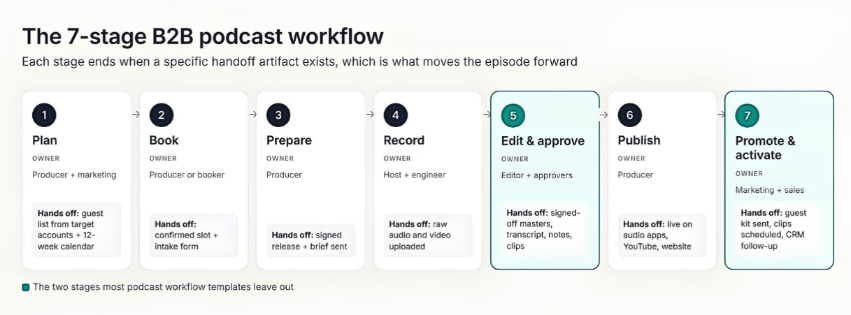
The seven stages of a B2B podcast workflow, with the handoff artifact that moves each episode to the next stage. Source: Content Allies original
Stage 1: Plan the Podcast Season Around Target Accounts and Topics
Build the guest list from your target-account list first, then choose topics those guests can speak to with authority. This keeps guest selection tied to the relationships you want the show to develop.
Pull your ideal customer profile and named target accounts from the CRM. Our ABM podcast strategy guide covers how to pick them.
Build a "Dream 50" list: decision-makers at those accounts, partners who sell to the same buyers, and voices your buyers already follow.
Map each guest to one of three to five content pillars, so the season covers your core themes.
Draft episode ideas from each guest's expertise.
Lay out a 12-week editorial calendar with recording targets and publish dates.
A balanced season usually mixes four guest types:
| Guest type | Why book them | Suggested share of a season |
|---|---|---|
| Prospect at a target account | Starts a relationship with a buyer on peer terms | 40-50% |
| Partner or adjacent vendor | Co-marketing reach and referral potential | 20-25% |
| Existing customer | Proof stories, retention, expansion | 15-20% |
| Industry voice or analyst | Credibility and audience growth | 10-15% |
This is where the podcast earns its keep. When Upshift partnered with Content Allies to produce its Hospitality Leaders podcast, the team built an ideal-customer catalog to identify and invite prospective guests. Over half of those interviews converted into new or expanded revenue.
Thought leadership also opens doors before the interview happens: in Edelman and LinkedIn's 2025 research, 95% of "hidden" B2B buyers said strong thought leadership makes them more receptive to outreach.
Stage 2: Book Podcast Guests With a Repeatable Outreach Sequence
Send a short, specific invite, follow up at least twice, and log every guest in your CRM the moment they reply. Guest booking fails when it's treated as one email and a hope. It works as a sequence with a fixed cadence and a self-serve appointment scheduling system at the end of it.
Run this sequence for every guest:
Day 0, invite. Name the show and its audience, say why you picked them specifically, state the time ask (45-60 minutes, remote), and add one line of social proof.
Day 3 or 4, first follow-up. Reply in the same thread with one new reason to say yes, such as a past guest from their industry.
Day 7 to 10, second follow-up. Keep it to two lines and offer a specific window.
On yes, send the booking link. Use a scheduling tool (Calendly, Cal.com, or SavvyCal) that only shows the host's recording blocks.
On booking, send confirmation plus the intake form. The calendar invite should already carry the studio link.
A tight sequence pays off. In our work with LTC Heroes, Content Allies achieved a 34% guest-scheduling booked-calls rate. This helped maintain a steady flow of podcast recordings.
The guest intake form should collect everything the later stages need, so nobody has to chase the guest twice:
Full name, title, company, and pronunciation of their name
A short bio and a high-resolution headshot
LinkedIn and other social handles for tagging
Two or three topics they'd most like to cover
Recording setup (mic, camera, quiet room)
Release form signature, or a link to sign it
Pro tip: Ask past guests to recommend someone with relevant expertise. Include the request in your thank-you email and log each introduction in your outreach tracker.
If booking is the bottleneck, our roundup of podcast guest booking services compares the outsourced options.
Stage 3: Prepare the Guest and Host Before Recording Day
Send the guest a one-page brief with four or five topics and get the release form signed at least a week before recording. A brief helps guests prepare useful examples. Signing the release before the call helps prevent permission disputes from delaying publication. Allow time for the guest's team to review it.
Treat the brief as a guide the host can depart from. For this example, plan a 45-minute conversation around four or five topics. The edited episode may run 20-35 minutes, depending on the conversation and cuts. Our walkthrough on how to prepare a B2B podcast brief covers the format.
Here's the full prep packet and when each piece goes out:
| Item | Send when | Owner |
|---|---|---|
| Calendar invite with studio link | At booking | Producer |
| Intake form | At booking | Producer |
| Guest release form | 7+ days before recording | Producer |
| One-page brief (objective, 4-5 topics, run of show) | 5-7 days before | Producer + host |
| Tech checklist (headphones, wired internet, light in front) | 3-5 days before | Engineer |
| Microphone shipment (enterprise or exec guests) | 7-10 days before | Producer |
| 15-20 minute prep call (optional) | 2-3 days before | Producer |
The podcast guest release form needs to cover more than permission to publish. Make sure it grants rights to clips, transcripts, AI-assisted editing, and repurposed articles, since those are where most of the episode's value goes.
Host prep is lighter but just as important:
Read the guest's last two or three LinkedIn posts or talks.
Know where their company sits in your pipeline, if anywhere.
Agree with the producer on the one takeaway the episode should leave listeners with.
Prepare two or three follow-up questions based on the guest's expertise and the topics in the brief.
Stage 4: Record the Podcast Interview and Batch Sessions
Book 60-minute slots for 45-minute conversations, and record local audio and video for every participant. Capture both when your distribution plan includes full video episodes or social clips.
Remote platforms that record each person on their own device (Riverside, SquadCast, Zencastr) reduce dependence on connection quality. Check that all local tracks have been uploaded before ending the session. Our guide to remote podcast recording covers the setup.
Run this checklist on recording day:
Join 10 minutes early and test both feeds, levels, and lighting.
Confirm name pronunciation, title, and anything the guest wants to avoid.
Hit record on all tracks and clap or count in to sync.
Record the conversation, keeping the brief open as a guide.
Record a 30-second cold-open or intro line from the guest if it fits the format.
Close with one ask: "Who else should we have on the show?"
Check that files have uploaded fully before the guest leaves the call.
How to Batch Record Podcast Interviews
Batch recording means grouping two or three interviews into one block on a fixed day, so the host isn't context-switching all week. Block "guest days" on the host's calendar (for example, Tuesday afternoons), leave 10-15 minute buffers between calls, and keep one backup guest who's happy to record on short notice.
Batching is how the host's time stays small. If your host is new to interviewing, a few sessions of host training make batched days far less draining.
Stage 5: Edit, Approve, and Package the Podcast Episode
Edit each episode in a fixed order, run it through named approval gates with deadlines, and package every asset before it's scheduled. Approval turnaround can extend the calendar beyond the editing work. Track it separately in the schedule.
Edit in this order, so no one polishes audio that's about to be cut:
Rough cut. Remove false starts, long pauses, and off-topic tangents.
Content edit. Tighten the story, move the strongest moment near the top, and flag anything sensitive for review.
Audio and video polish. Level, EQ, and master to Apple's recommended -16 dB LKFS loudness with true peak no higher than -1 dB FS.
Transcript check. Run AI transcription, then have a person fix names, company terms, and acronyms.
Show notes. Write a roughly 200-word description with keywords, guest links, and timestamps.
Then run the episode through approval gates:
| Gate | Who signs off | What they check | Turnaround target |
|---|---|---|---|
| Host review | Host | Accuracy, tone, anything they regret saying | 24 hours |
| Guest review (optional) | Guest or their comms team | Factual claims, confidential details | 48 hours, one pass only |
| Brand and marketing | Marketing lead | Messaging, title, thumbnail, CTA | 24 hours |
| Legal and compliance | Legal or compliance | Regulated claims, disclosures, customer names | 48-72 hours |
Agree the required compliance reviews, approvers, and turnaround with the company before production. Requirements depend on the content, applicable rules, and company policy. Our guide to podcast compliance for regulated B2B companies covers what reviewers usually look for.
The packaged episode should leave this stage with every asset the next two stages need:
Final audio master and video master
Clean transcript
Title, show notes, and chapter markers
Three to eight short clips and one or two quote graphics
Episode artwork and YouTube thumbnail
A guest share kit (covered in Stage 7)
Stage 6: Publish and Distribute the Podcast Episode
Publish through one podcast hosting RSS feed and get the full video onto YouTube the same day, or within 48 hours.
Use this publishing section of your podcast production checklist every time:
Upload the audio master to your host (Buzzsprout, Transistor, Captivate, or similar) with title, description, chapters, and episode artwork.
Schedule the release time and confirm it appears in Apple Podcasts and Spotify.
Upload the video to YouTube with chapters, a custom thumbnail, and the episode in your podcast playlist. YouTube can also ingest audio episodes from your RSS feed, and full video lets you publish the recorded interview footage.
Publish the episode page on your website with the embedded player, transcript, and show notes.
Post the internal announcement so sales and leadership know it's live.
Cadence matters more than frequency. Among shows hosted on Buzzsprout, the largest publishing-frequency group releases episodes every 8 to 14 days, according to its statistics checked in October 2026. A biweekly cadence is a practical starting point for a B2B team with approval gates.
Whatever you choose, hold a buffer of two to four finished episodes so one cancelled guest never breaks the schedule. Our B2B podcast release schedule guide covers timing by company type.
Stage 7: Promote the Podcast Episode and Activate the Guest
Send the guest a ready-to-post share kit the day after publication, then give sales a clip and a follow-up note for each relevant target account. Listen Notes lists around 3.8 million podcasts in its database as of October 2026. Give promotion a named owner, and equip guests to share the episode with their audiences.
Guest Co-Marketing Kit
Guests can introduce the show to a relevant new audience. When Content Allies produced Meta's Business, Innovation, and Technology podcast, VidMob's CEO shared his episode using the assets we supplied, BCG promoted its episode on LinkedIn, and the show reached about 170,000 downloads in the first six months of working with Content Allies.
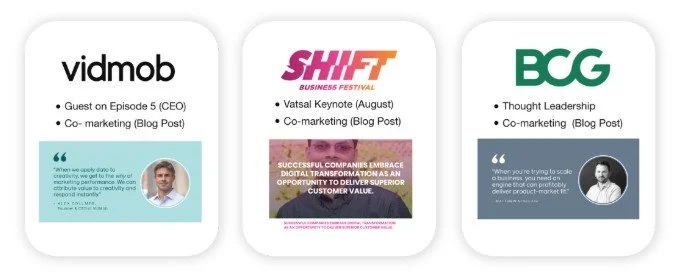
Make sharing effortless for the guest. A good kit contains:
Two or three vertical clips (1080x1920) featuring the guest
One quote graphic and one square episode graphic
A prewritten LinkedIn post they can edit, with the episode link
Tag handles for the host and the company page
Owned-Channel Promotion
Start with the host's personal LinkedIn if their network includes your target audience. Then work through the rest of your channels over the first week:
Post the strongest clip within 48 hours of release.
Add the episode to your newsletter.
Turn the transcript into an SEO article on your site.
Schedule the remaining clips across the next two weeks.
Our step-by-step guide on how to repurpose podcast content covers the full asset list per episode.
Sales Enablement and Guest Follow-Up
The episode becomes a sales asset the day it publishes. Have sales share relevant clips with other accounts in the guest's segment, send the guest a thank-you note with available performance numbers two weeks later, and ask for one referral. Log every touch in the CRM against the guest's account.
Choose clips relevant to the prospect's role and industry so the conversation speaks to their priorities. Keep a shared folder of clips sorted by industry and persona so reps can find the right one in under a minute.
Podcast Workflow Template: Fields, Statuses, and Owners to Include
The free copyable podcast workflow template below includes 15 fields and 10 statuses for the seven stages. Copy the field table into your project management tool, create one card per episode, and use the statuses as board columns. Copy the production schedule below to set relative due dates.
| Field | What it captures | Who updates it | Example value |
|---|---|---|---|
| Episode number | Order in the season | Producer | EP014 |
| Working title | Draft title for planning | Producer | How CFOs Budget for AI Pilots |
| Guest name and company | Who and where | Producer | Jane Doe, Acme Corp |
| Guest type | Prospect, partner, customer, or industry voice | Marketing | Prospect |
| CRM record link | Ties guest to account and pipeline | Sales or marketing | Link to HubSpot contact |
| Recording date | Confirmed slot | Producer | Oct 21, 2pm ET |
| Release form status | Not sent, sent, signed | Producer | Signed |
| Brief sent | Yes or no, with date | Producer | Yes, Oct 14 |
| Edit due date | Editor deadline | Editor | Oct 25 |
| Approval status | Host, guest, brand, legal | Producer | Waiting on legal |
| Publish date | Scheduled release | Producer | Nov 4 |
| Clip count | Number of clips produced | Editor | 6 |
| Guest kit sent | Yes or no | Marketing | Yes |
| Follow-up owner | Who closes the loop | Sales | Account executive |
| Pipeline touched | Opportunity or account influenced | Sales | Acme expansion opp |
Use these statuses as the board's columns, in order:
Idea
Outreach
Booked
Prepped
Recorded
In edit
In approval
Scheduled
Published
Promoted
Most teams build this in a tool they already have. Our list of podcast collaboration tools goes deeper on each option:
| Tool | Best for |
|---|---|
| Asana | Teams that need dependencies and approval tasks |
| ClickUp | All-in-one production plus docs and time tracking |
| Notion | Small teams that want the board, briefs, and notes in one place |
| Airtable | Large guest databases and multiple shows |
| Trello | Simple Kanban boards for one show |
Before you commit to a template, check it against this list. If it's missing more than one item, close those gaps before the season runs on it:
Every status has a named owner.
Every handoff has a due date.
Release form status is tracked.
Each guest links to a CRM record.
There's at least one field after "Published."
You can grab free guest scheduling, brief, and interview question templates from our podcast templates and resources page.
Which Podcast Workflow Steps Can You Automate?
Automate routine handoffs with triggers tied to completed tasks. Your scheduler and connected tools can handle the examples below; review AI-generated text before publication.
Booking confirmations. When a guest books, the scheduler sends the confirmation, the intake form, and reminders without anyone touching it.
Editor handoff. When raw files land in a shared folder, the editor gets a task with the files and the due date attached.
Transcripts and draft show notes. AI transcription runs on upload and drafts the show notes for a person to fix.
Board updates. Each finished step moves the episode card to its next status and tags the next owner.
Publish-day notifications. When the episode goes live, the guest, sales, and the newsletter list get the link.
Keep approvals and guest follow-up human. Those are the two steps where judgment and the relationship matter most.
Podcast Production Schedule Template: How Many Days Each Stage Takes
Use five weeks from first outreach to publication as a starting schedule, including 10 days from recording to release. Adjust these example dates for guest availability and your approval requirements.
The table below is a podcast workflow example for one episode, working backward from the publish date (T0), and you can drop it straight into any podcast planning template as a set of relative due dates.
| Day | Task | Owner |
|---|---|---|
| T-35 | Send outreach invite | Producer |
| T-21 | Recording slot confirmed, intake form received | Producer |
| T-17 | Release form and brief sent | Producer |
| T-10 | Record the interview | Host + engineer |
| T-7 | Rough cut and content edit delivered | Editor |
| T-5 | Approvals open (host, guest, brand, legal) | Producer |
| T-2 | Approved masters uploaded and scheduled | Producer |
| T0 | Episode publishes on audio apps, YouTube, and website | Producer |
| T+1 | Guest share kit sent, host LinkedIn post live | Marketing |
| T+2 | Top clip published | Marketing |
| T+7 | SEO article and newsletter feature live | Marketing |
| T+14 | Guest thank-you, referral ask, and CRM update | Sales |
In the 2025 Independent Podcaster Report cited above, 55% of active respondents reported spending one to five hours per episode from planning through publication.
The illustrative stage estimates above add up to 6 hours 45 minutes to 11 hours 45 minutes of work per episode, excluding season planning and additional approval work. Track each contributor's time separately from the elapsed days on the calendar.
A biweekly show with this schedule has several episodes active at once, across outreach, production, and follow-up. Track each episode separately on the workflow board.
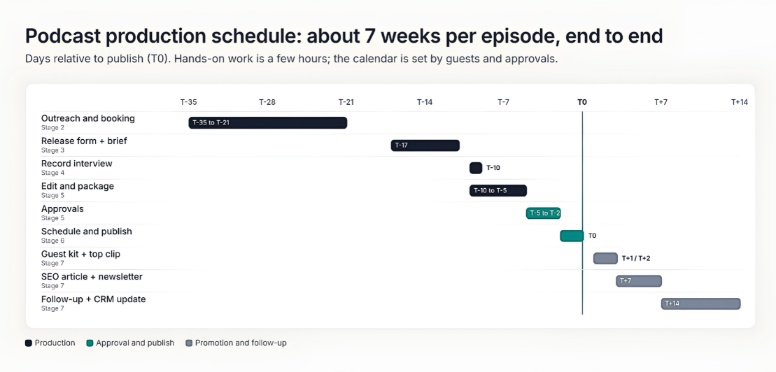
A podcast production schedule from first outreach (T-35) to guest follow-up (T+14). Source: Content Allies original
Who Owns Each Stage? A RACI for B2B Podcast Teams
Name one accountable owner per stage, usually the producer, and limit the host's responsibilities to preparation and recording. When the host owns booking or publishing, the show slows down every time the host gets busy.
| Stage | Host | Producer | Editor | Marketing | Sales | Legal |
|---|---|---|---|---|---|---|
| 1. Plan | C | A | I | R | C | I |
| 2. Book | I | A/R | I | C | C | I |
| 3. Prepare | R | A | I | I | C | I |
| 4. Record | R | A | I | I | I | I |
| 5. Edit and approve | C | A | R | C | I | C |
| 6. Publish | I | A/R | C | I | I | I |
| 7. Promote | C | C | C | A/R | R | I |
R = responsible, A = accountable, C = consulted, I = informed
The producer coordinates Stage 5; the editor owns editing, and each named reviewer owns their approval task. Track those sign-offs separately before scheduling the episode.
How this maps to team size:
One marketer plus freelancers. The marketer is producer and promoter; a freelance editor handles Stage 5. Booking is usually the first thing to slip.
In-house team of three to five. A dedicated producer owns Stages 1-6, marketing owns Stage 7, and sales joins at Stages 1 and 7.
Agency-run. The agency owns production operations. The host remains responsible for recording, and sales owns relationship follow-up. Company reviewers retain the required approval authority.
How to Measure Whether Your Podcast Workflow Is Working
Track two scoreboards: workflow health (on-time publishing, booking rate, buffer size) and business impact (guests engaged, opportunities, revenue).
Assess the show against its agreed business goals, which may include pipeline, brand awareness, customer education, or retention. Track release reliability alongside those outcomes.
| Metric | What it tells you | Where to find it |
|---|---|---|
| Booked-call rate | Whether outreach targeting and copy work | Outreach tracker |
| Days from recording to publish | Whether edit and approvals are bottlenecked | Workflow template dates |
| Episodes in buffer | How exposed you are to cancellations | Workflow board |
| On-time publish rate | Overall reliability | Hosting dashboard vs. calendar |
| Guest share rate | Whether guest kits get used | LinkedIn, guest tags |
| Downloads and YouTube views | Reach | Hosting analytics, YouTube Studio |
| Target-account guests | Whether booking matches your ICP | CRM |
| Opportunities sourced or influenced | Pipeline impact | CRM campaign or tag |
Why Do Podcast Workflows Stall? Common Bottlenecks and Fixes
Check booking, approval, and post-publication promotion when a show stalls. You can use this table to diagnose where yours is stuck.
| Symptom | Likely cause | Fix |
|---|---|---|
| Missed release dates | No buffer, approvals without deadlines | Use the Stage 6 buffer; add turnaround targets to each approval gate |
| Guests cancel or no-show | Weak confirmation, no reminder | Send confirmation plus reminders at 48 hours and 2 hours |
| Episodes stuck in legal | Legal sees the episode for the first time at the end | Share the brief with legal before recording |
| Clips posted once, then nothing | No promotion owner after T+1 | Assign Stage 7 to marketing with dated tasks |
| Downloads but no pipeline | Guests chosen for audience size alone | Rebuild the guest list from target accounts |
| Host burnout | Host owns booking or editing | Move booking and publishing to a producer; batch recordings |
Should You Run the Podcast Workflow In-House or Outsource It?
Consider an in-house workflow when you have a dedicated producer whose capacity covers booking, approvals, publishing, and promotion. Outsource when guest booking and promotion are the bottleneck, or when the host's time is the most expensive input in the show.
| Model | Host time per week | Who books guests | Who promotes | Best for |
|---|---|---|---|---|
| Fully in-house | Highest: prep, recording, and often booking | Host or marketer | Marketing team | Teams with a producer and a light schedule |
| In-house plus freelancers | Moderate: prep, recording, reviews | Marketer | Marketer | Small teams on a tight budget |
| Full-service agency | About 2 hours in the Sagemark example; varies by show | Agency | Agency, with sales follow-up | Teams that want revenue impact without hiring |
Tonkean considered producing its Modern Business Operations podcast internally but decided the approach would be unsustainable. After partnering with Content Allies to manage the podcast workflow, the show recorded a 174.36% growth in unique listeners in a single quarter.
The right call usually comes down to cost per episode weighed against the value of one good guest relationship in your market.
Run a Revenue-Focused B2B Podcast With Content Allies
Content Allies runs the full B2B podcast workflow covered in this guide. We:
Build the strategy around your target accounts
Research and book guests directly onto your calendar
Brief everyone
Engineer every recording
Edit and package each episode
Publish it across audio apps and YouTube
Promote it with clips, articles, and guest share kits
You show up for the conversations. We handle everything else, and we tie the show back to the metrics your leadership cares about: guests engaged, opportunities created, and revenue.
Schedule a call with our podcast team to map your guest list, cadence, and workflow. We'll show you what a season would look like for your accounts and where your current process is losing time.
FAQs
How do you attribute pipeline to a podcast when most listeners are anonymous?
Attribute through the guests first, since you know exactly who they are and which accounts they belong to. Tag each guest's account in the CRM, then track opportunities created or progressed within 90 days of the recording. For listeners, use company-level listener attribution where your hosting or analytics stack supports it, plus "how did you hear about us" fields.
Can one producer run the workflow for two shows at once?
One producer may manage two shows when editing is outsourced and the workload fits their available hours. Estimate booking, briefs, reviews, publishing, and promotion for each show before assigning both. Add support if deadlines or guest follow-up begin to slip.
How should the workflow change for a video-first podcast on YouTube?
Add three tasks: a thumbnail and title test before publishing, chapter markers on every upload, and vertical clips cut for Shorts. Recording also needs more prep, since lighting, framing, and a clean background now matter as much as audio. Publish the video and audio versions within 48 hours of each other so neither audience waits.
How many episodes should you have recorded before launching a guest-led B2B show?
If you choose to publish three episodes on launch day, finish and approve five to seven beforehand. This leaves the recommended two-to-four-episode buffer. A smaller launch release needs fewer finished episodes; keep the same buffer after publication.