
When Your Podcast Host Leaves: A Continuity Plan for a Company-Owned Show
One of our clients sends me an email with a calm subject line and a stressful first sentence: the host just gave notice. There was a season half recorded, a list of booked guests, and a feed full of episodes with that person’s voice on them.
It happens more often than most podcasting plans assume.
Median tenure with a current employer is 4.1 years, and S&P 500 CMOs average 4.1 years in the role. A company show that runs five years will probably outlive its first host.
My view: that makes a succession plan as basic as a backup of the show feed.
This guide is the continuity plan I walk clients through: what you keep, what you can lose, the first 30 days, and how to set things up so the next departure is a scheduling change.
P.S. If you’d like a team that handles strategy, guest booking, production, and host onboarding for you, my team at Content Allies runs company podcasts end to end.
TL;DR
The company usually owns the show feed, name, and archive. The host’s voice and likeness are a separate right, so get a written license before their last day.
In the first 30 days, move every account to a company login, bank episodes, record a handoff episode, and tell guests before listeners.
Keep the same feed. Continue under the same name when the show runs on a premise, and rebrand on that feed when the name belongs to the person leaving.
The safest successor is someone listeners and guests already know: a co-host, a frequent guest host, or a peer executive.
A one-page podcast succession plan covering contracts, accounts, a bench host, and handoff docs turns the next departure into a calendar update.
How I see it: a company podcast is a relationship engine before it’s a media property. Every interview is a conversation with someone the business wants to know, and the host is the person holding those relationships.
So when I plan a host transition, the microphone is the easy part. The hard part is moving trust, from listeners and from guests, to a new person without dropping the thread. Everything below follows from that.
What is Podcast Host Replacement for a Company-Owned Show?
Podcast host replacement is the planned handoff of the on-mic role on a show your company owns, so episodes, guest relationships, and listener trust carry on under a new voice.
I use “company-owned” on purpose: the business holds the feed, the name, and the archive, and that changes every decision.
The phrase has a second meaning, too. Plenty of “change podcast host” guides are about moving an RSS feed to a new hosting platform, which takes a 301 redirect that keeps your subscribers.
That’s a technical job, and this article is about the person.
A company show also differs from an indie co-host breakup. Two creators splitting a show are negotiating a partnership. A company adds employment contracts, brand rules, and a sales team that uses the clips.
What Does a Company Podcast Risk Losing When the Host Leaves?
A company podcast risks losing listener trust, the host’s guest relationships, and sometimes the right to keep publishing the host’s voice when that host leaves.
Listener attachment to hosts is measurable. In Edison Research’s Podcast Consumer 2026 report, 21% of weekly podcast consumers had paid to support a show in the past year, and 47% of those did it to support a host or other individual, while 36% paid for membership perks.
A Cumulus Media and Signal Hill study found listeners trust their hosts more than any other influencer type.
The same Edison research shows that listeners are not too keen on AI voices either. Simply cloning the host's voice for an audio-only podcast (with the rights, of course) will not cut it, at least not for a loyal audience.
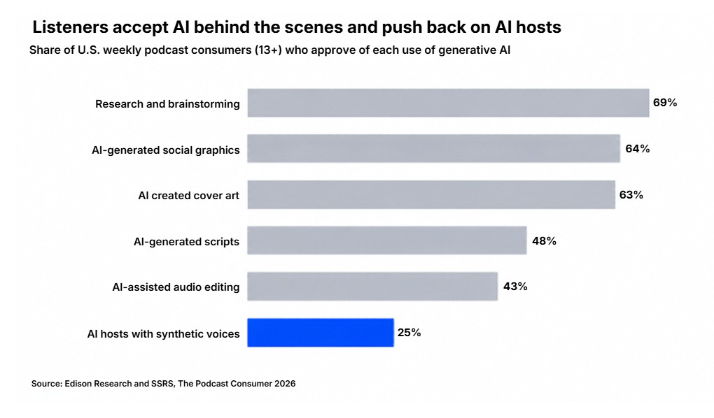
Listeners accept AI behind the scenes, and most reject it on the mic. Source: Edison Research and SSRS, The Podcast Consumer 2026
The most useful thing I read while researching this was a 2025 study of more than 12,000 listener reviews of Radiolab and This American Life. Listeners forgave a founding host for changing topics and treated it as growing pains, yet they read the original host’s departure as a broken brand promise. In other words, the audience files a host exit under “different show.”
For a B2B show, there’s a second, bigger asset at risk: the guest pipeline.
Leaders of B2B, the show Content Allies runs for itself, engaged 94 C-level executives and produced 43 sales opportunities and $100,500 in attributable revenue. Those conversations ran through a host, and a host who leaves without a handoff takes the relationships along.
| Asset | Usually stays with the company | Can leave with the host | Who decides |
|---|---|---|---|
| Show feed and hosting platform account | Yes, when the account sits on a company login | Yes, when it was opened on the host’s personal email | Whoever is listed as account owner |
| Show name and artwork | Yes | Rarely, unless the show is named after the host | Brand or legal team |
| Back catalog audio and video | Yes, as company IP | Disputed when no voice and likeness release exists | Employment contract and any release |
| Host’s voice and likeness in old episodes | Only with a written license | Often, by default | Counsel, under state law |
| Guest relationships and booked interviews | Only when logged in the CRM | Yes, they live in the host’s inbox | The podcast owner, early |
| Sales and social clips | Yes | Same voice and likeness question as the archive | Marketing plus counsel |
I’d rank the guest relationships as the most underrated row. Teams check the legal rows first and find the relationship gap a month later, when nobody knows who promised what to which guest.
What to Do in the First 30 Days After a Podcast Host Resigns
In the first 30 days, secure the accounts, bank every episode you can, settle the voice and likeness question in writing, and tell guests before listeners.
Leave the show’s name alone until the successor is clear.
The order matters because some doors close on the host’s last day. Here’s the sequence I’d follow:
Confirm the exit date and remaining sessions. Count the recording slots left before the last day, and book them all now.
Move every account to a company login. The hosting platform, YouTube channel, show socials, and recording tool should list a company email as owner and have two admins.
Get the voice and likeness question in writing. A short license to keep publishing existing episodes is far easier to sign during notice than after it (the ownership section below has the detail).
Record banked episodes and a handoff episode. Aim for three to four weeks of runway, plus one episode where the departing host and the successor or interim host talk on mic together.
Email booked and recent guests. Tell anyone scheduled or recorded in the past 90 days who they’ll talk to next and whether their episode still airs.
Keep the publishing cadence. Use banked episodes, an interim host or a short “best of” run, because a missed week costs more trust than a new voice.
Freeze rebrand decisions. Settle the successor first, and decide on the name and artwork after that.
I learned the cadence rule the hard way. Early on, I let a client’s show go quiet for most of a month while the team looked for the perfect successor, assuming listeners would wait. They didn’t, and the relaunch episode started from a smaller base than a quick handoff would have left.
My rule now: the feed never goes dark for more than one publishing cycle during a host change.
Who Owns the Podcast Feed, Archive, and Host’s Voice After the Host Quits?
The company usually owns podcast IP an employee creates on the job. The host’s name, voice, and likeness are a separate right that standard employment paperwork often leaves out.
That gap is spelled out in a lawyer’s breakdown on the Simplecast blog.
Typical invention assignment agreements cover work product, and most don’t grant rights to the employee’s name, voice, or likeness. A host who leaves without a license can ask the company to stop distributing episodes with their voice, even when the company owns the concept and the feed.
Scope of the job matters too. A show hosted by an engineer who volunteered is murkier than one hosted by a marketer hired to run it. External hosts on contract are a third case, where the services agreement is the only document that counts.
| Asset | Typical owner | Document that settles it | What to check now |
|---|---|---|---|
| Show concept, name and format | Company | Invention assignment or work-for-hire clause | Whether hosting the show was part of the host’s role |
| Show feed and hosting platform account | Whoever owns the login | Hosting platform account settings | The account owner email |
| Host’s name, voice and likeness | The host, by default | Voice and likeness release or license | Whether it survives the end of employment |
| Guest appearances | Company, with guest consent | Guest release form | That every guest signed one |
| External host’s work | Set by the contract | Services agreement | IP assignment and post-term license clauses |
Two media-company cases show both outcomes. When Ezra Klein left Vox for the New York Times in 2020, his Vox show ended while the production staff stayed with the company, and Vox planned a new interview show.
When three Kotaku hosts left G/O Media, they left Splitscreen behind and launched Triple Click elsewhere, moving listeners over with steady messaging.
I’m not a lawyer, and this isn’t legal advice.
Should You Continue, Rebrand, or Retire the Podcast After a Host Change?
Keep the same feed in almost every case: continue the name when the show runs on a premise, and rebrand when the name belongs to the departing host. Retire the show only when its business job is done.
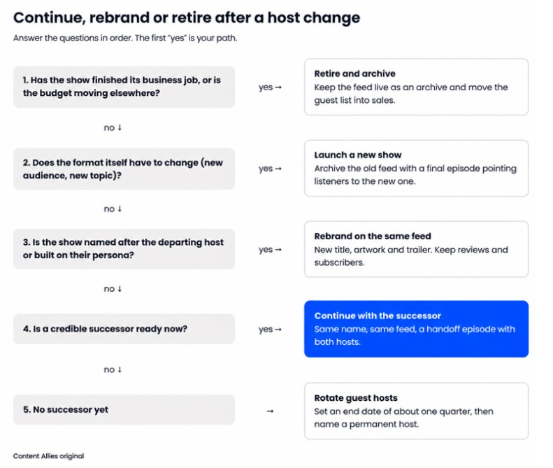
Decision tree: continue, rebrand or retire a company podcast after a host change. Source: Content Allies original
Names are where most company shows get stuck. A show titled after its CEO can’t outlive that CEO’s tenure, which is why I push clients toward premise-first titles from day one.
Can You Rename a Podcast on Spotify and Apple Podcasts without Losing Subscribers?
Yes. Change the title, artwork, and description in your hosting platform, and Apple Podcasts and Spotify pick them up from the show feed while followers stay subscribed. Apple says it detects metadata changes within 24 hours.
I’d publish the handoff or rebrand episode the same day, so the new name arrives with an explanation.
The Radiolab study adds a second rule: change one variable at a time. Radiolab changed its founding hosts and its focus in the same period, and long-time listeners reacted to both at once. If I plan a rebrand, the new name and the new host land in separate months.
Keep the feed and its reviews. Starting a fresh feed throws away years of directory history to solve a problem a new title and trailer already fix.
How to Choose a Replacement Podcast Host
Choose the successor your target guests already trust and who can protect a recording slot every cycle, because interview polish is the easiest part to train.
What I look for first is guest pull. In a B2B show, the host’s network books the guests, and the guests are the point of the show.
Internal Executive Successor
A peer executive brings the strongest guest pull, since prospects say yes to someone senior. Time is the constraint, so check the calendar before the title. A short round of media training for executive hosts shortens the ramp.
Promoted Co-host or Frequent Guest Host
This is the lowest-risk option because listeners already know the voice. Fresh Air is the cleanest public example: Tonya Mosley contributed interviews from 2021 and was named the show’s first co-host in April 2023, with Terry Gross staying on as host.
Rotating Guest Hosts as an Interim Format
Rotating hosts buy time and keep the cadence while you decide. Set an end date up front, because a rotation with no end reads as a show without an owner. Fresh Air lists a dedicated fill-in host on its staff page for this kind of coverage.
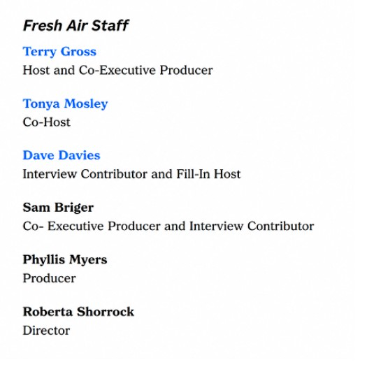
Fresh Air keeps a host, a co-host and a fill-in host on its staff list. Screenshot: NPR, Fresh Air “About” page
Alt text: Fresh Air staff list naming Terry Gross as host, Tonya Mosley as co-host and Dave Davies as fill-in host.
External Professional Host
A professional interviewer brings consistent craft, though guest pull in a niche B2B market is usually weaker. The contract has to cover IP and a post-term voice and likeness license.
For pay structures and where to find candidates, see this guide to hiring a B2B podcast host.
Replacement Host Scorecard
Score each candidate from 1 to 5 on six criteria, then compare totals:
Guest access: can they get your target guests to say yes?
Subject credibility: would a senior buyer learn something from their questions?
Recording time: can they protect a few hours every month for prep and recording?
Interview skill: do they listen and follow up, or read the next question off a list?
Likely tenure: will they still be in the role two years from now?
Brand fit: does their public voice match the show’s premise?
I weigh guest access and recording time double. Interview skill responds well to structured podcast host training, and a missing network doesn’t. A strong network in a niche market takes years to build, and no course shortens that.
Content Allies ran into this exact problem with Fringe. CEO Jordan Peace hosted The BragWorthy Culture himself until work and a growing family squeezed his time, so my team brought on and trained a second host, Cassandra Rose, and the show got back on schedule.
In my view, training is the fast part of that kind of handoff, and choosing someone the audience will accept is the decision that matters.
How to Announce a Podcast Host Change to Listeners
Announce the change once, on the feed, in a host’s own voice, and say what stays the same before you say what changes.
I’d keep the sequence tight so nobody hears it secondhand:
Tell the internal team and sales, so nobody is surprised by a prospect’s question.
Tell guests and sponsors, using the emails from the 30-day plan.
Publish the handoff episode, with both hosts on mic if the departure is friendly.
Update the feed copy, show description, and artwork the day the handoff episode airs.
Publish a re-cut trailer in the successor’s voice.
Post on LinkedIn from the departing host, the successor, and the company page.
A four-line announcement covers it:
What’s happening: “[Host] is moving on after [number] episodes, and [Successor] takes over from [date].”
Why: one line, as much as the departing host is comfortable sharing.
What stays the same: the topic and the publishing schedule.
What’s next: the first episode with the new host and who the guest is.
What stood out to me in the Fresh Air rollout was the order of events: listeners had heard Mosley as a contributor long before the title changed, so the announcement confirmed a voice they already knew. That’s the quiet advantage of a bench host.
Fresh Air handled the moment itself well too. In the on-air introduction of Mosley as co-host, Terry Gross told listeners she’d keep doing about the same number of interviews, then handed straight to Mosley’s interview. The way I read it, the handoff left listeners with the one fact they cared about: the show they liked wasn’t going anywhere.
One more piece I’d prepare: a two-sentence answer for sales and customer success. Prospects who listened will ask about the change on calls, and a consistent answer keeps the story on the company’s terms.
How to Keep Guest Relationships and the Sales Pipeline When a Podcast Host Leaves
Log every guest in your CRM with a named owner, then hand the warmest relationships to the successor through personal introductions from the departing host.
In a B2B show, those guests are the pipeline. On Upshift’s Hospitality Leaders podcast, the host converted over half of his interviews into revenue opportunities, and that value sat in one person’s inbox until someone wrote it down.
A sales lead on a client team put it to me bluntly during one transition: the host was leaving, and nobody could tell him which of the past year’s guests were mid-conversation with the company.
The CRM record I’d want for every guest:
Guest name, title and company.
Relationship stage: recorded, follow-up sent, in a sales conversation or customer.
Last touch date and who made it.
The next agreed step, if there is one.
The owner after the host leaves.
| Guest tier | Handoff action | Owner | Deadline |
|---|---|---|---|
| In an active sales conversation | Joint intro call with the departing host and the account owner | Sales lead | Before the host’s last day |
| Recorded in the past 90 days | Personal intro email from the departing host to the successor | Podcast owner | Within two weeks of notice |
| Older alumni guests | Invitation to a return episode with the successor | Successor host | First three months |
| Booked and not yet recorded | Reconfirmation with the successor’s name and a new time | Producer | Within one week |
The alumni return episode is my favorite move here. A returning guest gives the successor a warm first conversation and shows listeners the show’s network carried over.
Clips need a handoff too. Repost evergreen clips from the company page, keep the departing host’s tags on old posts and tag the successor in every new one, so guests see the show’s activity continue under a new name.
Relationship marketing with podcast guests has more ways to keep those ties active.
How Much Audience Loss to Expect After a Podcast Host Replacement
Expect a dip in downloads and a slower return from long-time listeners, and measure it against your own eight-week baseline.
No reliable public benchmark exists for host changes, and I’d distrust anyone quoting one.
What surprised me in the Radiolab research was how long the adjustment ran. The handover stretched across about two years (Krulwich left in 2020, Abumrad in 2022), and long-time listeners kept choosing archive episodes over new ones during it.
I’d expect a B2B show to adjust faster, because its listeners come for the topic as much as the voice, but I’d still plan in months.
| Metric | Normal transition signal | Red flag | What to check |
|---|---|---|---|
| Downloads per episode at 30 days | Small dip, then flat | Keeps falling after the first month | Cadence gaps, or format changes stacked on the host change |
| Completion rate | Stable | Drops sharply in the first minutes | The successor’s intro and pacing |
| Followers on Apple Podcasts and Spotify | Flat | Net unfollows after the announcement | Tone and clarity of the announcement |
| YouTube average view duration | Slight dip | Falls well below baseline | On-camera comfort and editing pace |
| Guest acceptance rate | Stable | Falls noticeably | The successor’s seniority and network |
| Pipeline sourced from episodes | Stable | Stalls for a quarter | Guest handoff and CRM follow-up |
If completion holds and downloads dip, the format works, and listeners are adjusting. Podcast retention fixes are worth a look only when completion falls too.
How to Build a Podcast Succession Plan Before Your Host Leaves
A podcast succession plan is a one-page document that names an interim host, puts accounts and rights in the company's hands, and keeps the show’s premise independent of any single voice.
I think every company show past its first season needs one.
Spencer Stuart found that 62% of departing CMOs at S&P 500 companies left for a similar or bigger role. The same logic applies to a good host: the better they get on mic, the more visible they become to recruiters.
The clearest signal on host risk I’ve read this year came from a deal this month. Entrepreneurs On Fire sold in a deal worth up to $9 million, and John Lee Dumas signed a three-year service agreement to keep hosting for the new owner.
Having founded and sold a company myself, I read that as a buyer pricing the host as a key-person risk and paying to contain it.
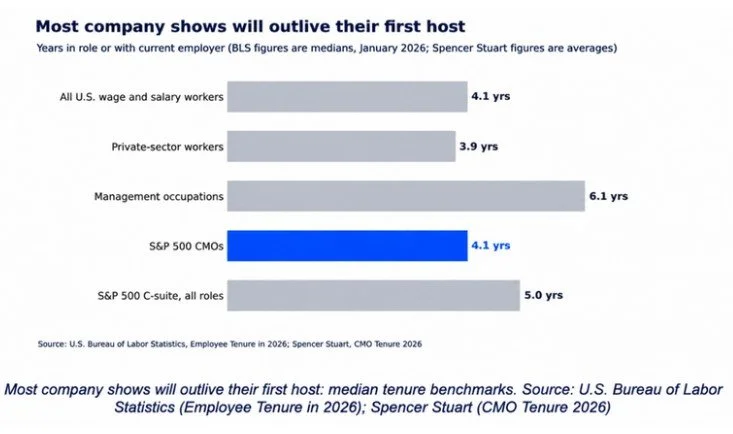
Most company shows will outlive their first host: median tenure benchmarks. Source: U.S. Bureau of Labor Statistics (Employee Tenure in 2026); Spencer Stuart (CMO Tenure 2026)
Most teams treat a departure as rare until it lands on their calendar, which is exactly when a plan is hardest to write. Here’s what the plan should include:
Contract Terms: Voice and Likeness License and Transition Period
Add a license that lets the company keep publishing the archive and clips after the host leaves, plus a notice period that includes a set number of handoff recordings. External hosts need the same terms in their services agreement.
Account Ownership for the RSS feed, YouTube Channel, and Social Profiles
Every login sits on a company email with at least two admins, and the host is a user on the account. This is the prevention version of step 2 in the 30-day plan, and it takes ten minutes.
Show Design that Outlasts One Host
As mentioned earlier, give the show a premise-first name, recurring segments, and a short show bible covering tone, guest profile, and question style. Podcast brand guidelines make a good template for that bible. The bible is what lets a new voice still sound like the same show.
A Guest-Host Bench
Keep two people who have each hosted at least one episode in the past year. Pick people with their own standing in the industry, since a bench host needs guest pull as much as a permanent one.
Pro Tip: Give the bench host one episode a quarter, so listeners already know the voice before they need it.
Handoff Documentation
Document the workflow, the guest CRM, and the episode brief so a successor can run the show without the departing host’s inbox. A podcast workflow template covers most of it.
Annual Succession Review
Spend 30 minutes once a year, or after any reorg, confirming owners, licenses, and the bench. I’d put it on the calendar next to the annual content planning session.
| Area | What to put in place | Owner | Review cadence |
|---|---|---|---|
| Contracts | Voice and likeness license, notice period with handoff recordings | Legal and HR | At hire, then yearly |
| Accounts | Company owner email and two admins on every platform | Marketing ops | Yearly |
| Show design | Premise-first name and a show bible | Podcast owner | At launch, then yearly |
| Bench | Two trained backup hosts, one episode a quarter | Producer | Quarterly |
| Guest CRM | Every guest logged with stage and owner | Sales and podcast owner | Monthly |
| Documentation | Workflow, brief template and guest list | Producer | Every six months |
Keep Your Company Podcast on Air with Content Allies
A host change is survivable when the show runs on a strong premise, the accounts and rights sit with the company, and the guest relationships live in a system. That’s the setup my team at Content Allies builds into every show: strategy tied to business goals, guest booking, full production and promotion, plus host onboarding when the lineup changes.
If your show depends on one person today, book a strategy call and bring the succession checklist above, so the conversation starts with your real gaps.
My single strongest recommendation, if you only do one thing this month: sign the voice and likeness license and move every account to a company login. Both cost almost nothing before a resignation and a lot after one.
FAQs
Can a company keep publishing old episodes if the departed host never signed a likeness release?
Sometimes, but the footing is weak. Without a license, a departed host can object to the company distributing their voice and likeness, as the Simplecast lawyer piece explains. Ask counsel, and try to get a short archive license signed as part of the exit.
Should the departing host record a handoff episode with the successor, or does that prolong the attachment?
Record it when the exit is friendly. A joint episode transfers some of the departing host’s trust to the successor in a way a written announcement can’t, and it gives listeners closure. Skip it if the departure is tense, and use a short solo announcement from the successor.
Can a company use an AI voice clone of the former host to finish a season?
In Edison’s 2026 data, only 25% of weekly podcast consumers approved of AI-generated hosts with synthetic voices, compared with 69% approval for AI used in research and brainstorming. Asked specifically about a host handing the show to an AI-generated version of themselves, 66% of weekly podcast consumers reacted negatively. Based on current data on podcast listeners, AI voice cloning is not the best idea, even with explicit host consent.
What if the host leaves for a competitor and launches a rival show?
Then the race is for the guests and the feed. Keep the show on schedule with an interim host, use the CRM to stay in touch with past guests, and confirm the company controls the feed and the name. Non-compete and non-solicit terms vary by state, so check them with counsel before relying on them.
Does a host change reset Apple Podcasts and Spotify reviews or rankings?
No. Reviews, ratings, and followers belong to the show feed, so they stay as long as you keep the same feed. Your Apple Podcasts and Spotify show links also stay the same, so old links in emails and sales decks keep working after a rebrand.
How long should a rotating-host period run before a permanent host is named?
Set an end date before the rotation starts, and keep it to about one quarter. After that, listeners and guests start to see the show as ownerless.
Do guest release forms need re-signing when the host changes?
Usually not, because a guest release grants rights to the company that owns the show, and that owner hasn’t changed. Check the wording: a release that names the host personally or a specific show title may need an update after a rebrand.